Oman Containers as a Service Market Size & Growth Rate (2026-2032)
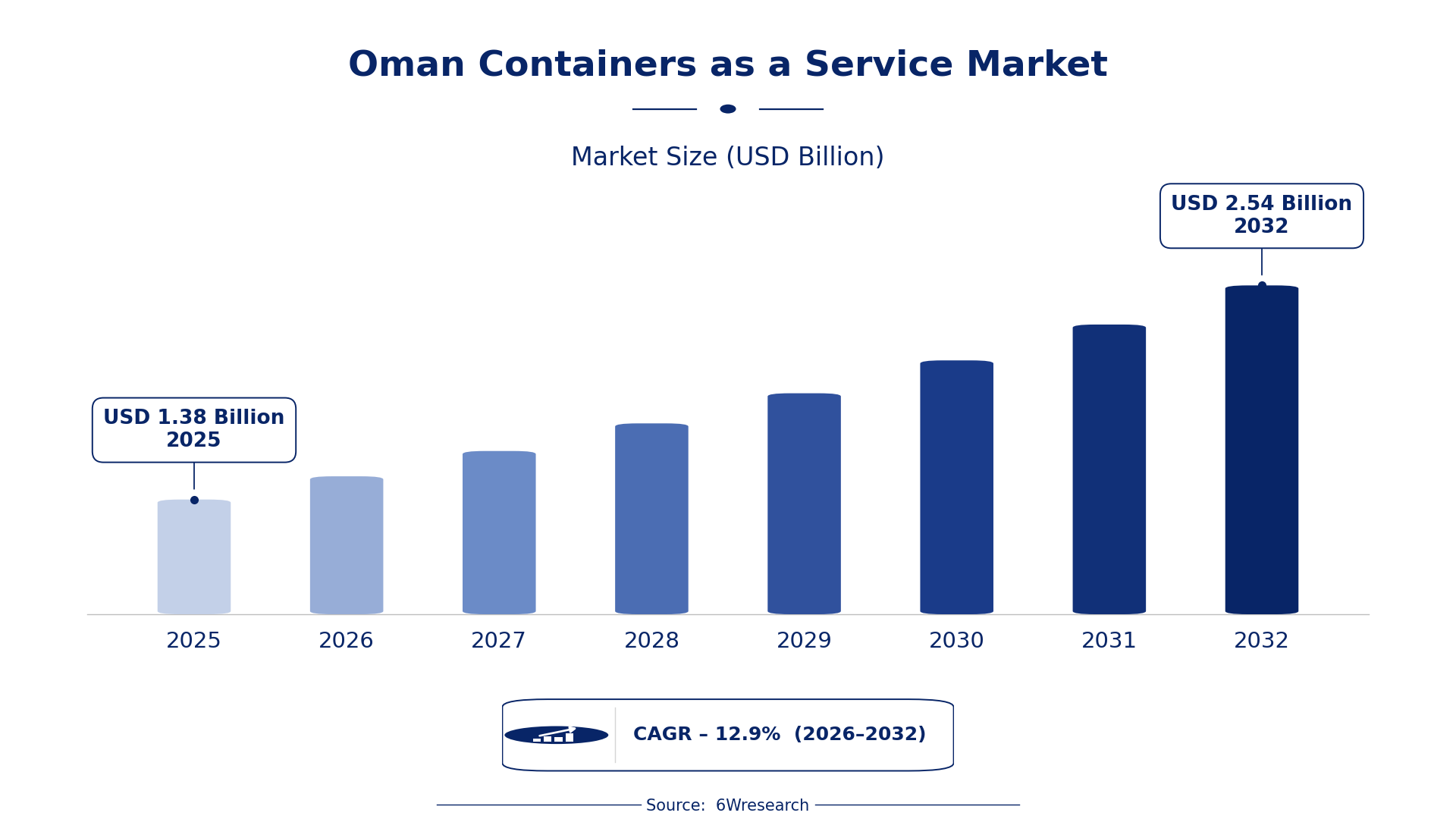
The Oman Containers as a Service Market was estimated at USD 1379 Million in 2025 and is projected to reach USD 2537 Million by 2032, growing at a CAGR of 12.9% from 2026 to 2032.
Oman Containers as a Service Market Synopsis
As organizations in Oman strive for digital transformation, the Containers as a Service (CaaS) market is witnessing a surge in demand. Companies are increasingly adopting CaaS platforms to streamline application development and enhance operational efficiency, driven by the need for agility and scalability.
The shift towards cloud-native applications is pushing businesses to rethink their infrastructure strategies. CaaS allows organizations to deploy and manage containerized applications with ease, reducing the burden of infrastructure management and promoting a focus on innovation.
Oman Containers as a Service Market Year-wise Growth Rate and Key Drivers
This graph illustrates the annual growth rates of the Oman Containers as a Service Market from 2021 to 2032, highlighting a steady upward trajectory and projected expansion over the forecast period.
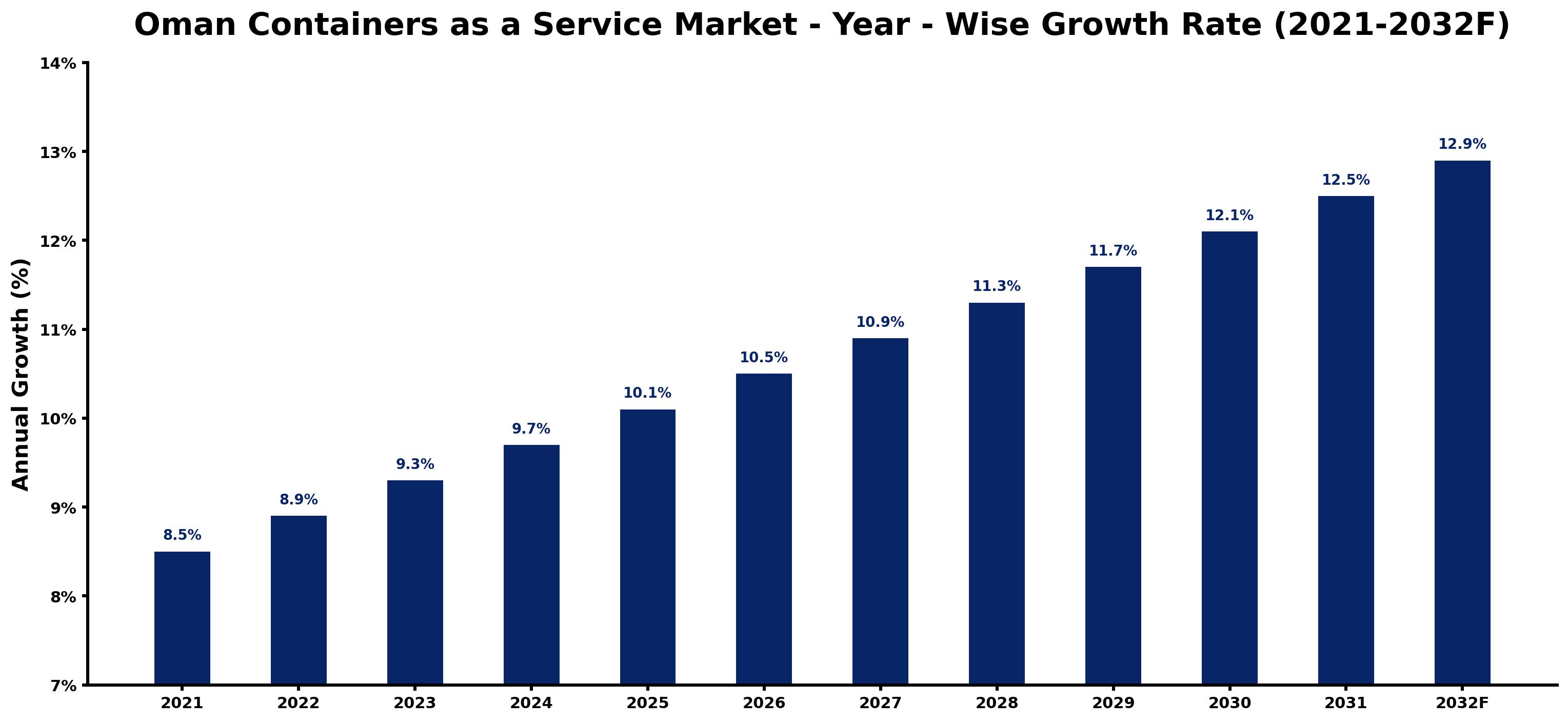
The table below presents the year‑wise growth rates along with the key drivers influencing the market
| Year | Growth Rate | Major Drivers |
| 2021 | 8.5% | Increasing government support for digital logistics transformation. |
| 2022 | 8.9% | New port regulations streamline container shipping processes. |
| 2023 | 9.3% | Oman's Vision 2040 promotes enhanced logistics infrastructure development. |
| 2024 | 9.7% | Emerging tech adoption improves supply chain efficiency. |
| 2025 | 10.1% | Surge in regional trade partnerships accelerates container usage. |
| 2026 | 10.5% | Rise in cold chain logistics enhances container market growth. |
| 2027 | 10.9% | Oman’s strategic location boosts transshipment activity demand. |
| 2028 | 11.3% | Investment in smart port technologies enhances service efficiency. |
| 2029 | 11.7% | Growing small business sector increases container service requirements. |
| 2030 | 12.1% | Export-driven economy fuels need for versatile container solutions. |
| 2031 | 12.5% | Government incentives encourage local businesses to adopt services. |
| 2032 | 12.9% | Sustainability initiatives drive demand for eco-friendly containers. |
Note: Market size estimations and growth projections presented in this report are based on 6Wresearch's proprietary forecasting methodology, utilizing the latest available industry data, government publications, and primary research inputs.
Oman Containers as a Service Market Key Takeaways
Below are some of the specific key takeaways from the market, including:
- Growing adoption of CaaS platforms is driven by the need for scalable IT solutions.
- Organizations are increasingly prioritizing rapid application deployment and development.
- Concerns about security and compliance remain significant barriers to broader CaaS adoption.
- The Omani government is actively supporting the transition to cloud-native technologies.
- Integration challenges with existing IT infrastructure are prevalent among businesses.
Evaluation of Restraints in Oman Containers as a Service Market
While the CaaS market in Oman is growing, several restraints hinder its full potential. Organizations often express concerns about data sovereignty and privacy, which can limit the acceptance of public CaaS offerings. Additionally, the complexities of integrating CaaS solutions with existing IT ecosystems pose significant challenges, particularly in hybrid and multi-cloud environments. As businesses weigh the benefits of adopting CaaS, they must also address apprehensions regarding vendor lock-in and the adequacy of service level agreements to ensure compliance and performance reliability.
Oman Containers as a Service Market Trends
The shift toward DevOps practices is shaping the CaaS market in Oman. Companies are increasingly integrating CaaS platforms with DevOps workflows to enhance collaboration between development and operations teams. Additionally, there is a growing trend towards hybrid cloud solutions, allowing organizations to maintain flexibility while optimizing their cloud strategies. The emphasis on microservices architectures also drives the demand for containerization, as businesses seek to build modular applications that can be easily deployed and scaled.
Oman Containers as a Service Market Opportunities
The Oman CaaS market presents numerous growth opportunities for businesses willing to invest in cloud-native technologies. As organizations continue to embrace digital transformation, there is potential for increased adoption of CaaS solutions, particularly among small and medium enterprises. The ongoing development of local cloud infrastructure and government initiatives to promote CaaS can further enhance market opportunities. Companies that focus on providing tailored solutions addressing security, compliance, and integration concerns will likely stand out in this evolving market.
Government Initiatives in the Oman Containers as a Service Market
The Omani government recognizes the strategic importance of cloud technologies and actively promotes the adoption of Containers as a Service (CaaS) models. By implementing supportive policies and encouraging collaboration between public and private sectors, the government aims to foster innovation and enhance the competitiveness of the CaaS market. These initiatives are crucial as they address the evolving needs of businesses seeking agile and efficient IT solutions.
- A national digital infrastructure upgrade programme launched in early 2025 is aimed at bolstering cloud capabilities.
- Current initiatives focus on enhancing cybersecurity measures for cloud-based services, ensuring compliance and security.
- A public-private partnership is underway, designed to develop local cloud data centers to support CaaS adoption.
- Planned regulatory frameworks will address data sovereignty concerns, expected to be introduced by 2026.
Future Insights of the Oman Containers as a Service Market
Looking ahead to 2026-2032, the Oman Containers as a Service market is set to expand significantly. Factors such as ongoing government support, increasing digital transformation efforts, and the rising demand for agile IT solutions will drive this growth. As businesses continue to recognize the benefits of containerization, the market is likely to see innovations in service offerings and improvements in integration capabilities, making CaaS an attractive option for a broader range of organizations.
Oman Containers as a Service Market Latest Developments
In the past year, the Oman CaaS market has experienced notable developments as businesses and government entities increasingly recognize the importance of cloud-native solutions. The trend towards enhanced security measures and infrastructure upgrades is a focal point for many organizations, reflecting a commitment to fostering a conducive environment for CaaS adoption.
- A major technology vendor launched a new CaaS platform in Q2 2025, aimed at enhancing user experience and operational efficiency.
- An initiative that began in early 2025 is currently underway, focusing on training local talent in cloud technologies to support the CaaS ecosystem.
- A partnership between public sector agencies and private companies is expected to roll out by mid-2026, enhancing cloud infrastructure capabilities in Oman.
- Recent upgrades to cybersecurity protocols for CaaS offerings were implemented in late 2025, addressing key compliance and security concerns.
Oman Containers as a Service Market - Key Attractiveness of the Report
- 10 Years of Market Numbers
- Historical Data Starting from 2022 to 2025
- Base Year: 2025
- Forecast Data until 2032
- Key Performance Indicators Impacting the Market
- Major Upcoming Developments and Projects
Key Highlights of the Report:
- Oman Containers as a Service Market Outlook
- Market Size of Oman Containers as a Service Market, 2025
- Forecast of Oman Containers as a Service Market, 2032
- Historical Data and Forecast of Oman Containers as a Service Revenues & Volume for the Period 2022-2032F
- Oman Containers as a Service Market Trend Evolution
- Oman Containers as a Service Market Drivers and Challenges
- Oman Containers as a Service Price Trends
- Oman Containers as a Service Porter's Five Forces
- Oman Containers as a Service Industry Life Cycle
- Historical Data and Forecast of Oman Containers as a Service Market Revenues & Volume By Service Type for the Period 2022-2032F
- Historical Data and Forecast of Oman Containers as a Service Market Revenues & Volume By Management & Orchestration for the Period 2022-2032F
- Historical Data and Forecast of Oman Containers as a Service Market Revenues & Volume By Security for the Period 2022-2032F
- Historical Data and Forecast of Oman Containers as a Service Market Revenues & Volume By Monitoring and Analytics for the Period 2022-2032F
- Historical Data and Forecast of Oman Containers as a Service Market Revenues & Volume By Storage and Networking for the Period 2022-2032F
- Historical Data and Forecast of Oman Containers as a Service Market Revenues & Volume By Continuous Integration and Continuous Deployment (CI/CD) for the Period 2022-2032F
- Historical Data and Forecast of Oman Containers as a Service Market Revenues & Volume By Training and Consulting for the Period 2022-2032F
- Historical Data and Forecast of Oman Containers as a Service Market Revenues & Volume By Support and Maintenance for the Period 2022-2032F
- Historical Data and Forecast of Oman Containers as a Service Market Revenues & Volume By Deployment Model for the Period 2022-2032F
- Historical Data and Forecast of Oman Containers as a Service Market Revenues & Volume By Public Cloud for the Period 2022-2032F
- Historical Data and Forecast of Oman Containers as a Service Market Revenues & Volume By Private Cloud for the Period 2022-2032F
- Historical Data and Forecast of Oman Containers as a Service Market Revenues & Volume By Hybrid Cloud for the Period 2022-2032F
- Historical Data and Forecast of Oman Containers as a Service Market Revenues & Volume By Organization Size for the Period 2022-2032F
- Historical Data and Forecast of Oman Containers as a Service Market Revenues & Volume By Small and Medium-Sized Enterprises (SMEs) for the Period 2022-2032F
- Historical Data and Forecast of Oman Containers as a Service Market Revenues & Volume By Large Enterprises for the Period 2022-2032F
- Historical Data and Forecast of Oman Containers as a Service Market Revenues & Volume By Vertical for the Period 2022-2032F
- Historical Data and Forecast of Oman Containers as a Service Market Revenues & Volume By Retail and Consumer Goods for the Period 2022-2032F
- Historical Data and Forecast of Oman Containers as a Service Market Revenues & Volume By Manufacturing for the Period 2022-2032F
- Historical Data and Forecast of Oman Containers as a Service Market Revenues & Volume By Media, Entertainment and Gaming for the Period 2022-2032F
- Historical Data and Forecast of Oman Containers as a Service Market Revenues & Volume By IT and Telecommunications for the Period 2022-2032F
- Historical Data and Forecast of Oman Containers as a Service Market Revenues & Volume By Healthcare for the Period 2022-2032F
- Historical Data and Forecast of Oman Containers as a Service Market Revenues & Volume By BFSI for the Period 2022-2032F
- Historical Data and Forecast of Oman Containers as a Service Market Revenues & Volume By Transportation & Logistics for the Period 2022-2032F
- Oman Containers as a Service Import Export Trade Statistics
- Market Opportunity Assessment By Service Type
- Market Opportunity Assessment By Deployment Model
- Market Opportunity Assessment By Organization Size
- Market Opportunity Assessment By Vertical
- Oman Containers as a Service Top Companies Market Share
- Oman Containers as a Service Competitive Benchmarking By Technical and Operational Parameters
- Oman Containers as a Service Company Profiles
- Oman Containers as a Service Key Strategic Recommendations






































