Oman Cyber Security Market Size, Share & Growth Rate
The Oman Cyber Security Market was estimated at USD 503 Million in 2025 and is projected to reach USD 721 Million by 2032, growing at a CAGR of 5.3% from 2026 to 2032. This growth trajectory is being propelled by the rapid digitalization across various sectors, driven largely by Industry 4.0 trends. As businesses increasingly adopt advanced digital frameworks, there is a corresponding surge in demand for robust security solutions to mitigate cyber threats, ensuring a secure digital environment for both enterprises and consumers.
Oman Cyber Security Market Year-wise Growth Rate and Key Drivers
This graph highlights how the Oman Cyber Security Market has steadily grown over the years, supported by major growth factors.
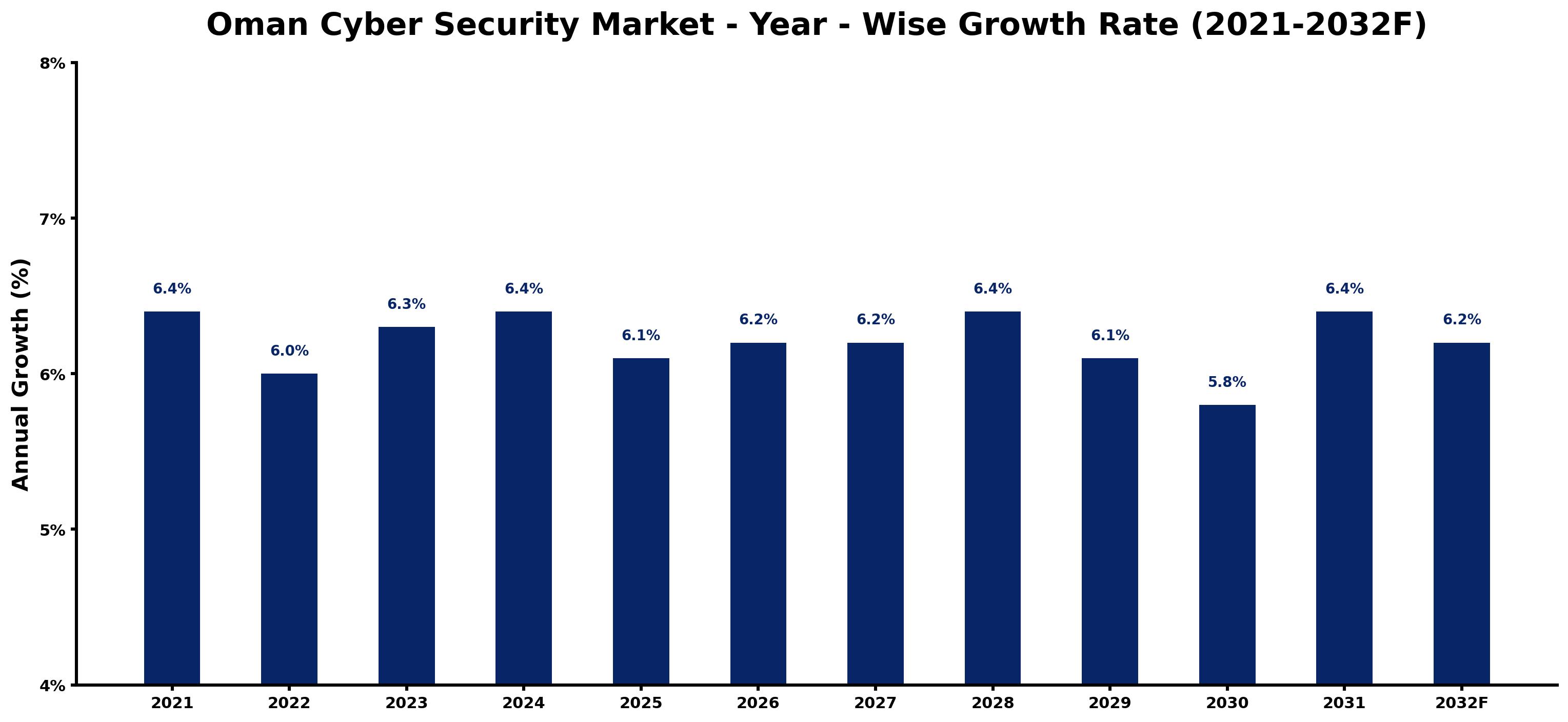
The table below presents the year‑wise growth rates along with the key drivers influencing the market
| Year | Growth Rate | Major Drivers |
| 2021 | 6.4% | Increasing industrial infrastructure investments |
| 2022 | 6.0% | Government infrastructure modernization initiatives |
| 2023 | 6.3% | Increasing industrial infrastructure investments |
| 2024 | 6.4% | Expansion of transportation and logistics networks |
| 2025 | 6.1% | Expansion of commercial construction activities |
| 2026 | 6.2% | Expansion of manufacturing activities |
| 2027 | 6.2% | Growing urbanization and commercial development |
| 2028 | 6.4% | Government infrastructure modernization initiatives |
| 2029 | 6.1% | Rising electricity demand across industries |
| 2030 | 5.8% | Increasing smart city development projects |
| 2031 | 6.4% | Increasing industrial automation investments |
| 2032 | 6.2% | Growing renewable energy integration projects |
Note - Market size estimations and growth projections presented in this report are based on 6Wresearch's advanced forecasting approach, validated with industry datasets as of June 2026.
Oman Cyber Security Market Synopsis
The Oman Cyber Security Market has witnessed a significant momentum in recent years, with organizations prioritizing the safeguarding of their digital assets. However, as the market evolves, it is anticipated that the growth will accelerate, fueled by both heightened awareness and increasing investment in advanced security infrastructure.
Transitioning from traditional to more integrated digital systems poses a myriad of challenges, yet it also presents opportunities for innovation in security measures. As Oman's economy continues to digitize, the adoption of comprehensive cyber security solutions will be essential for organizations to protect themselves against an increasingly sophisticated landscape of cyber threats.
Oman Cyber Security Market Key Takeaways
- The market is driven by the convergence of digital transformation and heightened cyber threats.
- Increasing reliance on cloud-based platforms necessitates advanced security protocols.
- Investment in cybersecurity is seen as critical to sustaining business continuity and operational integrity.
- The shift towards Industry 4.0 is a major catalyst for security solution adoption.
- Government initiatives are supporting the growth of the cyber security landscape in Oman.
Evaluation of Restraints in Oman Cyber Security Market
Despite its growth potential, the Oman Cyber Security Market faces several restraints that may impede progress. One of the most significant barriers is the lack of skilled professionals in the cybersecurity domain. Limited local talent leads to increased reliance on foreign expertise, which can impact project timelines and costs. Furthermore, budget constraints in some organizations limit their ability to invest in comprehensive security solutions. This combination of skill shortages and funding limitations could pose challenges in keeping pace with the rapidly evolving cyber threat landscape.
Oman Cyber Security Market Trends
Several key trends are currently shaping the Oman Cyber Security Market. Notably, the growing adoption of artificial intelligence and machine learning in cybersecurity solutions is enhancing threat detection and response capabilities. Additionally, businesses are increasingly prioritizing the integration of cybersecurity measures in the early stages of digital projects. The shift towards remote working arrangements due to the pandemic has further accelerated the demand for secure remote access solutions. Moreover, the rise of compliance requirements is prompting organizations to invest more heavily in security infrastructure.
Oman Cyber Security Market Opportunities
The Oman Cyber Security Market presents genuine opportunities for growth and investment in several areas. The increasing complexity of cyber threats necessitates advanced security solutions, creating a fertile ground for innovation. Additionally, sectors such as finance, healthcare, and government are expected to drive demand for specialized security services tailored to meet industry-specific regulations. With the government's push towards digital transformation, public sector initiatives are likely to open doors for cybersecurity investments, providing further avenues for businesses within this space.
Government Initiatives in the Oman Cyber Security Market
The Omani government has recognized the importance of cybersecurity in ensuring national security and economic growth. It has initiated various programs aimed at enhancing cybersecurity capabilities, including the establishment of a national cybersecurity strategy. Investments in public awareness campaigns and training programs for cybersecurity professionals have also been prioritized. Furthermore, partnerships with global organizations aim to enhance the technological landscape in Oman, fostering a collaborative approach to cybersecurity challenges.
Future Insights of the Oman Cyber Security Market
Looking forward to the 2026-2032 period, the Oman Cyber Security Market is expected to enter a robust growth phase. As digital transformation continues to penetrate various sectors, the integration of cybersecurity into organizational strategies will be pivotal. Companies will increasingly seek tailored solutions that address their unique vulnerabilities, driving demand for innovative products and services. Ultimately, the market is poised for significant expansion, driven by both the urgency of cyber resilience and the strategic alignment of cybersecurity with broader business objectives.
Oman Cyber Security Market Latest Developments (May 2025 - June 2026)
Recent developments within the Oman Cyber Security Market indicate a strong focus on enhancing threat intelligence capabilities. Organizations are beginning to implement more sophisticated detection systems that leverage machine learning algorithms. Moreover, collaborative efforts between public and private sectors have led to the establishment of cybersecurity frameworks aimed at increasing overall national resilience. As businesses adapt to the evolving threat landscape, the demand for integrated solutions continues to rise, positioning the market for sustained growth.
Oman Cyber Security Market - Key Attractiveness of the Report
- 10 Years of Market Numbers
- Historical Data Starting from 2022 to 2025
- Base Year: 2025
- Forecast Data until 2032
- Key Performance Indicators Impacting the Market
- Major Upcoming Developments and Projects
Key Highlights of the Report:
- Oman Cyber security Market Overview
- Oman Cyber security Market Outlook
- Oman Cyber security Market Forecast
- Historical Data of Oman Cyber security Market Revenues for the Period 2022-2032F
- Oman Cyber security Market Size and Oman Cyber security Market Forecast of Revenues, Until 2032F
- Historical Data of Oman Cyber security Market Revenues, by Product, for the Period 2022-2032F
- Market Size & Forecast of Oman Cyber security Market Revenues, by Product, Until 2032F
- Historical Data of Oman Cyber security Market Revenues, by Deployment Mode, for the Period 2022-2032F
- Market Size & Forecast of Oman Cyber security Market Revenues, by Deployment Mode, Until 2032F
- Historical Data of Oman Cyber security Market Revenues, by Regions, for the Period 2022-2032F
- Market Size & Forecast of Oman Cyber security Market Revenues, by Regions, Until 2032F
- Market Drivers and Restraints
- Oman Cyber security Market Trends and Industry Life Cycle
- Porter’s Five Force Analysis
- Market Opportunity Assessment
- Oman Cyber security Market Share, By Players
- Oman Cyber security Market Share, By Regions
- Oman Cyber security Market Overview on Competitive Benchmarking
Markets Covered
The Oman Cyber security Market report provides a detailed analysis of the following market segments:
- By Product type:
- Solutions
- Identity & Access Management
- Threat Detection & Prevention
- DDoS & Mitigation
- IDS
- Security Information & Event Management
- Others
- Services
- Solutions
- By End-user industry:
- Manufacturing
- Retail
- IT & Telecom
- Aerospace & Defense
- Healthcare
- Utility
- Others
- By Deployment Mode:
- On-premises
- Cloud






































