Oman Electronic Dictionary Market Size, Share & Growth Rate
The Oman Electronic Dictionary Market was estimated at USD 449 Million in 2025 and is projected to reach USD 612 Million by 2032, growing at a CAGR of 4.5% from 2026 to 2032. This growth trajectory is largely fueled by the increasing integration of digital learning tools in the education sector and a heightened demand for efficient language translation services. As educational institutions enhance their digital infrastructure, the need for accessible and user-friendly language resources continues to rise.
Oman Electronic Dictionary Market Year-wise Growth Rate and Key Drivers
This graph highlights how the Oman Electronic Dictionary Market has steadily grown over the years, supported by major growth factors.
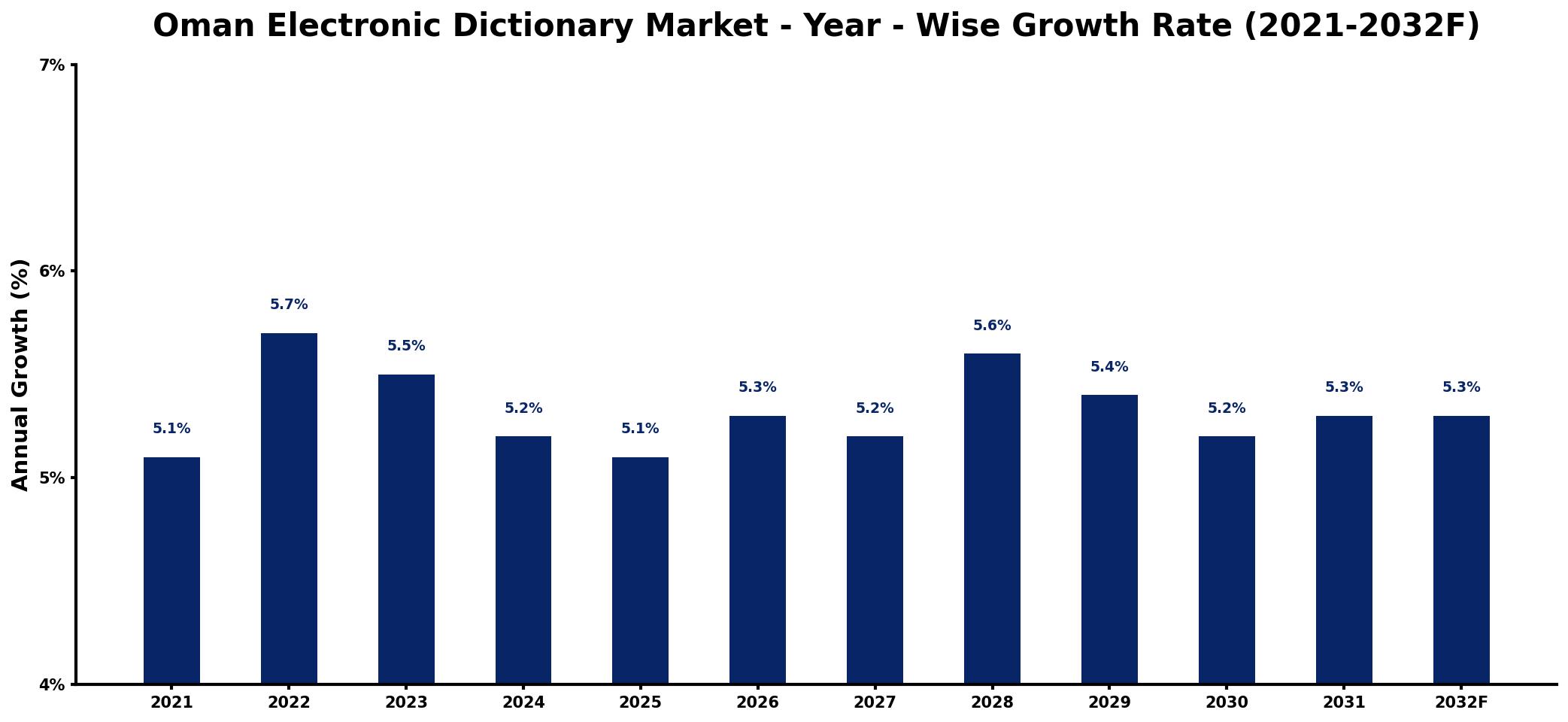
The table below presents the year‑wise growth rates along with the key drivers influencing the market
| Year | Growth Rate | Major Drivers |
| 2021 | 5.1% | Rising educational technology investments |
| 2022 | 5.7% | Increased mobile application usage |
| 2023 | 5.5% | Growing demand for language learning |
| 2024 | 5.2% | Expansion of digital content consumption |
| 2025 | 5.1% | Higher smartphone penetration rates |
| 2026 | 5.3% | Increased online learning platforms |
| 2027 | 5.2% | Demand for localization services |
| 2028 | 5.6% | Surge in youth internet usage |
| 2029 | 5.4% | Growth in cross-cultural communication |
| 2030 | 5.2% | Enhanced user engagement strategies |
| 2031 | 5.3% | Development of AI language tools |
| 2032 | 5.3% | Rising popularity of gamification |
Note: Market size estimations and growth projections presented in this report are based on 6Wresearch's proprietary forecasting methodology, utilizing the latest available industry data, government publications, and primary research inputs.
Oman Electronic Dictionary Market Synopsis
In recent years, the landscape of language learning in Oman has undergone a significant transformation. The proliferation of electronic dictionaries is not only a testament to changing educational methodologies but also reflects a cultural shift towards embracing technology in everyday learning. Students and professionals are increasingly relying on these digital tools to enhance their language proficiency.
Moreover, the accessibility of mobile applications and online platforms has rendered language learning more interactive and engaging. As the demand for multilingual capabilities grows, both local and international developers are innovating to meet the diverse needs of Omani users. The market is poised for continued expansion, driven by consumer preferences and advancements in technology.
Oman Electronic Dictionary Market Key Takeaways
- The market is driven by increased digital learning adoption in educational institutions.
- Growing demand for multilingual dictionaries among professionals is reshaping product offerings.
- Technological advancements such as AI-driven translation are becoming standard features.
- Partnerships between manufacturers and software developers are enhancing user experience.
- The market is benefiting from the rise of online learning platforms that complement traditional resources.
Evaluation of Restraints in Oman Electronic Dictionary Market
Despite the encouraging growth, the Oman Electronic Dictionary Market faces notable challenges. A significant barrier is the limited availability of comprehensive bilingual dictionaries that effectively cater to Arabic language learners. Moreover, competition from well-established global brands creates a saturated environment, complicating market entry for local players. Additionally, varying levels of digital literacy among the population can restrict widespread adoption of electronic dictionaries. Concerns regarding data privacy and security also loom large, potentially affecting consumer confidence and acceptance of these tools.
Oman Electronic Dictionary Market Trends
Current trends in the Oman Electronic Dictionary Market highlight the emergence of mobile applications equipped with advanced features, such as voice recognition and offline capabilities. Users increasingly prefer online dictionaries that provide real-time updates and interactive learning resources. Moreover, the integration of artificial intelligence into electronic dictionaries is enhancing translation accuracy and user engagement. Collaborative efforts between electronic dictionary manufacturers and educational institutions are also on the rise, aimed at improving educational outcomes and meeting specific learner needs.
Oman Electronic Dictionary Market Opportunities
The burgeoning Oman Electronic Dictionary Market presents an array of investment opportunities. There is a pressing need for high-quality electronic dictionaries that serve both Arabic and English learners. Developing innovative applications that incorporate interactive features and user-friendly interfaces can significantly enhance market appeal. Furthermore, establishing partnerships with educational institutions and language training centers can facilitate greater market penetration. Focusing on cultural relevance in product offerings can also differentiate local players in a competitive landscape.
Government Initiatives in the Oman Electronic Dictionary Market
The Omani government is actively supporting the electronic dictionary market through various initiatives aimed at enhancing digital literacy. Policies are in place to promote the integration of electronic dictionaries within educational curricula, thereby improving language proficiency among students. Furthermore, funding and resources are allocated to local enterprises to stimulate innovation in this sector. Regulations governing the quality and accuracy of dictionaries are also being enforced, ensuring that they are culturally relevant and beneficial for users in Oman.
Future Insights of the Oman Electronic Dictionary Market
Looking ahead, the Oman Electronic Dictionary Market is set for robust growth from 2026 to 2032. As digital literacy continues to improve and the uptake of e-learning platforms grows, the demand for sophisticated language learning tools will likely increase. The convenience and portability that electronic dictionaries offer position them as indispensable resources for students and professionals alike. Furthermore, as educational paradigms shift, opportunities for innovative solutions and enhanced user experiences will thrive, driving market evolution.
Oman Electronic Dictionary Market Latest Developments (2025 - 2026)
Recent developments in the Oman Electronic Dictionary Market highlight a shift towards more interactive and AI-driven solutions. Manufacturers are increasingly investing in partnerships to integrate advanced features into their offerings. Additionally, there's been a marked rise in collaborations with educational institutions to improve curriculum content. The focus remains on delivering user-centric products that resonate with the needs of language learners in Oman, further accelerating the market's growth potential.
Oman Electronic Dictionary Market - Key Attractiveness of the Report
- 10 Years of Market Numbers
- Historical Data Starting from 2022 to 2025
- Base Year: 2025
- Forecast Data until 2032
- Key Performance Indicators Impacting the Market
- Major Upcoming Developments and Projects
Key Highlights of the Report:
- Oman Electronic Dictionary Market Outlook
- Market Size of Oman Electronic Dictionary Market, 2025
- Forecast of Oman Electronic Dictionary Market, 2032
- Historical Data and Forecast of Oman Electronic Dictionary Revenues & Volume for the Period 2022-2032F
- Oman Electronic Dictionary Market Trend Evolution
- Oman Electronic Dictionary Market Drivers and Challenges
- Oman Electronic Dictionary Price Trends
- Oman Electronic Dictionary Porter's Five Forces
- Oman Electronic Dictionary Industry Life Cycle
- Historical Data and Forecast of Oman Electronic Dictionary Market Revenues & Volume By Application for the Period 2022-2032F
- Historical Data and Forecast of Oman Electronic Dictionary Market Revenues & Volume By Educational Institutions for the Period 2022-2032F
- Historical Data and Forecast of Oman Electronic Dictionary Market Revenues & Volume By Corporate for the Period 2022-2032F
- Historical Data and Forecast of Oman Electronic Dictionary Market Revenues & Volume By Government for the Period 2022-2032F
- Historical Data and Forecast of Oman Electronic Dictionary Market Revenues & Volume By Household for the Period 2022-2032F
- Historical Data and Forecast of Oman Electronic Dictionary Market Revenues & Volume By Others for the Period 2022-2032F
- Oman Electronic Dictionary Import Export Trade Statistics
- Market Opportunity Assessment By Application
- Oman Electronic Dictionary Top Companies Market Share
- Oman Electronic Dictionary Competitive Benchmarking By Technical and Operational Parameters
- Oman Electronic Dictionary Company Profiles
- Oman Electronic Dictionary Key Strategic Recommendations






































