Oman Enterprise Application Integration Market Size & Growth Rate (2026-2032)
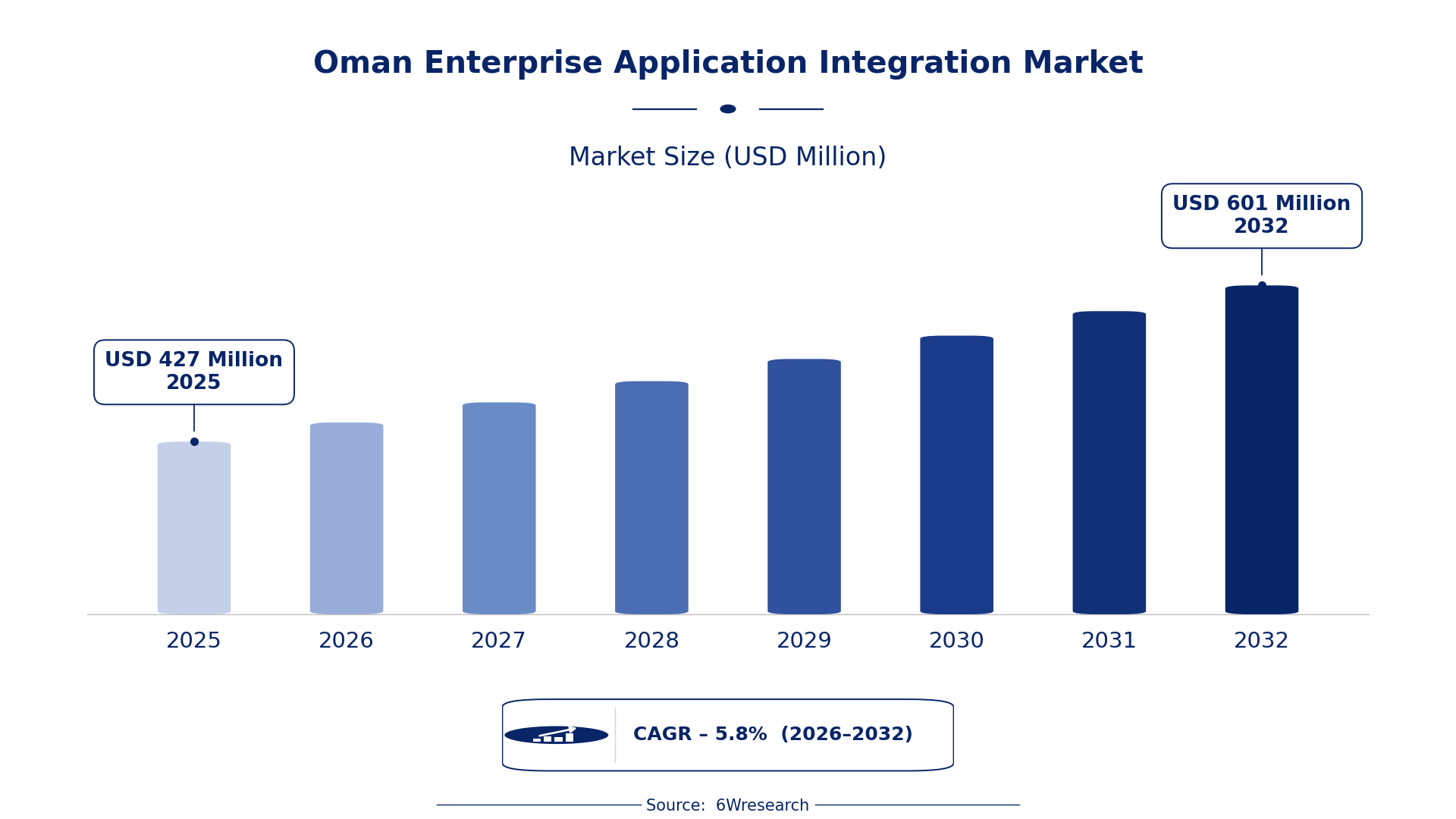
The Oman Enterprise Application Integration Market was estimated at USD 427 Million in 2025 and is projected to reach USD 601 Million by 2032, growing at a CAGR of 5.8% from 2026 to 2032.
Oman Enterprise Application Integration Market Synopsis
The primary force driving the Oman Enterprise Application Integration Market is the widespread adoption of digital technologies across critical sectors such as banking, healthcare, and manufacturing. Organizations are increasingly recognizing the importance of integrating disparate systems to enhance operational efficiency and streamline their business processes.
As businesses prioritize seamless data sharing and real-time access to information, the demand for enterprise application integration solutions has surged. This trend is further supported by government initiatives that encourage digital transformation, setting the stage for a dynamic growth trajectory in the EAI market.
Oman Enterprise Application Integration Market Year-wise Growth Rate and Key Drivers
This graph illustrates the annual growth rates of the Oman Enterprise Application Integration Market from 2021 to 2032, highlighting a steady upward trajectory and projected expansion over the forecast period.
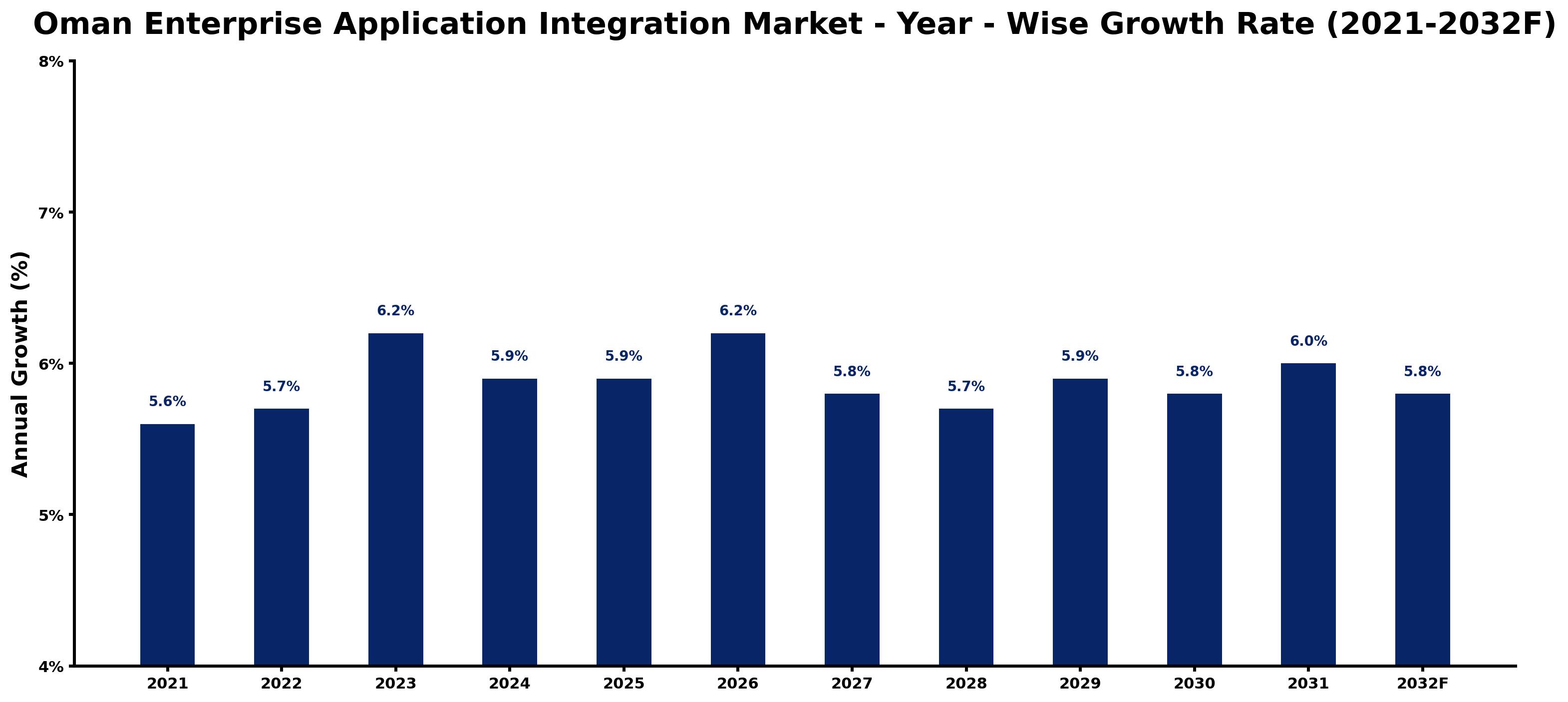
The table below presents the year‑wise growth rates along with the key drivers influencing the market
| Year | Growth Rate | Major Drivers |
| 2021 | 5.6% | Ministry of Transport's digital transformation strategy launched. |
| 2022 | 5.7% | Increased demand for cloud solutions in local enterprises. |
| 2023 | 6.2% | Oman national strategy supporting e-governance initiatives. |
| 2024 | 5.9% | Growing adoption of IoT by Omani businesses. |
| 2025 | 5.9% | Regulatory push for enhanced data interoperability standards. |
| 2026 | 6.2% | Rising investments in local tech startups and innovation. |
| 2027 | 5.8% | Focus on attracting foreign tech ventures to Oman. |
| 2028 | 5.7% | Development of smart city projects across major cities. |
| 2029 | 5.9% | Government incentives for integrating AI in business operations. |
| 2030 | 5.8% | Partnerships between global tech firms and Omani enterprises. |
| 2031 | 6.0% | Launch of local cloud service providers enhancing integration. |
| 2032 | 5.8% | Increased workforce training in information technology sectors. |
Note: Market size estimations and growth projections presented in this report are based on 6Wresearch's proprietary forecasting methodology, utilizing the latest available industry data, government publications, and primary research inputs.
Oman Enterprise Application Integration Market Key Takeaways
Below are some of the specific key takeaways from the market, including:
- The increasing demand for cloud-based integration solutions is reshaping the market dynamics.
- Integration of emerging technologies like AI and IoT is becoming a critical focus for businesses.
- Government policies promoting digital innovation are significantly influencing market growth.
- Organizations are investing in robust integration platforms to manage operational complexities.
- Ongoing digital transformation efforts are propelling the need for enhanced data connectivity.
Evaluation of Restraints in Oman Enterprise Application Integration Market
The Oman Enterprise Application Integration Market faces several restraints that can hinder its growth trajectory. One of the primary challenges is the complexity involved in integrating diverse systems and applications from various vendors. This situation often leads to compatibility issues, making it difficult for organizations to achieve seamless data exchange.
on top of that, many companies in Oman encounter limited technical expertise and resources, which can stall effective integration efforts. Additionally, stringent data security and compliance requirements pose significant hurdles, particularly in industries governed by strict regulations. To overcome these obstacles, organizations must invest in skilled personnel and adopt strategic planning for their integration initiatives.
Oman Enterprise Application Integration Market Trends
Current trends in the Oman Enterprise Application Integration Market indicate a marked shift toward cloud-based integration solutions. These platforms provide organizations with the flexibility and scalability needed to modernize their IT infrastructure. The push for operational efficiency is compelling businesses to adopt integration solutions that streamline workflows and enhance data accessibility.
on top of that, there’s a growing focus on incorporating technologies such as artificial intelligence and the Internet of Things (IoT) into enterprise systems. As companies look to enhance connectivity and foster innovation, robust integration solutions are becoming more essential, marking a significant trend in the market.
Oman Enterprise Application Integration Market Opportunities
Investment opportunities abound in the Oman Enterprise Application Integration market, particularly in cloud-based integration solutions and IoT integration services. The surge in digital technology adoption is driving the need for effective integration of diverse applications, creating a fertile ground for growth. Investing in API management platforms is another avenue that addresses the need for secure and efficient communication between systems.
These growth areas reflect the ongoing shift towards modernizing IT infrastructures, providing businesses with the tools they need to enhance efficiency and drive innovation.
Government Initiatives in the Oman Enterprise Application Integration Market
The Omani government is actively shaping the Enterprise Application Integration Market through policies aimed at fostering digital transformation across various sectors. This commitment to innovation is reflected in initiatives that promote the adoption of advanced technologies, including EAI solutions, to enhance operational efficiency and overall business performance.
- A recently completed initiative focused on enhancing digital skills among local businesses, equipping them to effectively utilize EAI solutions.
- Currently ongoing is a national digital infrastructure upgrade program aimed at improving connectivity and data accessibility for organizations.
- A planned public-private partnership expected to launch by 2026 will focus on expanding IoT integration capabilities across key industries.
- A regulatory framework introduced in 2025 mandates transparency in billing processes, impacting integration solutions.
- Ongoing efforts to provide funding and training programs for startups to leverage EAI technologies effectively.
Future Insights of the Oman Enterprise Application Integration Market
Looking ahead to 2026-2032, the Oman Enterprise Application Integration Market is set for steady growth, fueled by the increasing demand for digital solutions across various industries. Companies are prioritizing the integration of multiple applications to improve operational efficiencies and customer experiences.
With a growing emphasis on cloud-based solutions and the rising prevalence of IoT applications, the market is likely to see further investment and innovation. As government initiatives continue to promote digital transformation, the EAI market will become increasingly vital for organizations aiming to enhance connectivity and agility.
Oman Enterprise Application Integration Market Latest Developments
In the past year, the Oman Enterprise Application Integration Market has witnessed significant developments that point to a vibrant industry trajectory. Organizations are increasingly investing in advanced integration solutions to keep pace with technological advancements and business demands.
- A major technology vendor launched a new cloud-based integration platform in Q2 2025, aimed at enhancing operational efficiency for mid-sized companies.
- In early 2025, a leading regional operator completed a comprehensive upgrade of its integration systems to support emerging technologies.
- Currently, a collaborative initiative is underway between private firms to develop integration solutions specifically for the healthcare sector.
- A rollout of new training programs for businesses, expected to begin in late 2025, will focus on best practices for EAI implementation.
- A planned technology summit in 2026 aims to foster partnerships and innovation in the EAI space.
Oman Enterprise Application Integration Market - Key Attractiveness of the Report
- 10 Years of Market Numbers
- Historical Data Starting from 2022 to 2025
- Base Year: 2025
- Forecast Data until 2032
- Key Performance Indicators Impacting the Market
- Major Upcoming Developments and Projects
Key Highlights of the Report:
- Oman Enterprise Application Integration Market Outlook
- Market Size of Oman Enterprise Application Integration Market, 2025
- Forecast of Oman Enterprise Application Integration Market, 2032
- Historical Data and Forecast of Oman Enterprise Application Integration Revenues & Volume for the Period 2022-2032F
- Oman Enterprise Application Integration Market Trend Evolution
- Oman Enterprise Application Integration Market Drivers and Challenges
- Oman Enterprise Application Integration Price Trends
- Oman Enterprise Application Integration Porter's Five Forces
- Oman Enterprise Application Integration Industry Life Cycle
- Historical Data and Forecast of Oman Enterprise Application Integration Market Revenues & Volume By Deployment type for the Period 2022-2032F
- Historical Data and Forecast of Oman Enterprise Application Integration Market Revenues & Volume By Hosted for the Period 2022-2032F
- Historical Data and Forecast of Oman Enterprise Application Integration Market Revenues & Volume By On-Premise for the Period 2022-2032F
- Historical Data and Forecast of Oman Enterprise Application Integration Market Revenues & Volume By Hybrid for the Period 2022-2032F
- Historical Data and Forecast of Oman Enterprise Application Integration Market Revenues & Volume By Organization size for the Period 2022-2032F
- Historical Data and Forecast of Oman Enterprise Application Integration Market Revenues & Volume By Small for the Period 2022-2032F
- Historical Data and Forecast of Oman Enterprise Application Integration Market Revenues & Volume By Medium for the Period 2022-2032F
- Historical Data and Forecast of Oman Enterprise Application Integration Market Revenues & Volume By Enterprises for the Period 2022-2032F
- Historical Data and Forecast of Oman Enterprise Application Integration Market Revenues & Volume By Large Enterprises for the Period 2022-2032F
- Historical Data and Forecast of Oman Enterprise Application Integration Market Revenues & Volume By Industry Vertical for the Period 2022-2032F
- Historical Data and Forecast of Oman Enterprise Application Integration Market Revenues & Volume By Banking, financial services and insurance(BFSI) for the Period 2022-2032F
- Historical Data and Forecast of Oman Enterprise Application Integration Market Revenues & Volume By Business services for the Period 2022-2032F
- Historical Data and Forecast of Oman Enterprise Application Integration Market Revenues & Volume By IT and telecom for the Period 2022-2032F
- Historical Data and Forecast of Oman Enterprise Application Integration Market Revenues & Volume By Manufacturing for the Period 2022-2032F
- Historical Data and Forecast of Oman Enterprise Application Integration Market Revenues & Volume By Retail and wholesale for the Period 2022-2032F
- Historical Data and Forecast of Oman Enterprise Application Integration Market Revenues & Volume By Healthcare for the Period 2022-2032F
- Historical Data and Forecast of Oman Enterprise Application Integration Market Revenues & Volume By Government for the Period 2022-2032F
- Historical Data and Forecast of Oman Enterprise Application Integration Market Revenues & Volume By Other verticals( education, entertainment and media, power and utilities) for the Period 2022-2032F
- Oman Enterprise Application Integration Import Export Trade Statistics
- Market Opportunity Assessment By Deployment type
- Market Opportunity Assessment By Organization size
- Market Opportunity Assessment By Industry Vertical
- Oman Enterprise Application Integration Top Companies Market Share
- Oman Enterprise Application Integration Competitive Benchmarking By Technical and Operational Parameters
- Oman Enterprise Application Integration Company Profiles
- Oman Enterprise Application Integration Key Strategic Recommendations






































