Oman Fans and Ventilators Market Summary
The oman fans and ventilators market was estimated at USD 364 Million in 2025 and is projected to reach USD 491 Million by 2032, growing at a CAGR of 5.0% from 2026 to 2032.
Oman Fans and Ventilators Market Year-wise Growth Rate and Key Drivers
This graph highlights how the Oman Fans and Ventilators Market has steadily grown over the past five years, supported by major growth factors.
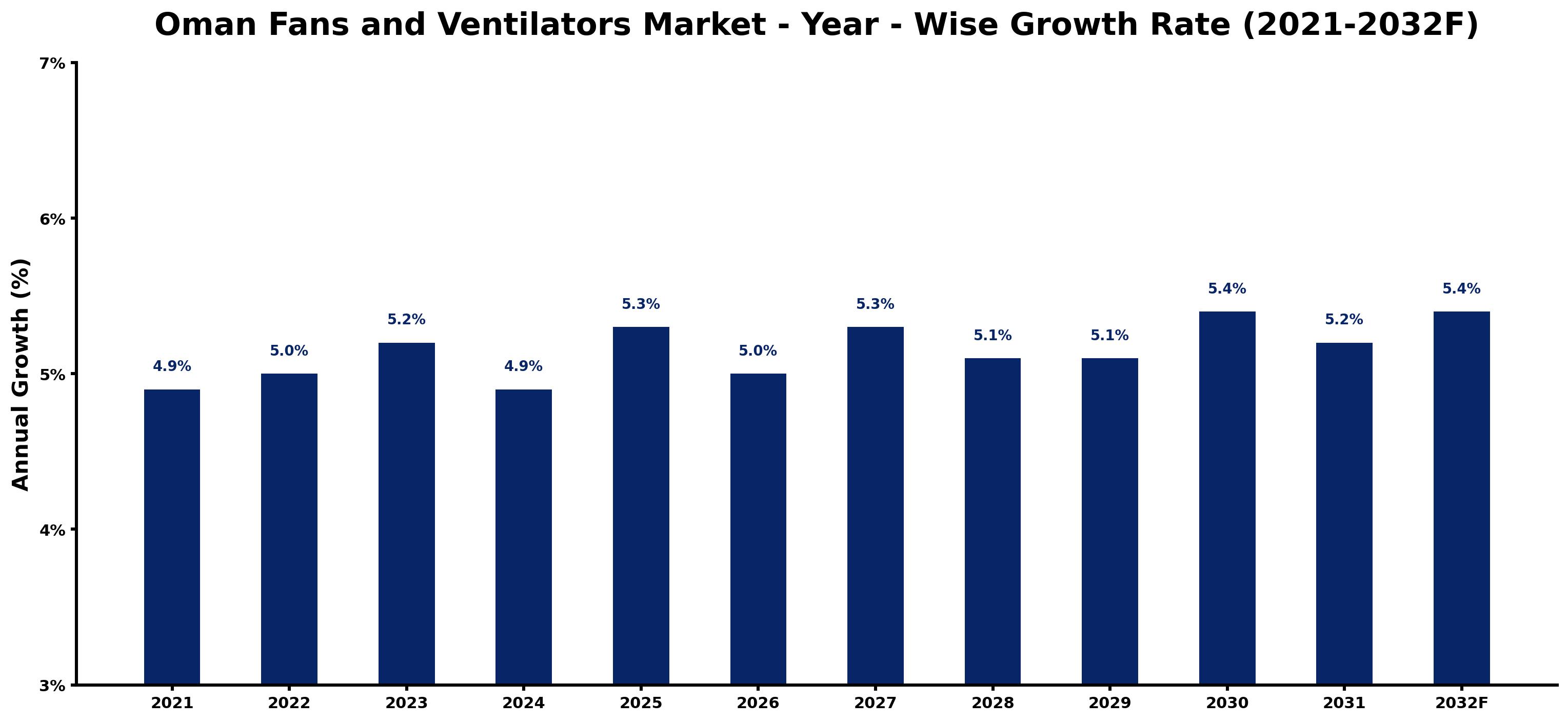
The table below presents the year wise growth rates along with the key drivers influencing the market
| Year | Growth Rate | Major Drivers |
| 2021 | 4.9% | Oman's hot climate necessitated efficient cooling solutions for residential buildings. |
| 2022 | 5.0% | Investments in tourism infrastructure spurred demand for high-performance ventilation systems. |
| 2023 | 5.2% | Local manufacturers expanded capabilities to meet international quality and efficiency standards. |
| 2024 | 4.9% | Smart home technologies increasingly integrated HVAC systems for enhanced user experiences. |
| 2025 | 5.3% | Sustainability trends prompted interest in energy-efficient fan and ventilator designs. |
| 2026 | 5.0% | Construction of new commercial spaces created opportunities for innovative ventilation solutions. |
| 2027 | 5.3% | Rising disposable incomes led to a shift toward premium home air quality products. |
| 2028 | 5.1% | Urbanization trends resulted in greater need for effective airflow management in cities. |
| 2029 | 5.1% | Increased awareness of indoor air quality motivated businesses to upgrade ventilation systems. |
| 2030 | 5.4% | Regional climate challenges necessitated investment in robust HVAC technology adaptations. |
| 2031 | 5.2% | Partnerships between suppliers and local contractors improved product accessibility and service. |
| 2032 | 5.4% | E-commerce platforms facilitated easier access to advanced fan and ventilator products. |
Note - Market size estimations and growth projections presented in this report are based on 6Wresearch's advanced forecasting approach, validated with industry datasets as of June 2026.
Oman Fans and Ventilators Market Synopsis
The Oman Fans and Ventilators Market is projected to reach 5.0% and witness significant growth during the forecast period (2026-2032). The market encompasses the supply and utilization of fans and ventilation systems essential for effective air circulation and ventilation across various settings including residential, commercial, and industrial sectors. As concerns regarding air quality and comfort continue to escalate, this market plays a vital role in ensuring both environmental and energy efficiency.
Oman Fans and Ventilators Market Growth Drivers
The expansion of the Oman Fans and Ventilators Market is largely attributed to several key factors:
- The burgeoning demand for efficient air circulation and ventilation solutions in diverse sectors underscores the necessity for advanced fan and ventilator technologies. These systems are pivotal in maintaining indoor air quality and achieving thermal comfort across various establishments.
- Urbanization trends in Oman have led to increased construction activities, driving the need for enhanced ventilation solutions in new residential and commercial properties.
- There is a growing consciousness among consumers regarding indoor air quality, prompting investments in better ventilation systems that meet health standards.
- Technological advancements facilitate improved efficiency, reduced noise levels, and the integration of smart controls into fans and ventilators, appealing to tech-savvy consumers.
- Furthermore, the rising emphasis on energy conservation and eco-friendly solutions is propelling the market, as consumers and businesses seek products that align with sustainability goals.
Oman Fans and Ventilators Market Challenges and Restraints
Despite the growth opportunities, the Oman Fans and Ventilators Market faces several challenges:
- One major challenge is achieving energy efficiency while reducing noise levels in ventilating systems, an aspect that is critical to consumer satisfaction and regulatory compliance.
- Manufacturers must also navigate the complexities of meeting diverse ventilation requirements across different industries, which often involve varying operational needs and safety standards.
- The reliability of ventilation products is a crucial factor for users, necessitating continuous innovation and quality assurance from manufacturers.
- Additionally, stringent regulations surrounding safety and environmental impact increasingly impact product development and manufacturing processes.
- Market players may struggle to keep pace with rapidly evolving consumer preferences, requiring agile and adaptive business strategies to maintain competitiveness.
Oman Fans and Ventilators Market Government Investment and Initiatives
The government of Oman plays a proactive role in promoting the Fans and Ventilators Market through various initiatives:
- Encouraging the adoption of energy-efficient fans and ventilation systems in both residential and commercial buildings aligns with national energy conservation goals.
- Regulations mandating compliance with safety and energy efficiency standards have been established, reinforcing the importance of quality control in product development.
- Support for local manufacturing initiatives is designed to bolster domestic production capabilities, thereby reducing reliance on imports and fostering economic growth.
- Incentives for technological advancement have been introduced, encouraging manufacturers to innovate in energy-saving and environmentally friendly ventilation solutions.
- The government also invests in public awareness campaigns aimed at educating consumers about the benefits of improved indoor air quality and the importance of efficient ventilation systems.
Oman Fans and Ventilators Market Latest Developments (May 2025 - June 2026)
Recent developments in the Oman Fans and Ventilators Market, covering the period from May 2025 to June 2026, indicate a strong industry shift towards eco-friendly solutions. There has been a noticeable increase in product launches featuring advanced technologies aimed at energy efficiency and noise reduction. Moreover, collaborative efforts between industry stakeholders and government entities have strengthened regulatory compliance around safety standards, further enhancing market integrity. Additionally, industry players are increasingly focused on implementing smart ventilation technologies, ensuring that systems can be monitored and controlled remotely through connected devices. As urbanization continues to reshape the Omani landscape, the demand for integrated ventilation solutions aligning with contemporary architectural design trends has also intensified.
Oman Fans and Ventilators Market - Key Attractiveness of the Report
- 10 Years of Market Numbers
- Historical Data Starting from 2022 to 2025
- Base Year: 2025
- Forecast Data until 2032
- Key Performance Indicators Impacting the Market
- Major Upcoming Developments and Projects
Key Highlights of the Report:
- Oman Fans and Ventilators Market Outlook
- Market Size of Oman Fans and Ventilators Market, 2025
- Forecast of Oman Fans and Ventilators Market, 2032
- Historical Data and Forecast of Oman Fans and Ventilators Revenues & Volume for the Period 2022-2032F
- Oman Fans and Ventilators Market Trend Evolution
- Oman Fans and Ventilators Market Drivers and Challenges
- Oman Fans and Ventilators Price Trends
- Oman Fans and Ventilators Porter's Five Forces
- Oman Fans and Ventilators Industry Life Cycle
- Historical Data and Forecast of Oman Fans and Ventilators Market Revenues & Volume By Material for the Period 2022-2032F
- Historical Data and Forecast of Oman Fans and Ventilators Market Revenues & Volume By Metal for the Period 2022-2032F
- Historical Data and Forecast of Oman Fans and Ventilators Market Revenues & Volume By Composite for the Period 2022-2032F
- Historical Data and Forecast of Oman Fans and Ventilators Market Revenues & Volume By Rubber for the Period 2022-2032F
- Historical Data and Forecast of Oman Fans and Ventilators Market Revenues & Volume By Plastic for the Period 2022-2032F
- Historical Data and Forecast of Oman Fans and Ventilators Market Revenues & Volume By Application for the Period 2022-2032F
- Historical Data and Forecast of Oman Fans and Ventilators Market Revenues & Volume By Interior for the Period 2022-2032F
- Historical Data and Forecast of Oman Fans and Ventilators Market Revenues & Volume By Exterior for the Period 2022-2032F
- Historical Data and Forecast of Oman Fans and Ventilators Market Revenues & Volume By Structural for the Period 2022-2032F
- Historical Data and Forecast of Oman Fans and Ventilators Market Revenues & Volume By Powertrain for the Period 2022-2032F
- Historical Data and Forecast of Oman Fans and Ventilators Market Revenues & Volume By Vehicle Types for the Period 2022-2032F
- Historical Data and Forecast of Oman Fans and Ventilators Market Revenues & Volume By Passenger Vehicles for the Period 2022-2032F
- Historical Data and Forecast of Oman Fans and Ventilators Market Revenues & Volume By Light Commercial Vehicles for the Period 2022-2032F
- Historical Data and Forecast of Oman Fans and Ventilators Market Revenues & Volume By Heavy Commercial Vehicles for the Period 2022-2032F
- Oman Fans and Ventilators Import Export Trade Statistics
- Market Opportunity Assessment By Material
- Market Opportunity Assessment By Application
- Market Opportunity Assessment By Vehicle Types
- Oman Fans and Ventilators Top Companies Market Share
- Oman Fans and Ventilators Competitive Benchmarking By Technical and Operational Parameters
- Oman Fans and Ventilators Company Profiles
- Oman Fans and Ventilators Key Strategic Recommendations






































