Oman Formwork Market Summary
The oman formwork market was estimated at USD 413 Million in 2025 and is projected to reach USD 585 Million by 2032, growing at a CAGR of 5.8% from 2026 to 2032.
Oman Formwork Market Year-wise Growth Rate and Key Drivers
This graph highlights how the Oman Formwork Market has steadily grown over the past five years, supported by major growth factors.
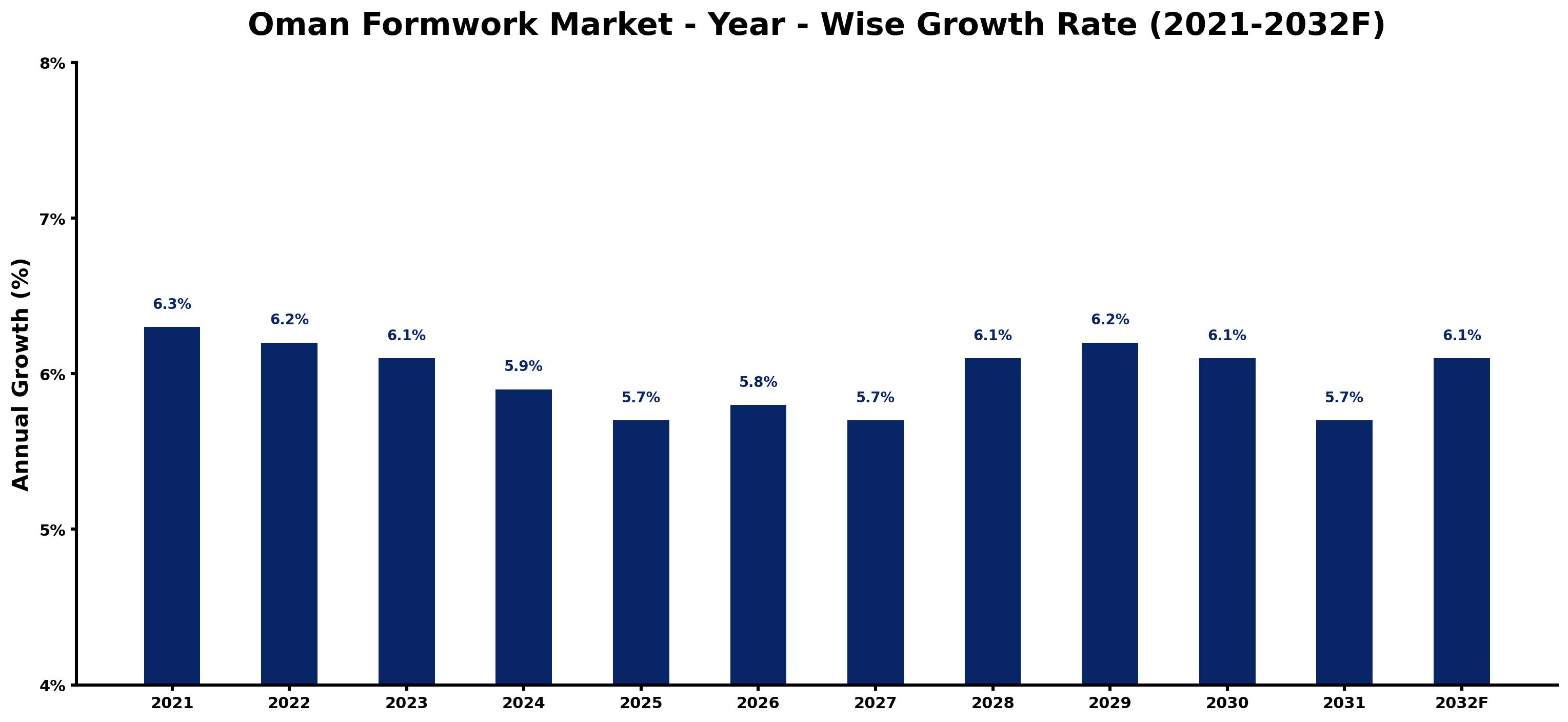
The table below presents the year wise growth rates along with the key drivers influencing the market
| Year | Growth Rate | Major Drivers |
| 2021 | 6.3% | Post-pandemic recovery in construction spurred significant demand for formwork solutions. |
| 2022 | 6.2% | Investment in infrastructure projects within Oman showcased the need for advanced formwork systems. |
| 2023 | 6.1% | Local companies began adopting innovative formwork technologies to enhance construction efficiency. |
| 2024 | 5.9% | Oman's Vision 2040 emphasized sustainable construction practices, impacting formwork material choices. |
| 2025 | 5.7% | Increased foreign direct investment resulted in more large-scale construction projects across Oman. |
| 2026 | 5.8% | The expanding residential sector required versatile formwork solutions to accommodate diverse designs. |
| 2027 | 5.7% | Emerging green building trends prompted shifts towards eco-friendly formwork materials. |
| 2028 | 6.1% | Technological integration in construction processes initiated a shift in formwork manufacturing methods. |
| 2029 | 6.2% | Local partnerships facilitated knowledge transfer, enhancing formwork systems' adaptability in challenging climates. |
| 2030 | 6.1% | The construction workforce began prioritizing training in advanced formwork techniques and safety standards. |
| 2031 | 5.7% | Infrastructure projects aligned with regional trade initiatives increased demand for efficient formwork. |
| 2032 | 6.1% | Sustainability measures and recycling initiatives further shaped the evolution of the Omani formwork market. |
Note - Market size estimations and growth projections presented in this report are based on 6Wresearch's advanced forecasting approach, validated with industry datasets as of June 2026.
Oman Formwork Market Synopsis
The Oman Formwork Market is projected to reach 5.8% and witness significant growth during the forecast period (2026-2032). This growth trajectory is primarily driven by the increasing demand for housing units both globally and within Oman, fueling a surge in construction activities that favor formwork solutions. The use of formworks, particularly in high-rise buildings and infrastructure such as bridges, has become a cost-effective and efficient method for the construction industry. As the landscape of urban development evolves, the adoption of formwork systems in slabs, walls, beams, and columns is set to escalate.
Oman Formwork Market Growth Drivers
Several factors are propelling the growth of the Oman formwork market. The ongoing urbanization in Oman is a significant driver, with a notable increase in construction projects aimed at addressing housing shortages. This surge in demand necessitates efficient construction methodologies, where formwork emerges as a critical component. Additionally, infrastructural development projects, such as roads and bridges, are expected to require extensive formwork solutions, further enhancing market prospects. The growing emphasis on sustainable construction practices promotes the use of reusable and recyclable formwork materials, aligning with global trends in eco-friendly building methods.
- The accelerating pace of urbanization in Oman has led to a rising demand for residential and commercial buildings.
- Infrastructural advancements, including road and bridge construction, call for effective formwork applications.
- There is a growing preference for efficient construction solutions that minimize labor costs and time, where formwork is indispensable.
- Technological advancements in formwork systems are enhancing performance and usability, driving their adoption.
- Sustainable construction practices are gaining traction, encouraging the use of environmentally friendly formwork materials.
Oman Formwork Market Challenges and Restraints
Despite the promising growth outlook, the Oman formwork market faces several challenges that could hinder its expansion. A primary concern is the escalating costs of raw materials, such as timber and steel, which can significantly impact the overall project budgets. This price volatility can deter construction firms from utilizing formwork systems, opting instead for alternative construction methods. Additionally, the region is experiencing a shortage of skilled labor, which not only affects the efficiency of construction projects but also limits the proper implementation of complex formwork systems. Consequently, companies may encounter delays and increased operational costs, adversely affecting market dynamics.
- The rising costs of raw materials such as timber and steel are straining profit margins in construction projects.
- A shortage of skilled labor in the construction sector limits the effective deployment of formwork systems.
- Market fluctuations and economic uncertainties can influence investment in new construction projects.
- Regulatory challenges and compliance requirements may complicate the procurement and usage of formwork materials.
- Competition from alternative construction methods, such as prefabricated building systems, may limit the market share of traditional formwork solutions.
Oman Formwork Market Government Investment and Initiatives
The Oman government has been increasingly focused on infrastructure development, showcasing commitment through various national initiatives and investments. These initiatives are designed to boost the construction sector, thereby indirectly enhancing the formwork market. Strategic plans aimed at urban development, housing projects, and transportation frameworks are being prioritized, signaling robust public spending in construction-related activities. Government incentives to stimulate private investment in construction utilities are also present, which may further endorse the use of efficient formwork systems. The alignment of public and private sectors in addressing housing demands presents opportunities for growth in the Oman formwork market.
- The government is committing resources to large-scale infrastructure projects, enhancing the overall demand for formwork solutions.
- Public-private partnerships in construction are being encouraged to expedite housing and infrastructure projects.
- Regulatory frameworks are being streamlined to support efficient procurement and utilization of construction materials.
- Investment in training programs aims to address the skills gap in the construction workforce.
- Government support for sustainable building practices promotes the adoption of modern formwork technologies.
Oman Formwork Market Latest Developments (May 2025 - June 2026)
The period from May 2025 to June 2026 has witnessed notable developments within the Oman formwork market as stakeholders adapt to evolving construction demands. There is increased awareness and implementation of innovative formwork technologies that allow for enhanced project efficiency. Industry players have also been pivoting towards sustainable practices, with a focus on reducing waste and utilizing eco-friendly materials. Collaborative efforts between government entities and private sector firms are becoming more prevalent, aligning strategic projects with national goals for urban development. This period is characterized by a shift towards quality construction standards, as stakeholders strive to meet rising client expectations.
- Adoption of advanced formwork technologies is improving project timelines and construction quality.
- Sustainable formwork solutions are gaining traction, aligning with international eco-friendly construction trends.
- Enhanced collaborations between government agencies and private developers are accelerating project implementations.
- Industry forums and workshops are being held to discuss best practices and innovations in formwork systems.
- Overall market sentiment is optimistic, driven by ongoing educational initiatives in the construction sector.
Oman Formwork Market - Key Attractiveness of the Report
- 10 Years of Market Numbers
- Historical Data Starting from 2022 to 2025
- Base Year: 2025
- Forecast Data until 2032
- Key Performance Indicators Impacting the Market
- Major Upcoming Developments and Projects
Key Highlights of the Report:
- Oman Formwork Market Outlook
- Market Size of Oman Formwork Market, 2025
- Forecast of Oman Formwork Market, 2032F
- Historical Data and Forecast of Oman Formwork Revenues & Volume for the Period 2022-2032F
- Oman Formwork Market Trend Evolution
- Oman Formwork Market Drivers and Challenges
- Oman Formwork Price Trends
- Oman Formwork Porter's Five Forces
- Oman Formwork Industry Life Cycle
- Historical Data and Forecast of Oman Formwork Market Revenues & Volume By Product Type for the Period 2022-2032F
- Historical Data and Forecast of Oman Formwork Market Revenues & Volume By Traditional timber formwork for the Period 2022-2032F
- Historical Data and Forecast of Oman Formwork Market Revenues & Volume By Engineered Formwork System for the Period 2022-2032F
- Historical Data and Forecast of Oman Formwork Market Revenues & Volume By Re-usable plastic formwork for the Period 2022-2032F
- Historical Data and Forecast of Oman Formwork Market Revenues & Volume By Others for the Period 2022-2032F
- Historical Data and Forecast of Oman Formwork Market Revenues & Volume By Applications for the Period 2022-2032F
- Historical Data and Forecast of Oman Formwork Market Revenues & Volume By Buildings for the Period 2022-2032F
- Historical Data and Forecast of Oman Formwork Market Revenues & Volume By Transportation for the Period 2022-2032F
- Historical Data and Forecast of Oman Formwork Market Revenues & Volume By Industrial Facilities for the Period 2022-2032F
- Oman Formwork Import Export Trade Statistics
- Market Opportunity Assessment By Product Type
- Market Opportunity Assessment By Applications
- Oman Formwork Top Companies Market Share
- Oman Formwork Competitive Benchmarking By Technical and Operational Parameters
- Oman Formwork Company Profiles
- Oman Formwork Key Strategic Recommendations






































