Oman Fruit Pulp Market Size, Share & Growth Rate
The Oman Fruit Pulp Market was estimated at USD 409 Million in 2025 and is projected to reach USD 559 Million by 2032, growing at a CAGR of 4.6% from 2026 to 2032. This growth trajectory is primarily fueled by a surge in consumer preference for healthier food options, leading to increased demand for fruit-based products like juices and smoothies. Furthermore, the rich agricultural landscape of Oman, characterized by an abundance of tropical fruits, complements the markets expansion by providing ample raw materials for local producers.
Oman Fruit Pulp Market Year-wise Growth Rate and Key Drivers
This graph highlights how the Oman Fruit Pulp Market has steadily grown over the years, supported by major growth factors.
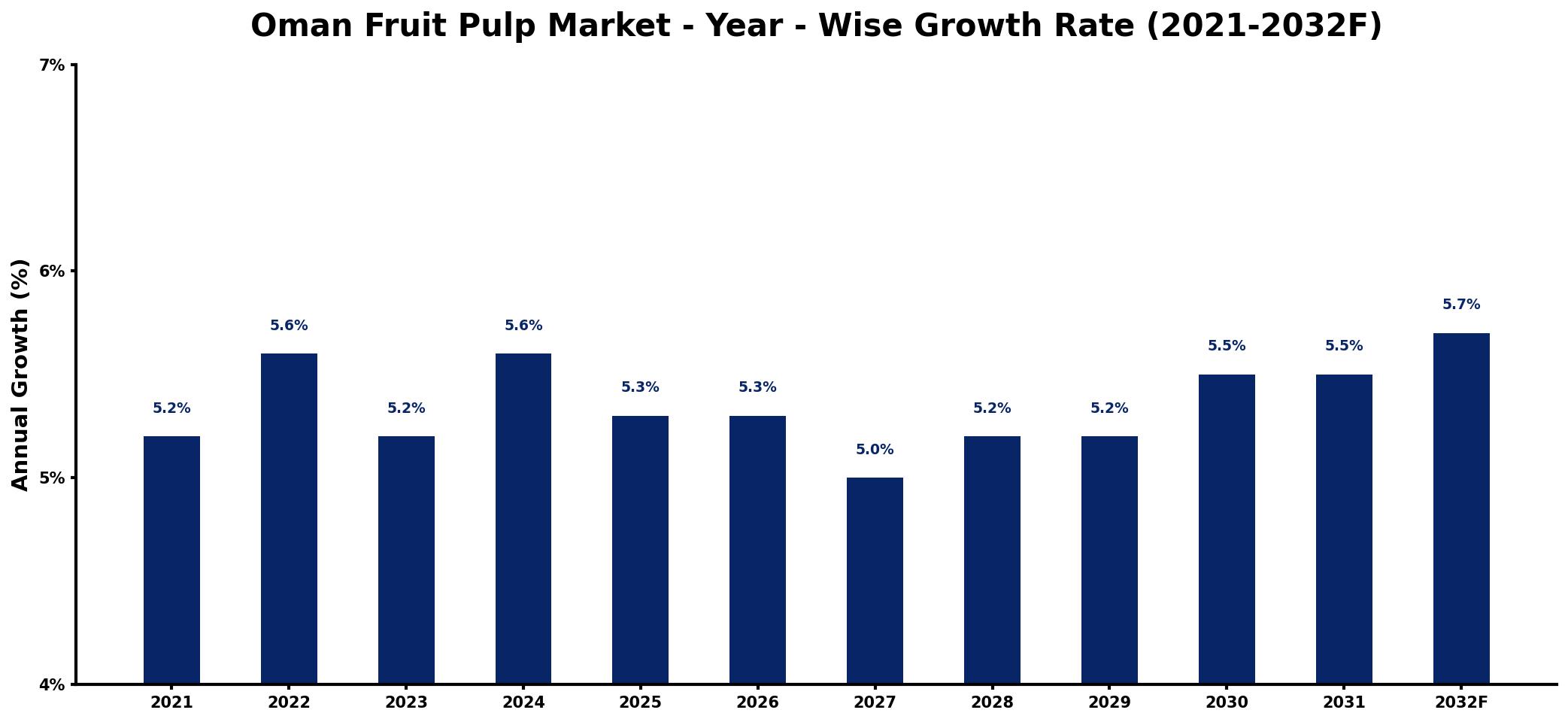
The table below presents the year‑wise growth rates along with the key drivers influencing the market
| Year | Growth Rate | Major Drivers |
| 2021 | 5.2% | Rising health consciousness among consumers |
| 2022 | 5.6% | Increased demand for natural ingredients |
| 2023 | 5.2% | Expansion of food processing sector |
| 2024 | 5.6% | rising export shipment volumes |
| 2025 | 5.3% | Investment in sustainable packaging solutions |
| 2026 | 5.3% | Surge in online retail channels |
| 2027 | 5.0% | Emergence of innovative flavor combinations |
| 2028 | 5.2% | increased overall sector activity |
| 2029 | 5.2% | Development of new distribution networks |
| 2030 | 5.5% | expanding manufacturing base activity |
| 2031 | 5.5% | Strengthening of export opportunities |
| 2032 | 5.7% | Increased consumer preference for convenience |
Note: Market size estimations and growth projections presented in this report are based on 6Wresearch's proprietary forecasting methodology, utilizing the latest available industry data, government publications, and primary research inputs.
Oman Fruit Pulp Market Synopsis
The primary driver reshaping the Oman Fruit Pulp Market is the growing inclination towards natural and wholesome ingredients among consumers. This shift is evident in the rising popularity of healthy snacks and beverages, where fruit pulp plays a critical role in enhancing nutritional profiles while providing distinct flavors.
Additionally, advancements in food processing technology are elevating the efficiency and consistency of fruit pulp production. These innovations not only extend the shelf life of products but also enhance the overall quality, meeting the rising standards of consumers and retailers alike.
Oman Fruit Pulp Market Key Takeaways
- The market is driven by increasing health consciousness and preference for natural ingredients.
- Omans tropical fruit production supports a robust domestic supply chain for fruit pulp.
- Technological advancements in processing enhance product quality and shelf life.
- The market is bolstered by the rise of plant-based diets and veganism.
- Challenges remain in quality control and compliance with stringent food safety standards.
Evaluation of Restraints in Oman Fruit Pulp Market
While the Oman Fruit Pulp Market shows promising growth, several restraints could hinder its full potential. Fluctuations in fruit supply due to seasonal variations can lead to inconsistent product availability, affecting production schedules and market reliability. Furthermore, navigating the complex landscape of food safety regulations poses a significant challenge for local processors. Maintaining competitive pricing without compromising quality demands a delicate balance, which can limit the agility of smaller producers striving to capture market share.
Oman Fruit Pulp Market Trends
A notable trend in the Oman Fruit Pulp Market is the increasing incorporation of fruit pulp into a wider range of food products beyond beverages, such as confectioneries and health snacks. This diversification is indicative of evolving consumer tastes and the market's adaptability. Moreover, the emphasis on sustainability is prompting manufacturers to explore eco-friendly packaging solutions, aligning product offerings with broader environmental goals.
Oman Fruit Pulp Market Opportunities
Genuine growth opportunities in the Oman Fruit Pulp Market are emerging from increased export potential. As global demand for natural and organic ingredients rises, Oman stands at a strategic advantage due to its rich agricultural resources. Furthermore, investments in processing technologies can enhance product quality, catering to both local and international markets. There is also significant scope for collaboration with food innovators to create unique fruit-based products that resonate with health-focused consumers.
Government Initiatives in the Oman Fruit Pulp Market
The Omani government is actively promoting sustainable agriculture and food processing technologies, aiming to improve the quality and competitiveness of local products. By encouraging initiatives focused on value addition within the agricultural sector, the government is fostering an environment conducive to growth and innovation in the fruit pulp market. These efforts align with broader economic goals of diversifying the economy and enhancing export capabilities.
Future Insights of the Oman Fruit Pulp Market
Looking ahead to 2026-2032, the Oman Fruit Pulp Market is expected to thrive amid ongoing shifts towards healthier eating patterns. The anticipated growth in global demand for natural ingredients will likely spur local producers to enhance their offerings. Moreover, the focus on technological advancements will continue to play a critical role in ensuring product quality and meeting the evolving preferences of both domestic and international consumers.
Oman Fruit Pulp Market Latest Developments (2025 - 2026)
Recent developments in the Oman Fruit Pulp Market indicate a shift towards greater innovation in processing techniques and product formulations. Local companies are increasingly exploring partnerships with research institutions to advance fruit processing technologies, enhancing the quality and variety of available fruit pulp products. Furthermore, there is a noticeable trend in marketing campaigns highlighting the health benefits of fruit pulp, aimed at raising consumer awareness and driving market penetration.
Oman Fruit Pulp Market - Key Attractiveness of the Report
- 10 Years of Market Numbers
- Historical Data Starting from 2022 to 2025
- Base Year: 2025
- Forecast Data until 2032
- Key Performance Indicators Impacting the Market
- Major Upcoming Developments and Projects
Key Highlights of the Report:
- Oman Fruit Pulp Market Outlook
- Market Size of Oman Fruit Pulp Market, 2025
- Forecast of Oman Fruit Pulp Market, 2032
- Historical Data and Forecast of Oman Fruit Pulp Revenues & Volume for the Period 2022-2032F
- Oman Fruit Pulp Market Trend Evolution
- Oman Fruit Pulp Market Drivers and Challenges
- Oman Fruit Pulp Price Trends
- Oman Fruit Pulp Porter's Five Forces
- Oman Fruit Pulp Industry Life Cycle
- Historical Data and Forecast of Oman Fruit Pulp Market Revenues & Volume By Fruit Type for the Period 2022-2032F
- Historical Data and Forecast of Oman Fruit Pulp Market Revenues & Volume By Mango for the Period 2022-2032F
- Historical Data and Forecast of Oman Fruit Pulp Market Revenues & Volume By Strawberry for the Period 2022-2032F
- Historical Data and Forecast of Oman Fruit Pulp Market Revenues & Volume By Apple for the Period 2022-2032F
- Historical Data and Forecast of Oman Fruit Pulp Market Revenues & Volume By Guava for the Period 2022-2032F
- Historical Data and Forecast of Oman Fruit Pulp Market Revenues & Volume By Berries for the Period 2022-2032F
- Historical Data and Forecast of Oman Fruit Pulp Market Revenues & Volume By Citrus Fruits for the Period 2022-2032F
- Historical Data and Forecast of Oman Fruit Pulp Market Revenues & Volume By Others for the Period 2022-2032F
- Historical Data and Forecast of Oman Fruit Pulp Market Revenues & Volume By Form for the Period 2022-2032F
- Historical Data and Forecast of Oman Fruit Pulp Market Revenues & Volume By Liquid for the Period 2022-2032F
- Historical Data and Forecast of Oman Fruit Pulp Market Revenues & Volume By Powder for the Period 2022-2032F
- Historical Data and Forecast of Oman Fruit Pulp Market Revenues & Volume By Application for the Period 2022-2032F
- Historical Data and Forecast of Oman Fruit Pulp Market Revenues & Volume By Food and Beverages for the Period 2022-2032F
- Historical Data and Forecast of Oman Fruit Pulp Market Revenues & Volume By Distribution for the Period 2022-2032F
- Historical Data and Forecast of Oman Fruit Pulp Market Revenues & Volume By E-Commerce for the Period 2022-2032F
- Historical Data and Forecast of Oman Fruit Pulp Market Revenues & Volume By Convenience Stores for the Period 2022-2032F
- Historical Data and Forecast of Oman Fruit Pulp Market Revenues & Volume By Supermarkets/Hypermarkets for the Period 2022-2032F
- Historical Data and Forecast of Oman Fruit Pulp Market Revenues & Volume By Specialty Stores for the Period 2022-2032F
- Historical Data and Forecast of Oman Fruit Pulp Market Revenues & Volume By Others for the Period 2022-2032F
- Oman Fruit Pulp Import Export Trade Statistics
- Market Opportunity Assessment By Fruit Type
- Market Opportunity Assessment By Form
- Market Opportunity Assessment By Application
- Market Opportunity Assessment By Distribution
- Oman Fruit Pulp Top Companies Market Share
- Oman Fruit Pulp Competitive Benchmarking By Technical and Operational Parameters
- Oman Fruit Pulp Company Profiles
- Oman Fruit Pulp Key Strategic Recommendations






































