Oman Fuel Station Market Size, Share & Growth Rate
The Oman Fuel Station Market was estimated at USD 469 Million in 2025 and is projected to reach USD 663 Million by 2032, growing at a CAGR of 5.1% from 2026 to 2032. This robust growth trajectory is primarily driven by the increasing vehicle ownership and the expanding population, resulting in a higher demand for fuel products. Furthermore, the government's commitment to modernize and enhance the nations road infrastructure plays a significant role in propelling market expansion.
Oman Fuel Station Market Year-wise Growth Rate and Key Drivers
This graph highlights how the Oman Fuel Station Market has steadily grown over the years, supported by major growth factors.
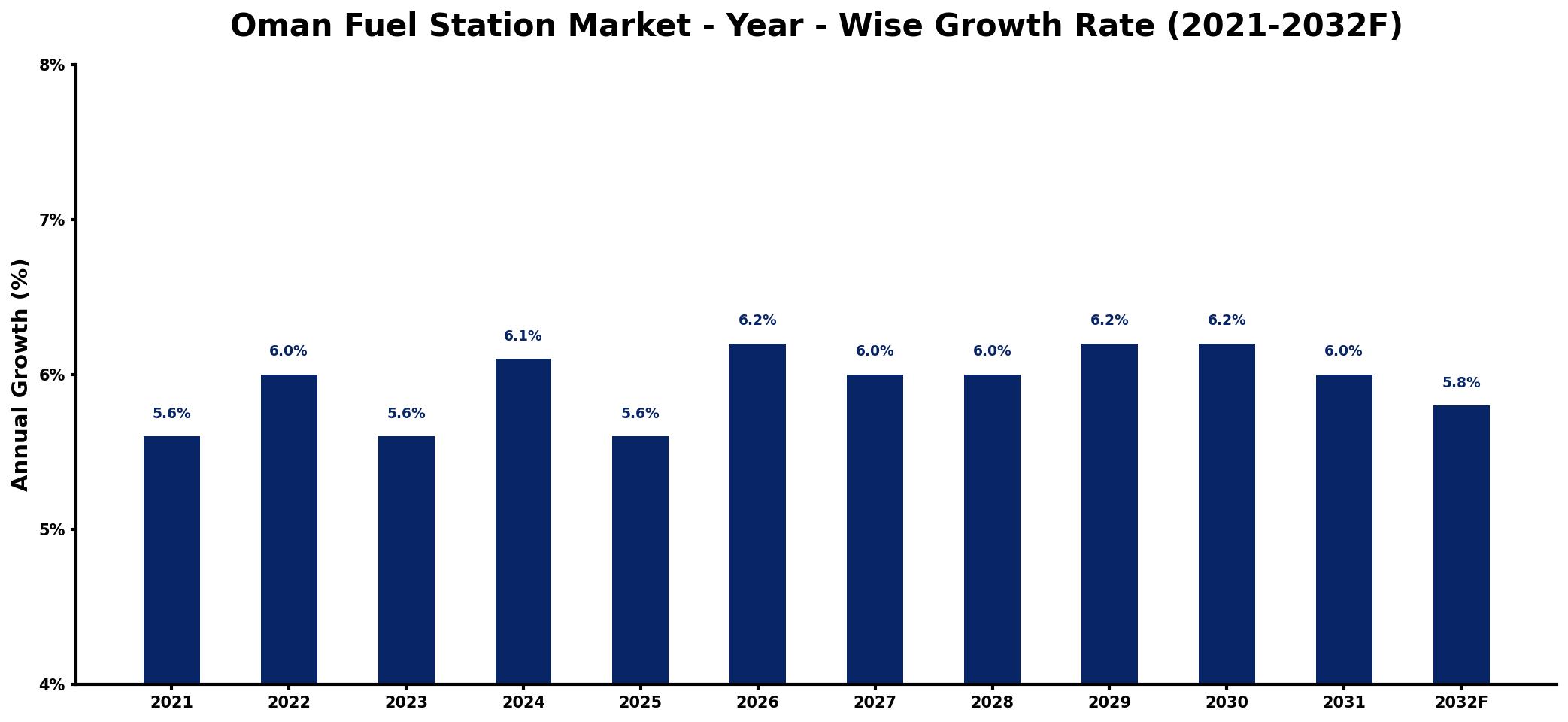
The table below presents the year‑wise growth rates along with the key drivers influencing the market
| Year | Growth Rate | Major Drivers |
| 2021 | 5.6% | Rising transportation sector activity |
| 2022 | 6.0% | Increased tourism and travel demand |
| 2023 | 5.6% | Growing urban population needs |
| 2024 | 6.1% | Expansion of logistics networks |
| 2025 | 5.6% | Higher disposable income levels |
| 2026 | 6.2% | Investment in renewable energy projects |
| 2027 | 6.0% | Development of electric vehicle infrastructure |
| 2028 | 6.0% | Increased commercial vehicle registrations |
| 2029 | 6.2% | Government initiatives for modernization |
| 2030 | 6.2% | Emerging market growth opportunities |
| 2031 | 6.0% | Boost in regional trade activities |
| 2032 | 5.8% | expanding healthcare application demand |
Note: Market size estimations and growth projections presented in this report are based on 6Wresearch's proprietary forecasting methodology, utilizing the latest available industry data, government publications, and primary research inputs.
Oman Fuel Station Market Synopsis
The strongest force shaping the Oman Fuel Station Market today is the rising demand for sustainable fuel solutions. As environmental consciousness grows, consumers and operators alike are increasingly focusing on cleaner energy alternatives, including electric vehicle charging stations and biofuels.
Additionally, fuel stations are evolving into multifaceted service hubs, offering convenience stores, car wash services, and fast-food outlets. This diversification is enhancing customer experience and driving footfall, which is vital in a competitive marketplace.
Oman Fuel Station Market Key Takeaways
- The market is projected to grow significantly, driven by population growth and vehicle ownership.
- Sustainability trends are reshaping fuel offerings with more focus on alternative energy sources.
- Fuel stations are diversifying their services to enhance customer experience.
- Regulatory changes are creating both challenges and opportunities for operators in the sector.
- Investment potential is high, particularly in infrastructure and technological advancements.
Evaluation of Restraints in Oman Fuel Station Market
Despite the promising growth of the Oman Fuel Station Market, several restraints are hindering its full potential. One significant concern is the increasing competition from international entrants, which places pressure on profit margins. Furthermore, fluctuations in fuel prices can adversely impact operational sustainability, making it crucial for operators to develop robust financial strategies. Regulatory changes also present challenges, necessitating adaptability and investment in compliance measures. As sustainability becomes a pressing issue, operators must balance profitability with environmental responsibilities, which can limit certain operational decisions.
Oman Fuel Station Market Trends
Emerging trends in the Oman Fuel Station Market indicate a clear shift towards sustainability. Fuel station operators are increasingly investing in alternative fuels and electric vehicle charging infrastructure, aligned with global energy transitions. Moreover, digitalization is gaining momentum, as stations adopt mobile payment systems, loyalty programs, and cutting-edge fueling technologies to enhance customer convenience. These trends illustrate an adaptive market responding to the evolving needs and preferences of consumers.
Oman Fuel Station Market Opportunities
There are considerable investment opportunities within the Oman Fuel Station Market, particularly for new entrants looking to establish stations in high-demand urban and highway locations. The increasing domestic consumption of petrol and diesel, alongside a burgeoning tourism sector, further emphasizes this potential. Expanding existing fuel station services to include electric vehicle charging and innovative amenities could yield significant returns. Additionally, partnerships with local businesses can help navigate market complexities and leverage existing networks for growth.
Government Initiatives in the Oman Fuel Station Market
Government policy plays a crucial role in shaping the dynamics of the Oman Fuel Station Market. Regulatory frameworks governing pricing, distribution, and environmental standards are designed to ensure fair market practices. Moreover, the government promotes the use of cleaner fuels and technologies, providing incentives for stations to transition towards more sustainable operations. Continued public spending on infrastructure improvements and enhancements to the transportation network further supports market growth.
Future Insights of the Oman Fuel Station Market
Looking ahead to 2026-2032, the Oman Fuel Station Market is poised for continued expansion. Factors such as rapid urbanization, increased disposable incomes, and a commitment to infrastructure development will likely sustain demand for fuel products. However, industry players must remain vigilant of shifts towards electric vehicles and fluctuating oil prices, adapting their strategies to maintain competitiveness. With the government facilitating foreign investments and economic diversification, the landscape appears conducive for innovative growth initiatives.
Oman Fuel Station Market Latest Developments (2025 - 2026)
In recent months, the Oman Fuel Station Market has seen a trend towards modernization, with operators upgrading facilities to offer a wider range of services. Investments in technology for enhanced customer experience are becoming commonplace. Furthermore, there is an observable increase in the establishment of electric vehicle charging stations as operators respond to the growing demand for sustainable energy solutions. The market continues to evolve, showcasing a commitment to adapting to consumer preferences and regulatory standards.
Oman Fuel Station Market - Key Attractiveness of the Report
- 10 Years of Market Numbers
- Historical Data Starting from 2022 to 2025
- Base Year: 2025
- Forecast Data until 2032
- Key Performance Indicators Impacting the Market
- Major Upcoming Developments and Projects
Key Highlights of the Report:
- Oman Fuel Station Market Outlook
- Market Size of Oman Fuel Station Market, 2025
- Forecast of Oman Fuel Station Market, 2032
- Historical Data and Forecast of Oman Fuel Station Revenues & Volume for the Period 2022-2032F
- Oman Fuel Station Market Trend Evolution
- Oman Fuel Station Market Drivers and Challenges
- Oman Fuel Station Price Trends
- Oman Fuel Station Porter's Five Forces
- Oman Fuel Station Industry Life Cycle
- Historical Data and Forecast of Oman Fuel Station Market Revenues & Volume By Fuel for the Period 2022-2032F
- Historical Data and Forecast of Oman Fuel Station Market Revenues & Volume By Gasoline for the Period 2022-2032F
- Historical Data and Forecast of Oman Fuel Station Market Revenues & Volume By Diesel for the Period 2022-2032F
- Historical Data and Forecast of Oman Fuel Station Market Revenues & Volume By Gas for the Period 2022-2032F
- Historical Data and Forecast of Oman Fuel Station Market Revenues & Volume By others for the Period 2022-2032F
- Historical Data and Forecast of Oman Fuel Station Market Revenues & Volume By End-User for the Period 2022-2032F
- Historical Data and Forecast of Oman Fuel Station Market Revenues & Volume By Road Transport Vehicles for the Period 2022-2032F
- Historical Data and Forecast of Oman Fuel Station Market Revenues & Volume By Air Transport Vehicles for the Period 2022-2032F
- Historical Data and Forecast of Oman Fuel Station Market Revenues & Volume By Water Transport Vehicles for the Period 2022-2032F
- Oman Fuel Station Import Export Trade Statistics
- Market Opportunity Assessment By Fuel
- Market Opportunity Assessment By End-User
- Oman Fuel Station Top Companies Market Share
- Oman Fuel Station Competitive Benchmarking By Technical and Operational Parameters
- Oman Fuel Station Company Profiles
- Oman Fuel Station Key Strategic Recommendations






































