Oman Furniture Market Size Growth Rate
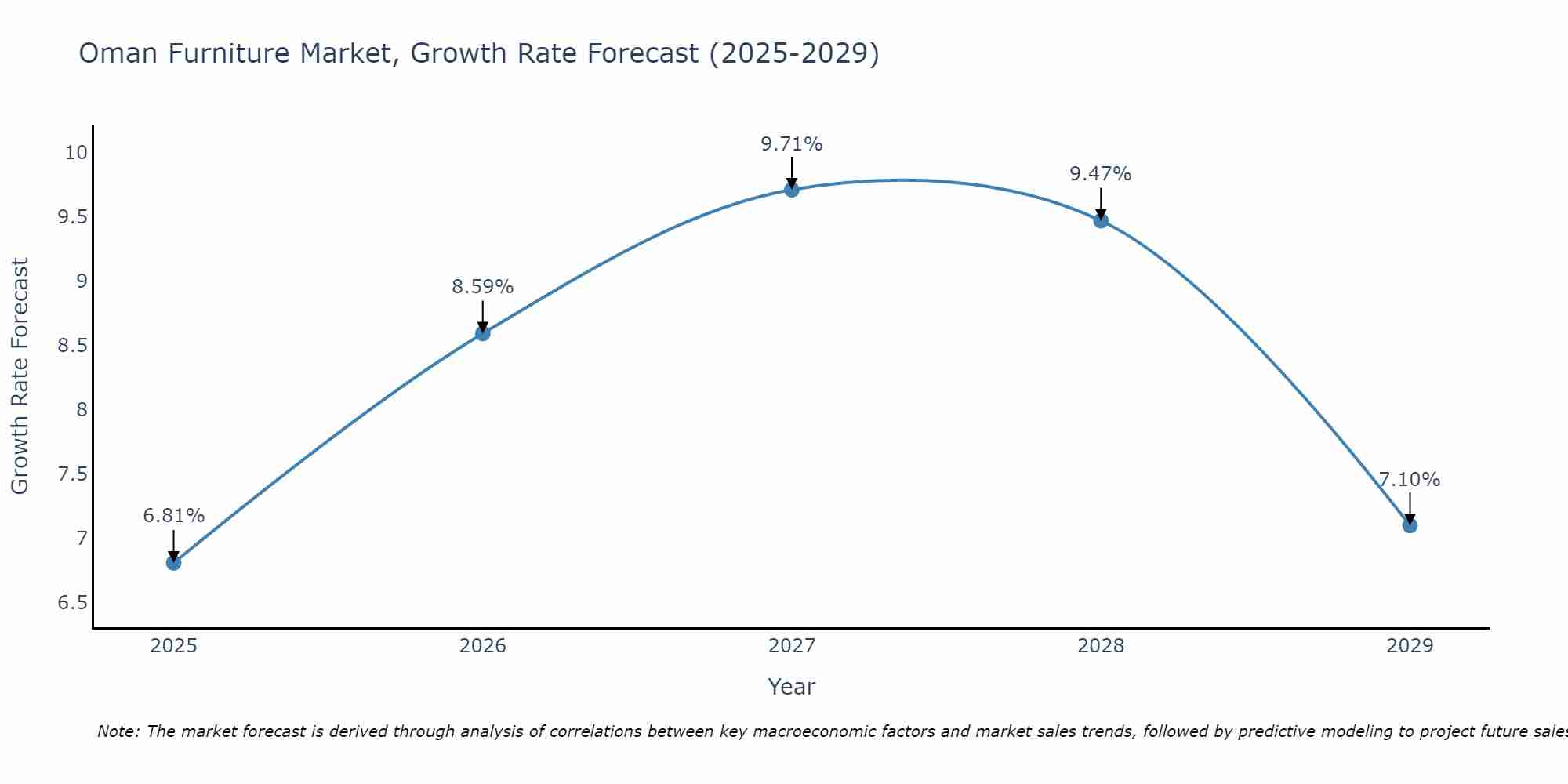
The Oman Furniture Market is projected to witness mixed growth rate patterns during 2025 to 2029. Growth accelerates to 9.71% in 2027, following an initial rate of 6.81%, before easing to 7.10% at the end of the period.
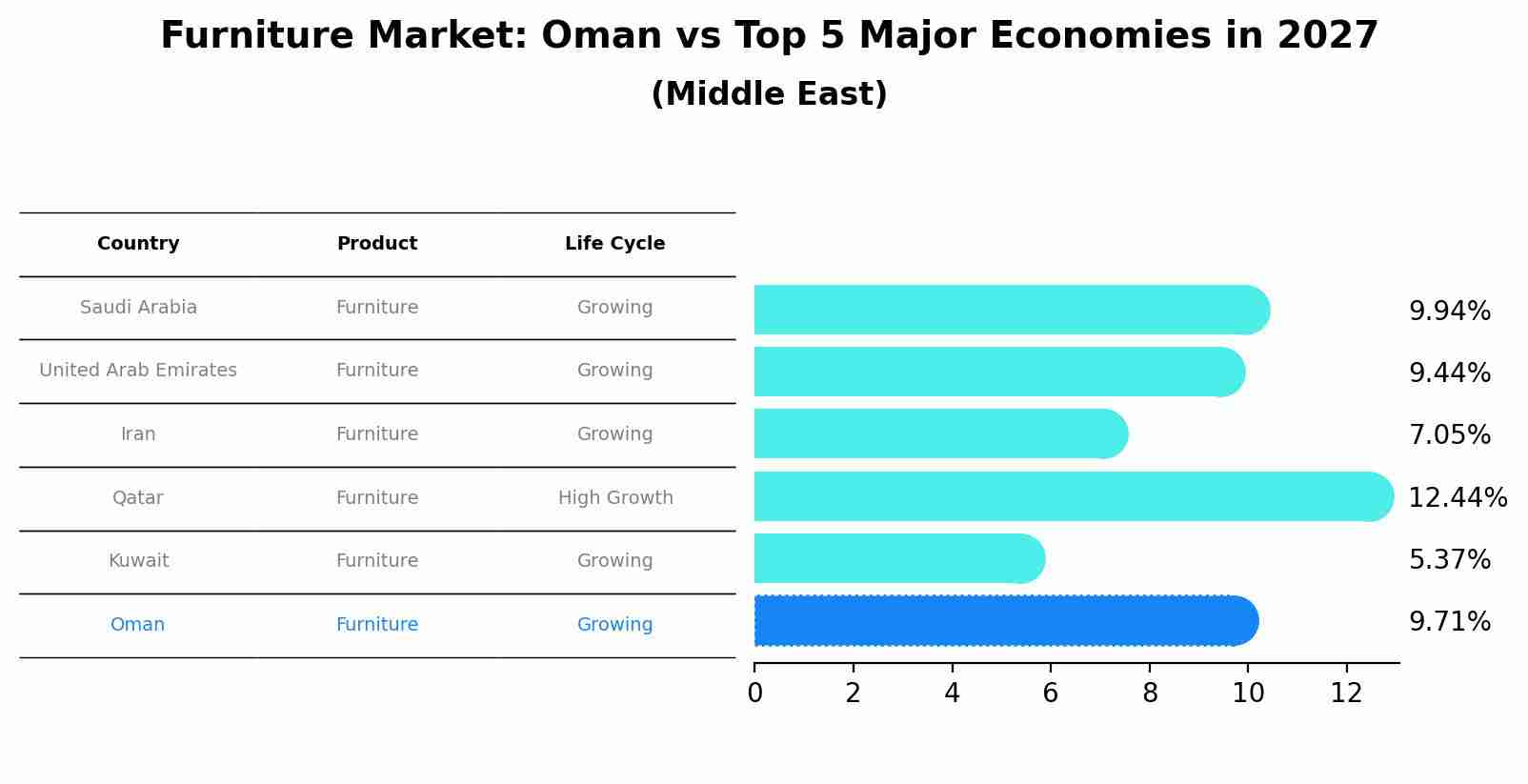
Furniture Market: Oman vs Top 5 Major Economies in 2027 (Middle East)
The Furniture market in Oman is projected to grow at a growing growth rate of 9.71% by 2027, within the Middle East region led by Saudi Arabia, along with other countries like United Arab Emirates, Iran, Qatar and Kuwait, collectively shaping a dynamic and evolving market environment driven by innovation and increasing adoption of emerging technologies.
Oman Furniture Market Synopsis
The report provides an in-depth assessment of the global Ottoman Furniture market including enabling technologies, key trends, market drivers, challenges, standardization, regulatory landscape, deployment models, operator case studies opportunities future roadmap and value chain. The report also presents forecasts for Ottoman Furniture investments from 2020 till 2026.
The Global Oman Furniture Market is expected to grow at a CAGR of 5.8% during the forecast period (2020-2026). Some of the factors driving the growth of oman furniture are increasing demand for comfortable seating solutions with aesthetic appeal; growing preference for multi-functional products such as storage ottomans; rising trend towards minimalistic living due to space constraints; and improved product designs that provide enhanced user experience. Furthermore, technological advancements in upholstery fabrics used in manufacturing furniture have increased their durability and stain resistance properties thereby fuelling growth prospects for the market studied over the forecast period. Additionally luxury homeowners using high end materials like leather or velvet fabric are likely to support revenue generation opportunities within this segment over upcoming years.
Key Highlights of the Report:
- Oman Furniture Market Outlook
- Market Size of Oman Furniture Market, 2019
- Forecast of Oman Furniture Market, 2026
- Historical Data and Forecast of Oman Furniture Revenues & Volume for the Period 2016 - 2026
- Oman Furniture Market Trend Evolution
- Oman Furniture Market Drivers and Challenges
- Oman Furniture Price Trends
- Oman Furniture Porter's Five Forces
- Oman Furniture Industry Life Cycle
- Historical Data and Forecast of Oman Furniture Market Revenues & Volume By Material Types for the Period 2016 - 2026
- Historical Data and Forecast of Oman Furniture Market Revenues & Volume By Plastic for the Period 2016 - 2026
- Historical Data and Forecast of Oman Furniture Market Revenues & Volume By Wood for the Period 2016 - 2026
- Historical Data and Forecast of Oman Furniture Market Revenues & Volume By Metal for the Period 2016 - 2026
- Historical Data and Forecast of Oman Furniture Market Revenues & Volume By Other for the Period 2016 - 2026
- Historical Data and Forecast of Oman Furniture Market Revenues & Volume By Applications for the Period 2016 - 2026
- Historical Data and Forecast of Oman Furniture Market Revenues & Volume By Residential for the Period 2016 - 2026
- Historical Data and Forecast of Oman Furniture Market Revenues & Volume By Commercial for the Period 2016 - 2026
- Oman Furniture Import Export Trade Statistics
- Market Opportunity Assessment By Material Types
- Market Opportunity Assessment By Applications
- Oman Furniture Top Companies Market Share
- Oman Furniture Competitive Benchmarking By Technical and Operational Parameters
- Oman Furniture Company Profiles
- Oman Furniture Key Strategic Recommendations






































