Oman Gas Chromatography Systems Market Size, Share & Growth Rate
The Oman Gas Chromatography Systems Market was estimated at USD 438 Million in 2025 and is projected to reach USD 595 Million by 2032, growing at a CAGR of 4.5% from 2026 to 2032. This growth trajectory is fueled by the rising demand for advanced analytical tools in sectors such as petrochemicals and pharmaceuticals, where precision in chemical analysis is paramount. Additionally, the increasing focus on environmental monitoring and regulatory compliance is further amplifying the need for sophisticated gas chromatography systems.
Oman Gas Chromatography Systems Market Year-wise Growth Rate and Key Drivers
This graph highlights how the Oman Gas Chromatography Systems Market has steadily grown over the years, supported by major growth factors.
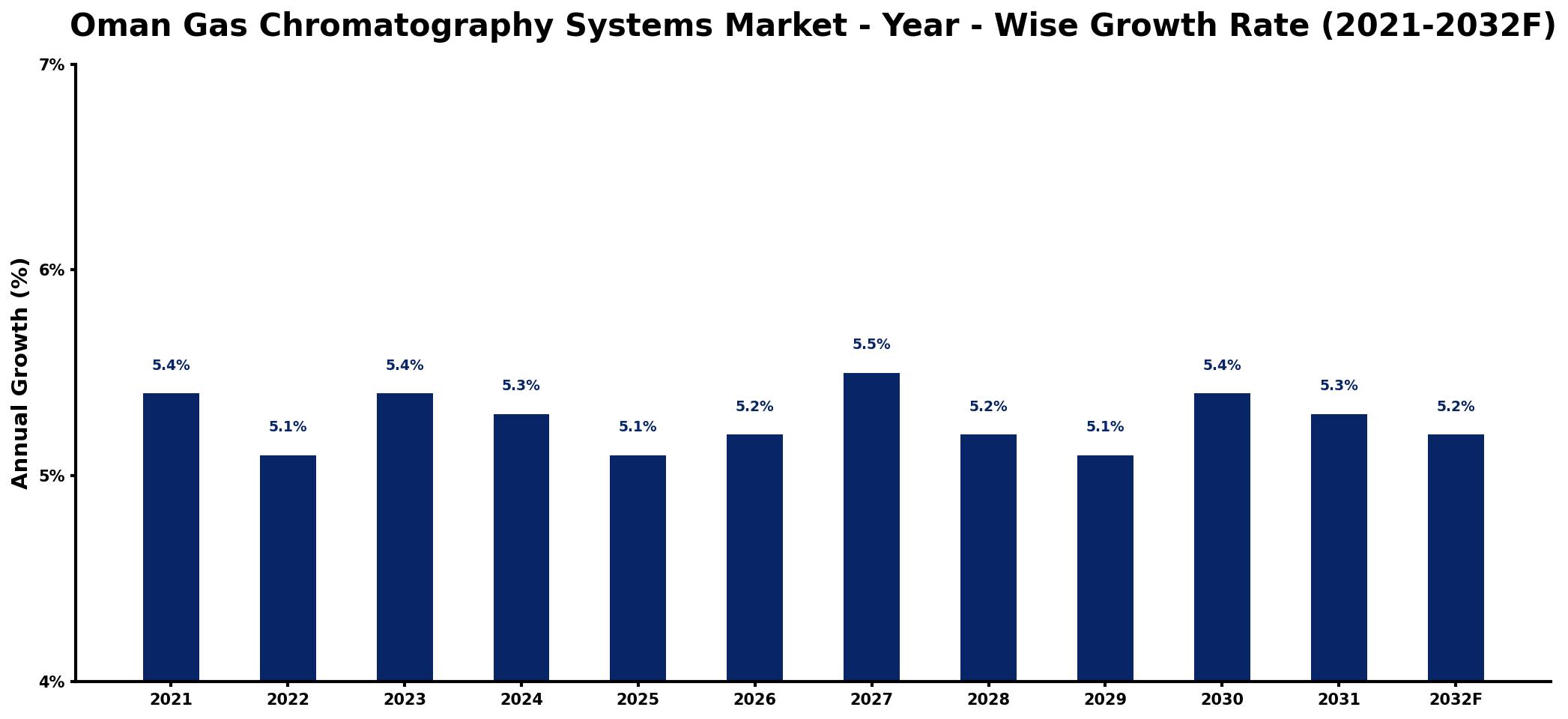
The table below presents the year‑wise growth rates along with the key drivers influencing the market
| Year | Growth Rate | Major Drivers |
| 2021 | 5.4% | Rising demand for environmental testing |
| 2022 | 5.1% | Increased investments in research facilities |
| 2023 | 5.4% | Growing pharmaceutical sector requirements |
| 2024 | 5.3% | Expansion of petrochemical industries |
| 2025 | 5.1% | Higher focus on quality control |
| 2026 | 5.2% | Emerging food safety regulations |
| 2027 | 5.5% | Surge in academic research funding |
| 2028 | 5.2% | Development of new analytical techniques |
| 2029 | 5.1% | Increased adoption in clinical labs |
| 2030 | 5.4% | Boost in industrial safety measures |
| 2031 | 5.3% | Growth in regulatory compliance needs |
| 2032 | 5.2% | Advancements in technology integration |
Note: Market size estimations and growth projections presented in this report are based on 6Wresearch's proprietary forecasting methodology, utilizing the latest available industry data, government publications, and primary research inputs.
Oman Gas Chromatography Systems Market Synopsis
In Oman, the gas chromatography systems market is being driven by the increasing investments in oil and gas exploration and production, which necessitate the use of analytical instruments for quality control and safety monitoring. This trend is complemented by a growing emphasis on environmental regulations that require stringent testing of emissions and chemical discharges.
Moreover, the integration of gas chromatography with emerging technologies, such as artificial intelligence and machine learning, is enhancing data analysis capabilities, making these systems more appealing to various industries. These advancements not only streamline operations but also increase efficiency, further promoting the adoption of gas chromatography systems across the region.
Oman Gas Chromatography Systems Market Key Takeaways
- The Oman Gas Chromatography Systems Market is set for a significant expansion, with a projected market value of USD 595 Million by 2032.
- Advancements in technology are leading to more sensitive detectors and user-friendly systems, widening the market's accessibility.
- Key industries driving growth include petrochemicals, pharmaceuticals, and environmental monitoring.
- Integration of gas chromatography with other analytical techniques is becoming increasingly common for comprehensive analysis.
- Challenges such as high initial investment costs and the scarcity of skilled operators may impact market growth.
Evaluation of Restraints in Oman Gas Chromatography Systems Market
Despite promising growth prospects, the Oman Gas Chromatography Systems Market faces significant constraints that could impede its expansion. A notable challenge is the high upfront investment associated with acquiring advanced gas chromatography systems, which can deter smaller enterprises from adopting this technology. Furthermore, the limited availability of skilled technicians proficient in operating and maintaining such sophisticated equipment poses operational inefficiencies, contributing to potential downtime and decreased productivity for users. This talent gap underscores the need for focused training programs and initiatives to cultivate the necessary expertise within the region.
Oman Gas Chromatography Systems Market Trends
Current trends in the Oman Gas Chromatography Systems Market reveal a marked shift towards the implementation of portable and user-friendly systems, catering to a broader audience. Moreover, the increasing adoption of gas chromatography in food safety testing and pharmaceuticals illustrates a growing recognition of the importance of precise analytical capabilities in ensuring product quality. The market is also embracing automation, which enhances operational efficiency and reliability, while reducing human error in analytical processes.
Oman Gas Chromatography Systems Market Opportunities
Investment opportunities within the Oman Gas Chromatography Systems Market are abundant, particularly as government policies increasingly promote industrial diversification and technological innovation. Companies focusing on research and development to enhance the functionality and accuracy of gas chromatography systems can benefit from rising demand across various sectors. Furthermore, the ongoing expansion of the petrochemical industry presents a fertile ground for investment, with potential returns for stakeholders willing to innovate and adapt to market needs.
Government Initiatives in the Oman Gas Chromatography Systems Market
The Omani government is actively promoting initiatives that enhance the capabilities of the Gas Chromatography Systems Market. Key policies focus on encouraging technological advancements, ensuring adherence to quality standards, and fostering a culture of innovation within the industry. Regulatory bodies, such as the Public Authority for Consumer Protection, oversee compliance measures that safeguard product integrity. Additionally, the emphasis on research and development aligns with Omans Vision 2040, which aims to diversify the economy and strengthen industrial capabilities.
Future Insights of the Oman Gas Chromatography Systems Market
Looking ahead to 2026-2032, the Oman Gas Chromatography Systems Market is poised for steady growth, driven by the increasing reliance on accurate analytical systems across various industries. A heightened focus on compliance with international safety and quality standards will further propel demand. As technology continues to evolve, the market is expected to see enhanced functionalities in gas chromatography systems, solidifying their role as indispensable tools for research, quality control, and environmental monitoring.
Oman Gas Chromatography Systems Market Latest Developments (2025 - 2026)
Recent developments in the Oman Gas Chromatography Systems Market indicate a growing interest in innovative technologies that enhance operational efficiency. Several industry players are exploring collaborations to integrate gas chromatography systems with complementary analytical technologies, aiming to offer comprehensive analytical solutions. There is also an increasing focus on sustainability, with companies investing in green technologies that reduce waste and enhance environmental compliance.
Oman Gas Chromatography Systems Market - Key Attractiveness of the Report
- 10 Years of Market Numbers
- Historical Data Starting from 2022 to 2025
- Base Year: 2025
- Forecast Data until 2032
- Key Performance Indicators Impacting the Market
- Major Upcoming Developments and Projects
Key Highlights of the Report:
- Oman Gas Chromatography Systems Market Outlook
- Market Size of Oman Gas Chromatography Systems Market, 2025
- Forecast of Oman Gas Chromatography Systems Market, 2032
- Historical Data and Forecast of Oman Gas Chromatography Systems Revenues & Volume for the Period 2022-2032F
- Oman Gas Chromatography Systems Market Trend Evolution
- Oman Gas Chromatography Systems Market Drivers and Challenges
- Oman Gas Chromatography Systems Price Trends
- Oman Gas Chromatography Systems Porter's Five Forces
- Oman Gas Chromatography Systems Industry Life Cycle
- Historical Data and Forecast of Oman Gas Chromatography Systems Market Revenues & Volume By Product for the Period 2022-2032F
- Historical Data and Forecast of Oman Gas Chromatography Systems Market Revenues & Volume By Systems for the Period 2022-2032F
- Historical Data and Forecast of Oman Gas Chromatography Systems Market Revenues & Volume By Detectors for the Period 2022-2032F
- Historical Data and Forecast of Oman Gas Chromatography Systems Market Revenues & Volume By Auto-samplers for the Period 2022-2032F
- Historical Data and Forecast of Oman Gas Chromatography Systems Market Revenues & Volume By Fraction Collectors for the Period 2022-2032F
- Historical Data and Forecast of Oman Gas Chromatography Systems Market Revenues & Volume By Other Products for the Period 2022-2032F
- Historical Data and Forecast of Oman Gas Chromatography Systems Market Revenues & Volume By End User for the Period 2022-2032F
- Historical Data and Forecast of Oman Gas Chromatography Systems Market Revenues & Volume By Pharmaceutical and Bioindustries for the Period 2022-2032F
- Historical Data and Forecast of Oman Gas Chromatography Systems Market Revenues & Volume By Academic Research Institutes for the Period 2022-2032F
- Historical Data and Forecast of Oman Gas Chromatography Systems Market Revenues & Volume By Other End Users for the Period 2022-2032F
- Oman Gas Chromatography Systems Import Export Trade Statistics
- Market Opportunity Assessment By Product
- Market Opportunity Assessment By End User
- Oman Gas Chromatography Systems Top Companies Market Share
- Oman Gas Chromatography Systems Competitive Benchmarking By Technical and Operational Parameters
- Oman Gas Chromatography Systems Company Profiles
- Oman Gas Chromatography Systems Key Strategic Recommendations






































