Oman Gas Sensors Market Size, Share & Growth Rate
The Oman Gas Sensors Market was estimated at USD 332 Million in 2025 and is projected to reach USD 474 Million by 2032, growing at a CAGR of 5.2% from 2026 to 2032. This growth trajectory is predominantly influenced by the rapid industrialization in Oman, particularly in sectors like oil and gas, and the increasing implementation of stringent safety regulations. As awareness about environmental pollution intensifies, industries are compelled to adopt advanced gas detection solutions to ensure compliance and protect both personnel and the environment.
Oman Gas Sensors Market Year-wise Growth Rate and Key Drivers
This graph highlights how the Oman Gas Sensors Market has steadily grown over the years, supported by major growth factors.
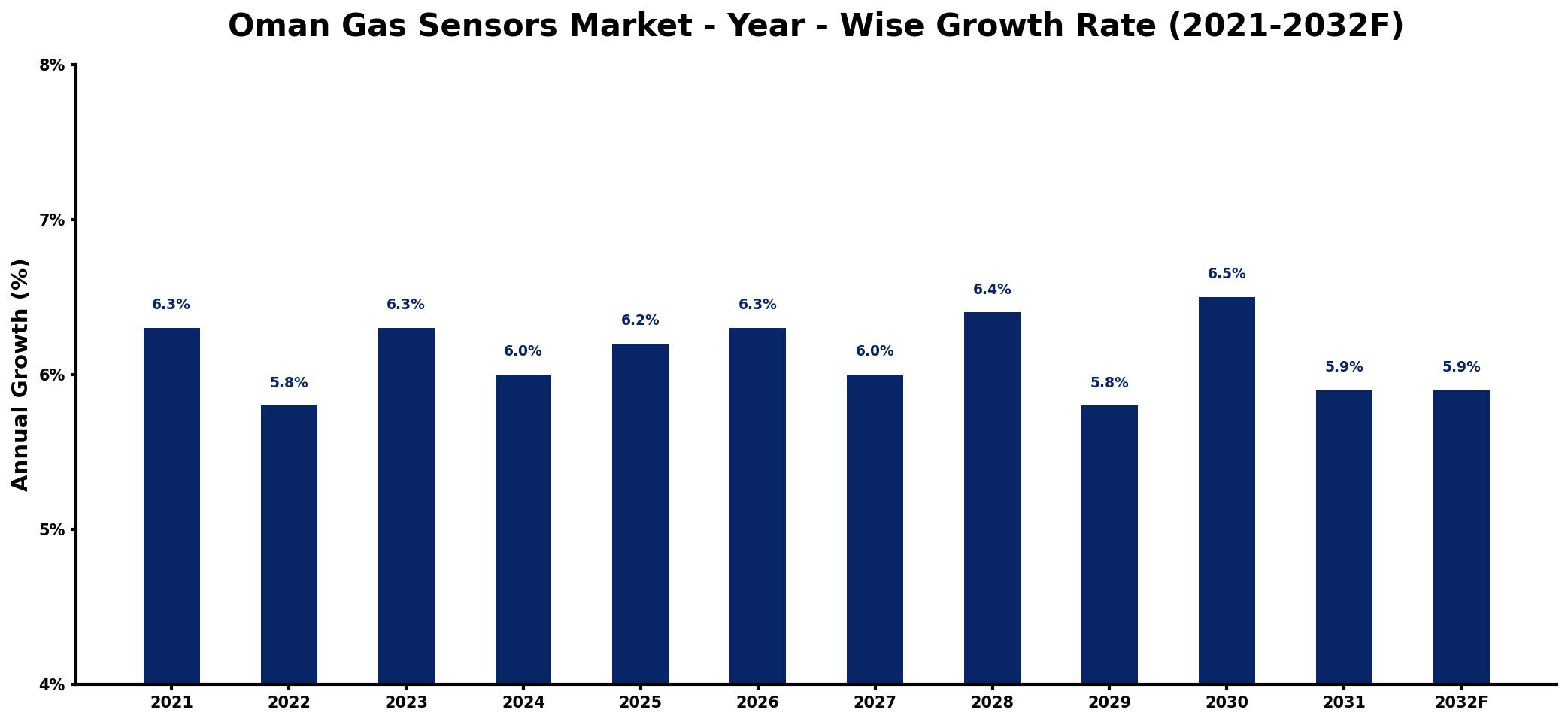
The table below presents the year‑wise growth rates along with the key drivers influencing the market
| Year | Growth Rate | Major Drivers |
| 2021 | 6.3% | Rising industrial safety regulations |
| 2022 | 5.8% | Increased investments in infrastructure |
| 2023 | 6.3% | Growing demand for monitoring solutions |
| 2024 | 6.0% | Expansion of energy sector projects |
| 2025 | 6.2% | Advancements in technology applications |
| 2026 | 6.3% | Focus on environmental sustainability initiatives |
| 2027 | 6.0% | Growing awareness of safety standards |
| 2028 | 6.4% | Increase in urban development projects |
| 2029 | 5.8% | Emergence of new industrial sectors |
| 2030 | 6.5% | Demand for real-time monitoring |
| 2031 | 5.9% | improved raw material availability |
| 2032 | 5.9% | Rise in public safety initiatives |
Note: Market size estimations and growth projections presented in this report are based on 6Wresearch's proprietary forecasting methodology, utilizing the latest available industry data, government publications, and primary research inputs.
Oman Gas Sensors Market Synopsis
The demand for gas sensors in Oman is witnessing a substantial uptick, primarily driven by the growing need for safety measures in high-risk sectors such as oil & gas and petrochemicals. With the implementation of international safety standards and environmental regulations, organizations are increasingly investing in reliable gas detection technologies to monitor emissions effectively.
In parallel, advancements in technology have spurred interest in wireless and IoT-enabled gas sensors, which facilitate real-time data analysis and remote monitoring capabilities. These innovations not only enhance efficiency but also enable industries to respond swiftly to potential hazards, making them essential tools in the workplace safety arsenal.
Oman Gas Sensors Market Key Takeaways
- Robust demand is emerging from sectors such as oil & gas, healthcare, and manufacturing, necessitating enhanced gas detection solutions.
- Technological innovations, including wireless connectivity and IoT integration, are transforming traditional gas sensors into advanced monitoring systems.
- The market is facing challenges related to awareness and initial investment costs, which could hinder growth.
- Government policies and initiatives are actively promoting the adoption of gas sensors, aligning with national safety and environmental goals.
- Future growth opportunities lie in niche applications and tailored sensor solutions for specific industry needs.
Evaluation of Restraints in Oman Gas Sensors Market
Despite the promising growth prospects, the Oman Gas Sensors Market faces notable restraints that may impede its full potential. A significant challenge is the limited awareness among end-users regarding the critical benefits of implementing gas sensors. This knowledge gap often leads to hesitancy in adoption, especially among small and medium-sized enterprises that may perceive the initial costs as prohibitive. Additionally, the presence of low-quality, cost-effective alternatives in the market can undermine the credibility of established manufacturers, complicating their efforts to maintain market share and assure customers of product reliability.
Oman Gas Sensors Market Trends
A notable trend in the Oman Gas Sensors Market is the escalating adoption of wireless gas sensors, which allow for more flexible monitoring solutions. These systems not only enhance operational efficiency but also enable seamless integration with existing data management systems for real-time analysis. Furthermore, there is a rising emphasis on developing sensors with improved sensitivity and accuracy, catering to the specific demands of various industries. The market is also witnessing a shift towards miniaturization, making gas detection technologies more accessible and cost-effective.
Oman Gas Sensors Market Opportunities
The Oman Gas Sensors Market holds substantial investment opportunities as industries increasingly focus on air quality monitoring and compliance with environmental regulations. Companies that innovate in the development of advanced gas sensors with real-time capabilities and tailored solutions for niche markets stand to gain significant advantages. Collaborating with local industries and governmental bodies can also foster long-term partnerships that address unique environmental challenges, propelling growth within the sector.
Government Initiatives in the Oman Gas Sensors Market
The government of Oman is actively pursuing policies that encourage the growth of the gas sensors market, aligned with Oman Vision 2040, which advocates for economic diversification and sustainable development. The Ministry of Environment and Climate Affairs (MECA) has established regulations that mandate stringent air quality monitoring, thereby catalyzing the demand for gas sensors. Incentives for local manufacturers further bolster domestic production efforts, reducing reliance on imports and supporting the local economy.
Future Insights of the Oman Gas Sensors Market
Looking ahead to the period from 2026 to 2032, the Oman Gas Sensors Market is set to experience notable growth, driven by heightened awareness surrounding workplace safety and environmental protection. As industries adapt to increasingly rigorous safety standards, the demand for effective gas detection solutions will surge. Additionally, technological advancements such as enhanced IoT connectivity and data analytics capabilities are expected to transform the landscape, paving the way for more sophisticated monitoring systems that can meet the evolving requirements of various sectors.
Oman Gas Sensors Market Latest Developments (2025 - 2026)
In recent months, the Oman Gas Sensors Market has seen a push towards integrating artificial intelligence and machine learning into gas detection systems. These advancements aim to improve predictive maintenance and provide deeper insights into potential hazards. Companies are also beginning to pilot innovative sensor technologies designed for specific applications, such as indoor air quality monitoring and specialized industrial environments, reflecting an industry-wide commitment to enhancing safety and compliance.
Oman Gas Sensors Market - Key Attractiveness of the Report
- 10 Years of Market Numbers
- Historical Data Starting from 2022 to 2025
- Base Year: 2025
- Forecast Data until 2032
- Key Performance Indicators Impacting the Market
- Major Upcoming Developments and Projects
Key Highlights of the Report:
- Oman Gas Sensors Market Outlook
- Market Size of Oman Gas Sensors Market, 2025
- Forecast of Oman Gas Sensors Market, 2032
- Historical Data and Forecast of Oman Gas Sensors Revenues & Volume for the Period 2022-2032F
- Oman Gas Sensors Market Trend Evolution
- Oman Gas Sensors Market Drivers and Challenges
- Oman Gas Sensors Price Trends
- Oman Gas Sensors Porter's Five Forces
- Oman Gas Sensors Industry Life Cycle
- Historical Data and Forecast of Oman Gas Sensors Market Revenues & Volume By Product for the Period 2022-2032F
- Historical Data and Forecast of Oman Gas Sensors Market Revenues & Volume By Hydrogen for the Period 2022-2032F
- Historical Data and Forecast of Oman Gas Sensors Market Revenues & Volume By Ammonia for the Period 2022-2032F
- Historical Data and Forecast of Oman Gas Sensors Market Revenues & Volume By Hydrogen Sulfide for the Period 2022-2032F
- Historical Data and Forecast of Oman Gas Sensors Market Revenues & Volume By Methyl Mercaptan Sensor for the Period 2022-2032F
- Historical Data and Forecast of Oman Gas Sensors Market Revenues & Volume By NOx Sensor for the Period 2022-2032F
- Historical Data and Forecast of Oman Gas Sensors Market Revenues & Volume By Carbon Monoxide Sensor for the Period 2022-2032F
- Historical Data and Forecast of Oman Gas Sensors Market Revenues & Volume By Carbon Dioxide Sensor for the Period 2022-2032F
- Historical Data and Forecast of Oman Hydrogen Gas Sensors Market Revenues & Volume By Oxygen/Lambda Sensor for the Period 2022-2032F
- Historical Data and Forecast of Oman Gas Sensors Market Revenues & Volume By Technology for the Period 2022-2032F
- Historical Data and Forecast of Oman Gas Sensors Market Revenues & Volume By Infrared for the Period 2022-2032F
- Historical Data and Forecast of Oman Gas Sensors Market Revenues & Volume By Catalytic for the Period 2022-2032F
- Historical Data and Forecast of Oman Gas Sensors Market Revenues & Volume By Photo-Ionization Detector for the Period 2022-2032F
- Historical Data and Forecast of Oman Gas Sensors Market Revenues & Volume By Solid State/MOS for the Period 2022-2032F
- Historical Data and Forecast of Oman Gas Sensors Market Revenues & Volume By Semiconductor for the Period 2022-2032F
- Historical Data and Forecast of Oman Gas Sensors Market Revenues & Volume By Electrochemical for the Period 2022-2032F
- Oman Gas Sensors Import Export Trade Statistics
- Market Opportunity Assessment By Product
- Market Opportunity Assessment By Technology
- Oman Gas Sensors Top Companies Market Share
- Oman Gas Sensors Competitive Benchmarking By Technical and Operational Parameters
- Oman Gas Sensors Company Profiles
- Oman Gas Sensors Key Strategic Recommendations






































