Oman Home Furnishings Market Summary
The oman home furnishings market was estimated at USD 288 Million in 2025 and is projected to reach USD 378 Million by 2032, growing at a CAGR of 4.9% from 2026 to 2032.
Oman Home Furnishings Market Year-wise Growth Rate and Key Drivers
This graph highlights how the Oman Home Furnishings Market has steadily grown over the past five years, supported by major growth factors.
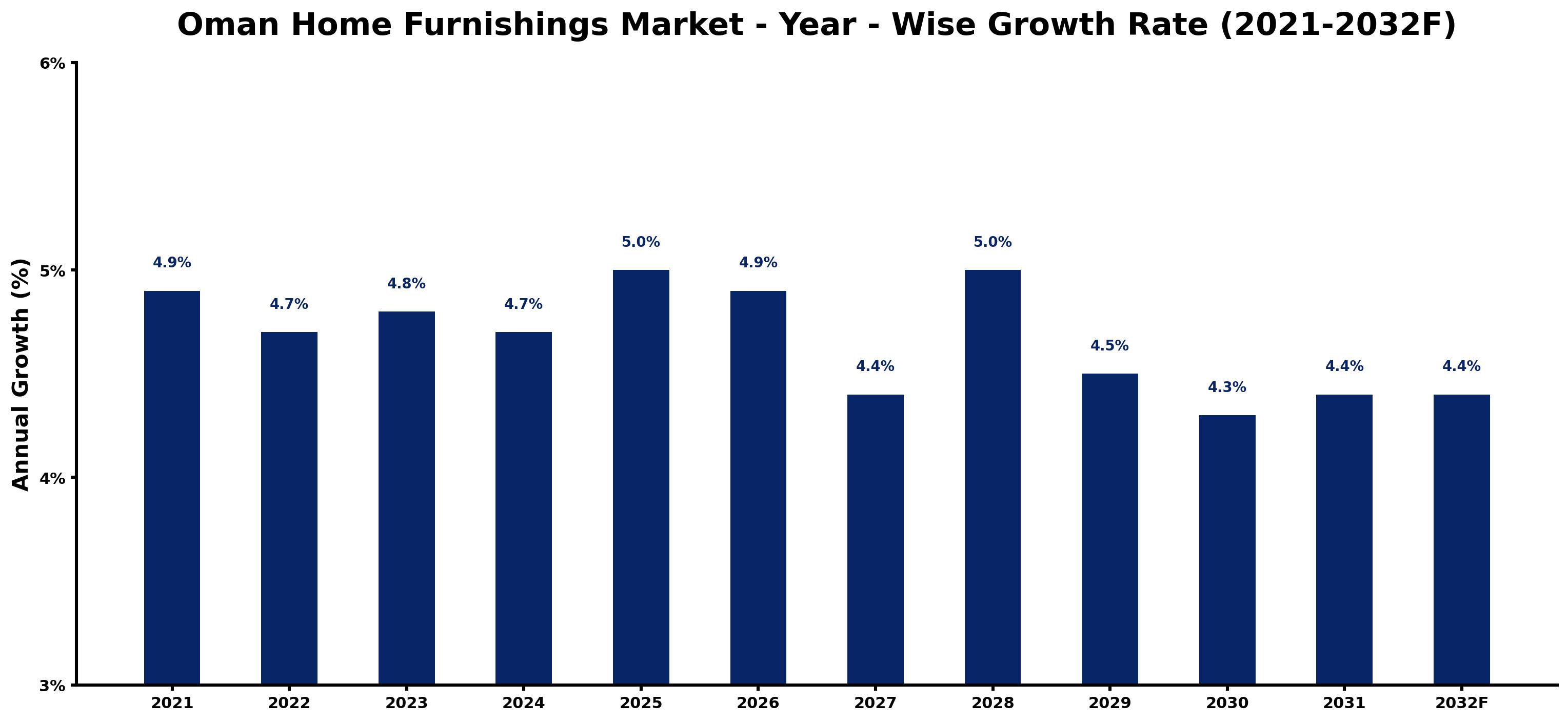
The table below presents the year wise growth rates along with the key drivers influencing the market
| Year | Growth Rate | Major Drivers |
| 2021 | 4.9% | Post-lockdown retail projects boosted consumer interest in home renovation and decor. |
| 2022 | 4.7% | Emerging middle class seeks affordable yet stylish home furnishings options. |
| 2023 | 4.8% | Local artisans gain traction, promoting traditional designs with modern functionality. |
| 2024 | 4.7% | Online shopping platforms expand, enhancing accessibility to diverse home furnishing brands. |
| 2025 | 5.0% | Sustainability trends influence consumers towards eco-friendly furnishings and materials. |
| 2026 | 4.9% | Economic diversification efforts spur investments in the construction sector and interiors. |
| 2027 | 4.4% | Increased expatriate population creates demand for versatile and adaptable living solutions. |
| 2028 | 5.0% | Smart home technology integration reshapes consumer expectations for modern furnishings. |
| 2029 | 4.5% | Cultural events and festivals promote local craftsmanship, enhancing market visibility. |
| 2030 | 4.3% | Urbanization drives up demand for compact, multifunctional furniture in metropolitan areas. |
| 2031 | 4.4% | Collaborations between global brands and local designers enrich product offerings and aesthetics. |
| 2032 | 4.4% | Shifts in consumer behavior favor experiential retail, blending shopping with lifestyle engagement. |
Note - Market size estimations and growth projections presented in this report are based on 6Wresearch's advanced forecasting approach, validated with industry datasets as of June 2026.
Oman Home Furnishings Market Synopsis
The Oman Home Furnishings Market is projected to reach 4.9% and witness significant growth during the forecast period (2026-2032). The growth trajectory of this market is attributed to several factors, including the rise in urbanization, increasing disposable incomes, and an evolving preference among consumers for modern and stylish home decor. Various product categories, such as furniture, textiles, lighting, and decorative accessories, are available to meet the diverse preferences of consumers. A noted trend in this market is the emphasis on sustainability, innovation, and the expansion of e-commerce platforms as brands strive to maintain a competitive advantage in a dynamic landscape.
Oman Home Furnishings Market Growth Drivers
Several driving forces are contributing to the expansion of the Oman Home Furnishings Market. Urbanization continues to play a pivotal role, with an increasing number of residents moving to urban centers, thereby enhancing the demand for home furnishings to accommodate modern living environments. Rising disposable incomes among the Omani population are enabling consumers to invest in quality furnishings that reflect their personal style. Additionally, the trend towards contemporary and aesthetically pleasing designs is steering consumer preferences towards sleek, functional, and stylish options.
Further, businesses are responding to the emphasis on customization and personalization by offering tailored products that resonate with individual consumer identities. The growing awareness of environmental issues is also changing purchasing decisions, driving consumers to seek out eco-friendly and sustainable home furnishing options. E-commerce platforms are gaining traction, allowing consumers to access a wider array of products conveniently, thereby further fueling market growth.
Oman Home Furnishings Market Trends and Opportunities
The Oman Home Furnishings Market is currently experiencing notable trends that open various opportunities for growth. There is a marked shift towards sustainable practices, with consumers favoring products made from natural materials like wood and bamboo. This trend towards eco-friendliness is coupled with an increasing demand for minimalist designs that reflect Scandinavian aesthetics, characterized by functionality and clean lines. The proliferation of e-commerce is also reshaping purchasing behaviors, with online shopping becoming a preferred method for many consumers seeking convenience and variety.
Customization options are gaining importance, allowing consumers to express their unique tastes effectively. As a result, there is an opportunity for businesses to innovate in product offerings, creating distinct pieces that appeal to the design-savvy market. The ongoing demand for luxury and modern furniture is also a promising avenue for investment, as home improvement and renovation projects are on the rise, driven by new urban developments.
Oman Home Furnishings Market Challenges and Restraints
Despite its potential, the Oman Home Furnishings Market faces several challenges that could impede growth. One significant challenge is the intense competition from both local and international players, which necessitates continuous innovation and differentiation among businesses. Economic fluctuations can lead to uncertainties in consumer purchasing power and preferences, impacting overall sales. Moreover, the market experiences difficulties related to a limited pool of skilled labor in manufacturing and design, which can restrict the ability to produce high-quality products.
Logistical issues pose another challenge, often resulting in supply chain disruptions that affect timely product availability. Businesses must navigate regulations on product quality and safety compliance, which can prove to be a hurdle for new entrants. To thrive, companies operating in the Oman Home Furnishings Market must remain agile, responsive to consumer demands, and adaptive to evolving market conditions.
Oman Home Furnishings Market Investment Opportunities
Investment opportunities within the Oman Home Furnishings Market are ripe for exploration, driven by both a growing population and an increase in disposable income. The demand for modern and stylish furniture is elevating opportunities for businesses to provide high-quality and functional home decor solutions. As sustainability becomes increasingly critical, companies focusing on eco-friendly furnishings can tap into a market eager for environmentally conscious products.
Furthermore, the trend towards urbanization and home renovation projects fosters a conducive environment for investment in innovative furnishings. E-commerce platforms present a compelling opportunity for capitalizing on the digital shopping revolution, allowing businesses to expand their market reach and accessibility. Overall, the potential for unique and differentiated product offerings aligns well with the evolving preferences of consumers in Oman.
Oman Home Furnishings Market Government Investment and Initiatives
Government policies play a crucial role in shaping the landscape of the Oman Home Furnishings Market. The Omani government is actively promoting local craftsmanship and sustainable practices, encouraging the use of traditional designs and materials to support local artisans while preserving cultural heritage. Regulations are enforced to ensure that products adhere to quality and safety standards, which enhances consumer trust in the market.
Furthermore, initiatives promoting sustainability are in place, incentivizing the use of eco-friendly materials and practices within the industry. Consumer protection regulations aim to create a fair marketplace, preventing unfair pricing practices and fostering healthy competition. By cultivating an environment that supports local talent and advocates for sustainability, government investment is positioned to bolster the growth of the Oman Home Furnishings Market.
Oman Home Furnishings Market Latest Developments (May 2025 - June 2026)
Recent developments in the Oman Home Furnishings Market indicate a pronounced shift towards accommodating consumer preferences for sustainable and unique home decor. Companies have increasingly focused on enhancing their online presence and optimizing e-commerce strategies to better serve the growing number of digital shoppers. This trend is coupled with heightened consumer interest in products that align with environmental and sustainability criteria, prompting businesses to innovate in their offerings.
Moreover, ongoing efforts to improve supply chain efficiency are apparent, as companies adapt to market demands and logistical challenges. There is a marked emphasis on integrating advanced technologies in manufacturing processes, which not only improves production capabilities but also aligns with the demand for high-quality, customized furnishings. The evolving landscape during this period highlights a proactive approach among businesses to stay competitive and address the shifting dynamics of consumer expectations in the Oman Home Furnishings Market.
Oman Home Furnishings Market - Key Attractiveness of the Report
- 10 Years of Market Numbers
- Historical Data Starting from 2022 to 2025
- Base Year: 2025
- Forecast Data until 2032
- Key Performance Indicators Impacting the Market
- Major Upcoming Developments and Projects
Key Highlights of the Report:
- Oman Home Furnishings Market Outlook
- Market Size of Oman Home Furnishings Market, 2025
- Forecast of Oman Home Furnishings Market, 2032F
- Historical Data and Forecast of Oman Home Furnishings Revenues & Volume for the Period 2022-2032F
- Oman Home Furnishings Market Trend Evolution
- Oman Home Furnishings Market Drivers and Challenges
- Oman Home Furnishings Price Trends
- Oman Home Furnishings Porter's Five Forces
- Oman Home Furnishings Industry Life Cycle
- Historical Data and Forecast of Oman Home Furnishings Market Revenues & Volume By Product Type for the Period 2022-2032F
- Historical Data and Forecast of Oman Home Furnishings Market Revenues & Volume By Home furniture market for the Period 2022-2032F
- Historical Data and Forecast of Oman Home Furnishings Market Revenues & Volume By Home textiles market for the Period 2022-2032F
- Historical Data and Forecast of Oman Home Furnishings Market Revenues & Volume By Floor coverings market for the Period 2022-2032F
- Historical Data and Forecast of Oman Home Furnishings Market Revenues & Volume By Distribution Channel for the Period 2022-2032F
- Historical Data and Forecast of Oman Home Furnishings Market Revenues & Volume By Offline Retail for the Period 2022-2032F
- Historical Data and Forecast of Oman Home Furnishings Market Revenues & Volume By Online Retail for the Period 2022-2032F
- Oman Home Furnishings Import Export Trade Statistics
- Market Opportunity Assessment By Product Type
- Market Opportunity Assessment By Distribution Channel
- Oman Home Furnishings Top Companies Market Share
- Oman Home Furnishings Competitive Benchmarking By Technical and Operational Parameters
- Oman Home Furnishings Company Profiles
- Oman Home Furnishings Key Strategic Recommendations






































