Oman Industrial Gases Market Summary
The oman industrial gases market was estimated at USD 131 Million in 2025 and is projected to reach USD 143 Million by 2032, growing at a CAGR of 1.0% from 2026 to 2032.
Oman Industrial Gases Market Year-wise Growth Rate and Key Drivers
This graph highlights how the Oman Industrial Gases Market has steadily grown over the past five years, supported by major growth factors.
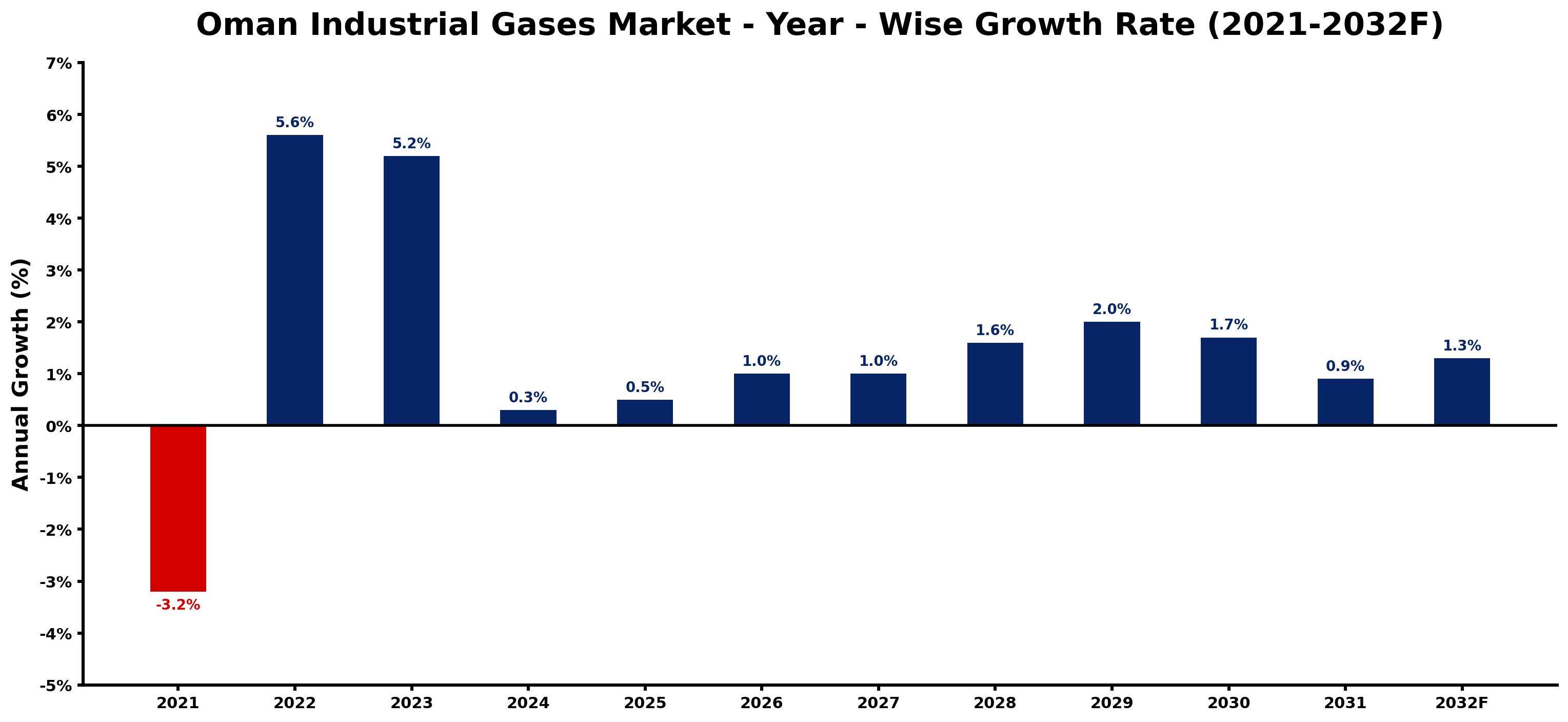
The table below presents the year wise growth rates along with the key drivers influencing the market
| Year | Growth Rate | Major Drivers |
| 2021 | -3.2% | Global supply chain disruptions hindered delivery timelines, causing production setbacks and decreasing market activity. |
| 2022 | 5.6% | Local manufacturing initiatives boosted the need for efficient industrial gas supply chains. |
| 2023 | 5.2% | Infrastructure development projects catalyzed a significant rise in gas consumption across industries. |
| 2024 | 0.3% | Technological innovations in gas production enhanced operational efficiency and reduced costs. |
| 2025 | 0.5% | Growing construction pipelines in Oman lifted requirements for industrial gases significantly. |
| 2026 | 1.0% | The push towards localized supply chains improved reliability and reduced delivery times. |
| 2027 | 1.0% | Emerging opportunities in renewable energy sectors created demand for specialized gas applications. |
| 2028 | 1.6% | Digital transformation within industries led to increased automation and gas usage. |
| 2029 | 2.0% | Sustainability goals prompted industries to seek cleaner gas alternatives and solutions. |
| 2030 | 1.7% | Collaborative ventures with regional players expanded market accessibility and client base. |
| 2031 | 0.9% | Shifts in global supply chains influenced local gas procurement strategies and preferences. |
| 2032 | 1.3% | Diverse applications in healthcare and electronics sectors expanded the gas market further. |
Note - Market size estimations and growth projections presented in this report are based on 6Wresearch's advanced forecasting approach, validated with industry datasets as of June 2026.
Oman Industrial Gases Market Synopsis
The Oman Industrial Gases Market is projected to reach 1.0% and witness significant growth during the forecast period (2026-2032). This growth is largely attributed to the increasing demand for industrial gases across multiple sectors, particularly in healthcare, manufacturing, and oil gas. Key drivers include ongoing infrastructure development, a burgeoning population, and escalating investments in industrial activities. As the market evolves, there is a notable shift towards sustainable and eco-friendly solutions aimed at reducing carbon emissions and enhancing energy efficiency.
Oman Industrial Gases Market Growth Drivers
The growth trajectory of the Oman Industrial Gases Market is influenced by several critical factors:
- The increasing demand from the healthcare sector for medical gases, which is driven by advancements in healthcare infrastructure and the rising prevalence of chronic diseases.
- The manufacturing sector's need for industrial gases such as oxygen and nitrogen, essential for various processes including welding, cutting, and enhancing process efficiencies.
- Investments in oil and gas exploration and production, which significantly contribute to the demand for specialty gases used in extraction and processing operations.
- A growing focus on sustainability, prompting industries to adopt cleaner alternatives and reduce their carbon footprint, which spurs the demand for green gases.
- Technological advancements in gas production and distribution, enabling more efficient operational practices and improved product offerings across the market.
Oman Industrial Gases Market Trends and Opportunities
The Oman Industrial Gases Market is poised for continued growth, characterized by specific trends and opportunities:
- The rising adoption of specialty gases tailored for specific applications, driven by innovation and heightened quality standards across industries.
- An increasing emphasis on operational efficiency and emission reductions, prompting industries to implement comprehensive gas solutions and technologies.
- Expansion of distribution networks to meet growing demand from remote areas, enhancing accessibility and reliability for end-users.
- Investment in R&D for developing new applications for industrial gases, particularly in emerging sectors such as electronics and renewable energy.
- Opportunities to innovate in recycling and recovery of gases, aligning with global sustainability goals and circular economy principles.
Oman Industrial Gases Market Challenges and Restraints
Despite the promising growth outlook, the Oman Industrial Gases Market faces several challenges:
- Intense competition from both local and international players, which can exert pressure on pricing strategies and market share.
- Fluctuating raw material prices that can affect profit margins and operational stability for companies within the sector.
- Regulatory hurdles related to compliance with safety and environmental regulations, which may increase operational costs for market participants.
- The small market size compared to other regions can limit economies of scale and restrict growth opportunities for industrial gas providers.
- A heavy reliance on the oil and gas sector makes the market vulnerable to shifts in global oil prices and overall economic conditions.
Oman Industrial Gases Market Investment Opportunities
There are several notable investment opportunities within the Oman Industrial Gases Market, driven by the country's focus on industrial expansion:
- Investment in the production of essential gases such as oxygen, nitrogen, and argon, which are pivotal for various industries including manufacturing and electronics.
- Upgrading existing production facilities with advanced technologies to enhance efficiency and reduce operational costs.
- Establishing reliable and efficient distribution networks to ensure timely delivery of gases to meet escalating demand.
- Exploring new applications for gases through R&D initiatives, thereby tapping into emerging market segments.
- Engaging in public-private partnerships to leverage government support for infrastructure and technology advancements in the gas sector.
Oman Industrial Gases Market Government Investment and Initiatives
The regulatory framework governing the Oman Industrial Gases Market is shaped by various government policies aimed at fostering industry growth:
- The Ministry of Oil and Gas oversees regulations ensuring safety, compliance, and environmental standards within the industrial gases sector.
- Licensing requirements for companies in this market ensure adherence to strict guidelines governing production, storage, and transportation.
- Government initiatives focus on attracting investment in the industrial gases sector through incentives for innovation and development.
- Support for research and development activities is encouraged, aiming to promote sustainability and competitiveness.
- These policies collectively aim to create a conducive environment for growth and innovation in the Oman Industrial Gases Market.
Oman Industrial Gases Market Latest Developments (May 2025 - June 2026)
Recent developments in the Oman Industrial Gases Market indicate a dynamic shift towards innovation and sustainability. Companies are increasingly focusing on enhancing production technologies and distribution capabilities to better serve burgeoning market demands. Initiatives aimed at fostering collaborations between private and public entities have been seen, aimed at bolstering infrastructure and research capabilities. Key industry stakeholders are also emphasizing the importance of eco-friendly gases, aligning with global sustainability goals while addressing local market needs.
Oman Industrial Gases Market - Key Attractiveness of the Report
- 10 Years of Market Numbers
- Historical Data Starting from 2022 to 2025
- Base Year: 2025
- Forecast Data until 2032
- Key Performance Indicators Impacting the Market
- Major Upcoming Developments and Projects
Growth is primarily driven by increasing demand from key sectors such as healthcare, manufacturing, and oil & gas, alongside government initiatives supporting industrial expansion.
Key Highlights of the Report:
- Oman Industrial Gases Market Outlook
- Market Size of Oman Industrial Gases Market, 2025
- Forecast of Oman Industrial Gases Market, 2032F
- Historical Data and Forecast of Oman Industrial Gases Revenues & Volume for the Period 2022-2032F
- Oman Industrial Gases Market Trend Evolution
- Oman Industrial Gases Market Drivers and Challenges
- Oman Industrial Gases Price Trends
- Oman Industrial Gases Porter's Five Forces
- Oman Industrial Gases Industry Life Cycle
- Historical Data and Forecast of Oman Industrial Gases Market Revenues & Volume By Product Type for the Period 2022-2032F
- Historical Data and Forecast of Oman Industrial Gases Market Revenues & Volume By Oxygen for the Period 2022-2032F
- Historical Data and Forecast of Oman Industrial Gases Market Revenues & Volume By Nitrogen for the Period 2022-2032F
- Historical Data and Forecast of Oman Industrial Gases Market Revenues & Volume By Hydrogen for the Period 2022-2032F
- Historical Data and Forecast of Oman Industrial Gases Market Revenues & Volume By Carbon Dioxide for the Period 2022-2032F
- Historical Data and Forecast of Oman Industrial Gases Market Revenues & Volume By Acetylene for the Period 2022-2032F
- Historical Data and Forecast of Oman Industrial Gases Market Revenues & Volume By Argon for the Period 2022-2032F
- Historical Data and Forecast of Oman Industrial Gases Market Revenues & Volume By Others for the Period 2022-2032F
- Historical Data and Forecast of Oman Industrial Gases Market Revenues & Volume By Application for the Period 2022-2032F
- Historical Data and Forecast of Oman Industrial Gases Market Revenues & Volume By Healthcare for the Period 2022-2032F
- Historical Data and Forecast of Oman Industrial Gases Market Revenues & Volume By Manufacturing for the Period 2022-2032F
- Historical Data and Forecast of Oman Industrial Gases Market Revenues & Volume By Metallurgy & Glasses for the Period 2022-2032F
- Historical Data and Forecast of Oman Industrial Gases Market Revenues & Volume By Food & Beverage for the Period 2022-2032F
- Historical Data and Forecast of Oman Industrial Gases Market Revenues & Volume By Retail for the Period 2022-2032F
- Historical Data and Forecast of Oman Industrial Gases Market Revenues & Volume By Chemicals & Energy for the Period 2022-2032F
- Historical Data and Forecast of Oman Industrial Gases Market Revenues & Volume By Others for the Period 2022-2032F
- Historical Data and Forecast of Oman Industrial Gases Market Revenues & Volume By Distribution for the Period 2022-2032F
- Historical Data and Forecast of Oman Industrial Gases Market Revenues & Volume By On-site for the Period 2022-2032F
- Historical Data and Forecast of Oman Industrial Gases Market Revenues & Volume By Bulk (Liquid Gas Transport) for the Period 2022-2032F
- Historical Data and Forecast of Oman Industrial Gases Market Revenues & Volume By Cylinder (Merchant) for the Period 2022-2032F
- Oman Industrial Gases Import Export Trade Statistics
- Market Opportunity Assessment By Product Type
- Market Opportunity Assessment By Application
- Market Opportunity Assessment By Distribution
- Oman Industrial Gases Top Companies Market Share
- Oman Industrial Gases Competitive Benchmarking By Technical and Operational Parameters
- Oman Industrial Gases Company Profiles
- Oman Industrial Gases Key Strategic Recommendations






































