Oman Leather Market Summary
The oman leather market was estimated at USD 396 Million in 2025 and is projected to reach USD 527 Million by 2032, growing at a CAGR of 4.9% from 2026 to 2032.
Oman Leather Market Year-wise Growth Rate and Key Drivers
This graph highlights how the Oman Leather Market has steadily grown over the past five years, supported by major growth factors.
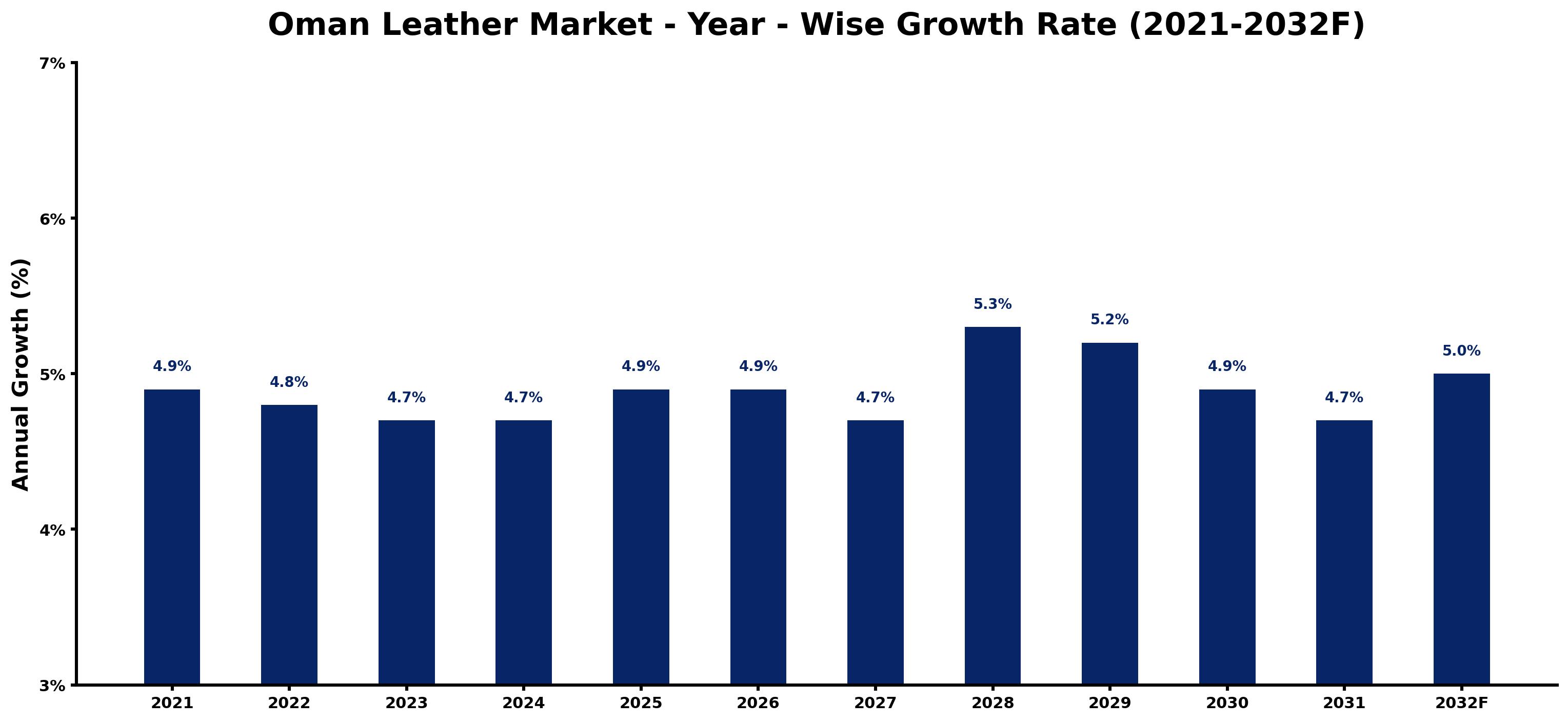
The table below presents the year wise growth rates along with the key drivers influencing the market
| Year | Growth Rate | Major Drivers |
| 2021 | 4.9% | Increased consumer interest in sustainable and ethically sourced leather products emerges. |
| 2022 | 4.8% | Online retail channels witness significant growth, reshaping traditional shopping habits. |
| 2023 | 4.7% | Luxury brands introduce innovative leather collections, attracting affluent customers in Oman. |
| 2024 | 4.7% | Local artisans gain recognition, elevating traditional craftsmanship within the leather sector. |
| 2025 | 4.9% | Expansion of tourism initiatives boosts demand for high-quality leather souvenirs. |
| 2026 | 4.9% | International trade agreements facilitate easier access to diverse leather materials. |
| 2027 | 4.7% | Emerging fashion trends prioritize leather as a core material for contemporary styles. |
| 2028 | 5.3% | Eco-friendly tanning techniques gain traction, appealing to environmentally conscious consumers. |
| 2029 | 5.2% | Increased disposable income enhances consumer spending on luxury leather goods. |
| 2030 | 4.9% | Collaborations between local brands and international designers create unique leather offerings. |
| 2031 | 4.7% | Investment in local manufacturing capabilities strengthens the resilience of the leather supply chain. |
| 2032 | 5.0% | Climate adaptation strategies encourage more sustainable practices across the leather industry. |
Note - Market size estimations and growth projections presented in this report are based on 6Wresearch's advanced forecasting approach, validated with industry datasets as of June 2026.
Oman Leather Market Synopsis
The Oman Leather Market is projected to reach 4.9% and witness significant growth during the forecast period (2026-2032). This growth is primarily driven by increasing consumer demand for luxury furniture in residential and commercial spaces. Additionally, the rise in consumer spending on interior decoration and home décor is set to enhance the demand for leather products. The market is also anticipated to benefit from technological advancements in manufacturing processes, which will create further growth opportunities throughout the forecast period.
Oman Leather Market Growth Drivers
One of the key growth drivers for the Oman Leather Market is the expanding demand for luxury furniture. Homeowners and businesses alike are increasingly investing in high-quality furnishings, which often incorporate premium leather materials. This trend is further supported by a shift towards more luxurious living environments, indicating a higher acceptance of spending on quality home accessories.
Another significant factor driving market growth is the rise in consumer awareness regarding interior design and décor trends. As individuals become more conscious of aesthetic appeal, the demand for bespoke leather goods, such as custom-designed ottoman leather products, is expected to increase. This trend correlates with a broader cultural shift towards personalization in home design.
Technological advancements in the leather manufacturing industry are also anticipated to spur growth. Innovations in production techniques not only enhance the quality of leather goods but also improve efficiency and reduce waste. These advancements can provide manufacturers with a competitive edge, which is likely to attract investments and encourage market expansion.
Lastly, the increased availability of leather products through online platforms is making them more accessible to a broader audience. The growing trend of e-commerce in Oman allows consumers to explore a more extensive variety of leather goods, thus driving sales and contributing to overall market growth.
In summary, the combination of rising demand for luxury furniture, increased consumer investment in home décor, technological advancements in manufacturing, and the expansion of e-commerce platforms are pivotal in shaping the growth trajectory of the Oman Leather Market.
Oman Leather Market Trends and Opportunities
The Oman Leather Market is poised to embrace several emerging trends that present valuable opportunities for stakeholders. One prominent trend is the increasing inclination towards sustainable and ethically sourced leather. Consumers are becoming more environmentally conscious, prompting manufacturers to adopt sustainable practices in their production processes.
Another trend gaining traction is the customization of leather products. As more consumers seek unique and personal items, the ability to customize leather goods to suit individual preferences will become increasingly appealing. This focus on customization can create a niche market for small and medium-sized enterprises.
There is also a growing trend towards multifunctional furniture solutions that incorporate leather design elements. With the trend of urban living and smaller living spaces, furniture that serves multiple purposes is gaining popularity. Leather products will likely be at the forefront of this trend, combining aesthetics with practicality.
Moreover, the global rise in tourism and expatriate population in Oman can also boost the market. Visitors often seek local products, including quality leather goods, thereby enhancing market visibility and sales potential.
In conclusion, the trends of sustainability, customization, multifunctional furniture, and increasing tourism are shaping the opportunities within the Oman Leather Market, creating a favorable environment for innovative products and strategic business initiatives.
Oman Leather Market Government Investment and Initiatives
The Omani government has been proactive in fostering the development of the leather industry as part of its broader economic diversification plan. Policies aimed at enhancing local manufacturing capabilities and attracting foreign investment are central to these initiatives. The government has launched various programs to promote small and medium-sized enterprises (SMEs) in the leather sector, providing financial support and technical assistance to encourage innovation.
Additionally, initiatives to improve infrastructure and logistics in Oman are paving the way for more efficient supply chains in the leather market. Investments in transportation networks and industrial zones are expected to facilitate easier access to key markets, thus enhancing export potential.
Trade agreements and partnerships with other nations are also pivotal in expanding the market's horizons. The government is actively pursuing bilateral agreements that will benefit the leather sector, potentially leading to reduced tariffs and increased access to international markets.
Public spending on vocational training programs is another critical area of focus. By developing a skilled workforce, the government aims to elevate the standards of craftsmanship in the leather industry, ensuring that Omani leather products are competitive in both local and global markets.
In summary, government initiatives focused on investment, infrastructure improvement, trade agreements, and workforce development are instrumental in shaping a vibrant future for the Oman Leather Market.
Oman Leather Market Latest Developments (May 2025 - June 2026)
Recent developments in the Oman Leather Market reflect a growing confidence in the sector's future. Over the past year, there has been a notable increase in the adoption of advanced manufacturing technologies, particularly digital tools that enhance design and production efficiency. These developments are expected to position Omani manufacturers favorably in the regional and global leather markets.
Furthermore, there has been an uptick in collaborations between local businesses and international firms. These partnerships are fostering knowledge exchange and innovation, helping to raise the standards of products being offered in the Oman Leather Market.
Consumer trends continue to shift towards online shopping, and the leather sector has embraced this by expanding its digital presence. More companies are leveraging e-commerce platforms to reach a broader audience, emphasizing the need for robust online marketing strategies.
Additionally, sustainability initiatives are becoming more prominent, with companies taking steps to implement eco-friendly practices in their manufacturing processes. This focus on sustainability is expected to resonate well with an increasingly environmentally conscious consumer base.
Overall, the latest developments in the Oman Leather Market highlight a transition towards modernization, collaboration, consumer engagement, and sustainability, setting the stage for significant advancements in the coming years.
Oman Leather Market - Key Attractiveness of the Report
- 10 Years of Market Numbers
- Historical Data Starting from 2022 to 2025
- Base Year: 2025
- Forecast Data until 2032
- Key Performance Indicators Impacting the Market
- Major Upcoming Developments and Projects
Key Highlights of the Report:
- Oman Leather Market Outlook
- Market Size of Oman Leather Market, 2025
- Forecast of Oman Leather Market, 2032F
- Historical Data and Forecast of Oman Leather Revenues & Volume for the Period 2022-2032F
- Oman Leather Market Trend Evolution
- Oman Leather Market Drivers and Challenges
- Oman Leather Price Trends
- Oman Leather Porter's Five Forces
- Oman Leather Industry Life Cycle
- Historical Data and Forecast of Oman Leather Market Revenues & Volume By Type for the Period 2022-2032F
- Historical Data and Forecast of Oman Leather Market Revenues & Volume By Luggage for the Period 2022-2032F
- Historical Data and Forecast of Oman Leather Market Revenues & Volume By Footwear for the Period 2022-2032F
- Historical Data and Forecast of Oman Leather Market Revenues & Volume By Accessories for the Period 2022-2032F
- Historical Data and Forecast of Oman Leather Market Revenues & Volume By Distribution Channel for the Period 2022-2032F
- Historical Data and Forecast of Oman Leather Market Revenues & Volume By Online for the Period 2022-2032F
- Historical Data and Forecast of Oman Leather Market Revenues & Volume By Offline for the Period 2022-2032F
- Oman Leather Import Export Trade Statistics
- Market Opportunity Assessment By Type
- Market Opportunity Assessment By Distribution Channel
- Oman Leather Top Companies Market Share
- Oman Leather Competitive Benchmarking By Technical and Operational Parameters
- Oman Leather Company Profiles
- Oman Leather Key Strategic Recommendations






































