Oman Middleware Market Size & Growth Rate (2026-2032)
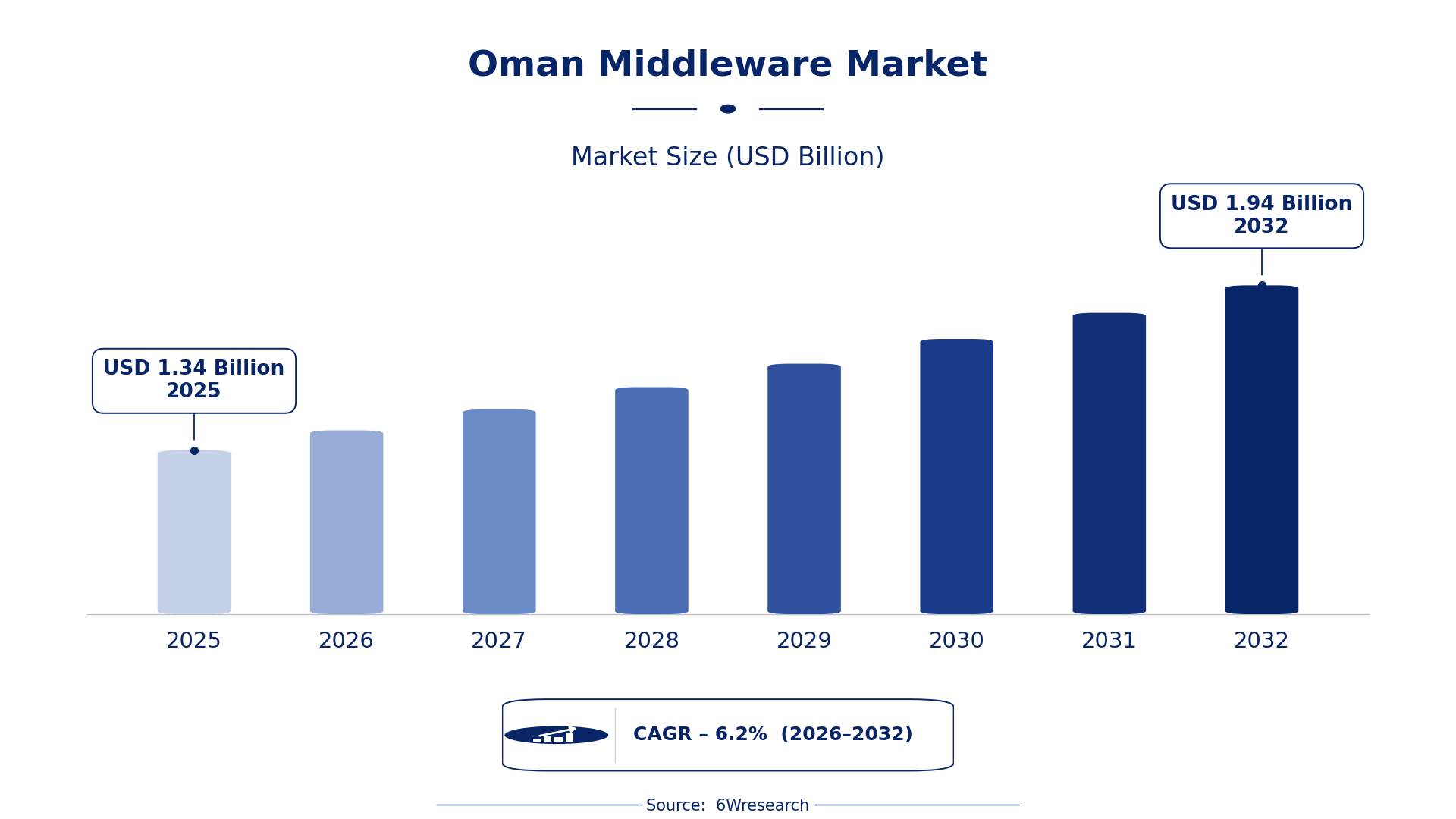
The Oman Middleware Market was estimated at USD 1336 Million in 2025 and is projected to reach USD 1941 Million by 2032, growing at a CAGR of 6.2% from 2026 to 2032.
Oman Middleware Market Synopsis
The Oman Middleware Market is rapidly evolving as businesses increasingly prioritize digital transformation. Middleware solutions are vital for enabling seamless communication and data management between diverse software applications, making them indispensable for organizations aiming to enhance operational efficiency.
As the demand for cloud computing, big data analytics, and Internet of Things (IoT) applications rises, middleware platforms are positioned at the forefront of this technological shift. Enterprises in Oman are recognizing the need for sophisticated middleware to address the complexities of modern IT environments.
Oman Middleware Market Year-wise Growth Rate and Key Drivers
This graph illustrates the annual growth rates of the Oman Middleware Market from 2021 to 2032, highlighting a steady upward trajectory and projected expansion over the forecast period.
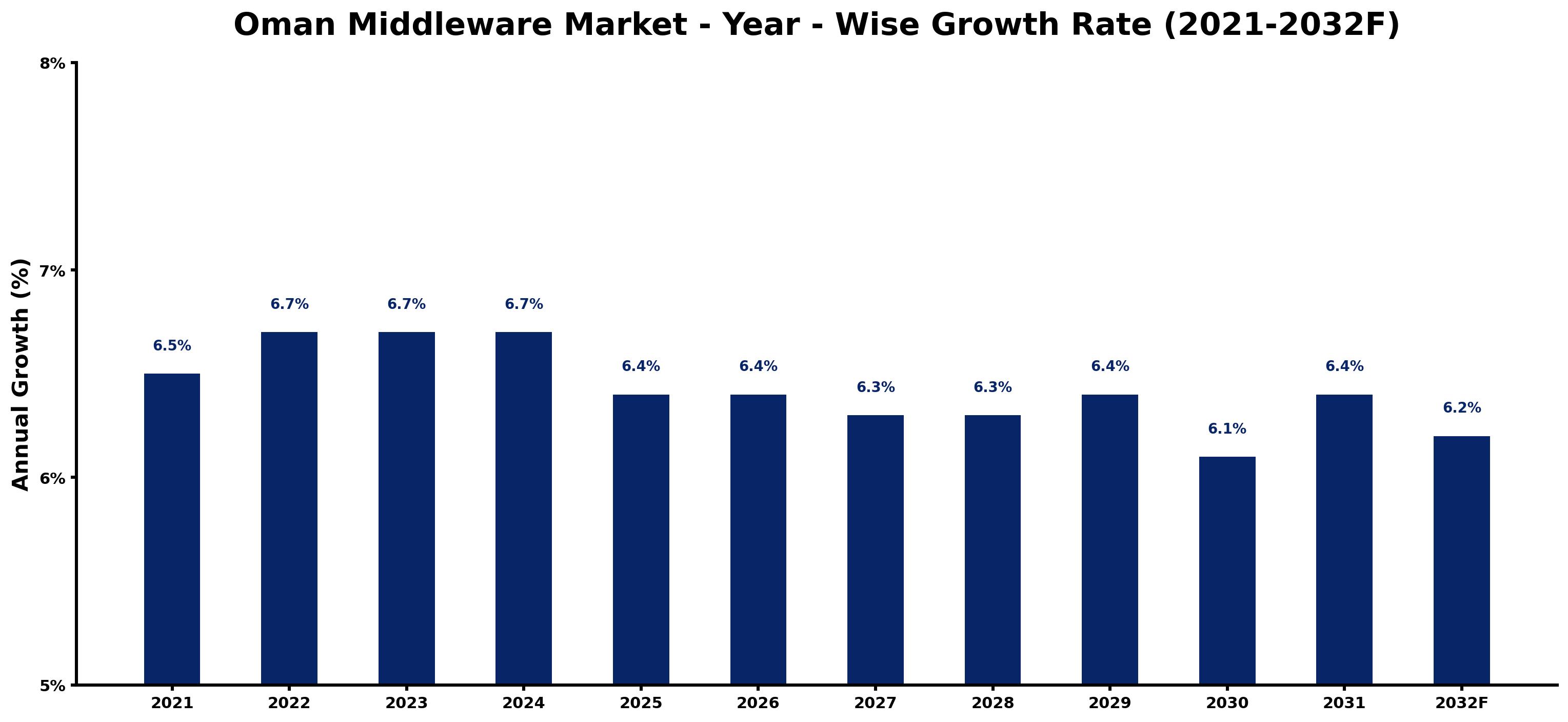
The table below presents the year‑wise growth rates along with the key drivers influencing the market
| Year | Growth Rate | Major Drivers |
| 2021 | 6.5% | Digital Oman strategy boosts cloud service integration. |
| 2022 | 6.7% | Increased demand for e-government services drives middleware use. |
| 2023 | 6.7% | Telecom sector advancements enhance middleware deployment opportunities. |
| 2024 | 6.7% | Growing fintech solutions necessitate robust middleware support. |
| 2025 | 6.4% | Oman's national cybersecurity framework drives middleware investments. |
| 2026 | 6.4% | Healthcare sector digitalization increases middleware requirements. |
| 2027 | 6.3% | Education sector modernization fuels middleware technology adoption. |
| 2028 | 6.3% | Local enterprises digitizing to improve operational efficiencies. |
| 2029 | 6.4% | Smart city initiatives require seamless middleware solutions. |
| 2030 | 6.1% | Transport sector digitization demands advanced middleware technologies. |
| 2031 | 6.4% | Rising mobile application development necessitates middleware platforms. |
| 2032 | 6.2% | Government investments in IT infrastructure boost middleware sector. |
Note: Market size estimations and growth projections presented in this report are based on 6Wresearch's proprietary forecasting methodology, utilizing the latest available industry data, government publications, and primary research inputs.
Oman Middleware Market Key Takeaways
Below are some of the specific key takeaways from the market, including:
- The increasing integration of enterprise applications is driving middleware demand across various sectors.
- Cloud computing services are being widely adopted, further fueling the middleware market.
- Data analytics and business intelligence are becoming crucial in decision-making processes, enhancing middleware significance.
- The expanding IT sector in Oman presents new opportunities for middleware solutions.
- Challenges in integrating middleware with legacy systems remain a critical concern for organizations.
Evaluation of Restraints in Oman Middleware Market
The Oman Middleware Market faces several challenges that hinder its growth. A primary restraint is the complexity of integrating middleware solutions into existing IT infrastructures. Many organizations grapple with outdated systems that lack compatibility with modern middleware technologies, resulting in high implementation costs. Additionally, the scarcity of skilled professionals well-versed in middleware technologies slows down adoption rates and limits effective utilization.
Oman Middleware Market Trends
Several trends are shaping the Oman Middleware Market. The surge in demand for cloud-based services has prompted businesses to seek middleware that can facilitate smooth transitions to cloud environments. on top of that, the increasing emphasis on data-driven decision-making is driving the adoption of middleware solutions that support advanced analytics capabilities. Lastly, the rise of IoT applications is pushing for middleware that can manage diverse data streams efficiently.
Oman Middleware Market Opportunities
Genuine growth opportunities exist within the Oman Middleware Market as organizations seek to modernize their IT infrastructures. Investments in cloud computing and data analytics offer promising avenues for middleware development. Additionally, sectors such as finance, healthcare, and manufacturing are increasingly looking for tailored middleware solutions to optimize operations and improve efficiency. This opens the door for innovative middleware platforms that address specific industry needs.
Government Initiatives in the Oman Middleware Market
The Omani government is actively promoting the adoption of advanced IT solutions, which significantly impacts the middleware market. Current policies are designed to enhance efficiency across public and private sectors through digital transformation initiatives. By investing in ICT infrastructure and providing incentives for companies to adopt new technologies, the government aims to foster innovation and bolster the middleware ecosystem.
- A national digital infrastructure upgrade programme launched in early 2023 aims to improve ICT capabilities across sectors.
- Currently ongoing initiatives are focused on providing training and development programs to enhance the skill sets of IT professionals in middleware technologies.
- Upcoming policies include plans for establishing a regulatory framework aimed at promoting transparency and security in middleware implementations by 2025.
- Government-backed incentives for small to medium enterprises adopting middleware solutions are currently being rolled out.
- A collaborative project with international tech firms to develop smart city middleware solutions is expected to begin in late 2024.
Future Insights of the Oman Middleware Market
Looking ahead to 2026-2032, the Oman Middleware Market is expected to witness robust growth driven by technological advancements and increasing demand for integrated solutions. As organizations continue to prioritize digital transformation, middleware will become a fundamental component of IT strategies. The ongoing push for cloud adoption and data analytics will further solidify middleware's role in facilitating seamless operations across industries.
Oman Middleware Market Latest Developments
Recent developments in the Oman Middleware Market indicate a strong momentum toward innovation and integration. Over the past year, companies have actively sought to enhance their middleware capabilities, aligning with the broader trend of digital transformation across the region.
- A major technology vendor announced the launch of a new middleware platform designed for cloud integration in Q1 2023, aimed at helping businesses streamline operations.
- Ongoing partnerships between local IT firms and international technology providers have been established to develop customized middleware solutions tailored for the healthcare sector.
- A pilot project focusing on IoT middleware for smart agriculture was initiated in mid-2023, showcasing the potential for agricultural efficiency improvements.
- Upcoming initiatives include a rollout of middleware training workshops planned for late 2024, aimed at addressing the skills gap in the region.
- A recent collaboration aimed at enhancing cybersecurity measures for middleware platforms was announced in Q2 2023, reflecting the growing concern over data security.
Oman Middleware Market - Key Attractiveness of the Report
- 10 Years of Market Numbers
- Historical Data Starting from 2022 to 2025
- Base Year: 2025
- Forecast Data until 2032
- Key Performance Indicators Impacting the Market
- Major Upcoming Developments and Projects
Key Highlights of the Report:
- Oman Middleware Market Outlook
- Market Size of Oman Middleware Market, 2025
- Forecast of Oman Middleware Market, 2032
- Historical Data and Forecast of Oman Middleware Revenues & Volume for the Period 2022-2032F
- Oman Middleware Market Trend Evolution
- Oman Middleware Market Drivers and Challenges
- Oman Middleware Price Trends
- Oman Middleware Porter's Five Forces
- Oman Middleware Industry Life Cycle
- Historical Data and Forecast of Oman Middleware Market Revenues & Volume By Product Type for the Period 2022-2032F
- Historical Data and Forecast of Oman Middleware Market Revenues & Volume By Communication Middleware for the Period 2022-2032F
- Historical Data and Forecast of Oman Middleware Market Revenues & Volume By Platform Middleware for the Period 2022-2032F
- Historical Data and Forecast of Oman Middleware Market Revenues & Volume By Integration Middleware for the Period 2022-2032F
- Historical Data and Forecast of Oman Middleware Market Revenues & Volume By Others for the Period 2022-2032F
- Historical Data and Forecast of Oman Middleware Market Revenues & Volume By Deployment Types for the Period 2022-2032F
- Historical Data and Forecast of Oman Middleware Market Revenues & Volume By On-Premise for the Period 2022-2032F
- Historical Data and Forecast of Oman Middleware Market Revenues & Volume By Hosted for the Period 2022-2032F
- Historical Data and Forecast of Oman Middleware Market Revenues & Volume By Hybrid for the Period 2022-2032F
- Historical Data and Forecast of Oman Middleware Market Revenues & Volume By Organization Size for the Period 2022-2032F
- Historical Data and Forecast of Oman Middleware Market Revenues & Volume By Small businesses for the Period 2022-2032F
- Historical Data and Forecast of Oman Middleware Market Revenues & Volume By Medium businesses for the Period 2022-2032F
- Historical Data and Forecast of Oman Middleware Market Revenues & Volume By Enterprises for the Period 2022-2032F
- Historical Data and Forecast of Oman Middleware Market Revenues & Volume By Large enterprises for the Period 2022-2032F
- Historical Data and Forecast of Oman Middleware Market Revenues & Volume By Verticals for the Period 2022-2032F
- Historical Data and Forecast of Oman Middleware Market Revenues & Volume By Banking, financial services and insurance (BFSI) for the Period 2022-2032F
- Historical Data and Forecast of Oman Middleware Market Revenues & Volume By Consumer Goods and Retail for the Period 2022-2032F
- Historical Data and Forecast of Oman Middleware Market Revenues & Volume By IT and telecom for the Period 2022-2032F
- Historical Data and Forecast of Oman Middleware Market Revenues & Volume By Manufacturing for the Period 2022-2032F
- Historical Data and Forecast of Oman Middleware Market Revenues & Volume By Oil and Gas for the Period 2022-2032F
- Historical Data and Forecast of Oman Middleware Market Revenues & Volume By Healthcare for the Period 2022-2032F
- Historical Data and Forecast of Oman Middleware Market Revenues & Volume By Government for the Period 2022-2032F
- Oman Middleware Import Export Trade Statistics
- Market Opportunity Assessment By Product Type
- Market Opportunity Assessment By Deployment Types
- Market Opportunity Assessment By Organization Size
- Market Opportunity Assessment By Verticals
- Oman Middleware Top Companies Market Share
- Oman Middleware Competitive Benchmarking By Technical and Operational Parameters
- Oman Middleware Company Profiles
- Oman Middleware Key Strategic Recommendations






































