Oman Organic Fruits And Vegetables Market Size, Share & Growth Rate
The Oman Organic Fruits And Vegetables Market was estimated at USD 188 Million in 2025 and is projected to reach USD 248 Million by 2032, growing at a CAGR of 4.0% from 2026 to 2032. This growth trajectory is underpinned by a surge in consumer awareness regarding the health advantages of organic produce, coupled with rising disposable incomes. With more Omani consumers prioritizing sustainable choices, the demand for organic fruits and vegetables continues to gain momentum.
Oman Organic Fruits And Vegetables Market Year-wise Growth Rate and Key Drivers
This graph highlights how the Oman Organic Fruits And Vegetables Market has steadily grown over the years, supported by major growth factors.
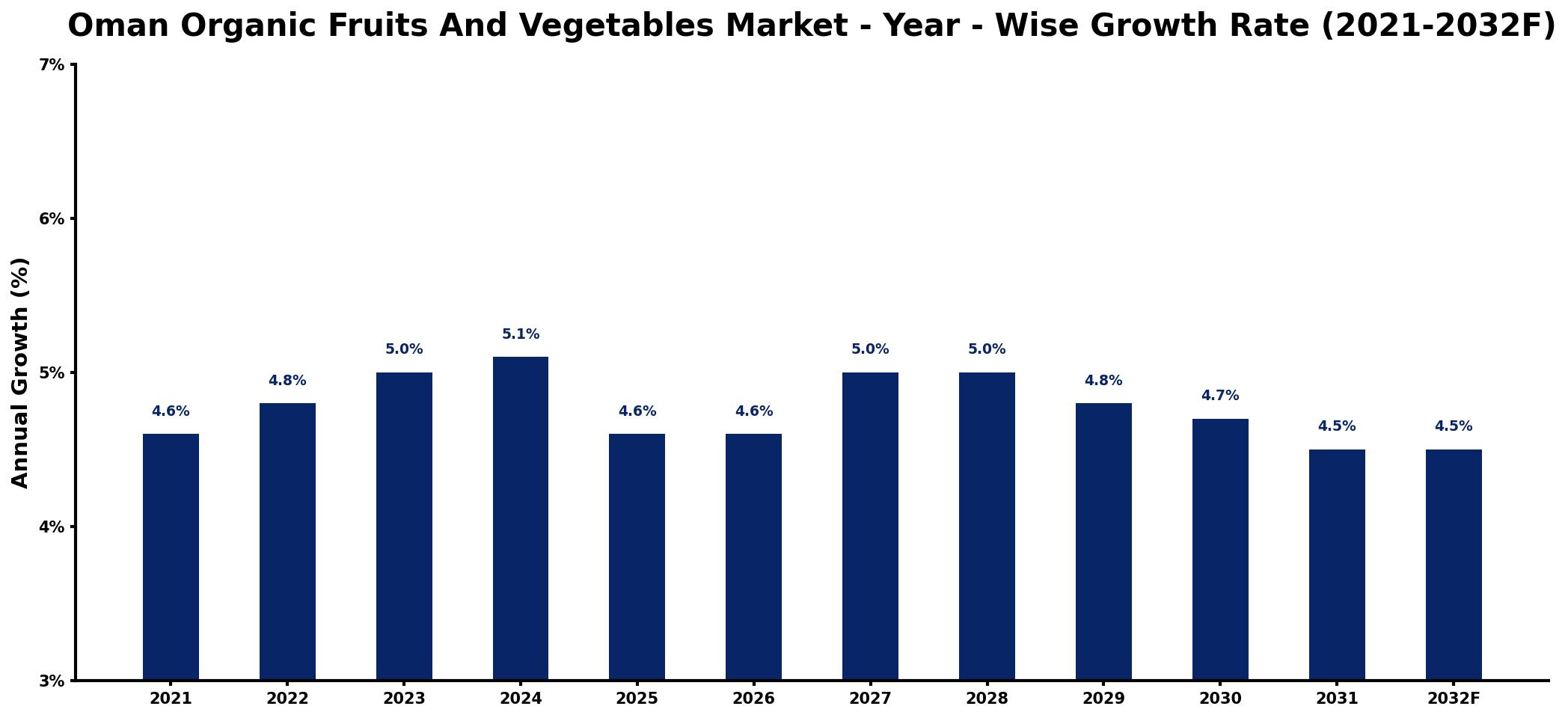
The table below presents the year‑wise growth rates along with the key drivers influencing the market
| Year | Growth Rate | Major Drivers |
| 2021 | 4.6% | Rising consumer health awareness |
| 2022 | 4.8% | Increased local farming initiatives |
| 2023 | 5.0% | Growing demand for sustainability |
| 2024 | 5.1% | Expansion of distribution networks |
| 2025 | 4.6% | Investment in agricultural technology |
| 2026 | 4.6% | Enhanced marketing strategies adopted |
| 2027 | 5.0% | Boost in export opportunities |
| 2028 | 5.0% | Strengthening of local cooperatives |
| 2029 | 4.8% | Surge in eco-friendly certifications |
| 2030 | 4.7% | Development of urban farming projects |
| 2031 | 4.5% | Increase in government support programs |
| 2032 | 4.5% | Emergence of health-focused retailers |
Note: Market size estimations and growth projections presented in this report are based on 6Wresearch's proprietary forecasting methodology, utilizing the latest available industry data, government publications, and primary research inputs.
Oman Organic Fruits And Vegetables Market Synopsis
The Oman organic fruits and vegetables market has been witnessing consistent growth, driven primarily by heightened consumer interest in health and wellness. As awareness around the adverse effects of conventional farming practices escalates, more consumers are opting for organic options perceived as safer and more nutritious. This trend is further amplified by government initiatives that support organic farming and sustainability.
Looking ahead, the market is poised for significant expansion, thanks to both local and international players who are increasingly investing in the organic sector. With a firm commitment to improving farming practices and enhancing supply chains, the future of organic produce in Oman looks promising as it embraces sustainability and health-consciousness.
Oman Organic Fruits And Vegetables Market Key Takeaways
- The market is driven by a rise in consumer awareness about the health benefits of organic produce.
- Government initiatives are promoting organic farming, leading to increased local production.
- There is a notable trend towards locally sourced, sustainable products among consumers.
- Investment opportunities in distribution and organic farming practices are rapidly growing.
- Challenges such as high production costs and inconsistent supply need to be addressed for sustainable growth.
Evaluation of Restraints in Oman Organic Fruits And Vegetables Market
Despite the positive trajectory, several restraints are currently limiting the market's potential. Consumer education regarding the advantages of organic produce remains insufficient, which could hinder wider adoption. Moreover, organic farming often entails higher production costs, which can deter new entrants. Inconsistent supply due to adverse weather conditions and the finite availability of suitable land for organic farming further complicate the landscape. The lack of standardized regulations and certification processes contributes to challenges in ensuring product quality, which can undermine consumer trust.
Oman Organic Fruits And Vegetables Market Trends
Several key trends are shaping the Oman organic fruits and vegetables market. Firstly, there is a marked increase in health consciousness, leading consumers to prioritize organic options perceived as free from harmful chemicals. Secondly, the trend of sustainable eating is gaining traction, with consumers increasingly concerned about the environmental impact of food production. Furthermore, technological advancements in organic farming practices are enhancing productivity and quality, enabling farmers to meet rising demand.
Oman Organic Fruits And Vegetables Market Opportunities
Investment opportunities abound within the Oman organic fruits and vegetables market. As consumer demand for healthier and sustainably sourced food options grows, there is a need for enhanced organic farming practices, including organic certification processes. Furthermore, with the increasing popularity of locally sourced produce, opportunities for vertical integration within the supply chain are emerging. Investing in effective distribution channels and targeted marketing strategies will also present lucrative avenues for growth as the market continues to evolve.
Government Initiatives in the Oman Organic Fruits And Vegetables Market
The Omani government has undertaken numerous initiatives aimed at bolstering the organic fruits and vegetables market. This includes providing subsidies and financial incentives to organic farmers, thereby promoting sustainable agricultural practices. There are also efforts to establish certification standards to ensure product quality and authenticity. Additionally, government investment in research and development is focused on enhancing organic farming techniques, enabling farmers to increase productivity while maintaining ecological integrity.
Future Insights of the Oman Organic Fruits And Vegetables Market
As we look towards 2026-2032, the outlook for the Oman organic fruits and vegetables market is promising. An increasing focus on health and sustainability will continue to drive demand for organic produce. The government's ongoing support for organic farming practices, along with the expansion of retail channels dedicated to organic products, will further boost market growth. With a growing range of organic options becoming available and advancements in farming technology, the market is set for substantial expansion in the coming years.
Oman Organic Fruits And Vegetables Market Latest Developments (2025 - 2026)
Recent developments in the Oman organic fruits and vegetables market have seen a greater push towards sustainability and health-focused food options. Initiatives to educate consumers about the benefits of organic produce are being actively pursued, resulting in increased consumer engagement. Additionally, partnerships between local farmers and retailers are being established to ensure a steady supply of organic products to meet rising demand, reflecting a collaborative effort to enhance the organic marketplace.
Oman Organic Fruits And Vegetables Market - Key Attractiveness of the Report
- 10 Years of Market Numbers
- Historical Data Starting from 2022 to 2025
- Base Year: 2025
- Forecast Data until 2032
- Key Performance Indicators Impacting the Market
- Major Upcoming Developments and Projects
Key Highlights of the Report:
- Oman Organic Fruits And Vegetables Market Outlook
- Market Size of Oman Organic Fruits And Vegetables Market, 2025
- Forecast of Oman Organic Fruits And Vegetables Market, 2032
- Historical Data and Forecast of Oman Organic Fruits And Vegetables Revenues & Volume for the Period 2022-2032F
- Oman Organic Fruits And Vegetables Market Trend Evolution
- Oman Organic Fruits And Vegetables Market Drivers and Challenges
- Oman Organic Fruits And Vegetables Price Trends
- Oman Organic Fruits And Vegetables Porter's Five Forces
- Oman Organic Fruits And Vegetables Industry Life Cycle
- Historical Data and Forecast of Oman Organic Fruits And Vegetables Market Revenues & Volume By Product Type for the Period 2022-2032F
- Historical Data and Forecast of Oman Organic Fruits And Vegetables Market Revenues & Volume By Organic Fruits for the Period 2022-2032F
- Historical Data and Forecast of Oman Organic Fruits And Vegetables Market Revenues & Volume By Organic Vegetables for the Period 2022-2032F
- Historical Data and Forecast of Oman Organic Fruits And Vegetables Market Revenues & Volume By Form for the Period 2022-2032F
- Historical Data and Forecast of Oman Organic Fruits And Vegetables Market Revenues & Volume By Fresh for the Period 2022-2032F
- Historical Data and Forecast of Oman Organic Fruits And Vegetables Market Revenues & Volume By Frozen for the Period 2022-2032F
- Historical Data and Forecast of Oman Organic Fruits And Vegetables Market Revenues & Volume By End User for the Period 2022-2032F
- Historical Data and Forecast of Oman Organic Fruits And Vegetables Market Revenues & Volume By Residential for the Period 2022-2032F
- Historical Data and Forecast of Oman Organic Fruits And Vegetables Market Revenues & Volume By Commercial for the Period 2022-2032F
- Historical Data and Forecast of Oman Organic Fruits And Vegetables Market Revenues & Volume By Distribution Channel for the Period 2022-2032F
- Historical Data and Forecast of Oman Organic Fruits And Vegetables Market Revenues & Volume By Supermarket for the Period 2022-2032F
- Historical Data and Forecast of Oman Organic Fruits And Vegetables Market Revenues & Volume By Hypermarket for the Period 2022-2032F
- Historical Data and Forecast of Oman Organic Fruits And Vegetables Market Revenues & Volume By Convenience Store for the Period 2022-2032F
- Historical Data and Forecast of Oman Organic Fruits And Vegetables Market Revenues & Volume By Online Sale Channel for the Period 2022-2032F
- Historical Data and Forecast of Oman Organic Fruits And Vegetables Market Revenues & Volume By Others for the Period 2022-2032F
- Oman Organic Fruits And Vegetables Import Export Trade Statistics
- Market Opportunity Assessment By Product Type
- Market Opportunity Assessment By Form
- Market Opportunity Assessment By End User
- Market Opportunity Assessment By Distribution Channel
- Oman Organic Fruits And Vegetables Top Companies Market Share
- Oman Organic Fruits And Vegetables Competitive Benchmarking By Technical and Operational Parameters
- Oman Organic Fruits And Vegetables Company Profiles
- Oman Organic Fruits And Vegetables Key Strategic Recommendations






































