Oman Personal Cloud Market Size & Growth Rate (2026-2032)
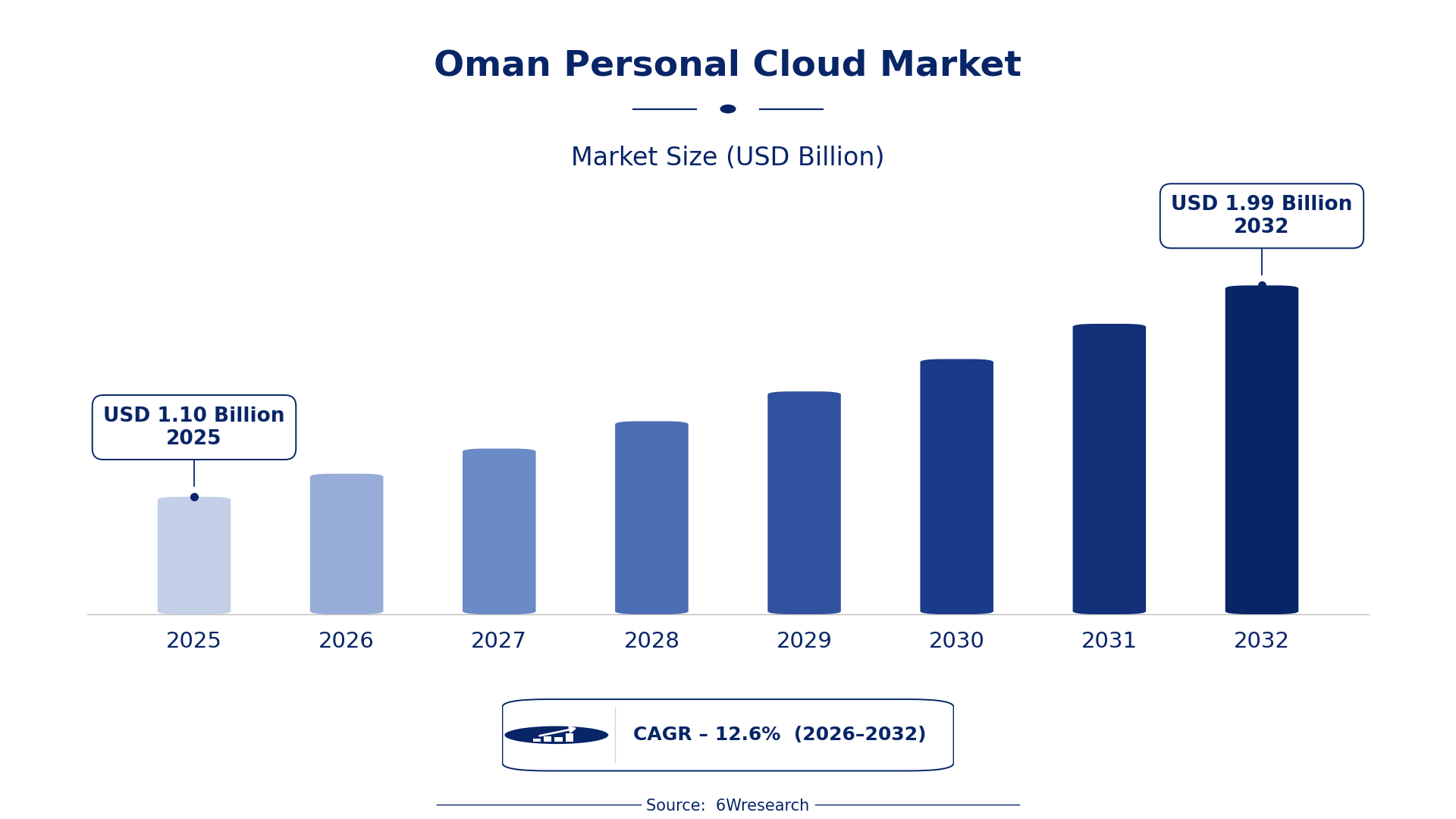
The Oman Personal Cloud Market was estimated at USD 1099 Million in 2025 and is projected to reach USD 1989 Million by 2032, growing at a CAGR of 12.6% from 2026 to 2032.
Oman Personal Cloud Market Synopsis
The Oman Personal Cloud Market is witnessing a surge in interest, fueled by a growing demand for secure data storage solutions among consumers. As digitalization intensifies and remote access to data becomes a necessity, personal cloud services are becoming increasingly popular for their efficiency in backup, synchronization, and sharing functionalities.
Looking ahead, the market is set for substantial expansion. The rise in internet penetration, coupled with heightened awareness of data security and privacy concerns, positions personal cloud services as a critical need for individuals in Oman. Providers that prioritize user-friendly interfaces and robust encryption features will likely see a competitive edge.
Oman Personal Cloud Market Year-wise Growth Rate and Key Drivers
This graph illustrates the annual growth rates of the Oman Personal Cloud Market from 2021 to 2032, highlighting a steady upward trajectory and projected expansion over the forecast period.
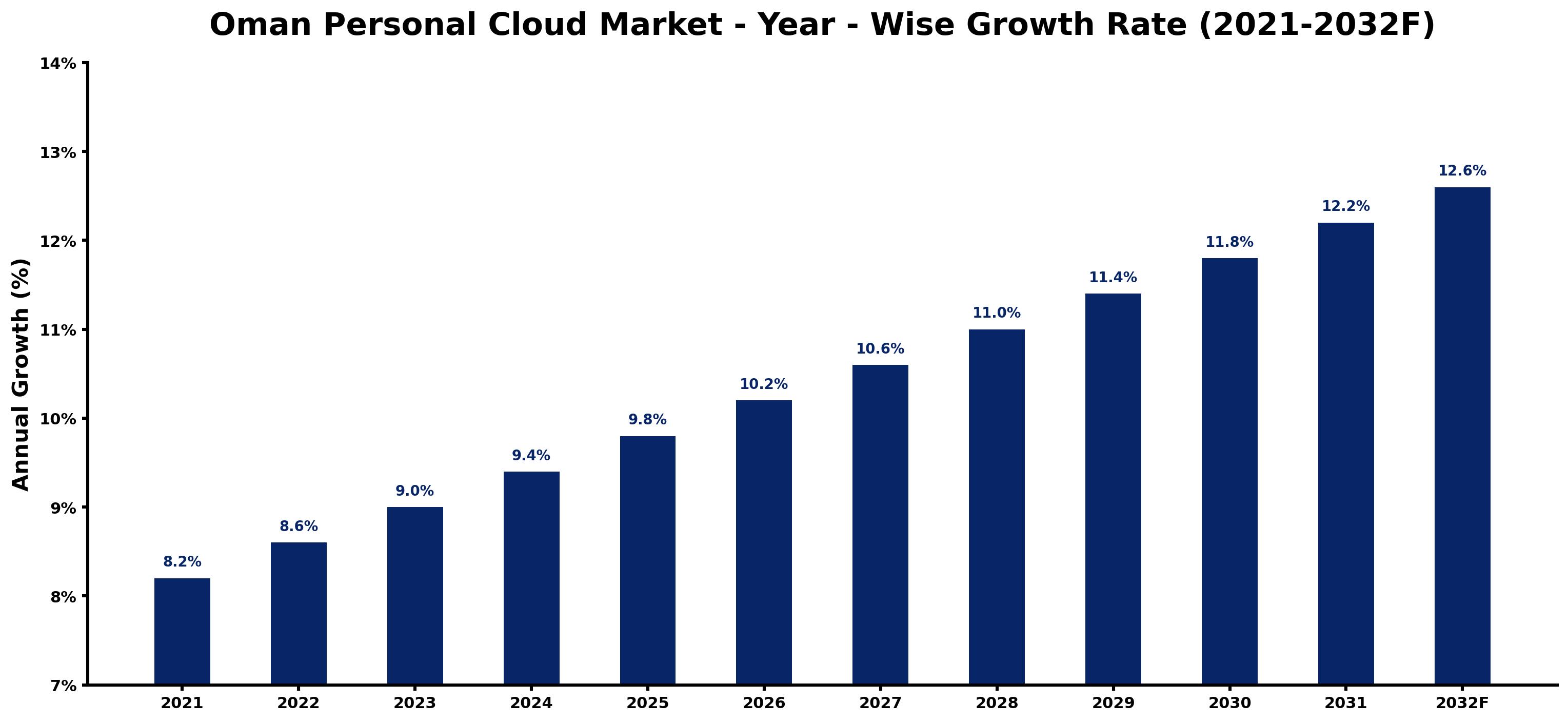
The table below presents the year‑wise growth rates along with the key drivers influencing the market
| Year | Growth Rate | Major Drivers |
| 2021 | 8.2% | Increased smartphone penetration driving personal cloud use. |
| 2022 | 8.6% | Omani youth prioritizing digital content storage solutions. |
| 2023 | 9.0% | Growing awareness of data privacy and security needs. |
| 2024 | 9.4% | Local startup ecosystem fostering cloud-based innovations. |
| 2025 | 9.8% | Increased adoption of e-learning platforms and resources. |
| 2026 | 10.2% | Government backing for tech incubators boosting cloud services. |
| 2027 | 10.6% | Rise in digital content creation among local influencers. |
| 2028 | 11.0% | Expanding internet infrastructure enhancing cloud accessibility. |
| 2029 | 11.4% | Increased adoption of IoT devices needing data storage. |
| 2030 | 11.8% | Growing popularity of mobile apps reliant on cloud storage. |
| 2031 | 12.2% | Youth engagement in coding and cloud education initiatives. |
| 2032 | 12.6% | Strong cultural shift towards digital lifestyle adoption. |
Note: Market size estimations and growth projections presented in this report are based on 6Wresearch's proprietary forecasting methodology, utilizing the latest available industry data, government publications, and primary research inputs.
Oman Personal Cloud Market Key Takeaways
Below are some of the specific key takeaways from the market, including:
- The market is on track for significant growth, driven by increasing digitalization and remote work.
- Consumers are prioritizing security and privacy, influencing service provider offerings.
- User-friendly interfaces and competitive pricing are critical for attracting customers.
- Innovative services, such as automated backups, are emerging as popular options.
- Government initiatives are enhancing the digital landscape, fostering market growth.
Evaluation of Restraints in Oman Personal Cloud Market
A few notable restraints are limiting the growth of the Oman Personal Cloud Market. One primary issue is the prevalent lack of awareness regarding the functionalities and advantages of personal cloud services among potential users. This knowledge gap results in hesitance to adopt these solutions. In addition, security and privacy concerns deter individuals from entrusting sensitive information to cloud platforms. Lastly, inconsistent internet connectivity in various regions hampers user experience and accessibility, further stalling market progress.
Oman Personal Cloud Market Trends
Several trends are shaping the Oman Personal Cloud Market. The shift towards remote work has accelerated the demand for reliable cloud storage solutions, enabling users to access personal data from any location. Enhanced awareness of data security is leading to increased preference for cloud services that offer encryption and secure access controls. Additionally, providers that focus on seamless synchronization across devices are likely to gain traction as consumers seek convenience in their digital interactions.
Oman Personal Cloud Market Opportunities
Investment prospects in the Oman Personal Cloud Market are robust, driven by the rising need for secure data storage among individuals and small businesses. The trend of digitalization creates opportunities for services offering automatic backups, file sharing, and enhanced privacy features. Companies that can deliver innovative and reliable solutions will find a loyal customer base eager for improved cloud services, ensuring long-term growth potential in this expanding market.
Government Initiatives in the Oman Personal Cloud Market
The Omani government is actively fostering the growth of the cloud computing sector, including personal cloud services, to accelerate digital transformation across various industries. Policies aimed at enhancing data security, promoting data localization, and improving internet infrastructure are crucial for market expansion. By encouraging public-private partnerships, the government is working to boost digital literacy and ensure a supportive regulatory environment for cloud services.
- A national cybersecurity policy introduced in 2024 aims to strengthen data protection measures for cloud users.
- Currently ongoing is an infrastructure development program that focuses on enhancing internet connectivity nationwide, crucial for cloud service performance.
- A planned public-private initiative expected to launch in 2026 will focus on increasing awareness and education about cloud services among the general population.
- Recent investments in data centers across Oman are intended to localize data storage and improve service reliability.
- Upcoming regulations expected in late 2025 will mandate stronger data privacy measures for all cloud service providers operating in the region.
Future Insights of the Oman Personal Cloud Market
The Oman Personal Cloud Market is on a promising trajectory for 2026-2032. Continued growth in digital services and increasing internet accessibility will drive demand for secure cloud solutions. As consumer awareness of data security rises, providers will need to enhance their offerings to meet expectations. The proliferation of smart devices and the push for digital transformation will further bolster the demand for personal cloud services, making this an attractive market for investment and innovation.
Oman Personal Cloud Market Latest Developments
Recent activities in the Oman Personal Cloud Market indicate a dynamic shift towards enhanced service offerings and infrastructure improvements. In the past year, several initiatives have emerged, reflecting the growing interest in cloud solutions.
- A major technology vendor launched a new personal cloud service aimed at small businesses in Q1 2025, emphasizing enhanced security features.
- In early 2025, a leading regional operator completed the rollout of upgraded data encryption protocols across its cloud services.
- An initiative focusing on expanding cloud service access in rural areas began in mid-2025 and remains ongoing, aiming to bridge the digital divide.
- Plans for a comprehensive public awareness campaign on cloud security are set to kick off in late 2025 to educate consumers.
- By Q3 2026, a new cloud service package tailored for educational institutions is expected to launch, enhancing learning accessibility through technology.
Oman Personal Cloud Market - Key Attractiveness of the Report
- 10 Years of Market Numbers
- Historical Data Starting from 2022 to 2025
- Base Year: 2025
- Forecast Data until 2032
- Key Performance Indicators Impacting the Market
- Major Upcoming Developments and Projects
Key Highlights of the Report:
- Oman Personal Cloud Market Outlook
- Market Size of Oman Personal Cloud Market, 2025
- Forecast of Oman Personal Cloud Market, 2032
- Historical Data and Forecast of Oman Personal Cloud Revenues & Volume for the Period 2022-2032F
- Oman Personal Cloud Market Trend Evolution
- Oman Personal Cloud Market Drivers and Challenges
- Oman Personal Cloud Price Trends
- Oman Personal Cloud Porter's Five Forces
- Oman Personal Cloud Industry Life Cycle
- Historical Data and Forecast of Oman Personal Cloud Market Revenues & Volume By User Type for the Period 2022-2032F
- Historical Data and Forecast of Oman Personal Cloud Market Revenues & Volume By Consumers for the Period 2022-2032F
- Historical Data and Forecast of Oman Personal Cloud Market Revenues & Volume By Enterprises for the Period 2022-2032F
- Historical Data and Forecast of Oman Personal Cloud Market Revenues & Volume By Revenue Type for the Period 2022-2032F
- Historical Data and Forecast of Oman Personal Cloud Market Revenues & Volume By Direct Revenue for the Period 2022-2032F
- Historical Data and Forecast of Oman Personal Cloud Market Revenues & Volume By Indirect Revenue for the Period 2022-2032F
- Oman Personal Cloud Import Export Trade Statistics
- Market Opportunity Assessment By User Type
- Market Opportunity Assessment By Revenue Type
- Oman Personal Cloud Top Companies Market Share
- Oman Personal Cloud Competitive Benchmarking By Technical and Operational Parameters
- Oman Personal Cloud Company Profiles
- Oman Personal Cloud Key Strategic Recommendations






































