Oman Personal Computers Market Size, Share & Growth Rate
The Oman Personal Computers Market was estimated at USD 225 Million in 2025 and is projected to reach USD 306 Million by 2032, growing at a CAGR of 4.5% from 2026 to 2032. This growth trajectory is primarily driven by the increasing demand for innovative computing solutions among a tech-savvy population, as well as government initiatives aimed at promoting digitalization and enhancing accessibility to technology. The surge in remote work and online education has further accelerated the need for personal computers, making them essential tools in both personal and professional settings.
Oman Personal Computers Market Year-wise Growth Rate and Key Drivers
This graph highlights how the Oman Personal Computers Market has steadily grown over the years, supported by major growth factors.
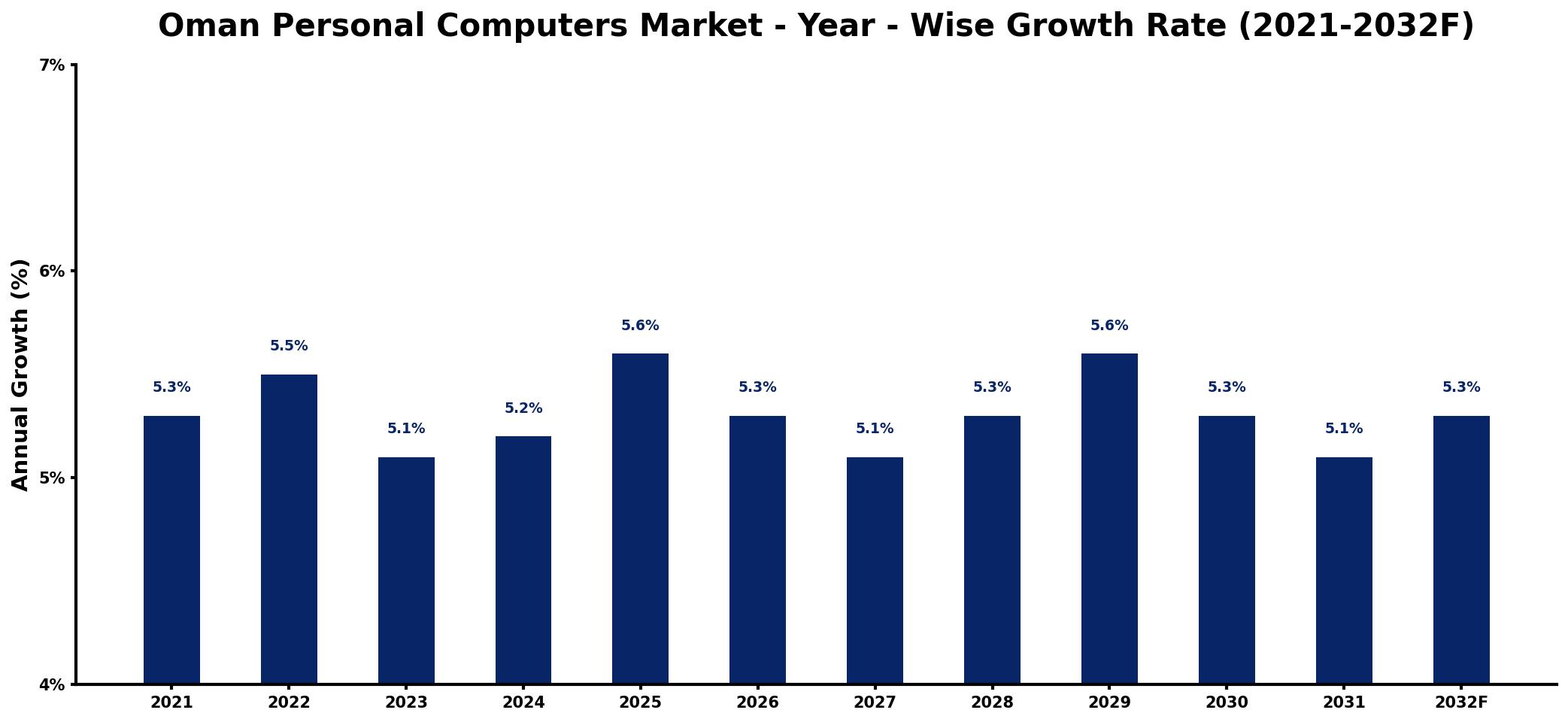
The table below presents the year‑wise growth rates along with the key drivers influencing the market
| Year | Growth Rate | Major Drivers |
| 2021 | 5.3% | Increased remote work adoption |
| 2022 | 5.5% | Growth in e-learning platforms |
| 2023 | 5.1% | Surge in gaming sector demand |
| 2024 | 5.2% | Expansion of digital services market |
| 2025 | 5.6% | Rise in content creation activities |
| 2026 | 5.3% | Investment in tech infrastructure |
| 2027 | 5.1% | expanding manufacturing base activity |
| 2028 | 5.3% | Increased focus on cybersecurity solutions |
| 2029 | 5.6% | Demand for cloud computing services |
| 2030 | 5.3% | increased capital investment inflows |
| 2031 | 5.1% | growing automotive sector requirements |
| 2032 | 5.3% | growing downstream application demand |
Note: Market size estimations and growth projections presented in this report are based on 6Wresearch's proprietary forecasting methodology, utilizing the latest available industry data, government publications, and primary research inputs.
Oman Personal Computers Market Synopsis
The Oman Personal Computers Market is currently characterized by a steady growth rate, fueled by a rise in consumer and business interest in laptops, desktops, and tablets. With an increasing number of young, tech-savvy users and a focus on remote learning and working, the demand for personal computing devices has become more pronounced.
In recent years, a noticeable shift towards high-performance devices has emerged, as consumers prioritize features such as faster processors, enhanced graphics, and extended battery life. This evolution is further supported by the influx of government initiatives aimed at facilitating the adoption of technology across various sectors, making personal computers more accessible and desirable.
Oman Personal Computers Market Key Takeaways
- The market is driven by the increasing need for technology in education and business environments.
- There is a growing consumer preference for lightweight and portable devices, including laptops and ultrabooks.
- Gaming PCs and high-performance systems are gaining traction among enthusiasts and professionals.
- Government initiatives are positively influencing digital literacy and technology adoption.
- Investment opportunities exist for both local and international players to enhance their market share.
Evaluation of Restraints in Oman Personal Computers Market
Despite the growth potential, several factors pose challenges to the Oman Personal Computers Market. Intense competition among global brands puts pressure on pricing and market penetration strategies, potentially limiting the market share for local players. Additionally, economic fluctuations can impact consumer purchasing power, making it crucial for companies to develop adaptive strategies. Infrastructure limitations, such as inconsistent internet connectivity in certain regions, can also hinder the growth of online sales, thereby impacting overall market performance.
Oman Personal Computers Market Trends
As the demand for personal computing devices continues to evolve, the Oman market is witnessing trends favoring portable and feature-rich products. Lightweight laptops, ultrabooks, and 2-in-1 devices are becoming increasingly popular due to their convenience for remote work and educational purposes. Furthermore, the growing interest in gaming is pushing manufacturers to focus on high-performance PCs equipped with advanced graphics capabilities and faster processing power. Enhanced connectivity options and longer battery life are becoming critical features that consumers are looking for in their devices.
Oman Personal Computers Market Opportunities
The Oman Personal Computers Market offers numerous opportunities for investment and growth, particularly in light of the country's push towards digitization. Companies that can provide tailored solutions addressing local needs, such as affordability, durability, and after-sales support, are well-positioned to capitalize on the burgeoning demand. Additionally, strategic partnerships with local retailers can enhance market presence, enabling businesses to tap into the increasing consumer base seeking cutting-edge technology.
Government Initiatives in the Oman Personal Computers Market
The Omani government has been proactive in fostering the growth of the personal computers market through various initiatives. These include reducing tariffs on imported computer components, which lowers costs for consumers and businesses alike. Moreover, investments aimed at improving digital literacy, especially in rural areas, are pivotal in expanding technology access. Incentives promoting digital technology adoption across sectors such as education and healthcare further enhance the competitiveness of Omans economy in the digital realm.
Future Insights of the Oman Personal Computers Market
Looking ahead to 2026-2032, the Oman Personal Computers Market is poised for continued growth. Rising disposable incomes and an expanding young population are expected to further drive the demand for innovative personal computing solutions. The government's ongoing commitment to digital transformation will likely create a more favorable environment for investment, pushing companies to innovate and diversify their product offerings. As technology advances, the introduction of smart features and enhanced performance will continue to attract consumers, solidifying the market's upward trajectory.
Oman Personal Computers Market Latest Developments (2025 - 2026)
In recent months, the Oman Personal Computers Market has seen a wave of new product launches, particularly focusing on high-performance laptops and gaming devices. Manufacturers are increasingly integrating advanced technologies, such as AI and cloud capabilities, into their devices to meet the growing consumer expectations for performance and connectivity. Additionally, partnerships with educational institutions have been established to promote technology adoption, enabling students to access essential tools for learning and development.
Oman Personal Computers Market - Key Attractiveness of the Report
- 10 Years of Market Numbers
- Historical Data Starting from 2022 to 2025
- Base Year: 2025
- Forecast Data until 2032
- Key Performance Indicators Impacting the Market
- Major Upcoming Developments and Projects
Key Highlights of the Report:
- Oman Personal Computers Market Outlook
- Market Size of Oman Personal Computers Market, 2025
- Forecast of Oman Personal Computers Market, 2032
- Historical Data and Forecast of Oman Personal Computers Revenues & Volume for the Period 2022-2032F
- Oman Personal Computers Market Trend Evolution
- Oman Personal Computers Market Drivers and Challenges
- Oman Personal Computers Price Trends
- Oman Personal Computers Porter's Five Forces
- Oman Personal Computers Industry Life Cycle
- Historical Data and Forecast of Oman Personal Computers Market Revenues & Volume By Product Type for the Period 2022-2032F
- Historical Data and Forecast of Oman Personal Computers Market Revenues & Volume By Desktop for the Period 2022-2032F
- Historical Data and Forecast of Oman Personal Computers Market Revenues & Volume By Notebook for the Period 2022-2032F
- Historical Data and Forecast of Oman Personal Computers Market Revenues & Volume By Workstation for the Period 2022-2032F
- Historical Data and Forecast of Oman Personal Computers Market Revenues & Volume By Others for the Period 2022-2032F
- Historical Data and Forecast of Oman Personal Computers Market Revenues & Volume By Distribution Channel for the Period 2022-2032F
- Historical Data and Forecast of Oman Personal Computers Market Revenues & Volume By Business-To-Business (B2B) for the Period 2022-2032F
- Historical Data and Forecast of Oman Personal Computers Market Revenues & Volume By Business-To-Consumer (B2C) for the Period 2022-2032F
- Historical Data and Forecast of Oman Personal Computers Market Revenues & Volume By Application for the Period 2022-2032F
- Historical Data and Forecast of Oman Personal Computers Market Revenues & Volume By Consumer for the Period 2022-2032F
- Historical Data and Forecast of Oman Personal Computers Market Revenues & Volume By Commercial for the Period 2022-2032F
- Historical Data and Forecast of Oman Personal Computers Market Revenues & Volume By Industrial for the Period 2022-2032F
- Oman Personal Computers Import Export Trade Statistics
- Market Opportunity Assessment By Product Type
- Market Opportunity Assessment By Distribution Channel
- Market Opportunity Assessment By Application
- Oman Personal Computers Top Companies Market Share
- Oman Personal Computers Competitive Benchmarking By Technical and Operational Parameters
- Oman Personal Computers Company Profiles
- Oman Personal Computers Key Strategic Recommendations






































