Oman Point Of Sale Terminals Market Size, Share & Growth Rate
The Oman Point Of Sale Terminals Market was estimated at USD 225 Million in 2025 and is projected to reach USD 308 Million by 2032, growing at a CAGR of 4.6% from 2026 to 2032. This growth trajectory is underpinned by the rapid expansion of the retail sector in Oman, which is increasingly shifting towards embracing digital payment solutions. Enhanced consumer preferences for convenience and speed in transactions further drive the adoption of advanced POS systems with features such as mobile payment acceptance and cloud-based analytics.
Oman Point Of Sale Terminals Market Year-wise Growth Rate and Key Drivers
This graph highlights how the Oman Point Of Sale Terminals Market has steadily grown over the years, supported by major growth factors.
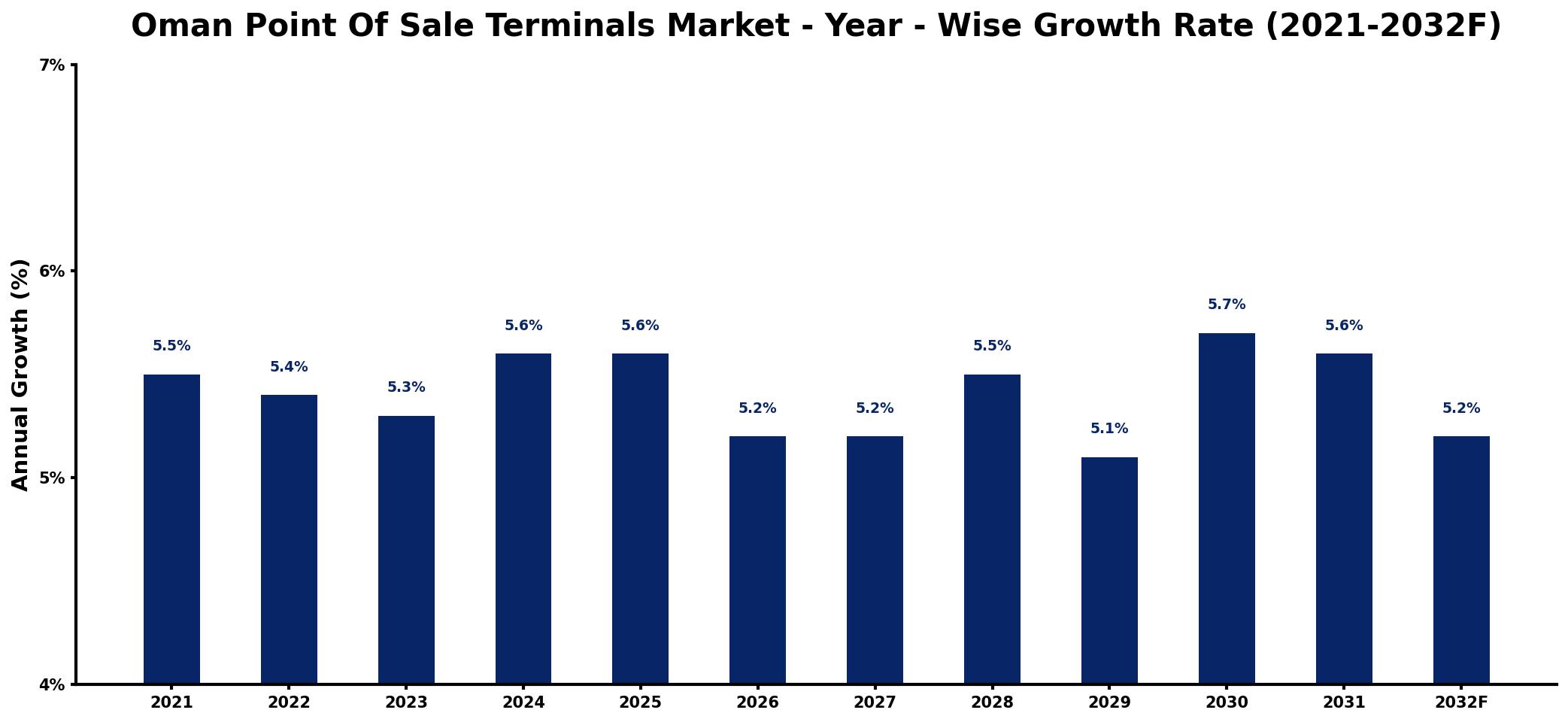
The table below presents the year‑wise growth rates along with the key drivers influencing the market
| Year | Growth Rate | Major Drivers |
| 2021 | 5.5% | Increased digital payment adoption |
| 2022 | 5.4% | Growth in retail sector investments |
| 2023 | 5.3% | Expansion of e-commerce platforms |
| 2024 | 5.6% | Rising consumer spending trends |
| 2025 | 5.6% | Enhanced mobile payment solutions |
| 2026 | 5.2% | Investment in fintech innovations |
| 2027 | 5.2% | Greater focus on security features |
| 2028 | 5.5% | Surge in hospitality sector demand |
| 2029 | 5.1% | Adoption of contactless payment methods |
| 2030 | 5.7% | growing commercial sector adoption |
| 2031 | 5.6% | Increased government digital initiatives |
| 2032 | 5.2% | expanding manufacturing base activity |
Note: Market size estimations and growth projections presented in this report are based on 6Wresearch's proprietary forecasting methodology, utilizing the latest available industry data, government publications, and primary research inputs.
Oman Point Of Sale Terminals Market Synopsis
The landscape of the Oman Point Of Sale Terminals Market is transforming, fueled by an influx of retail outlets and the growing inclination toward electronic payment systems. More businesses are seeking reliable POS solutions to streamline transactions and improve customer experiences, which is evident in the increasing penetration of advanced terminals.
The ongoing digitization efforts backed by government policies are further stimulating market growth. Retailers are prioritizing systems that not only facilitate quicker payments but also enhance their operational efficiency through better inventory management and analytics capabilities.
Oman Point Of Sale Terminals Market Key Takeaways
- The market is characterized by a strong demand for advanced features such as NFC and mobile payment options.
- Government policies play a pivotal role in promoting POS adoption for increased transaction security.
- The growing retail sector is a primary driver of the market's expansion.
- Cybersecurity and regulatory compliance remain critical considerations for market participants.
- Investment in cloud-based POS solutions is on the rise, indicating a shift towards modern retail technologies.
Evaluation of Restraints in Oman Point Of Sale Terminals Market
Despite the promising growth outlook, the Oman Point Of Sale Terminals Market faces significant restraints. The rapid pace of technological advancements necessitates that businesses continually update their systems, which can lead to substantial installation and maintenance costs. Additionally, regulatory compliance issues often pose challenges, as companies must navigate a complex landscape of laws and standards, particularly related to data security and consumer protection. These factors may hinder widespread adoption and limit the market's growth potential.
Oman Point Of Sale Terminals Market Trends
The market is experiencing several trends that are shaping its evolution. One prominent trend is the integration of mobile payment solutions, driven by increasing smartphone penetration and consumer preference for contactless payments. Retailers are also leaning towards cloud-based POS systems that offer enhanced data analytics capabilities, enabling better decision-making and customer insights. Additionally, there is a notable shift towards omni-channel solutions that facilitate seamless transactions across various platforms, further enriching the customer shopping experience.
Oman Point Of Sale Terminals Market Opportunities
Significant growth and investment opportunities exist within the Oman Point Of Sale Terminals Market. As retailers increasingly prioritize customer-centric solutions, there is a compelling case for investing in innovative POS technologies that enhance the purchasing journey. Additionally, with government initiatives supporting digital transformation, businesses can leverage financial incentives to adopt more advanced systems. The expansion of e-commerce in Oman also provides fertile ground for POS solutions designed to bridge online and offline retail experiences.
Government Initiatives in the Oman Point Of Sale Terminals Market
The government of Oman actively supports the digitization of the retail sector through various policies and programs aimed at promoting the adoption of point-of-sale terminals. These initiatives focus on enhancing transaction security and improving business efficiencies, which in turn contribute to overall economic growth. By fostering a conducive environment for digital transformation, the government is positioning Oman as a competitive player in the regional market.
Future Insights of the Oman Point Of Sale Terminals Market
Looking ahead, the Oman Point Of Sale Terminals Market is expected to continue its upward trajectory from 2026 to 2032. The ongoing advancements in technology, coupled with a robust retail sector, will be pivotal in driving market growth. As consumers increasingly demand more integrated and efficient payment solutions, businesses that invest in state-of-the-art POS systems will likely gain a competitive edge. Furthermore, the alignment of governmental policies with market needs will significantly bolster the sector's development.
Oman Point Of Sale Terminals Market Latest Developments (2025 - 2026)
In the latest developments within the Oman Point Of Sale Terminals Market, several retailers have begun pilot programs to integrate advanced POS systems that support mobile wallet transactions. There is also a growing emphasis on training staff to effectively utilize these new technologies, which will enhance customer engagement. Public discussions around regulatory frameworks for data protection in digital transactions have gained traction, highlighting the importance of cybersecurity measures in the sector.
Oman Point Of Sale Terminals Market - Key Attractiveness of the Report
- 10 Years of Market Numbers
- Historical Data Starting from 2022 to 2025
- Base Year: 2025
- Forecast Data until 2032
- Key Performance Indicators Impacting the Market
- Major Upcoming Developments and Projects
Key Highlights of the Report:
- Oman Point Of Sale Terminals Market Outlook
- Market Size of Oman Point Of Sale Terminals Market, 2025
- Forecast of Oman Point Of Sale Terminals Market, 2032
- Historical Data and Forecast of Oman Point Of Sale Terminals Revenues & Volume for the Period 2022-2032F
- Oman Point Of Sale Terminals Market Trend Evolution
- Oman Point Of Sale Terminals Market Drivers and Challenges
- Oman Point Of Sale Terminals Price Trends
- Oman Point Of Sale Terminals Porter's Five Forces
- Oman Point Of Sale Terminals Industry Life Cycle
- Historical Data and Forecast of Oman Point Of Sale Terminals Market Revenues & Volume By Product for the Period 2022-2032F
- Historical Data and Forecast of Oman Point Of Sale Terminals Market Revenues & Volume By Fixed for the Period 2022-2032F
- Historical Data and Forecast of Oman Point Of Sale Terminals Market Revenues & Volume By Mobile for the Period 2022-2032F
- Historical Data and Forecast of Oman Point Of Sale Terminals Market Revenues & Volume By Component for the Period 2022-2032F
- Historical Data and Forecast of Oman Point Of Sale Terminals Market Revenues & Volume By Hardware for the Period 2022-2032F
- Historical Data and Forecast of Oman Point Of Sale Terminals Market Revenues & Volume By Software for the Period 2022-2032F
- Historical Data and Forecast of Oman Point Of Sale Terminals Market Revenues & Volume By Services for the Period 2022-2032F
- Historical Data and Forecast of Oman Point Of Sale Terminals Market Revenues & Volume By Deployment for the Period 2022-2032F
- Historical Data and Forecast of Oman Point Of Sale Terminals Market Revenues & Volume By Cloud for the Period 2022-2032F
- Historical Data and Forecast of Oman Point Of Sale Terminals Market Revenues & Volume By On-premise for the Period 2022-2032F
- Historical Data and Forecast of Oman Point Of Sale Terminals Market Revenues & Volume By End Use for the Period 2022-2032F
- Historical Data and Forecast of Oman Point Of Sale Terminals Market Revenues & Volume By Restaurants for the Period 2022-2032F
- Historical Data and Forecast of Oman Point Of Sale Terminals Market Revenues & Volume By Retail for the Period 2022-2032F
- Historical Data and Forecast of Oman Point Of Sale Terminals Market Revenues & Volume By Hospitality for the Period 2022-2032F
- Historical Data and Forecast of Oman Point Of Sale Terminals Market Revenues & Volume By Healthcare for the Period 2022-2032F
- Historical Data and Forecast of Oman Point Of Sale Terminals Market Revenues & Volume By Warehouse for the Period 2022-2032F
- Historical Data and Forecast of Oman Point Of Sale Terminals Market Revenues & Volume By Entertainment for the Period 2022-2032F
- Historical Data and Forecast of Oman Point Of Sale Terminals Market Revenues & Volume By Others for the Period 2022-2032F
- Oman Point Of Sale Terminals Import Export Trade Statistics
- Market Opportunity Assessment By Product
- Market Opportunity Assessment By Component
- Market Opportunity Assessment By Deployment
- Market Opportunity Assessment By End Use
- Oman Point Of Sale Terminals Top Companies Market Share
- Oman Point Of Sale Terminals Competitive Benchmarking By Technical and Operational Parameters
- Oman Point Of Sale Terminals Company Profiles
- Oman Point Of Sale Terminals Key Strategic Recommendations






































