Oman Rubber Market Summary
The oman rubber market was estimated at USD 318 Million in 2025 and is projected to reach USD 428 Million by 2032, growing at a CAGR of 5.4% from 2026 to 2032.
Oman Rubber Market Year-wise Growth Rate and Key Drivers
This graph highlights how the Oman Rubber Market has steadily grown over the past five years, supported by major growth factors.
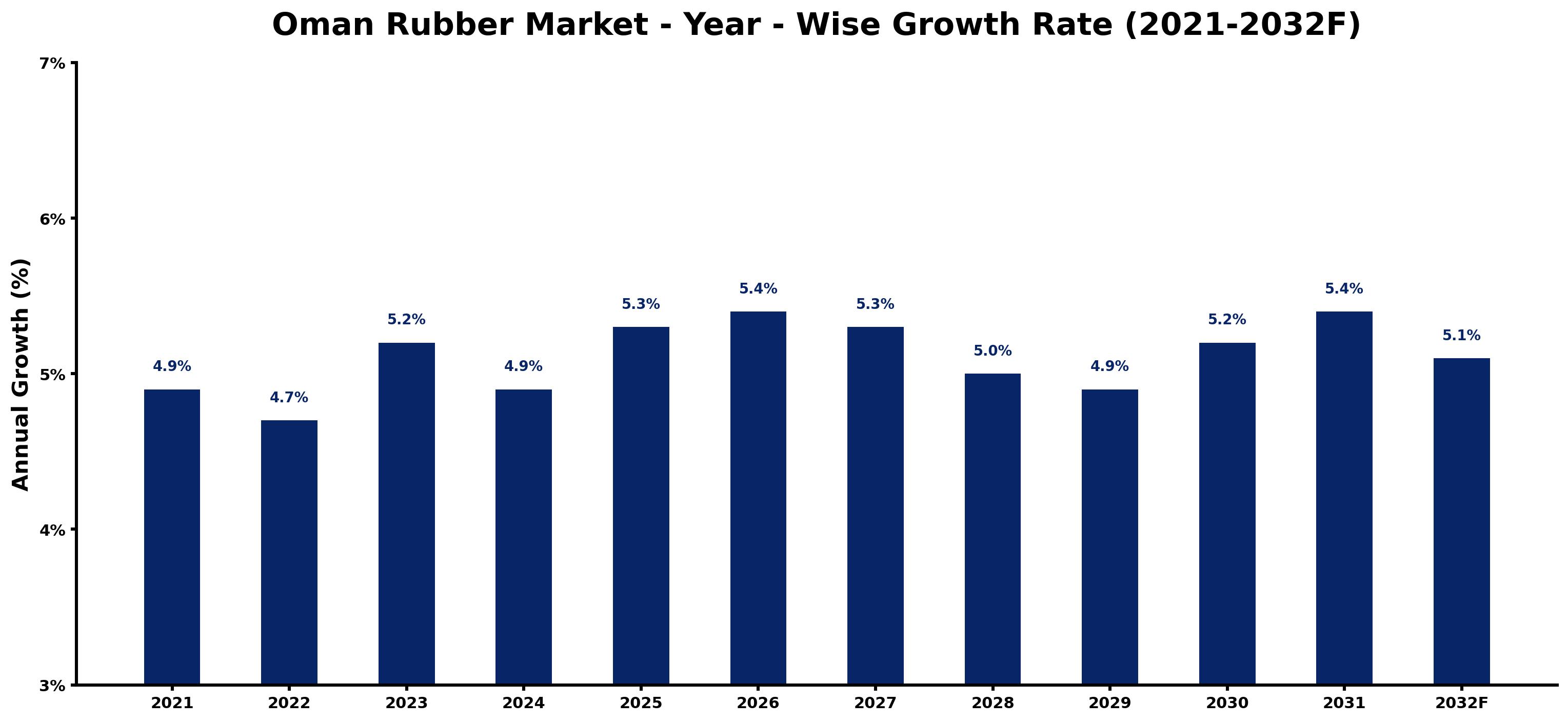
The table below presents the year wise growth rates along with the key drivers influencing the market
| Year | Growth Rate | Major Drivers |
| 2021 | 4.9% | Post-lockdown recovery saw increased infrastructure developments and construction activities across Oman. |
| 2022 | 4.7% | International investments flooded into Oman, targeting rubber manufacturing and processing facilities. |
| 2023 | 5.2% | Local industries embraced sustainable practices, boosting the demand for eco-friendly rubber products. |
| 2024 | 4.9% | Emergence of automotive manufacturing in Oman created new opportunities for rubber suppliers. |
| 2025 | 5.3% | Construction pipelines expanded, necessitating higher rubber usage for various applications. |
| 2026 | 5.4% | Integration of advanced materials in technology fostered innovation within the rubber sector. |
| 2027 | 5.3% | Regional partnerships formed, enhancing collaboration between GCC countries in rubber production. |
| 2028 | 5.0% | Technological advancements in rubber recycling opened up new market opportunities. |
| 2029 | 4.9% | Oman's tourism sector growth increased the demand for rubber flooring and related products. |
| 2030 | 5.2% | Emerging local brands began focusing on quality, elevating the overall market competition. |
| 2031 | 5.4% | Environmental awareness campaigns influenced consumer preferences towards sustainable rubber alternatives. |
| 2032 | 5.1% | The rise of smart cities in Oman demands innovative rubber solutions for urban infrastructure. |
Note - Market size estimations and growth projections presented in this report are based on 6Wresearch's advanced forecasting approach, validated with industry datasets as of June 2026.
Oman Rubber Market Synopsis
The Oman Rubber Market is projected to reach 5.4% and witness significant growth during the forecast period (2026-2032). This growth is driven by increasing demand across pivotal sectors, including automotive, construction, and healthcare. The strategic efforts by the government and a rising focus on sustainable practices further reinforce the market's expansion, ensuring that Oman solidifies its position as a key player in the regional rubber industry.
Oman Rubber Market Growth Drivers
The growth trajectory of the Oman Rubber Market is significantly influenced by various factors that enhance its attractiveness for investment and development. One of the primary drivers is the increasing demand for natural rubber, primarily sourced from plantations in Salalah and Dhofar. This indigenous production is supported by:
- Industry demand: The automotive sector's continuous growth necessitates high-quality rubber products for tire manufacturing and other components, enhancing market opportunities.
- Construction expansion: Oman's construction industry is thriving, resulting in a heightened need for rubber-based products, such as sealants and flooring materials.
- Healthcare sector requirements: The rise in healthcare infrastructure projects has spurred the need for rubber products in medical devices and equipment.
- Government initiatives: Oman's governmental support for sustainable agriculture has catalyzed the growth of the rubber market, presenting new avenues for farmers and investors alike.
- Technological advancements: Innovations in manufacturing processes are enhancing production efficiency and product quality, driving market growth.
Oman Rubber Market Trends and Opportunities
The Oman Rubber Market is witnessing several noteworthy trends that present lucrative opportunities for stakeholders. A pronounced trend towards sustainability is reshaping consumer preferences, with an increasing demand for eco-friendly and recycled rubber materials. This shift can be attributed to:
- Consumer awareness: The growing awareness of environmental issues is driving demand for sustainably sourced rubber products, providing a competitive advantage for producers who adapt quickly.
- Innovation in production: Companies are investing in innovative technologies, such as data analytics and AI, to streamline operations and reduce environmental impact.
- Diversification in application: There is a rising trend in the adoption of rubber materials across various industries, expanding market opportunities for specialized products.
- Research and development: Investment in R&D is fostering the development of advanced rubber solutions that meet new industry standards and consumer demands.
- Collaborations and partnerships: Increased collaborations among industry stakeholders are facilitating knowledge sharing and technological advancements, further driving market growth.
Oman Rubber Market Challenges and Restraints
Despite the promising prospects, the Oman Rubber Market faces several challenges that could hinder its growth. Key challenges include:
- Volatile raw material prices: Fluctuating prices of natural and synthetic rubber create uncertainty in production costs, impacting profitability for local manufacturers.
- Import competition: The influx of imported rubber products from established markets puts pressure on local producers to maintain competitive pricing and quality.
- Technological gaps: Limited technological advancements in rubber processing within Oman can restrict efficiency and overall product quality.
- Labor market constraints: A shortage of skilled labor and expertise in specialized rubber manufacturing techniques poses a challenge for industry growth.
- Regulatory hurdles: Compliance with environmental regulations can impose additional costs and operational complexities for companies in the rubber sector.
Oman Rubber Market Investment Opportunities
Investment opportunities in the Oman Rubber Market are plentiful, driven by the increasing demand from diverse sectors. Strategic areas for investment include:
- Rubber plantations: Investing in sustainable rubber plantations can ensure a steady supply and provide an economic return as demand grows.
- Processing facilities: Establishing local rubber processing plants can meet domestic and regional needs, capitalizing on growth in neighboring markets.
- Export potential: Leveraging Oman's strategic location for exporting rubber products can enhance market reach beyond the region.
- Research and technology: Funding R&D initiatives focused on innovative rubber products can yield significant competitive advantages and market differentiation.
- Infrastructure development: Collaborating on infrastructure projects can facilitate the growth of the rubber sector and enhance distribution networks.
Oman Rubber Market Government Investment and Initiatives
The government of Oman has actively implemented various policies to bolster the rubber market. Key initiatives include:
- Financial incentives: The government offers financial assistance to local rubber farmers, encouraging increased production and investment in the sector.
- Research focus: Enhanced support for research and development initiatives is aimed at improving rubber cultivation techniques and product quality.
- Environmental regulations: Policies ensuring sustainable farming and resource management practices are established to promote environmental responsibility within the rubber industry.
- Infrastructure investments: Efforts to upgrade transport and logistics infrastructure are underway to facilitate the distribution and export of rubber products.
- Market linkages: The government aims to strengthen market connections between producers and consumers, enhancing accessibility and trade opportunities.
Oman Rubber Market Latest Developments (May 2025 - June 2026)
Recent developments in the Oman Rubber Market highlight a pronounced shift towards sustainability and technological advancement. During this period, there has been a notable increase in demand for eco-friendly rubber products, reflecting the global trend towards sustainable materials. Additionally, investments in advanced production techniques have been increasingly observed, as companies seek to enhance efficiency and reduce waste. Collaborations among local producers and international entities have also become more common, aiming to leverage technological advancements to improve product quality. Awareness campaigns emphasizing the benefits of locally produced rubber have contributed to a favorable environment for domestic manufacturers, positioning them to compete effectively against imports.
Oman Rubber Market - Key Attractiveness of the Report
- 10 Years of Market Numbers
- Historical Data Starting from 2022 to 2025
- Base Year: 2025
- Forecast Data until 2032
- Key Performance Indicators Impacting the Market
- Major Upcoming Developments and Projects
Key Highlights of the Report:
- Oman Rubber Market Outlook
- Market Size of Oman Rubber Market, 2025
- Forecast of Oman Rubber Market, 2032F
- Historical Data and Forecast of Oman Rubber Revenues & Volume for the Period 2022-2032F
- Oman Rubber Market Trend Evolution
- Oman Rubber Market Drivers and Challenges
- Oman Rubber Price Trends
- Oman Rubber Porter's Five Forces
- Oman Rubber Industry Life Cycle
- Historical Data and Forecast of Oman Rubber Market Revenues & Volume By Product Type for the Period 2022-2032F
- Historical Data and Forecast of Oman Rubber Market Revenues & Volume By Natural Rubber for the Period 2022-2032F
- Historical Data and Forecast of Oman Rubber Market Revenues & Volume By Synthetic Rubber for the Period 2022-2032F
- Historical Data and Forecast of Oman Rubber Market Revenues & Volume By End-users for the Period 2022-2032F
- Historical Data and Forecast of Oman Rubber Market Revenues & Volume By Automotive & Transportation for the Period 2022-2032F
- Historical Data and Forecast of Oman Rubber Market Revenues & Volume By Building & Construction for the Period 2022-2032F
- Historical Data and Forecast of Oman Rubber Market Revenues & Volume By Industrial Machinery & Equipment for the Period 2022-2032F
- Historical Data and Forecast of Oman Rubber Market Revenues & Volume By Others for the Period 2022-2032F
- Oman Rubber Import Export Trade Statistics
- Market Opportunity Assessment By Product Type
- Market Opportunity Assessment By End-users
- Oman Rubber Top Companies Market Share
- Oman Rubber Competitive Benchmarking By Technical and Operational Parameters
- Oman Rubber Company Profiles
- Oman Rubber Key Strategic Recommendations






































