Oman Secondhand Apparel Market Size, Share & Growth Rate
The Oman Secondhand Apparel Market was estimated at USD 385 Million in 2025 and is projected to reach USD 532 Million by 2032, growing at a CAGR of 4.7% from 2026 to 2032. This growth is propelled by a shift in consumer behavior towards sustainable fashion, coupled with the rising acceptance of vintage clothing as a viable alternative to fast fashion. Additionally, the proliferation of online platforms has made secondhand shopping more accessible and appealing to a wider demographic.
Oman Secondhand Apparel Market Year-wise Growth Rate and Key Drivers
This graph highlights how the Oman Secondhand Apparel Market has steadily grown over the years, supported by major growth factors.
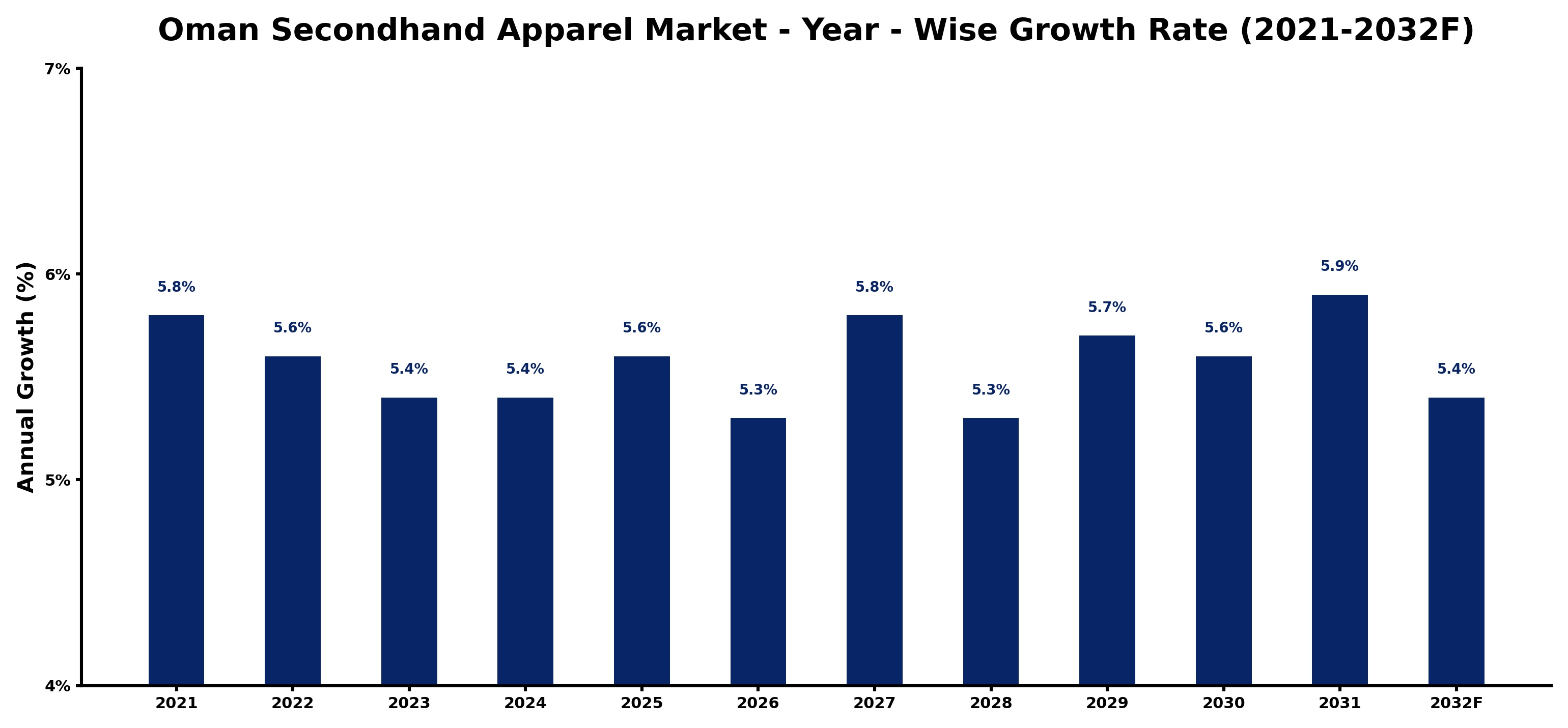
The table below presents the year‑wise growth rates along with the key drivers influencing the market
| Year | Growth Rate | Major Drivers |
| 2021 | 5.8% | Expansion of transportation and logistics networks |
| 2022 | 5.6% | Expansion of transportation and logistics networks |
| 2023 | 5.4% | Rapid growth in telecom and data center sectors |
| 2024 | 5.4% | Increasing adoption of advanced technologies |
| 2025 | 5.6% | Rising electricity demand across industries |
| 2026 | 5.3% | Growing renewable energy integration projects |
| 2027 | 5.8% | Increasing smart city development projects |
| 2028 | 5.3% | Increasing industrial infrastructure investments |
| 2029 | 5.7% | Government infrastructure modernization initiatives |
| 2030 | 5.6% | Increasing industrial infrastructure investments |
| 2031 | 5.9% | Increasing smart city development projects |
| 2032 | 5.4% | Growing renewable energy integration projects |
Note - Market size estimations and growth projections presented in this report are based on 6Wresearch's advanced forecasting approach, validated with industry datasets as of June 2026.
Oman Secondhand Apparel Market Synopsis
The demand for secondhand apparel in Oman is on the rise, largely fueled by increasing consumer awareness of the environmental impacts associated with clothing production. Shoppers are actively seeking unique items that offer a sense of individuality, driving the popularity of vintage and one-of-a-kind apparel.
On the supply side, both online marketplaces and physical thrift stores have become crucial in offering a diverse array of secondhand clothing options. As these avenues grow, they provide consumers with more choices and enhance the overall shopping experience, making it a viable alternative for those looking to blend sustainability with style.
Oman Secondhand Apparel Market Key Takeaways
- The market is anticipated to grow significantly, driven by sustainability trends.
- Consumer preferences are shifting towards unique, vintage fashion items.
- Online platforms and social media are enhancing accessibility and engagement.
- Challenges remain regarding consumer perceptions of quality and hygiene.
- Investment in curated secondhand clothing stores presents lucrative opportunities.
Evaluation of Restraints in Oman Secondhand Apparel Market
Despite its growth potential, the Oman Secondhand Apparel Market faces notable restraints. Many consumers still harbor misconceptions about the quality and hygiene of secondhand clothing, which hinders broader acceptance. Additionally, the market's fragmented retail infrastructure can impede the effective distribution of secondhand items, making it difficult for sellers to reach a larger audience. Tackling these challenges will be essential to unlocking the market's full potential.
Oman Secondhand Apparel Market Trends
The secondhand apparel market in Oman is characterized by several emerging trends. The rise of upcycling—where older garments are creatively transformed into new pieces—is resonating with environmentally conscious consumers. Furthermore, thrift stores and vintage shops are gaining traction, offering curated selections that appeal to shoppers looking for distinct items. Social media platforms are also fostering communities around sustainable fashion, enabling users to share and promote their unique finds.
Oman Secondhand Apparel Market Opportunities
Opportunities abound in the Oman Secondhand Apparel Market as sustainable fashion continues to trend. Investment in specialized online platforms that focus on curated secondhand offerings can cater to the growing demand for affordable yet unique clothing. Additionally, providing repair and alteration services for pre-owned garments can enhance their appeal, further encouraging consumers to embrace sustainable options. Collaborations with local influencers to elevate the visibility of secondhand apparel can also attract a more extensive customer base.
Government Initiatives in the Oman Secondhand Apparel Market
The Oman government is proactive in regulating the secondhand apparel market through the Ministry of Commerce, Industry, and Investment Promotion. Policies are in place to ensure that imported secondhand clothing meets safety and quality standards. There is also an emphasis on promoting sustainability and supporting practices that foster a circular economy, allowing the secondhand apparel market to thrive while aligning with national environmental goals.
Future Insights of the Oman Secondhand Apparel Market
Looking ahead, the Oman Secondhand Apparel Market is set to expand as consumer demand for sustainable options continues to rise. The increasing popularity of thrifting and unique fashion pieces will drive market growth, alongside an ongoing commitment to sustainability. As online platforms become more sophisticated and widely used, they will further facilitate access to secondhand apparel, reinforcing the market's positive trajectory through 2032 and beyond.
Oman Secondhand Apparel Market Latest Developments (May 2025 - June 2026)
In recent months, there has been a notable increase in the establishment of both online and physical stores specializing in secondhand apparel. New thrift shops are opening, and existing retailers are expanding their secondhand offerings. Additionally, social media campaigns promoting sustainable fashion and thrift culture have gained traction, further heightening consumer interest. These developments signal a vibrant, evolving market focused on sustainability and unique fashion choices.
Oman Secondhand Apparel Market - Key Attractiveness of the Report
- 10 Years of Market Numbers
- Historical Data Starting from 2022 to 2025
- Base Year: 2025
- Forecast Data until 2032
- Key Performance Indicators Impacting the Market
- Major Upcoming Developments and Projects
Key Highlights of the Report:
- Oman Secondhand Apparel Market Outlook
- Market Size of Oman Secondhand Apparel Market, 2025
- Forecast of Oman Secondhand Apparel Market, 2032
- Historical Data and Forecast of Oman Secondhand Apparel Revenues & Volume for the Period 2022-2032F
- Oman Secondhand Apparel Market Trend Evolution
- Oman Secondhand Apparel Market Drivers and Challenges
- Oman Secondhand Apparel Price Trends
- Oman Secondhand Apparel Porter's Five Forces
- Oman Secondhand Apparel Industry Life Cycle
- Historical Data and Forecast of Oman Secondhand Apparel Market Revenues & Volume By Sector for the Period 2022-2032F
- Historical Data and Forecast of Oman Secondhand Apparel Market Revenues & Volume By Resale for the Period 2022-2032F
- Historical Data and Forecast of Oman Secondhand Apparel Market Revenues & Volume By Traditional Thrift Stores and Donations for the Period 2022-2032F
- Historical Data and Forecast of Oman Secondhand Apparel Market Revenues & Volume By Product Type for the Period 2022-2032F
- Historical Data and Forecast of Oman Secondhand Apparel Market Revenues & Volume By Dresses & Tops for the Period 2022-2032F
- Historical Data and Forecast of Oman Secondhand Apparel Market Revenues & Volume By Shirts & T-shirts for the Period 2022-2032F
- Historical Data and Forecast of Oman Secondhand Apparel Market Revenues & Volume By Sweaters, Coats & Jackets for the Period 2022-2032F
- Historical Data and Forecast of Oman Secondhand Apparel Market Revenues & Volume By Jeans & Pants for the Period 2022-2032F
- Historical Data and Forecast of Oman Secondhand Apparel Market Revenues & Volume By Others for the Period 2022-2032F
- Historical Data and Forecast of Oman Secondhand Apparel Market Revenues & Volume By Target Population for the Period 2022-2032F
- Historical Data and Forecast of Oman Secondhand Apparel Market Revenues & Volume By Men for the Period 2022-2032F
- Historical Data and Forecast of Oman Secondhand Apparel Market Revenues & Volume By Women for the Period 2022-2032F
- Historical Data and Forecast of Oman Secondhand Apparel Market Revenues & Volume By Kids for the Period 2022-2032F
- Historical Data and Forecast of Oman Secondhand Apparel Market Revenues & Volume By Sales Channel for the Period 2022-2032F
- Historical Data and Forecast of Oman Secondhand Apparel Market Revenues & Volume By Wholesalers/Distributors for the Period 2022-2032F
- Historical Data and Forecast of Oman Secondhand Apparel Market Revenues & Volume By Hypermarkets/Supermarkets for the Period 2022-2032F
- Historical Data and Forecast of Oman Secondhand Apparel Market Revenues & Volume By Multi-brand Stores for the Period 2022-2032F
- Historical Data and Forecast of Oman Secondhand Apparel Market Revenues & Volume By Independent Small Stores for the Period 2022-2032F
- Historical Data and Forecast of Oman Secondhand Apparel Market Revenues & Volume By Departmental Stores for the Period 2022-2032F
- Historical Data and Forecast of Oman Secondhand Apparel Market Revenues & Volume By Online Retailers for the Period 2022-2032F
- Historical Data and Forecast of Oman Secondhand Apparel Market Revenues & Volume By Others for the Period 2022-2032F
- Oman Secondhand Apparel Import Export Trade Statistics
- Market Opportunity Assessment By Sector
- Market Opportunity Assessment By Product Type
- Market Opportunity Assessment By Target Population
- Market Opportunity Assessment By Sales Channel
- Oman Secondhand Apparel Top Companies Market Share
- Oman Secondhand Apparel Competitive Benchmarking By Technical and Operational Parameters
- Oman Secondhand Apparel Company Profiles
- Oman Secondhand Apparel Key Strategic Recommendations






































