Oman Spinning Machinery Market Size, Share & Growth Rate
The Oman Spinning Machinery Market was estimated at USD 498 Million in 2025 and is projected to reach USD 697 Million by 2032, growing at a CAGR of 4.9% from 2026 to 2032. This growth trajectory is being driven by the burgeoning textile industry in Oman, which is increasingly focused on modernizing its production capabilities. Investment in advanced spinning technologies and government support are enhancing operational efficiencies, further fueling market expansion.
Oman Spinning Machinery Market Year-wise Growth Rate and Key Drivers
This graph highlights how the Oman Spinning Machinery Market has steadily grown over the years, supported by major growth factors.
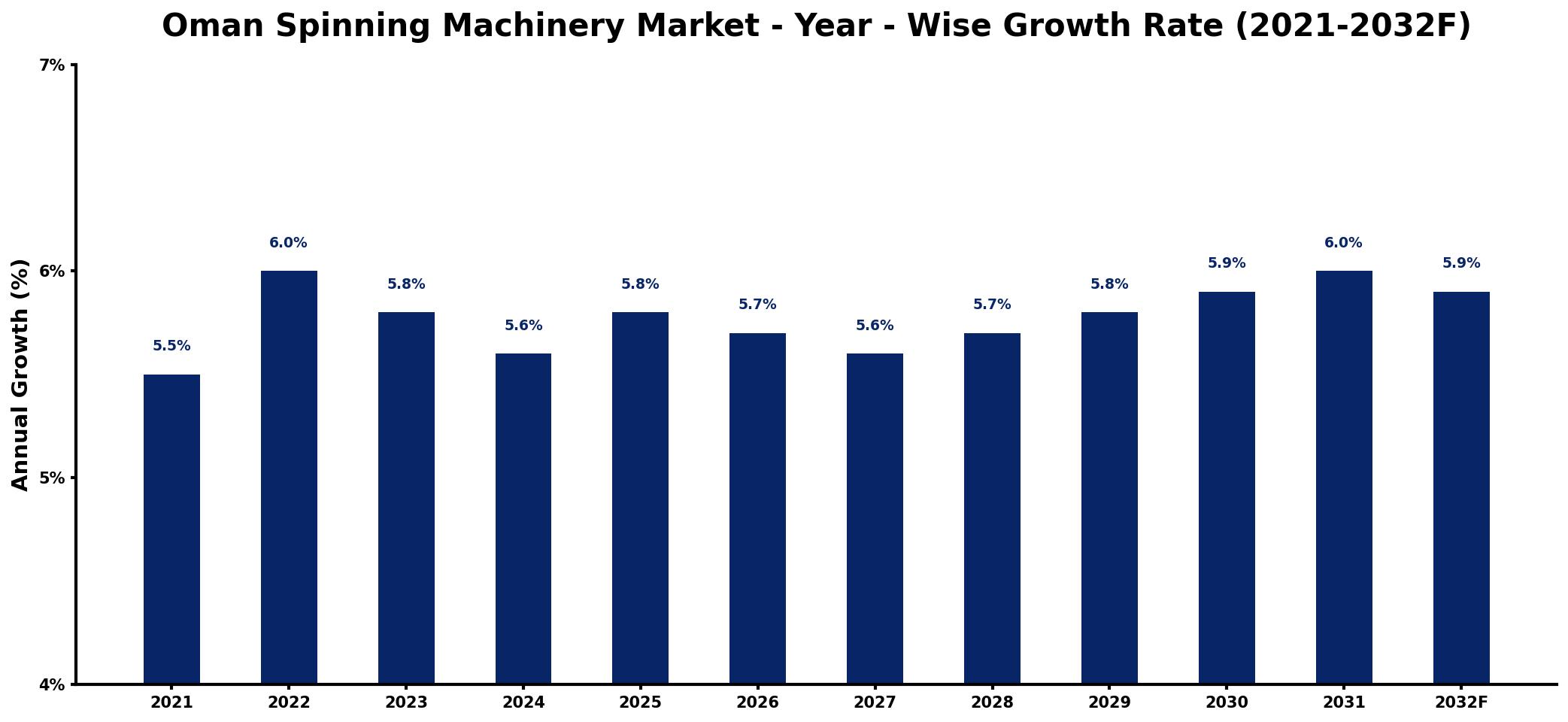
The table below presents the year‑wise growth rates along with the key drivers influencing the market
| Year | Growth Rate | Major Drivers |
| 2021 | 5.5% | Rising textile production capacity |
| 2022 | 6.0% | Increased investment in automation |
| 2023 | 5.8% | Growing demand for sustainable textiles |
| 2024 | 5.6% | Expansion of regional manufacturing hubs |
| 2025 | 5.8% | Emerging market consumer preferences |
| 2026 | 5.7% | Enhanced technological advancements adoption |
| 2027 | 5.6% | Strengthening global supply chain networks |
| 2028 | 5.7% | Diversification of textile applications |
| 2029 | 5.8% | Surge in export opportunities |
| 2030 | 5.9% | Heightened focus on quality standards |
| 2031 | 6.0% | Growing awareness of eco-friendly practices |
| 2032 | 5.9% | rising export shipment volumes |
Note: Market size estimations and growth projections presented in this report are based on 6Wresearch's proprietary forecasting methodology, utilizing the latest available industry data, government publications, and primary research inputs.
Oman Spinning Machinery Market Synopsis
The strongest force shaping the Oman Spinning Machinery Market is the continuous modernization of textile manufacturing processes. With a robust emphasis on efficiency and sustainability, local manufacturers are actively seeking advanced solutions to streamline operations and improve output quality.
In response to this demand, the market is witnessing increased competition among both domestic and international manufacturers. They are offering a diverse range of products, including ring spinning, open-end spinning, and compact spinning machines, tailored to the unique requirements of the Omani textile sector.
Oman Spinning Machinery Market Key Takeaways
- The market is poised for steady growth, influenced by a rising domestic and regional demand for textiles.
- Investments in automation and digitalization are transforming the operational landscape of spinning machinery.
- Government initiatives are actively promoting investment in the textile manufacturing sector.
- Key market trends include a focus on sustainability and eco-friendly machinery solutions.
- There is a rising demand for compact machinery capable of processing various fiber types.
Evaluation of Restraints in Oman Spinning Machinery Market
Despite the market's promising growth, several restraints are evident. Increasing competition from international players is challenging domestic manufacturers, compelling them to innovate and reduce costs. Additionally, fluctuating raw material prices can affect profitability, while the necessity for ongoing technological advancements poses a significant hurdle. Furthermore, labor shortages and high energy costs exacerbate operational challenges, necessitating strategic responses from companies to remain competitive.
Oman Spinning Machinery Market Trends
A significant trend reshaping the Oman Spinning Machinery Market is the shift towards automation and digitalization. Manufacturers are increasingly integrating technologies such as IoT, artificial intelligence, and data analytics into their machinery to optimize production processes and minimize downtime. Additionally, there is a growing emphasis on sustainability, with eco-friendly machinery designed to reduce energy and water consumption gaining traction. The demand for compact and versatile spinning solutions is also on the rise, allowing manufacturers to adapt to diverse fiber and yarn requirements.
Oman Spinning Machinery Market Opportunities
Investment opportunities abound in the Oman Spinning Machinery Market, driven primarily by the expanding textile sector. As local manufacturers seek to modernize their operations, there is a significant demand for advanced spinning equipment, including ring spinning frames and open-end machines. Furthermore, investing in technology upgrades for existing mills and forming partnerships with textile companies to provide tailored solutions can yield substantial returns. The sector presents a fertile ground for investors looking to capitalize on the ongoing transformation of textile manufacturing.
Government Initiatives in the Oman Spinning Machinery Market
The Omani government has enacted several policies aimed at nurturing the spinning machinery market. Among these, the Industrial Strategy of Oman is pivotal, offering incentives such as tax breaks and financing options to bolster investments in manufacturing, including spinning machinery. Furthermore, the government is committed to enhancing infrastructure to support industrial growth, ensuring that quality standards and safety regulations are upheld. These initiatives are designed to boost the competitiveness and sustainability of Omans spinning machinery landscape.
Future Insights of the Oman Spinning Machinery Market
The future outlook for the Oman Spinning Machinery Market is optimistic. With the textile industry poised for continued growth both domestically and internationally, the need for advanced spinning technologies will only intensify. As the government continues its efforts to diversify the economy and promote textile manufacturing, the market is expected to flourish. The rising trend of sustainability will further encourage the adoption of modern spinning solutions, making the next several years critical for manufacturers and investors alike.
Oman Spinning Machinery Market Latest Developments (2025 - 2026)
In recent months, the Oman Spinning Machinery Market has witnessed a flurry of activity focused on technology upgrades and sustainability initiatives. Manufacturers are exploring cutting-edge machinery that emphasizes energy efficiency and resource conservation. Additionally, there is a notable increase in collaboration between local textile companies and machinery suppliers to develop customized solutions tailored to unique production needs. This industry direction reflects a growing commitment to innovation and adaptability within the market.
Oman Spinning Machinery Market - Key Attractiveness of the Report
- 10 Years of Market Numbers
- Historical Data Starting from 2022 to 2025
- Base Year: 2025
- Forecast Data until 2032
- Key Performance Indicators Impacting the Market
- Major Upcoming Developments and Projects
Key Highlights of the Report:
- Oman Spinning Machinery Market Outlook
- Market Size of Oman Spinning Machinery Market, 2025
- Forecast of Oman Spinning Machinery Market, 2032
- Historical Data and Forecast of Oman Spinning Machinery Revenues & Volume for the Period 2022-2032F
- Oman Spinning Machinery Market Trend Evolution
- Oman Spinning Machinery Market Drivers and Challenges
- Oman Spinning Machinery Price Trends
- Oman Spinning Machinery Porter's Five Forces
- Oman Spinning Machinery Industry Life Cycle
- Historical Data and Forecast of Oman Spinning Machinery Market Revenues & Volume By Type for the Period 2022-2032F
- Historical Data and Forecast of Oman Spinning Machinery Market Revenues & Volume By Ring for the Period 2022-2032F
- Historical Data and Forecast of Oman Spinning Machinery Market Revenues & Volume By Rotor Spinning for the Period 2022-2032F
- Historical Data and Forecast of Oman Spinning Machinery Market Revenues & Volume By Material for the Period 2022-2032F
- Historical Data and Forecast of Oman Spinning Machinery Market Revenues & Volume By Natural for the Period 2022-2032F
- Historical Data and Forecast of Oman Spinning Machinery Market Revenues & Volume By Synthetic for the Period 2022-2032F
- Historical Data and Forecast of Oman Spinning Machinery Market Revenues & Volume By Others for the Period 2022-2032F
- Historical Data and Forecast of Oman Spinning Machinery Market Revenues & Volume By End-Use Industry for the Period 2022-2032F
- Historical Data and Forecast of Oman Spinning Machinery Market Revenues & Volume By Clothing for the Period 2022-2032F
- Historical Data and Forecast of Oman Spinning Machinery Market Revenues & Volume By Textile for the Period 2022-2032F
- Historical Data and Forecast of Oman Spinning Machinery Market Revenues & Volume By Other Industry for the Period 2022-2032F
- Oman Spinning Machinery Import Export Trade Statistics
- Market Opportunity Assessment By Type
- Market Opportunity Assessment By Material
- Market Opportunity Assessment By End-Use Industry
- Oman Spinning Machinery Top Companies Market Share
- Oman Spinning Machinery Competitive Benchmarking By Technical and Operational Parameters
- Oman Spinning Machinery Company Profiles
- Oman Spinning Machinery Key Strategic Recommendations






































