Oman Urea Market Size, Share & Growth Rate
The Oman Urea Market was estimated at USD 358 Million in 2025 and is projected to reach USD 472 Million by 2032, growing at a CAGR of 4.0% from 2026 to 2032. This upward trajectory is significantly fueled by the increasing agricultural activities across Oman, where urea serves as a critical nitrogen-based fertilizer essential for enhancing crop yields. As Oman's agricultural sector continues to evolve, the demand for efficient and effective fertilizers, particularly urea, is expected to rise sharply, reinforcing the market's growth.
Oman Urea Market Growth Rate Analysis (2021-2032)
The Oman Urea market is poised for moderate growth, registering 4.7% in 2021 and stabilizing at 4.5% in 2022. A resurgence to 4.7% in 2023 is attributed to heightened agricultural productivity, essential given Oman’s focus on food security and sustainable farming practices. As the market moves into 2024, a projected increase to 5.0% reflects ongoing investments in urea production driven by technological advancements and robust infrastructure development. However, growth will slightly taper to around 4.5% by 2026, primarily due to fluctuating global urea prices and shifting energy policies. The anticipated demand rebound, alongside investments in carbon capture technologies, will help sustain growth levels around 5.0% through 2032, underpinning a stable yet dynamic market environment.
Oman Urea Market Year-wise Growth Rate and Key Drivers
This graph highlights how the Oman Urea Market has steadily grown over the past five years, supported by major growth factors.
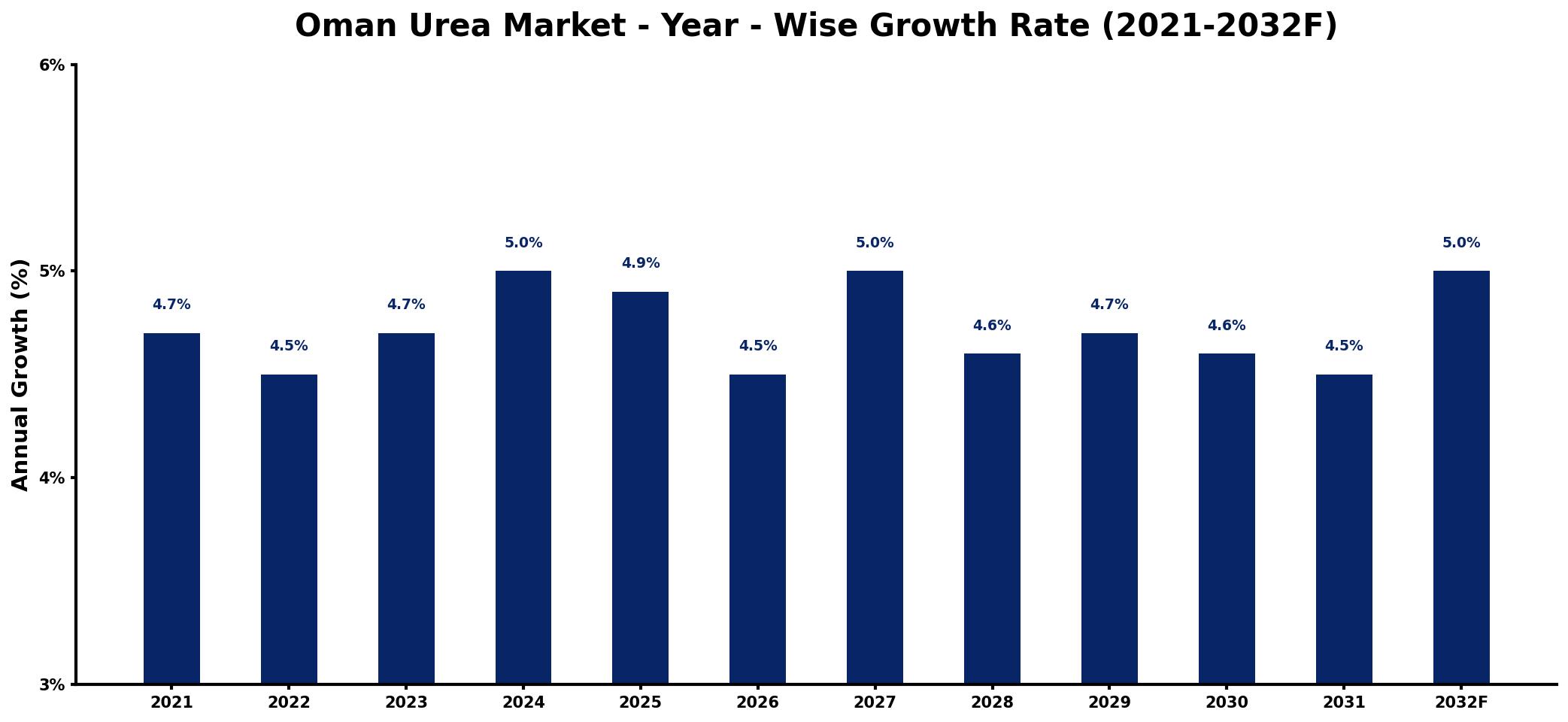
The table below presents the year‑wise growth rates along with the key drivers influencing the market
| Year | Growth Rate | Major Drivers |
| 2021 | 4.7% | Increased agricultural investment initiatives |
| 2022 | 4.5% | Rising fertilizer consumption rates |
| 2023 | 4.7% | Growing population food demand |
| 2024 | 5.0% | Expansion of irrigation systems |
| 2025 | 4.9% | Higher crop yield expectations |
| 2026 | 4.5% | Strengthening global commodity prices |
| 2027 | 5.0% | Increased international trade agreements |
| 2028 | 4.6% | Technological advancements in farming |
| 2029 | 4.7% | Sustainable farming practices adoption |
| 2030 | 4.6% | Government subsidies for agriculture |
| 2031 | 4.5% | Growing interest in biofuels |
| 2032 | 5.0% | Increased research and development funding |
Note: Market size estimations and growth projections presented in this report are based on 6Wresearch's proprietary forecasting methodology, utilizing the latest available industry data, government publications, and primary research inputs.
Oman Urea Market Synopsis
The Oman Urea Market is currently witnessing a dynamic phase of growth, driven by the critical role urea plays in enhancing agricultural productivity. With its robust properties as a nitrogen-release fertilizer, urea is indispensable for farmers looking to improve crop yields and soil health.
Furthermore, Omans strategic focus on food security and sustainable farming practices further amplifies the significance of urea in agricultural development. As local agricultural demand continues to rise, the need for consistent supply and innovative fertilizer solutions becomes increasingly vital.
Oman Urea Market Key Takeaways
- The market is driven by rising agricultural activity and the need for efficient fertilizers.
- Urea is crucial for enhancing soil fertility and crop yield, particularly in Omans diverse climatic conditions.
- Challenges include dependency on natural gas for production, affecting pricing stability.
- Environmental regulations are pushing for the development of sustainable urea products.
- Government policies are likely to play a significant role in supporting domestic urea production.
Evaluation of Restraints in Oman Urea Market
The growth of the Oman Urea Market faces several significant restraints that could impede its trajectory. A notable concern is the heavy reliance on natural gas as a primary feedstock for urea production, making the market susceptible to fluctuations in natural gas prices and availability. This dependency can lead to pricing volatility, impacting overall market stability. Additionally, the global competitiveness of the urea market means that local producers must navigate pressure from larger manufacturers in other regions, which can squeeze margins and market share. Moreover, the increasing emphasis on sustainable agricultural practices poses a challenge for traditional urea fertilizers, which are often associated with environmental pollution. Addressing these issues will be crucial for the long-term growth of the market.
Oman Urea Market Trends
Several trends are emerging in the Oman Urea Market that are shaping both demand and technology. There is a significant move towards the adoption of smart farming techniques, which leverage technology for precision agriculture, resulting in more efficient fertilizer application. This trend is complemented by an increasing awareness of sustainable practices among farmers, leading to a demand for more environmentally friendly urea formulations. Additionally, as agricultural productivity becomes a national priority, investments in urea production technologies are expected to increase, enhancing output efficiency and reducing the environmental footprint of fertilizer production.
Oman Urea Market Opportunities
Significant growth opportunities exist in the Oman Urea Market, particularly in the realm of sustainable and innovative fertilizer solutions. There is an increasing demand for slow-release and coated urea products, which offer enhanced efficiency and reduced environmental impact. Furthermore, the government's push for agricultural self-sufficiency creates a ripe landscape for investment in local urea production facilities. Partnerships with agricultural cooperatives can also foster the development of tailored fertilizer solutions that meet the specific needs of Omani farmers, thereby driving demand for urea products.
Government Initiatives in the Oman Urea Market
The Omani government is actively exploring initiatives aimed at bolstering domestic urea production to improve food security and agricultural output. These initiatives may include financial incentives for local producers, regulatory frameworks to ensure quality standards, and investments in state-of-the-art production technologies. By fostering a supportive environment for urea production, the government is keen to stimulate growth in this vital sector, which is essential for achieving broader agricultural goals.
Future Insights of the Oman Urea Market
Looking ahead to 2026-2032, the Oman Urea Market is positioned for steady growth, driven by the dual forces of increasing agricultural demand and governmental support for domestic production. As farmers embrace modern farming techniques and sustainable practices, the demand for advanced urea products is likely to rise. Moreover, ongoing investments in production capacity and logistics improvements will further enhance market stability and accessibility. This strategic alignment between agricultural growth and fertilizer production bodes well for the future of the Oman Urea Market.
Oman Urea Market Latest Developments (2025 - 2026)
Recent developments in the Oman Urea Market indicate a growing interest in innovative fertilizer technologies, as producers seek to address both efficiency and environmental concerns. Efforts to enhance the supply chain logistics for urea have gained traction, aiming to improve distribution channels and reduce costs for local farmers. Additionally, collaborations between agricultural stakeholders and research institutions are becoming more common, with a focus on developing new formulations that align with sustainable agricultural practices.
Oman Urea Market - Key Attractiveness of the Report
- 10 Years of Market Numbers
- Historical Data Starting from 2022 to 2025
- Base Year: 2025
- Forecast Data until 2032
- Key Performance Indicators Impacting the Market
- Major Upcoming Developments and Projects
Key Highlights of the Report:
- Oman Urea Market Outlook
- Market Size of Oman Urea Market, 2025
- Forecast of Oman Urea Market, 2032
- Historical Data and Forecast of Oman Urea Revenues & Volume for the Period 2022-2032F
- Oman Urea Market Trend Evolution
- Oman Urea Market Drivers and Challenges
- Oman Urea Price Trends
- Oman Urea Porter's Five Forces
- Oman Urea Industry Life Cycle
- Historical Data and Forecast of Oman Urea Market Revenues & Volume By Grade for the Period 2022-2032F
- Historical Data and Forecast of Oman Urea Market Revenues & Volume By Fertilizer for the Period 2022-2032F
- Historical Data and Forecast of Oman Urea Market Revenues & Volume By Feed for the Period 2022-2032F
- Historical Data and Forecast of Oman Urea Market Revenues & Volume By Technical for the Period 2022-2032F
- Historical Data and Forecast of Oman Urea Market Revenues & Volume By End-user Industry for the Period 2022-2032F
- Historical Data and Forecast of Oman Urea Market Revenues & Volume By Agriculture for the Period 2022-2032F
- Historical Data and Forecast of Oman Urea Market Revenues & Volume By Chemical for the Period 2022-2032F
- Historical Data and Forecast of Oman Urea Market Revenues & Volume By Automotive for the Period 2022-2032F
- Historical Data and Forecast of Oman Urea Market Revenues & Volume By Medical for the Period 2022-2032F
- Historical Data and Forecast of Oman Urea Market Revenues & Volume By Others for the Period 2022-2032F
- Oman Urea Import Export Trade Statistics
- Market Opportunity Assessment By Grade
- Market Opportunity Assessment By End-user Industry
- Oman Urea Top Companies Market Share
- Oman Urea Competitive Benchmarking By Technical and Operational Parameters
- Oman Urea Company Profiles
- Oman Urea Key Strategic Recommendations






































