Oman Urodynamic Equipment Market Size, Share & Growth Rate
The Oman Urodynamic Equipment Market was estimated at USD 151 Million in 2025 and is projected to reach USD 204 Million by 2032, growing at a CAGR of 4.4% from 2026 to 2032. This upward trajectory can be attributed to the increasing prevalence of urological disorders, which necessitates enhanced diagnostic capabilities across healthcare facilities. Furthermore, the aging population is amplifying the demand for effective monitoring and treatment options for urinary conditions.
Oman Urodynamic Equipment Market Year-wise Growth Rate and Key Drivers
This graph highlights how the Oman Urodynamic Equipment Market has steadily grown over the years, supported by major growth factors.
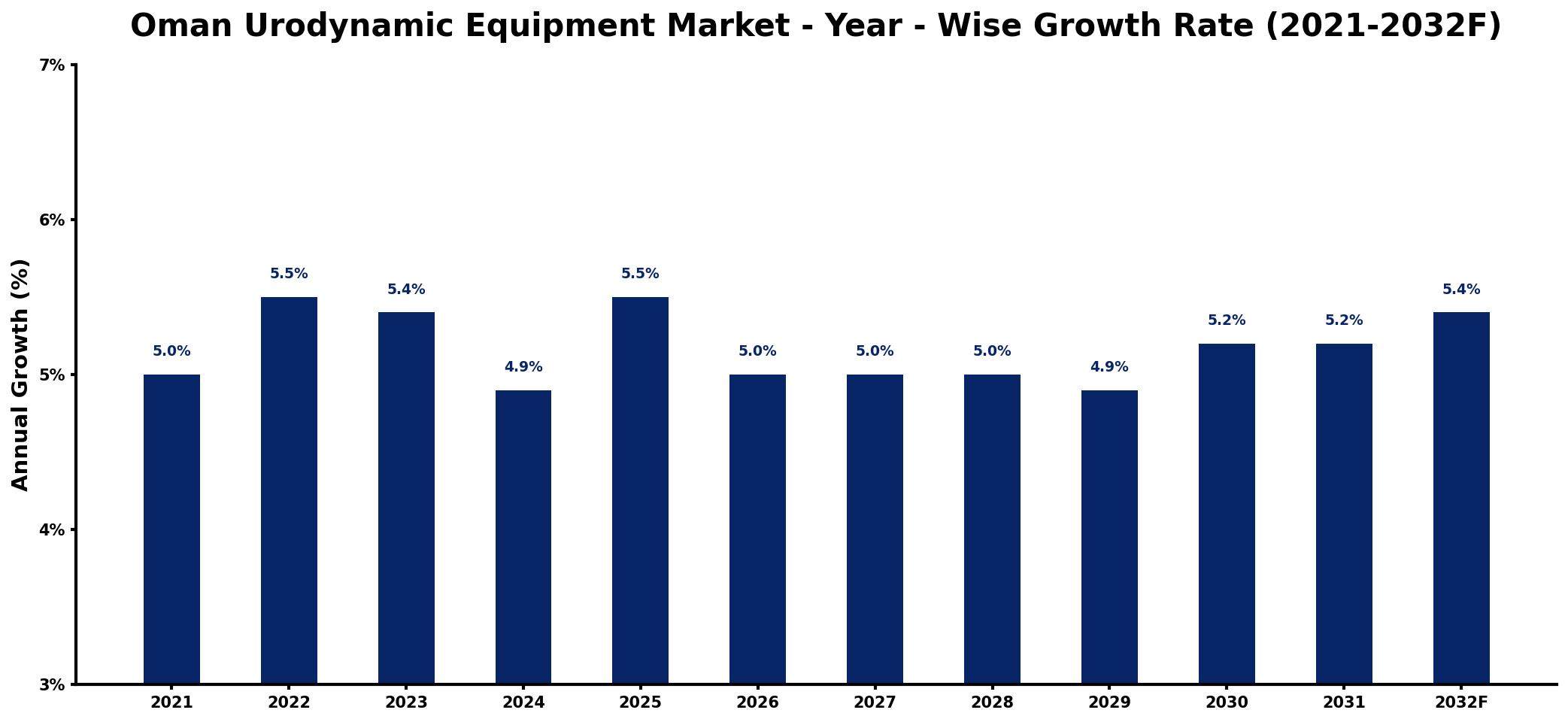
The table below presents the year‑wise growth rates along with the key drivers influencing the market
| Year | Growth Rate | Major Drivers |
| 2021 | 5.0% | Increased healthcare infrastructure investments |
| 2022 | 5.5% | Rising prevalence of urinary disorders |
| 2023 | 5.4% | Advancements in diagnostic technologies |
| 2024 | 4.9% | Growing awareness of patient outcomes |
| 2025 | 5.5% | Expansion of healthcare facilities network |
| 2026 | 5.0% | Surge in aging population demographics |
| 2027 | 5.0% | Enhanced training programs for professionals |
| 2028 | 5.0% | Rising demand for telehealth solutions |
| 2029 | 4.9% | Supportive government healthcare policies |
| 2030 | 5.2% | Increased focus on preventive care |
| 2031 | 5.2% | Growth in clinical research initiatives |
| 2032 | 5.4% | Emergence of innovative treatment methods |
Note: Market size estimations and growth projections presented in this report are based on 6Wresearch's proprietary forecasting methodology, utilizing the latest available industry data, government publications, and primary research inputs.
Oman Urodynamic Equipment Market Synopsis
The Oman Urodynamic Equipment Market is currently in a phase of steady growth, primarily driven by a heightened awareness of urological health and an increase in diagnosed conditions. Urodynamic testing is becoming essential for effective treatment plans, particularly as the population ages and more individuals seek preventive care.
In Oman, the evolution of healthcare infrastructure, supported by governmental initiatives, is pivotal in facilitating access to advanced urodynamic equipment. This is further underscored by technological advancements that aim to enhance patient comfort and diagnostic accuracy, driving both demand and innovation in the market.
Oman Urodynamic Equipment Market Key Takeaways
- The market is projected to grow from USD 151 Million in 2025 to USD 204 Million by 2032.
- Technological innovations are leading to the development of more user-friendly and accurate urodynamic devices.
- The increasing elderly population is a significant contributing factor to rising urological disorders.
- Healthcare facilities are focusing on improving patient outcomes through early diagnosis and treatment.
- Awareness campaigns are vital to overcoming cultural sensitivities surrounding urological conditions.
Evaluation of Restraints in Oman Urodynamic Equipment Market
While the Oman Urodynamic Equipment Market is poised for growth, several restraints pose challenges to its expansion. A notable barrier is the limited awareness among healthcare providers and patients regarding the necessity of urodynamic testing. Moreover, healthcare infrastructure still requires improvement, especially in rural areas, where access to advanced diagnostic technologies remains constrained. The high costs associated with urodynamic equipment may further limit widespread adoption, especially in smaller healthcare facilities that may struggle with budgetary constraints.
Oman Urodynamic Equipment Market Trends
Emerging trends in the Oman Urodynamic Equipment Market indicate a growing preference for non-invasive diagnostic methods, leading to innovations such as wireless systems and telemedicine applications. As healthcare providers strive for more patient-centered approaches, devices that enhance comfort and minimize procedural discomfort are in high demand. The integration of artificial intelligence in data analysis is also becoming a focal point, aiming to improve diagnostic accuracy and patient management.
Oman Urodynamic Equipment Market Opportunities
There are significant investment opportunities within the Oman Urodynamic Equipment Market, particularly for firms looking to introduce advanced diagnostic technologies. As healthcare facilities upgrade their diagnostic capabilities, the demand for sophisticated urodynamic equipment, such as uroflowmetry systems and cystometers, is set to grow. Partnerships with local healthcare providers to facilitate training and support services can further enhance market penetration and customer engagement.
Government Initiatives in the Oman Urodynamic Equipment Market
The Omani government has implemented several initiatives aimed at bolstering healthcare services, including enhancements to urodynamic testing capabilities. Investments in modern medical equipment are prioritized to facilitate accurate diagnoses and improve treatment modalities. Regulatory frameworks ensuring the quality and safety of imported urodynamic equipment have been established, fostering an environment conducive to market growth while enhancing patient care standards.
Future Insights of the Oman Urodynamic Equipment Market
Looking ahead to 2026-2032, the Oman Urodynamic Equipment Market appears well-positioned for sustained growth. The persistent rise in urological disorders coupled with an increasing elderly population is expected to drive demand for advanced diagnostic solutions. Technological advancements, particularly in minimally invasive and remote diagnostic technologies, are likely to enhance the efficacy and accessibility of urodynamic testing, thereby encouraging more healthcare facilities to adopt these innovations.
Oman Urodynamic Equipment Market Latest Developments (2025 - 2026)
Recent developments in the Oman Urodynamic Equipment Market have focused on improving the availability and functionality of diagnostic tools. Several healthcare facilities are exploring partnerships with technology providers to integrate AI-driven systems for better data analysis and patient management. Additionally, awareness programs targeting healthcare professionals have been initiated to ensure widespread understanding of the benefits of urodynamic testing, helping to increase the number of procedures performed.
Oman Urodynamic Equipment Market - Key Attractiveness of the Report
- 10 Years of Market Numbers
- Historical Data Starting from 2022 to 2025
- Base Year: 2025
- Forecast Data until 2032
- Key Performance Indicators Impacting the Market
- Major Upcoming Developments and Projects
Key Highlights of the Report:
- Oman Urodynamic Equipment Market Outlook
- Market Size of Oman Urodynamic Equipment Market, 2025
- Forecast of Oman Urodynamic Equipment Market, 2032
- Historical Data and Forecast of Oman Urodynamic Equipment Revenues & Volume for the Period 2022-2032F
- Oman Urodynamic Equipment Market Trend Evolution
- Oman Urodynamic Equipment Market Drivers and Challenges
- Oman Urodynamic Equipment Price Trends
- Oman Urodynamic Equipment Porter's Five Forces
- Oman Urodynamic Equipment Industry Life Cycle
- Historical Data and Forecast of Oman Urodynamic Equipment Market Revenues & Volume By Product Type for the Period 2022-2032F
- Historical Data and Forecast of Oman Urodynamic Equipment Market Revenues & Volume By Urodynamic Equipment for the Period 2022-2032F
- Historical Data and Forecast of Oman Urodynamic Equipment Market Revenues & Volume By Urodynamic Consumables for the Period 2022-2032F
- Historical Data and Forecast of Oman Urodynamic Equipment Market Revenues & Volume By End User for the Period 2022-2032F
- Historical Data and Forecast of Oman Urodynamic Equipment Market Revenues & Volume By Hospitals for the Period 2022-2032F
- Historical Data and Forecast of Oman Urodynamic Equipment Market Revenues & Volume By Ambulatory Centers for the Period 2022-2032F
- Historical Data and Forecast of Oman Urodynamic Equipment Market Revenues & Volume By Diagnostic Centers for the Period 2022-2032F
- Historical Data and Forecast of Oman Urodynamic Equipment Market Revenues & Volume By Others for the Period 2022-2032F
- Oman Urodynamic Equipment Import Export Trade Statistics
- Market Opportunity Assessment By Product Type
- Market Opportunity Assessment By End User
- Oman Urodynamic Equipment Top Companies Market Share
- Oman Urodynamic Equipment Competitive Benchmarking By Technical and Operational Parameters
- Oman Urodynamic Equipment Company Profiles
- Oman Urodynamic Equipment Key Strategic Recommendations






































