Oman Washing Machine Market Size, Share & Growth Rate
The Oman Washing Machine Market was estimated at USD 1492 Million in 2025 and is projected to reach USD 2134 Million by 2032, growing at a CAGR of 5.2% from 2026 to 2032. This robust growth trajectory is primarily fueled by the increasing urbanization in Oman, which is leading to higher disposable incomes and a growing affinity for modern household appliances. Additionally, advancements in technology, particularly in the areas of energy efficiency and smart features, are enhancing consumer interest in washing machines, making them indispensable in daily life.
Oman Washing Machine Market Growth Rate Analysis (2021-2032)
The Omani washing machine market has exhibited stable growth, with annual increases primarily driven by rising consumer demand and increased investments in home appliances. The market recorded a growth rate of 6.3% in 2021, followed by 5.8% in 2022, reflecting fluctuations influenced by global supply chain challenges. However, the momentum picked up again in 2023 at 6.0% and is projected to maintain a growth rate of 6.1% into 2024 and 2025. Key factors fueling this growth include advancements in technology, heightened awareness of energy-efficient appliances, and a growing middle-class population eager for modern conveniences. The market's expected expansion through to 2032 underscores the positive response to evolving consumer preferences and ongoing infrastructural improvements in Oman.
Oman Washing Machine Market Year-wise Growth Rate and Key Drivers
This graph highlights how the Oman Washing Machine Market has steadily grown over the past five years, supported by major growth factors.
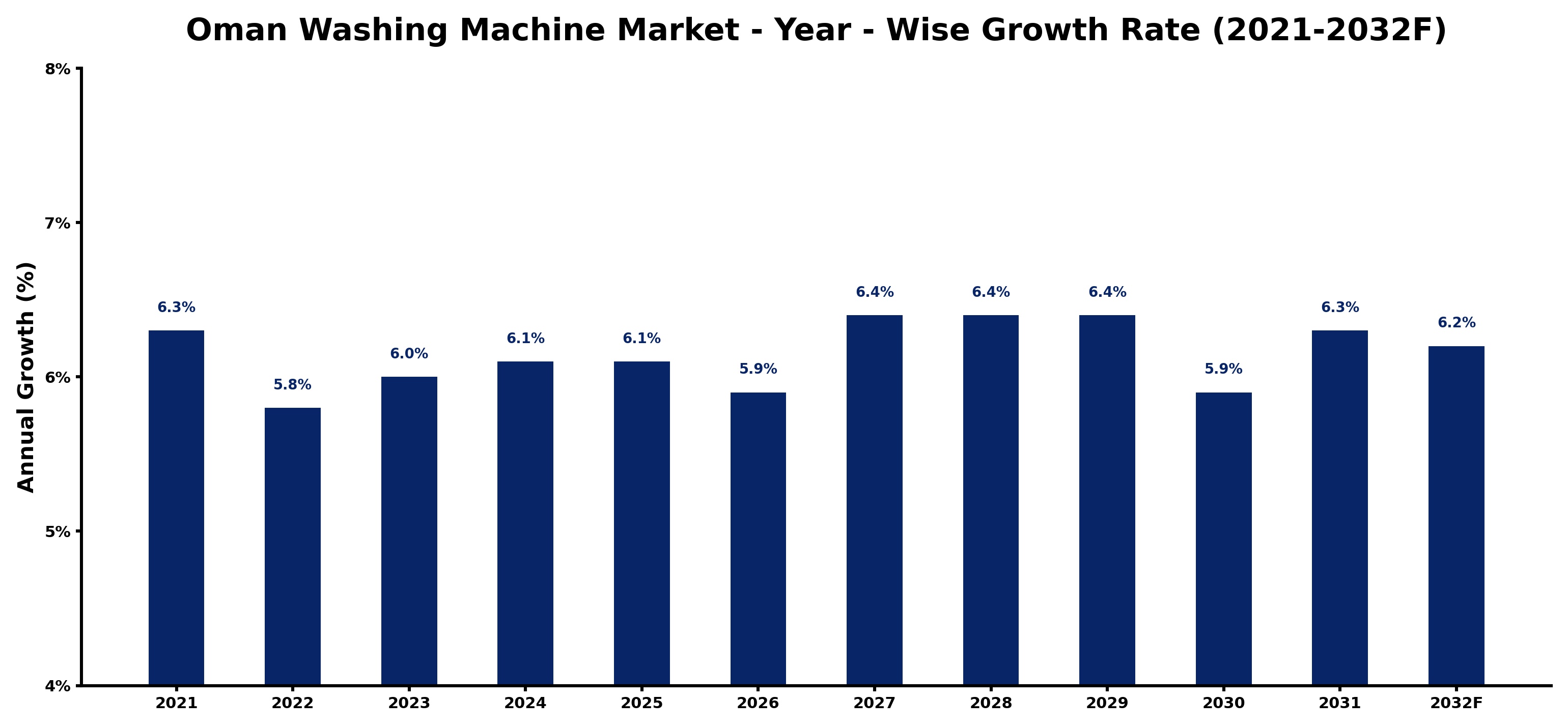
The table below presents the year‑wise growth rates along with the key drivers influencing the market
| Year | Growth Rate | Major Drivers |
| 2021 | 6.3% | Higher demand for eco friendly products drives local manufacturing investments |
| 2022 | 5.8% | Retail refurbishment projects stimulate demand for washing machine imports |
| 2023 | 6.0% | Technology integration drives advanced washing machine production efficiency |
| 2024 | 6.1% | Local assembly plants boost washing machine production capabilities significantly |
| 2025 | 6.1% | Export driven demand for eco friendly washing machines boosts manufacturing investments |
| 2026 | 5.9% | Improved assembly line efficiency boosted washing machine production capacity |
| 2027 | 6.4% | Local assembly plants optimized logistics, boosting washing machine output |
| 2028 | 6.4% | Manufacturing investments in automation boost washing machine production capacity |
| 2029 | 6.4% | Local assembly plants enhance washing machine manufacturing capacity in Oman |
| 2030 | 5.9% | Surging hospitality sector drives washing machine production demand in Oman |
| 2031 | 6.3% | Smart washing machine technology integration boosts local assembly line efficiency |
| 2032 | 6.2% | Domestic assembly plants boost washing machine manufacturing efficiency and output |
Note - Market size estimations and growth projections presented in this report are based on 6Wresearch’s advanced forecasting approach, validated with industry datasets as of June 2026.
Oman Washing Machine Market Synopsis
In recent years, the Oman washing machine market has experienced considerable momentum, spurred by a shift in consumer behavior and a growing housing sector. However, as we look to the future, the market is expected to evolve, driven by continued technological innovation and a push towards sustainability in household appliances.
Despite this positive outlook, the market must navigate challenges related to low penetration in certain demographic segments, particularly among rural households. As more consumers embrace automated solutions for their laundry needs, we can anticipate a transformative period that bridges the gap between traditional practices and modern convenience.
Oman Washing Machine Market Key Takeaways
- The Oman washing machine market is positioned for significant growth, influenced by increasing urbanization and disposable incomes.
- Technological advancements, particularly in energy-efficient and smart appliance features, are reshaping consumer preferences.
- Market penetration remains a challenge in rural areas, necessitating targeted strategies to enhance accessibility and affordability.
- Government policies promoting sustainability are expected to foster a more eco-friendly appliance landscape.
- Consumer education and incentive programs will play a vital role in driving the adoption of modern washing machines.
Evaluation of Restraints in Oman Washing Machine Market
The Oman washing machine market faces notable challenges that may hinder its growth potential. A key restraint is the relatively low penetration of washing machines in certain segments, especially in rural areas where traditional handwashing remains dominant. Affordability and access to financing options are critical barriers that need to be addressed to encourage broader adoption. Additionally, there are concerns regarding water and energy efficiency, particularly given the resource constraints in Oman. To ensure sustainable market growth, it will be essential to promote awareness and availability of energy-efficient and water-saving washing machines.
Oman Washing Machine Market Trends
Several current and emerging trends are shaping the Oman washing machine market. The shift towards smart appliances, equipped with IoT technology, is gaining traction, offering consumers enhanced convenience and control. Moreover, there is a growing preference for eco-friendly appliances, reflecting a societal trend towards sustainability. The demand for multifunctional machines that cater to various laundry needs is also on the rise, as consumers seek efficiency and versatility in their home appliances.
Oman Washing Machine Market Opportunities
The Oman washing machine market presents a myriad of growth opportunities for manufacturers and investors alike. Expanding into underpenetrated rural areas through affordable pricing strategies can unlock significant potential. Additionally, investing in consumer education about the benefits of modern washing machines, especially energy-efficient models, is likely to drive demand. Partnerships with local retailers to improve product accessibility and promotional campaigns that highlight the convenience and effectiveness of washing machines can further stimulate market expansion.
Government Initiatives in the Oman Washing Machine Market
The Omani government plays an instrumental role in supporting the washing machine market through various initiatives. Policies aimed at promoting energy-efficient and water-saving technologies are becoming increasingly significant. This includes potential subsidies for energy-efficient appliances and regulations enforcing environmental standards. Public awareness campaigns are also being implemented to educate consumers on the advantages of modern washing machines, fostering a more informed consumer base.
Future Insights of the Oman Washing Machine Market
Looking ahead to 2026-2032, the Oman washing machine market is poised for transformative growth, driven by technological advancements and changing consumer behaviors. As urbanization continues to rise, coupled with increasing disposable incomes, the demand for automated household solutions will likely escalate. The integration of smart technologies and eco-friendly features will play a significant role in attracting environmentally conscious consumers. Overall, the market is set to evolve into a more innovative and sustainable landscape, aligning with global trends.
Oman Washing Machine Market Latest Developments (May 2025 - June 2026)
In the latest developments, the Oman washing machine market is witnessing a surge in the introduction of advanced models featuring smart technologies and enhanced energy efficiency. Consumer interest in eco-friendly appliances is leading companies to innovate and diversify their product offerings. Additionally, promotional efforts are increasingly focusing on educating consumers about the benefits of modern washing machines, further driving market engagement. As housing projects expand, so too does the opportunity for new entrants to capitalize on this growing demand.
Oman Washing Machine Market - Key Attractiveness of the Report
- 10 Years of Market Numbers
- Historical Data Starting from 2022 to 2025
- Base Year: 2025
- Forecast Data until 2032
- Key Performance Indicators Impacting the Market
- Major Upcoming Developments and Projects
Key Highlights of the Report:
- Oman Washing Machine Market Outlook
- Market Size of Oman Washing Machine Market, 2025
- Forecast of Oman Washing Machine Market, 2032
- Historical Data and Forecast of Oman Washing Machine Revenues & Volume for the Period 2022-2032F
- Oman Washing Machine Market Trend Evolution
- Oman Washing Machine Market Drivers and Challenges
- Oman Washing Machine Price Trends
- Oman Washing Machine Porter's Five Forces
- Oman Washing Machine Industry Life Cycle
- Historical Data and Forecast of Oman Washing Machine Market Revenues & Volume By Product for the Period 2022-2032F
- Historical Data and Forecast of Oman Washing Machine Market Revenues & Volume By Fully automatic for the Period 2022-2032F
- Historical Data and Forecast of Oman Washing Machine Market Revenues & Volume By Semi-automatic for the Period 2022-2032F
- Historical Data and Forecast of Oman Washing Machine Market Revenues & Volume By Dryers for the Period 2022-2032F
- Historical Data and Forecast of Oman Washing Machine Market Revenues & Volume By Technology for the Period 2022-2032F
- Historical Data and Forecast of Oman Washing Machine Market Revenues & Volume By Smart connected washing machine for the Period 2022-2032F
- Historical Data and Forecast of Oman Washing Machine Market Revenues & Volume By Conventional washing machine for the Period 2022-2032F
- Historical Data and Forecast of Oman Washing Machine Market Revenues & Volume By Capacity for the Period 2022-2032F
- Historical Data and Forecast of Oman Washing Machine Market Revenues & Volume By Below 6 kg for the Period 2022-2032F
- Historical Data and Forecast of Oman Washing Machine Market Revenues & Volume By 6.1 to 8 kg for the Period 2022-2032F
- Historical Data and Forecast of Oman Washing Machine Market Revenues & Volume By Above 8 kg for the Period 2022-2032F
- Historical Data and Forecast of Oman Washing Machine Market Revenues & Volume By End-use for the Period 2022-2032F
- Historical Data and Forecast of Oman Washing Machine Market Revenues & Volume By Commercial for the Period 2022-2032F
- Historical Data and Forecast of Oman Washing Machine Market Revenues & Volume By Residential for the Period 2022-2032F
- Historical Data and Forecast of Oman Washing Machine Market Revenues & Volume By Application for the Period 2022-2032F
- Historical Data and Forecast of Oman Washing Machine Market Revenues & Volume By Healthcare for the Period 2022-2032F
- Historical Data and Forecast of Oman Washing Machine Market Revenues & Volume By Hospitality for the Period 2022-2032F
- Historical Data and Forecast of Oman Washing Machine Market Revenues & Volume By Others for the Period 2022-2032F
- Oman Washing Machine Import Export Trade Statistics
- Market Opportunity Assessment By Product
- Market Opportunity Assessment By Technology
- Market Opportunity Assessment By Capacity
- Market Opportunity Assessment By End-use
- Market Opportunity Assessment By Application
- Oman Washing Machine Top Companies Market Share
- Oman Washing Machine Competitive Benchmarking By Technical and Operational Parameters
- Oman Washing Machine Company Profiles
- Oman Washing Machine Key Strategic Recommendations






































