Oman Wind Energy Market Size, Share & Growth Rate
The Oman Wind Energy Market was estimated at USD 311 Million in 2025 and is projected to reach USD 405 Million by 2032, growing at a CAGR of 3.8% from 2026 to 2032. This growth is primarily driven by the Omani government's resolute efforts to diversify its energy sources, shifting away from a heavy reliance on fossil fuels. The favorable wind conditions prevalent in coastal and mountainous regions of Oman further enhance the investment appeal for wind energy projects, catalyzing a robust market environment.
Oman Wind Energy Market Year-wise Growth Rate and Key Drivers
This graph highlights how the Oman Wind Energy Market has steadily grown over the years, supported by major growth factors.
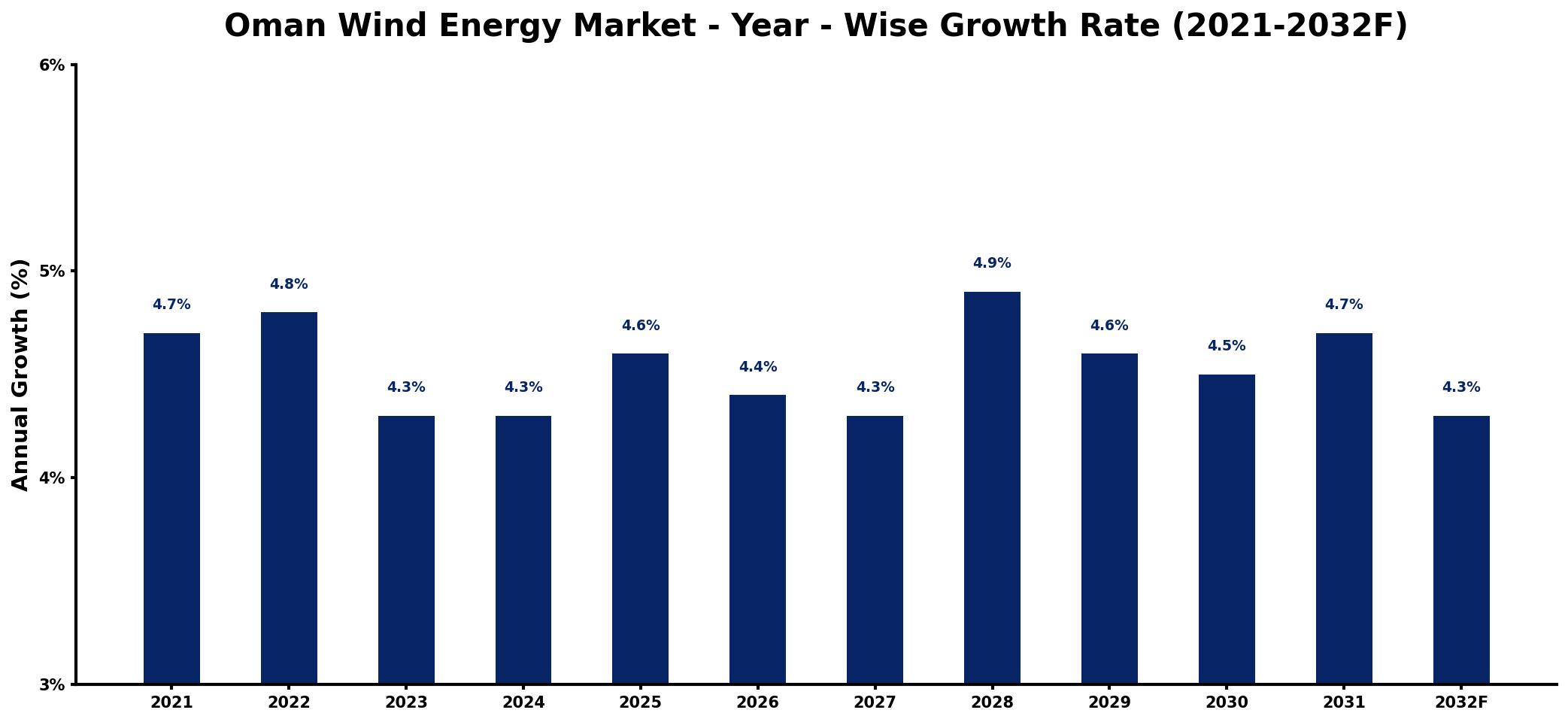
The table below presents the year‑wise growth rates along with the key drivers influencing the market
| Year | Growth Rate | Major Drivers |
| 2021 | 4.7% | Rising investments in renewable technologies |
| 2022 | 4.8% | Increased government support initiatives |
| 2023 | 4.3% | Growing demand for sustainable solutions |
| 2024 | 4.3% | Advancements in technology and efficiency |
| 2025 | 4.6% | Expansion of infrastructure projects |
| 2026 | 4.4% | Emergence of new market players |
| 2027 | 4.3% | rising demand from electronics |
| 2028 | 4.9% | Increased foreign direct investments |
| 2029 | 4.6% | Heightened awareness of climate change |
| 2030 | 4.5% | enhanced product quality standards |
| 2031 | 4.7% | Growing consumer preference for sustainability |
| 2032 | 4.3% | Development of innovative financing models |
Note: Market size estimations and growth projections presented in this report are based on 6Wresearch's proprietary forecasting methodology, utilizing the latest available industry data, government publications, and primary research inputs.
Oman Wind Energy Market Synopsis
The most influential factor currently shaping the Oman Wind Energy Market is the government's commitment to enhancing the share of renewable energy in the national energy portfolio. With aggressive targets set under the National Energy Strategy 2040, wind energy is positioned to play a crucial role in the countrys future energy landscape.
Additionally, the favorable regulatory framework and supportive policies are instrumental in spurring investments and partnerships across the industry. The increasing collaboration between international entities and local firms is particularly notable, aiming to leverage Oman's untapped wind resources for sustainable energy generation.
Oman Wind Energy Market Key Takeaways
- Significant growth expected due to government-driven renewable energy initiatives.
- Coastal and mountainous regions provide substantial wind resources for project development.
- Collaboration between local and international companies is accelerating market expansion.
- Technological advancements in turbine efficiency are shaping new project designs.
- Investment opportunities are bolstered by government incentives and strategic policies.
Evaluation of Restraints in Oman Wind Energy Market
Despite the optimistic outlook, the Oman Wind Energy Market faces some notable restraints that could hinder its development. A key challenge is the limited infrastructure necessary for effective wind energy generation, which includes underdeveloped transmission and distribution systems. Additionally, the intermittent nature of wind production underscores the necessity for sophisticated energy storage solutions, which are currently insufficient in Oman. High initial costs for establishing wind farms, combined with a scarcity of skilled workforce and expertise in the sector, also pose significant barriers. Addressing these challenges will be imperative for the market to realize its full potential.
Oman Wind Energy Market Trends
The landscape of the Oman Wind Energy Market is characterized by several current trends that are shaping its future. Notably, there is a marked shift towards the implementation of larger, more efficient wind turbines designed to maximize energy output. The integration of advanced technologies, such as energy storage systems, is becoming essential to mitigate the challenges posed by the intermittency of wind energy. Furthermore, public and private sector collaborations are on the rise, fostering a dynamic environment ripe for innovation and expansion. These trends indicate a commitment to a more sustainable energy future and an eagerness to harness Oman's wind potential effectively.
Oman Wind Energy Market Opportunities
The Oman Wind Energy Market offers a wealth of investment opportunities, underscored by the country's focus on transitioning to renewable energy sources. The governments favorable stance towards wind energy development, including financial incentives and a regulatory framework designed to attract private investments, presents a fertile ground for growth. Opportunities abound across the entire value chain, from project development to equipment supply and maintenance services. As the demand for electricity continues to surge, Oman's advantageous geographic location and abundant wind resources further elevate the attractiveness of investing in this sector.
Government Initiatives in the Oman Wind Energy Market
The Omani government is actively fostering the growth of the wind energy sector through an array of initiatives and policies. The National Energy Strategy 2040 is pivotal in this regard, as it aims to significantly increase the share of renewable sources, including wind power, in the national energy mix. Regulatory oversight by the Authority for Electricity Regulation (AER) is crucial in facilitating the development and promotion of renewable projects. Various incentives, such as feed-in tariffs and power purchase agreements, are also in place to stimulate investments and encourage participation from the private sector. These efforts collectively aim to create a conducive environment for the sustainable growth of the wind energy market.
Future Insights of the Oman Wind Energy Market
Looking ahead to the period between 2026 and 2032, the Oman Wind Energy Market is anticipated to experience robust growth, fueled by ambitious renewable energy targets set by the government. The ongoing focus on sustainability and the transition towards cleaner energy sources positions the market for a substantial increase in installed capacity. As collaboration between stakeholders intensifies, and technological advancements continue to emerge, the future appears bright for wind energy in Oman, paving the way for a greener energy landscape.
Oman Wind Energy Market Latest Developments (2025 - 2026)
In recent months, the Oman Wind Energy Market has seen a flurry of activity, reflecting the growing momentum behind renewable energy projects. Various initiatives have been launched, focusing on enhancing the infrastructure necessary for wind energy generation. Partnerships between local companies and international firms are becoming more prevalent, as collaborative efforts are strengthened to harness Oman's wind potential. Furthermore, discussions around innovative financing models and technological upgrades are underway to ensure the effective deployment of wind projects in the region, indicating a proactive approach to overcoming existing challenges.
Oman Wind Energy Market - Key Attractiveness of the Report
- 10 Years of Market Numbers
- Historical Data Starting from 2022 to 2025
- Base Year: 2025
- Forecast Data until 2032
- Key Performance Indicators Impacting the Market
- Major Upcoming Developments and Projects
Key Highlights of the Report:
- Oman Wind Energy Market Outlook
- Market Size of Oman Wind Energy Market, 2025
- Forecast of Oman Wind Energy Market, 2032
- Historical Data and Forecast of Oman Wind Energy Revenues & Volume for the Period 2022-2032F
- Oman Wind Energy Market Trend Evolution
- Oman Wind Energy Market Drivers and Challenges
- Oman Wind Energy Price Trends
- Oman Wind Energy Porter's Five Forces
- Oman Wind Energy Industry Life Cycle
- Historical Data and Forecast of Oman Wind Energy Market Revenues & Volume By Type for the Period 2022-2032F
- Historical Data and Forecast of Oman Wind Energy Market Revenues & Volume By Offshore for the Period 2022-2032F
- Historical Data and Forecast of Oman Wind Energy Market Revenues & Volume By Onshore for the Period 2022-2032F
- Historical Data and Forecast of Oman Wind Energy Market Revenues & Volume By End User for the Period 2022-2032F
- Historical Data and Forecast of Oman Wind Energy Market Revenues & Volume By Industrial for the Period 2022-2032F
- Historical Data and Forecast of Oman Wind Energy Market Revenues & Volume By Commercial for the Period 2022-2032F
- Historical Data and Forecast of Oman Wind Energy Market Revenues & Volume By Residential for the Period 2022-2032F
- Oman Wind Energy Import Export Trade Statistics
- Market Opportunity Assessment By Type
- Market Opportunity Assessment By End User
- Oman Wind Energy Top Companies Market Share
- Oman Wind Energy Competitive Benchmarking By Technical and Operational Parameters
- Oman Wind Energy Company Profiles
- Oman Wind Energy Key Strategic Recommendations






































