Oman Yarn Market Size, Share & Growth Rate
The Oman Yarn Market was estimated at USD 229 Million in 2025 and is projected to reach USD 321 Million by 2032, growing at a CAGR of 4.9% from 2026 to 2032. This upward trajectory is primarily fueled by the increasing demand for textiles and garments within Oman, driven by evolving consumer preferences and a growing fashion industry. Furthermore, government initiatives aimed at bolstering the textile manufacturing sector contribute significantly to the market's robust outlook.
Oman Yarn Market Growth Rate Analysis (2021-2032)
The Oman Yarn Market displays a stable growth pattern, with annual growth rates ranging from 5.5% to 6.2% from 2021 to 2032. Notably, the growth rate peaked at 6.2% in 2024, driven by increasing consumer demand for high-quality textiles, bolstered by investments in modern manufacturing technologies and sustainable practices. The market maintained a steady 5.6% in 2022 and 2023, reflecting stable economic conditions and consistent demand. Fluctuations are expected, with a slight dip to 5.5% in 2026, likely due to global supply chain disruptions. However, factors such as energy transition initiatives and digitalization are anticipated to foster a rebound, supporting a gradual increase to 6.0% by 2032.
Oman Yarn Market Year-wise Growth Rate and Key Drivers
This graph highlights how the Oman Yarn Market has steadily grown over the past five years, supported by major growth factors.
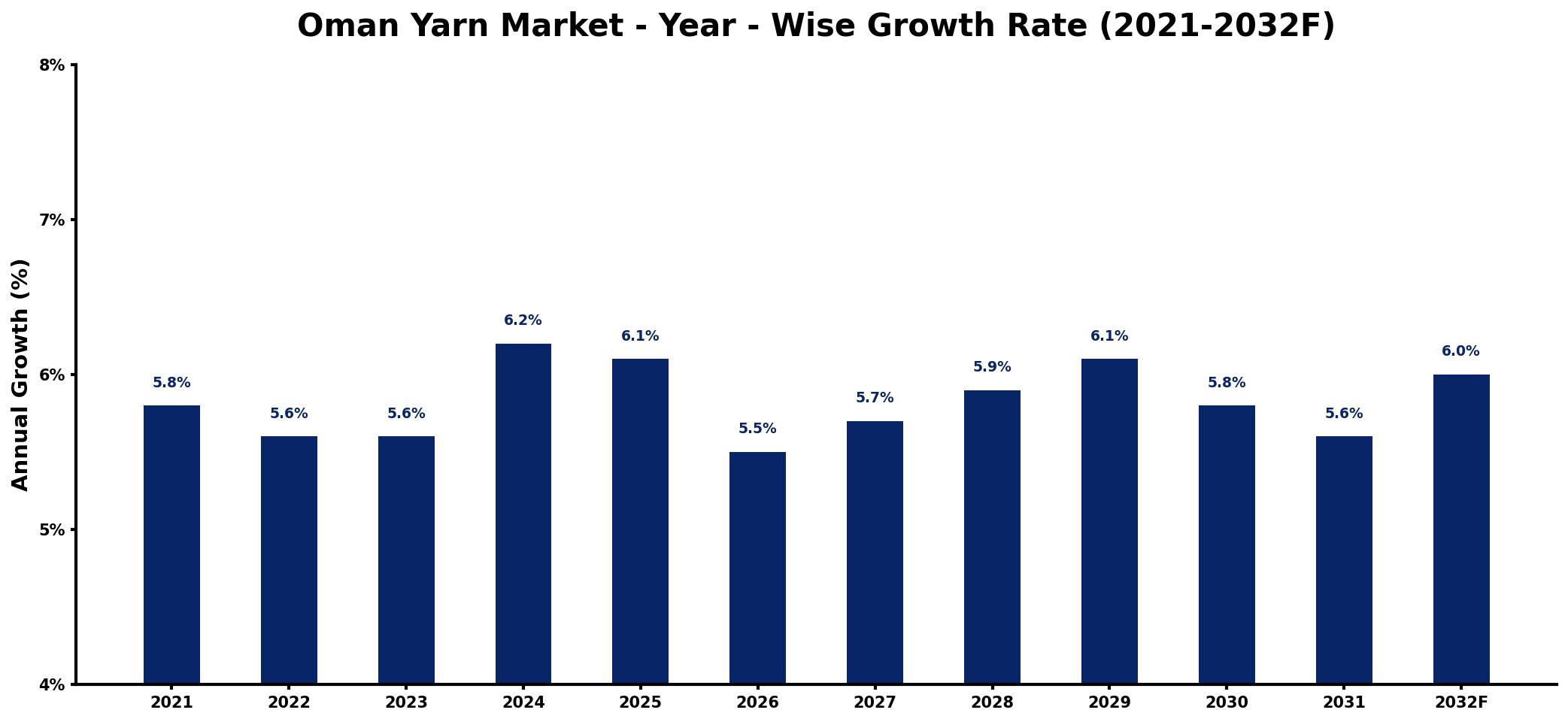
The table below presents the year‑wise growth rates along with the key drivers influencing the market
| Year | Growth Rate | Major Drivers |
| 2021 | 5.8% | Rising textile manufacturing capabilities |
| 2022 | 5.6% | Increased fashion industry demand |
| 2023 | 5.6% | Expansion of eco-friendly materials |
| 2024 | 6.2% | Growth in home textile sector |
| 2025 | 6.1% | Technological advancements in production |
| 2026 | 5.5% | Surge in export opportunities |
| 2027 | 5.7% | Growing demand for technical textiles |
| 2028 | 5.9% | Investment in sustainable practices |
| 2029 | 6.1% | Emergence of new market players |
| 2030 | 5.8% | Rising consumer awareness trends |
| 2031 | 5.6% | Diversification in textile applications |
| 2032 | 6.0% | Strengthening supply chain networks |
Note: Market size estimations and growth projections presented in this report are based on 6Wresearch's proprietary forecasting methodology, utilizing the latest available industry data, government publications, and primary research inputs.
Oman Yarn Market Synopsis
The Oman yarn market is currently witnessing notable growth, underpinned by a rising awareness of sustainable fashion and a shift towards eco-friendly materials. This aligns with global trends that emphasize sustainable practices, pushing manufacturers to innovate with organic and recycled yarn options.
Oman's strategic geographical position, coupled with supportive government policies, enhances its attractiveness as a production hub for various types of yarn, including cotton, polyester, and blends. The market's evolution reflects a proactive response to both local consumer demands and international market dynamics.
Oman Yarn Market Key Takeaways
- The market is currently expanding due to increasing demand for textiles and garments.
- Sustainability is a primary focus, with a rise in eco-friendly and organic yarns.
- Technological advancements are enabling the production of innovative yarn blends.
- Government initiatives support the growth of the local yarn manufacturing industry.
- Investment opportunities abound in spinning mills and modernization of production facilities.
Evaluation of Restraints in Oman Yarn Market
Despite its positive growth trajectory, the Oman yarn market grapples with several challenges that could hinder its progress. Fluctuating raw material prices often impact production costs, creating unpredictability for manufacturers. Intense competition from international players puts pressure on local businesses to innovate and adapt swiftly to consumer preferences. Furthermore, the reliance on imported materials can make the market vulnerable to global economic fluctuations and currency volatility. Limited access to skilled labor also complicates matters, as manufacturers strive to keep pace with advancements in technology and production methods. These challenges require strategic approaches to ensure long-term sustainability and competitiveness.
Oman Yarn Market Trends
The market is currently witnessing a pronounced trend towards sustainability, with consumers increasingly favoring products that are environmentally friendly. Organic and recycled yarns are gaining traction, as manufacturers respond to this shift by integrating natural fibers into their offerings. Additionally, the growing interest in customization and personalization is reshaping product development, pushing brands to create specialty yarns tailored for niche applications. Advances in technology are also paving the way for innovative yarn types, enhancing performance attributes and expanding the scope of applications in the textile industry.
Oman Yarn Market Opportunities
The Oman yarn market is ripe with investment opportunities, particularly in sectors such as spinning mills and modern production facilities. As demand for quality yarn products rises, manufacturers are encouraged to explore the integration of advanced technologies to improve production efficiency and product offerings. Collaborating with local textile manufacturers presents a strategic advantage, allowing investors to tap into existing supply chains and market knowledge. Furthermore, the governments initiatives to bolster the manufacturing sector provide a conducive environment for investments aimed at capitalizing on the evolving market landscape.
Government Initiatives in the Oman Yarn Market
The Omani government has actively implemented policies to enhance the competitiveness of the yarn industry. Initiatives include providing incentives and subsidies to local manufacturers to encourage innovation and research development. Support for partnerships with international players is also a focus, aimed at fostering technology transfer and improving production methods. Moreover, the government is working to strengthen infrastructure and logistics, facilitating smoother operations within the yarn market, ultimately supporting the industrys growth and global competitiveness.
Future Insights of the Oman Yarn Market
Looking ahead to 2026-2032, the Oman yarn market is anticipated to sustain its growth momentum, driven by the escalating demand for textiles, particularly within the growing fashion sector. As disposable incomes rise, consumer interest in a diverse range of yarn products is set to increase. The trend towards sustainability will likely amplify, with a greater emphasis on eco-friendly materials and practices. While challenges such as fluctuating raw material prices persist, the ongoing government support is expected to play a pivotal role in navigating these hurdles and fostering a robust yarn market in Oman.
Oman Yarn Market Latest Developments (2025 - 2026)
In recent months, the Oman yarn market has seen a marked push towards innovation, with several manufacturers investing in advanced technologies to streamline production processes. There is also an increasing focus on developing partnerships that facilitate knowledge transfer and collaborative product development. Moreover, sustainability initiatives are at the forefront, as local companies strive to incorporate more eco-friendly practices into their production lines. Such developments indicate a collective commitment to enhancing the market's global standing.
Oman Yarn Market - Key Attractiveness of the Report
- 10 Years of Market Numbers
- Historical Data Starting from 2022 to 2025
- Base Year: 2025
- Forecast Data until 2032
- Key Performance Indicators Impacting the Market
- Major Upcoming Developments and Projects
Key Highlights of the Report:
- Oman Yarn Market Outlook
- Market Size of Oman Yarn Market, 2025
- Forecast of Oman Yarn Market, 2032
- Historical Data and Forecast of Oman Yarn Revenues & Volume for the Period 2022-2032F
- Oman Yarn Market Trend Evolution
- Oman Yarn Market Drivers and Challenges
- Oman Yarn Price Trends
- Oman Yarn Porter's Five Forces
- Oman Yarn Industry Life Cycle
- Historical Data and Forecast of Oman Yarn Market Revenues & Volume By Source for the Period 2022-2032F
- Historical Data and Forecast of Oman Yarn Market Revenues & Volume By Animal for the Period 2022-2032F
- Historical Data and Forecast of Oman Yarn Market Revenues & Volume By Chemical for the Period 2022-2032F
- Historical Data and Forecast of Oman Yarn Market Revenues & Volume By Plant for the Period 2022-2032F
- Historical Data and Forecast of Oman Yarn Market Revenues & Volume By Material for the Period 2022-2032F
- Historical Data and Forecast of Oman Yarn Market Revenues & Volume By Natural Fiber for the Period 2022-2032F
- Historical Data and Forecast of Oman Yarn Market Revenues & Volume By Synthetic Fiber for the Period 2022-2032F
- Historical Data and Forecast of Oman Yarn Market Revenues & Volume By Material for the Period 2022-2032F
- Historical Data and Forecast of Oman Yarn Market Revenues & Volume By Natural Fiber for the Period 2022-2032F
- Historical Data and Forecast of Oman Yarn Market Revenues & Volume By Synthetic Fiber for the Period 2022-2032F
- Historical Data and Forecast of Oman Yarn Market Revenues & Volume By Application for the Period 2022-2032F
- Historical Data and Forecast of Oman Yarn Market Revenues & Volume By Apparel for the Period 2022-2032F
- Historical Data and Forecast of Oman Yarn Market Revenues & Volume By Home Textile for the Period 2022-2032F
- Historical Data and Forecast of Oman Yarn Market Revenues & Volume By Industrial for the Period 2022-2032F
- Oman Yarn Import Export Trade Statistics
- Market Opportunity Assessment By Source
- Market Opportunity Assessment By Material
- Market Opportunity Assessment By Material
- Market Opportunity Assessment By Application
- Oman Yarn Top Companies Market Share
- Oman Yarn Competitive Benchmarking By Technical and Operational Parameters
- Oman Yarn Company Profiles
- Oman Yarn Key Strategic Recommendations






































