Oman Zinc Sulphate Market Size, Share & Growth Rate
The Oman Zinc Sulphate Market was estimated at USD 400 Million in 2025 and is projected to reach USD 566 Million by 2032, growing at a CAGR of 5.1% from 2026 to 2032. This promising growth trajectory is largely driven by the increasing emphasis on sustainable agricultural practices and the rising adoption of advanced nutrient management techniques across Oman. The heightened awareness regarding soil health and the role of micronutrients in enhancing crop yields further catalyze the demand for zinc sulfate, reinforcing its significance in both agricultural and industrial applications.
Oman Zinc Sulphate Market Year-wise Growth Rate and Key Drivers
This graph highlights how the Oman Zinc Sulphate Market has steadily grown over the years, supported by major growth factors.
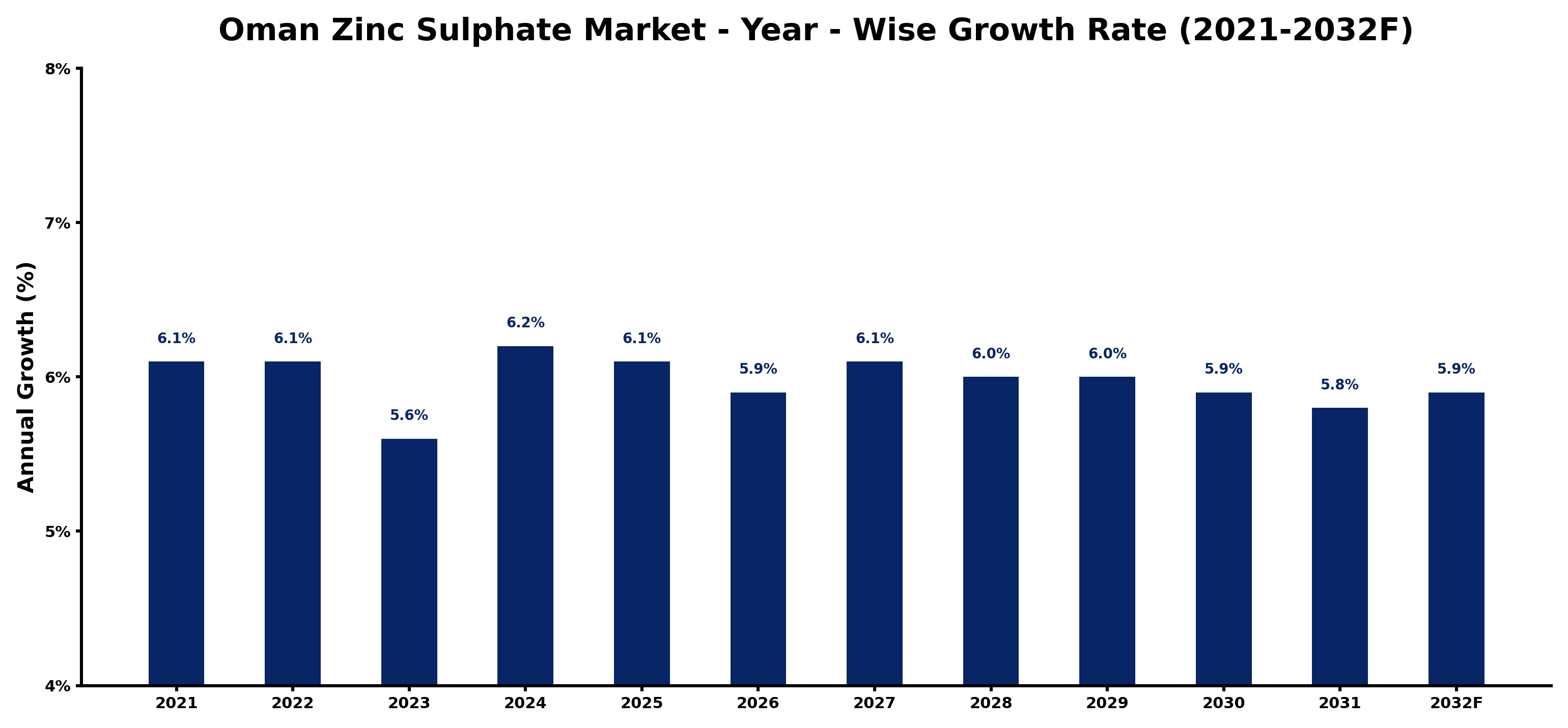
The table below presents the year‑wise growth rates along with the key drivers influencing the market
| Year | Growth Rate | Major Drivers |
| 2021 | 6.1% | Agricultural sector demand increased |
| 2022 | 6.1% | Fertilizer usage expanded significantly |
| 2023 | 5.6% | Livestock farming practices improved |
| 2024 | 6.2% | Export opportunities enhanced growth |
| 2025 | 6.1% | Soil health awareness increased |
| 2026 | 5.9% | Crop yield optimization gained traction |
| 2027 | 6.1% | Sustainable farming practices adopted |
| 2028 | 6.0% | Government support for agriculture |
| 2029 | 6.0% | Research and development investments rose |
| 2030 | 5.9% | Zinc deficiency awareness heightened |
| 2031 | 5.8% | Organic farming trends influenced demand |
| 2032 | 5.9% | Technological advancements improved production |
Note - Market size estimations and growth projections presented in this report are based on 6Wresearch’s advanced forecasting approach, validated with industry datasets as of June 2026.
Oman Zinc Sulphate Market Synopsis
The strongest force shaping the Oman Zinc Sulphate Market today is the escalating use of zinc sulfate in agriculture, particularly as a micronutrient fertilizer. As farmers strive to improve crop quality and output, zinc sulfate has emerged as a key solution to address zinc deficiencies in soil, which are becoming increasingly recognized as detrimental to agricultural productivity.
Alongside agricultural uses, the incorporation of zinc sulfate in animal nutrition is gaining traction. Livestock producers are increasingly aware of the benefits associated with zinc supplementation, leading to enhanced growth rates and improved immune function in poultry and livestock. This multifaceted application spectrum positions zinc sulfate as a critical component in both farming and animal husbandry sectors in Oman.
Oman Zinc Sulphate Market Key Takeaways
- The market is primarily driven by agricultural demand, emphasizing the need for micronutrient fertilizers.
- Advancements in nutrient management and modern farming techniques play a crucial role in market expansion.
- The aquaculture sector is emerging as a significant application area for zinc sulfate in Oman.
- Government policies supporting agricultural productivity and quality control are facilitating market growth.
- Rising awareness about the importance of zinc in animal nutrition is boosting demand across livestock sectors.
Evaluation of Restraints in Oman Zinc Sulphate Market
Despite the growth potential, the Oman Zinc Sulphate Market faces notable restraints that could inhibit expansion. Fluctuations in the availability and pricing of key raw materials, such as zinc ore and sulfuric acid, present significant challenges to producers. Furthermore, maintaining consistent product quality and complying with stringent regulatory standards in agriculture and pharmaceuticals adds layers of complexity. The presence of competitive alternative zinc sources also creates a more dynamic market environment, where differentiation becomes essential for market players.
Oman Zinc Sulphate Market Trends
Several trends are emerging within the Oman Zinc Sulphate Market that are reshaping demand and influencing technology use. The rise of precision agriculture is notable; technologies that enable targeted application of micronutrients are gaining traction among farmers, thereby optimizing fertilizer use efficiency. Additionally, the trend toward organic farming and sustainable practices is encouraging a greater focus on the natural benefits of zinc sulfate, highlighting its role in promoting soil health without compromising environmental standards.
Oman Zinc Sulphate Market Opportunities
Significant growth and investment opportunities lie in the diversification of applications for zinc sulfate beyond traditional agriculture. The growing aquaculture industry, alongside potential uses in water treatment processes, presents new avenues for market players. Moreover, with increasing consumer awareness surrounding nutrition, the integration of zinc sulfate in dietary supplements for human health is becoming a promising frontier. Emphasizing research and development to innovate new formulations can further enhance competitive advantages in this evolving market landscape.
Government Initiatives in the Oman Zinc Sulphate Market
The government of Oman is playing a proactive role in fostering a conducive environment for the zinc sulfate market. Through subsidies for manufacturers and importers, the government aims to stabilize supply chains crucial for agriculture and industry. Additionally, initiatives aimed at improving educational outreach regarding the benefits and proper usage of zinc sulfate are essential for empowering farmers and industry stakeholders. These policies reflect a commitment to ensuring that zinc sulfate products adhere to international quality standards, further supporting the market's integrity.
Future Insights of the Oman Zinc Sulphate Market
Looking ahead to the period from 2026 to 2032, the Oman Zinc Sulphate Market is poised for continued growth driven by a confluence of factors. The increasing need for sustainable agriculture and enhanced crop yields, coupled with the expanding applications in aquaculture and nutrition, signals a bright future for zinc sulfate. As technological advancements in farming practices take root, the market is expected to see innovations that will further bolster zinc sulfate's role as a key nutrient, ensuring its relevance in future agricultural and industrial landscapes.
Oman Zinc Sulphate Market Latest Developments (May 2025 - June 2026)
In recent months, the Oman Zinc Sulphate Market has observed a surge in initiatives aimed at enhancing product quality and expanding educational outreach. Various stakeholders are increasingly collaborating to develop training programs for farmers, focusing on best practices for micronutrient applications. Additionally, the industry has seen advancements in production techniques that prioritize sustainability, addressing both environmental concerns and market demands for higher quality products.
Oman Zinc Sulphate Market - Key Attractiveness of the Report
- 10 Years of Market Numbers
- Historical Data Starting from 2022 to 2025
- Base Year: 2025
- Forecast Data until 2032
- Key Performance Indicators Impacting the Market
- Major Upcoming Developments and Projects
Key Highlights of the Report:
- Oman Zinc Sulphate Market Outlook
- Market Size of Oman Zinc Sulphate Market, 2025
- Forecast of Oman Zinc Sulphate Market, 2032
- Historical Data and Forecast of Oman Zinc Sulphate Revenues & Volume for the Period 2022-2032F
- Oman Zinc Sulphate Market Trend Evolution
- Oman Zinc Sulphate Market Drivers and Challenges
- Oman Zinc Sulphate Price Trends
- Oman Zinc Sulphate Porter's Five Forces
- Oman Zinc Sulphate Industry Life Cycle
- Historical Data and Forecast of Oman Zinc Sulphate Market Revenues & Volume By Type for the Period 2022-2032F
- Historical Data and Forecast of Oman Zinc Sulphate Market Revenues & Volume By Zinc Sulphate Anhydrous for the Period 2022-2032F
- Historical Data and Forecast of Oman Zinc Sulphate Market Revenues & Volume By Zinc Sulphate Hexahydrate for the Period 2022-2032F
- Historical Data and Forecast of Oman Zinc Sulphate Market Revenues & Volume By Zinc Sulphate Heptahydrate for the Period 2022-2032F
- Historical Data and Forecast of Oman Zinc Sulphate Market Revenues & Volume By Zinc Sulphate Monohydrate for the Period 2022-2032F
- Historical Data and Forecast of Oman Zinc Sulphate Market Revenues & Volume By Application for the Period 2022-2032F
- Historical Data and Forecast of Oman Zinc Sulphate Market Revenues & Volume By Agrochemicals for the Period 2022-2032F
- Historical Data and Forecast of Oman Zinc Sulphate Market Revenues & Volume By Chemicals for the Period 2022-2032F
- Historical Data and Forecast of Oman Zinc Sulphate Market Revenues & Volume By Pharmaceuticals for the Period 2022-2032F
- Historical Data and Forecast of Oman Zinc Sulphate Market Revenues & Volume By Synthetic Fibers for the Period 2022-2032F
- Historical Data and Forecast of Oman Zinc Sulphate Market Revenues & Volume By Water Treatment for the Period 2022-2032F
- Historical Data and Forecast of Oman Zinc Sulphate Market Revenues & Volume By Others for the Period 2022-2032F
- Oman Zinc Sulphate Import Export Trade Statistics
- Market Opportunity Assessment By Type
- Market Opportunity Assessment By Application
- Oman Zinc Sulphate Top Companies Market Share
- Oman Zinc Sulphate Competitive Benchmarking By Technical and Operational Parameters
- Oman Zinc Sulphate Company Profiles
- Oman Zinc Sulphate Key Strategic Recommendations






































