Pakistan 5G NTN Market Size, Share & Growth Rate
The Pakistan 5G NTN Market was estimated at USD 160 Million in 2025 and is projected to reach USD 222 Million by 2032, growing at a CAGR of 4.8% from 2026 to 2032. This robust growth trajectory is primarily driven by the increasing demand for high-speed connectivity and advanced digital services across diverse sectors in Pakistan. As telecom operators actively roll out 5G networks, the market is witnessing accelerated adoption rates, particularly in remote areas that have traditionally been underserved.
Pakistan 5G NTN Market Year-wise Growth Rate and Key Drivers
This graph highlights how the Pakistan 5G NTN Market has steadily grown over the years, supported by major growth factors.
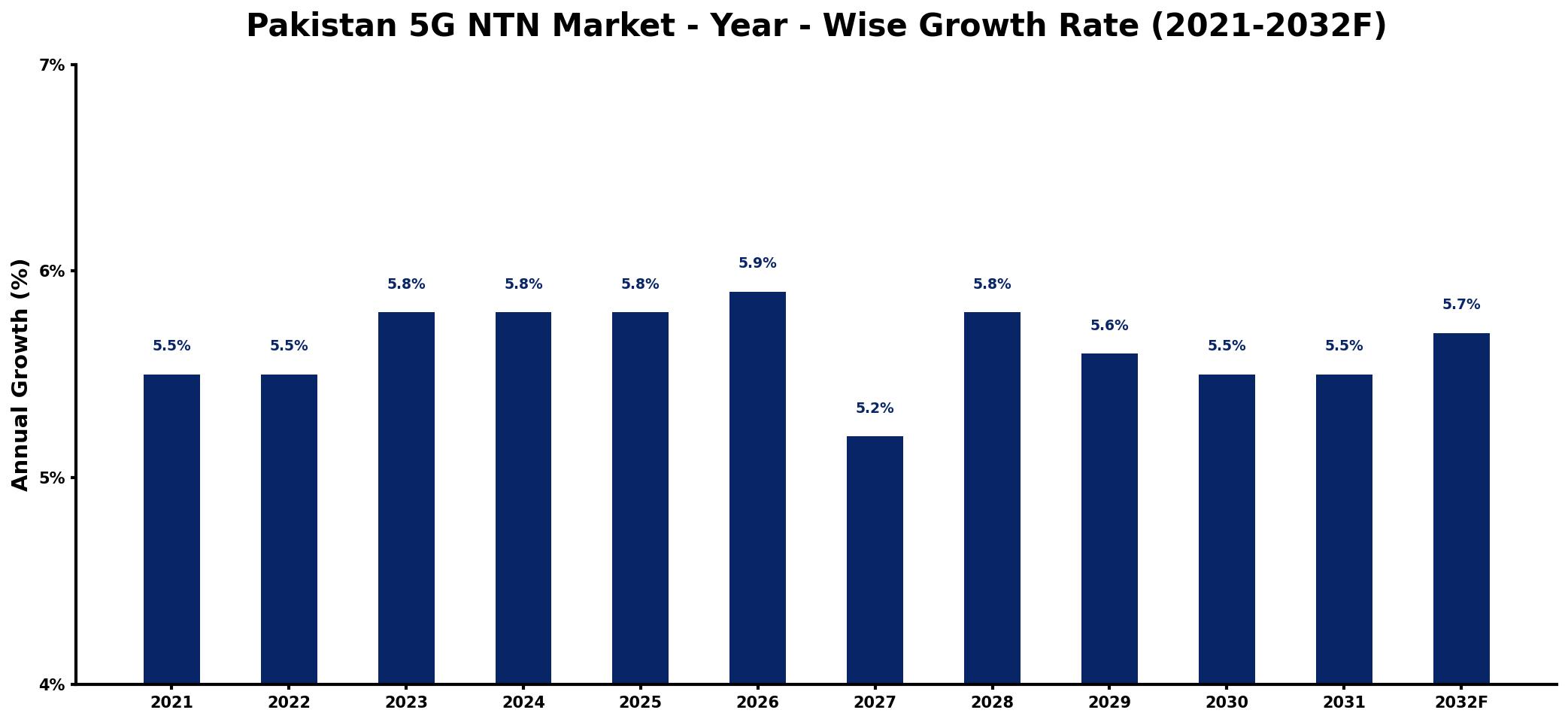
The table below presents the year‑wise growth rates along with the key drivers influencing the market
| Year | Growth Rate | Major Drivers |
| 2021 | 5.5% | rising consumer technology adoption |
| 2022 | 5.5% | increased investment in infrastructure |
| 2023 | 5.8% | growing demand for connectivity solutions |
| 2024 | 5.8% | expansion of digital services market |
| 2025 | 5.8% | enhanced mobile application development |
| 2026 | 5.9% | boost in broadband subscription rates |
| 2027 | 5.2% | shifts towards remote working trends |
| 2028 | 5.8% | growing interest in smart cities |
| 2029 | 5.6% | growing commercial sector adoption |
| 2030 | 5.5% | increased focus on digital transformation |
| 2031 | 5.5% | rising demand for cloud services |
| 2032 | 5.7% | growth in virtual reality applications |
Note: Market size estimations and growth projections presented in this report are based on 6Wresearch's proprietary forecasting methodology, utilizing the latest available industry data, government publications, and primary research inputs.
Pakistan 5G NTN Market Synopsis
The strongest force shaping the Pakistan 5G NTN market is the burgeoning need for enhanced connectivity solutions across urban and rural landscapes. As local communities and businesses increasingly rely on digital services, the significance of deploying 5G NTN technologies to bridge the digital divide has never been clearer.
In addition, government initiatives aimed at digital transformation play a critical role in this market. By promoting 5G infrastructure development through favorable regulations and support for innovative technologies, the government fosters an environment ripe for investment and expansion in the telecommunications sector.
Pakistan 5G NTN Market Key Takeaways
- The market is anticipated to expand significantly, with a projected value increase of 38.75% from 2025 to 2032.
- Rising demand for high-speed internet and IoT applications continues to drive market momentum.
- Government support is crucial in overcoming existing infrastructure and regulatory barriers.
- Investment opportunities are on the rise, particularly in satellite communication and network equipment manufacturing.
- Partnerships and collaborations between telecom operators and technology providers are becoming increasingly common.
Evaluation of Restraints in Pakistan 5G NTN Market
Despite the promising outlook, the Pakistan 5G NTN market faces significant constraints that could impede progress. One primary challenge is the inadequate infrastructure necessary for the successful implementation of advanced 5G networks. Upgrading existing networks requires substantial investment, which can be difficult given economic constraints. Furthermore, the limited availability of spectrum and the high costs associated with spectrum auctions present additional hurdles for telecom operators eager to expand their 5G services. Additionally, the lengthy regulatory approval processes can stall the rollout of new technologies, thereby delaying the anticipated benefits of 5G NTN solutions.
Pakistan 5G NTN Market Trends
The current trends in the Pakistan 5G NTN market indicate a robust shift towards enhanced connectivity solutions, driven by the increasing appetite for faster data speeds and improved network capacity. Key sectors such as healthcare and manufacturing are leveraging 5G technology to facilitate innovations like telemedicine and smart factories. Moreover, as more consumers engage with immersive technologies like augmented and virtual reality, demand for 5G services will continue to grow. The collaborative efforts among telecom operators to share infrastructure and develop joint ventures further exemplify the trend towards integrated solutions that address connectivity challenges in underserved areas.
Pakistan 5G NTN Market Opportunities
The Pakistan 5G NTN market harbors several lucrative investment opportunities, particularly as the nation works toward enhanced digital connectivity. Investors can explore avenues such as building satellite networks, high-altitude platforms, and drone technologies aimed at providing coverage in rural locales. Additionally, there are significant prospects in network equipment manufacturing and spectrum licensing, positioning investors to benefit from the anticipated surge in demand for 5G services. Furthermore, focusing on research and development initiatives in the realm of 5G NTN solutions can lead to sustainable competitive advantages in a rapidly evolving telecommunications landscape.
Government Initiatives in the Pakistan 5G NTN Market
The government of Pakistan has demonstrated a proactive stance in facilitating the rollout of 5G technology. The Pakistan Telecommunication Authority (PTA) is engaged in formulating supportive policies and regulations aimed at fostering a conducive environment for telecom operators. These initiatives include incentives such as tax breaks and streamlined approval processes, which are crucial for encouraging investment in 5G infrastructure. Additionally, the government emphasizes cybersecurity to ensure that 5G networks are safe, thereby instilling confidence among operators and consumers alike.
Future Insights of the Pakistan 5G NTN Market
Looking ahead to the period from 2026 to 2032, the future of the Pakistan 5G NTN market appears bright. The increasing demand for high-speed internet, coupled with the growing prevalence of IoT applications, is expected to propel market growth. Moreover, the deployment of non-terrestrial networks, including satellite and high-altitude platforms, will significantly improve connectivity in remote regions, helping to bridge the digital divide. Strong government initiatives, along with strategic partnerships among telecom operators and technology providers, are likely to further stimulate market expansion and innovation, ensuring a dynamic telecommunications landscape in Pakistan.
Pakistan 5G NTN Market Latest Developments (2025 - 2026)
Recent developments in the Pakistan 5G NTN market highlight a growing interest in innovative solutions to enhance connectivity. With telecom operators increasingly investing in satellite and drone technologies, new partnerships are forming to create a more integrated service offering. Furthermore, regulatory bodies are beginning to streamline processes for spectrum allocation and licensing, which could expedite the rollout of 5G services nationwide. As the market matures, ongoing initiatives are also focusing on the enhancement of cybersecurity measures to support the emerging digital economy.
Pakistan 5G NTN Market - Key Attractiveness of the Report
- 10 Years of Market Numbers
- Historical Data Starting from 2022 to 2025
- Base Year: 2025
- Forecast Data until 2032
- Key Performance Indicators Impacting the Market
- Major Upcoming Developments and Projects
Key Highlights of the Report:
- Pakistan 5G NTN Market Outlook
- Market Size of Pakistan 5G NTN Market, 2025
- Forecast of Pakistan 5G NTN Market, 2032
- Historical Data and Forecast of Pakistan 5G NTN Revenues & Volume for the Period 2022-2032F
- Pakistan 5G NTN Market Trend Evolution
- Pakistan 5G NTN Market Drivers and Challenges
- Pakistan 5G NTN Price Trends
- Pakistan 5G NTN Porter's Five Forces
- Pakistan 5G NTN Industry Life Cycle
- Historical Data and Forecast of Pakistan 5G NTN Market Revenues & Volume By Component for the Period 2022-2032F
- Historical Data and Forecast of Pakistan 5G NTN Market Revenues & Volume By Hardware for the Period 2022-2032F
- Historical Data and Forecast of Pakistan 5G NTN Market Revenues & Volume By Solutions for the Period 2022-2032F
- Historical Data and Forecast of Pakistan 5G NTN Market Revenues & Volume By Services for the Period 2022-2032F
- Historical Data and Forecast of Pakistan 5G NTN Market Revenues & Volume By End-Use Industry for the Period 2022-2032F
- Historical Data and Forecast of Pakistan 5G NTN Market Revenues & Volume By Maritime for the Period 2022-2032F
- Historical Data and Forecast of Pakistan 5G NTN Market Revenues & Volume By Aerospace for the Period 2022-2032F
- Historical Data and Forecast of Pakistan 5G NTN Market Revenues & Volume By Defense for the Period 2022-2032F
- Historical Data and Forecast of Pakistan 5G NTN Market Revenues & Volume By Government for the Period 2022-2032F
- Historical Data and Forecast of Pakistan 5G NTN Market Revenues & Volume By Mining for the Period 2022-2032F
- Historical Data and Forecast of Pakistan 5G NTN Market Revenues & Volume By Application for the Period 2022-2032F
- Historical Data and Forecast of Pakistan 5G NTN Market Revenues & Volume By EMBB for the Period 2022-2032F
- Historical Data and Forecast of Pakistan 5G NTN Market Revenues & Volume By URLLC for the Period 2022-2032F
- Historical Data and Forecast of Pakistan 5G NTN Market Revenues & Volume By MMTC for the Period 2022-2032F
- Pakistan 5G NTN Import Export Trade Statistics
- Market Opportunity Assessment By Component
- Market Opportunity Assessment By End-Use Industry
- Market Opportunity Assessment By Application
- Pakistan 5G NTN Top Companies Market Share
- Pakistan 5G NTN Competitive Benchmarking By Technical and Operational Parameters
- Pakistan 5G NTN Company Profiles
- Pakistan 5G NTN Key Strategic Recommendations






































