Pakistan Accounting Software Market Size, Share & Growth Rate
The Pakistan Accounting Software Market was estimated at USD 314 Million in 2025 and is projected to reach USD 434 Million by 2032, growing at a CAGR of 4.7% from 2026 to 2032. This growth trajectory is largely fueled by the ongoing digital transformation among enterprises, the increasing reliance on cloud-based solutions, and the enforcement of government regulations mandating electronic tax filings. Moreover, the expanding base of small and medium-sized enterprises (SMEs) seeking efficient and cost-effective financial solutions is also driving demand, solidifying the market's upward trend.
Pakistan Accounting Software Market Year-wise Growth Rate and Key Drivers
This graph highlights how the Pakistan Accounting Software Market has steadily grown over the years, supported by major growth factors.
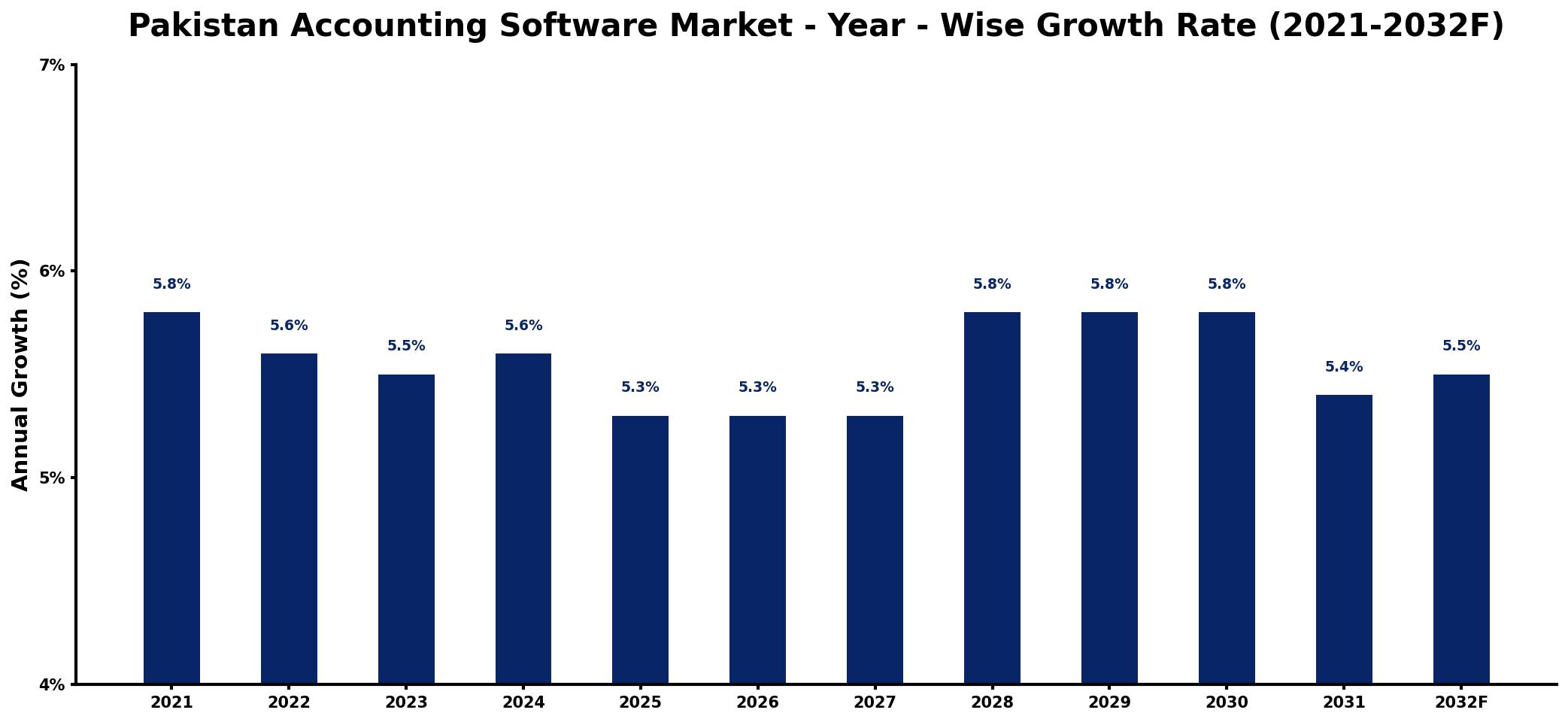
The table below presents the year‑wise growth rates along with the key drivers influencing the market
| Year | Growth Rate | Major Drivers |
| 2021 | 5.8% | Rising demand for digital solutions |
| 2022 | 5.6% | Increase in small business registrations |
| 2023 | 5.5% | Expansion of fintech ecosystem initiatives |
| 2024 | 5.6% | Growth in e-commerce sector activities |
| 2025 | 5.3% | Surge in remote work adoption |
| 2026 | 5.3% | Investment in digital transformation projects |
| 2027 | 5.3% | Development of local tech startups |
| 2028 | 5.8% | Emergence of cloud computing services |
| 2029 | 5.8% | Increased focus on regulatory compliance |
| 2030 | 5.8% | Advancements in data analytics capabilities |
| 2031 | 5.4% | rising infrastructure development spending |
| 2032 | 5.5% | strengthening international trade flows |
Note: Market size estimations and growth projections presented in this report are based on 6Wresearch's proprietary forecasting methodology, utilizing the latest available industry data, government publications, and primary research inputs.
Pakistan Accounting Software Market Synopsis
The landscape of the Pakistan Accounting Software Market is evolving rapidly, with businesses recognizing the advantages of digital financial management. Increasing compliance requirements and the need for improved efficiency are prompting organizations to transition from manual processes to sophisticated software solutions.
Today, the market is characterized by a diverse array of offerings tailored to meet the varying needs of businesses across different sectors. Features such as automated invoicing, advanced financial reporting, and seamless inventory management have become essential for companies looking to maintain competitiveness in an increasingly digital economy.
Pakistan Accounting Software Market Key Takeaways
- The market is experiencing significant growth, primarily driven by SME demand for automation and efficiency in financial processes.
- Cloud-based solutions are gaining traction, with businesses seeking scalable and accessible accounting software.
- Data security and compliance are top priorities for enterprises choosing accounting software in Pakistan.
- Vendor innovation focuses on user-friendly interfaces and extensive customization to cater to local business needs.
- Government regulations are facilitating a shift towards electronic invoicing and proper accounting practices, driving software adoption.
Evaluation of Restraints in Pakistan Accounting Software Market
Despite the promising growth prospects, the Pakistan Accounting Software Market faces several constraints. One significant barrier is the limited awareness among small and medium-sized enterprises (SMEs) regarding the benefits and functionalities of accounting software. Many businesses still rely on outdated manual processes, inhibiting rapid adoption. Furthermore, the presence of a considerable number of unorganized enterprises, combined with persistent concerns regarding data security and privacy, complicates market penetration for advanced software solutions. Addressing these issues will be crucial for future growth and market expansion.
Pakistan Accounting Software Market Trends
The market is witnessing a pronounced shift towards cloud-based accounting solutions, driven by the growing need for remote access and scalability in financial management. Additionally, the integration of accounting software with other business applications is becoming increasingly prevalent, as companies strive for streamlined operations and improved efficiency. Furthermore, the popularity of mobile accounting applications is on the rise, enabling users to manage financial operations on-the-go. Enhanced focus on data security, coupled with compliance to local regulations, remains a pivotal consideration for businesses investing in accounting software.
Pakistan Accounting Software Market Opportunities
The market presents significant investment opportunities, especially with the increasing digital adoption among Pakistani businesses. Innovators can tap into this demand by offering localized cloud-based accounting solutions that address the specific needs of various industries. Furthermore, targeting niche segments, such as retail and e-commerce, can unlock additional growth avenues. By focusing on affordability and customizable features, investors can capitalize on a burgeoning market poised for substantial expansion.
Government Initiatives in the Pakistan Accounting Software Market
The Pakistani government is actively promoting the use of modern accounting practices to enhance financial transparency and compliance. Policies implemented by regulatory bodies encourage companies to maintain accurate accounting records and utilize approved software solutions. Initiatives aimed at promoting digital technologies serve to support businesses in their transition towards more efficient financial operations. Additionally, efforts to streamline tax processes through electronic invoicing are designed to improve tax collection efficiency and mitigate evasion.
Future Insights of the Pakistan Accounting Software Market
Looking ahead to 2026-2032, the Pakistan Accounting Software Market is anticipated to experience robust growth as businesses increasingly embrace digital transformation. Factors such as the rising demand for user-friendly software solutions, government backing of technology adoption, and the ongoing evolution of e-commerce will continue to fuel market dynamics. SMEs, in particular, are expected to lead the charge in software adoption, driven by the necessity to optimize financial management practices. As the market matures, businesses will gravitate toward more sophisticated solutions that enhance operational efficiency and data integrity.
Pakistan Accounting Software Market Latest Developments (2025 - 2026)
Recent developments in the Pakistan Accounting Software Market indicate a surge in interest for cloud-based solutions, with many companies adopting Software as a Service (SaaS) offerings. The introduction of mobile applications has also made significant headway, allowing users to manage their finances on their smartphones conveniently. There is an emerging emphasis on data security, prompting software vendors to implement stronger security measures. Overall, the industry is aligning with global trends while catering to local needs, leading to a vibrant and responsive marketplace.
Pakistan Accounting Software Market - Key Attractiveness of the Report
- 10 Years of Market Numbers
- Historical Data Starting from 2022 to 2025
- Base Year: 2025
- Forecast Data until 2032
- Key Performance Indicators Impacting the Market
- Major Upcoming Developments and Projects
Key Highlights of the Report:
- Pakistan Accounting Software Market Outlook
- Market Size of Pakistan Accounting Software Market, 2025
- Forecast of Pakistan Accounting Software Market, 2032
- Historical Data and Forecast of Pakistan Accounting Software Revenues & Volume for the Period 2022-2032F
- Pakistan Accounting Software Market Trend Evolution
- Pakistan Accounting Software Market Drivers and Challenges
- Pakistan Accounting Software Price Trends
- Pakistan Accounting Software Porter's Five Forces
- Pakistan Accounting Software Industry Life Cycle
- Historical Data and Forecast of Pakistan Accounting Software Market Revenues & Volume By Component for the Period 2022-2032F
- Historical Data and Forecast of Pakistan Accounting Software Market Revenues & Volume By Software for the Period 2022-2032F
- Historical Data and Forecast of Pakistan Accounting Software Market Revenues & Volume By Services for the Period 2022-2032F
- Historical Data and Forecast of Pakistan Accounting Software Market Revenues & Volume By Enterprise Size for the Period 2022-2032F
- Historical Data and Forecast of Pakistan Accounting Software Market Revenues & Volume By Large for the Period 2022-2032F
- Historical Data and Forecast of Pakistan Accounting Software Market Revenues & Volume By Small & Medium for the Period 2022-2032F
- Historical Data and Forecast of Pakistan Accounting Software Market Revenues & Volume By Type for the Period 2022-2032F
- Historical Data and Forecast of Pakistan Accounting Software Market Revenues & Volume By Spreadsheets for the Period 2022-2032F
- Historical Data and Forecast of Pakistan Accounting Software Market Revenues & Volume By ERP for the Period 2022-2032F
- Historical Data and Forecast of Pakistan Accounting Software Market Revenues & Volume By Custom Accounting Software for the Period 2022-2032F
- Historical Data and Forecast of Pakistan Accounting Software Market Revenues & Volume By Tax Management Software for the Period 2022-2032F
- Historical Data and Forecast of Pakistan Accounting Software Market Revenues & Volume By End-use Industry for the Period 2022-2032F
- Historical Data and Forecast of Pakistan Accounting Software Market Revenues & Volume By BFSI for the Period 2022-2032F
- Historical Data and Forecast of Pakistan Accounting Software Market Revenues & Volume By IT & Telecommunication for the Period 2022-2032F
- Historical Data and Forecast of Pakistan Accounting Software Market Revenues & Volume By Government & Public Sector for the Period 2022-2032F
- Historical Data and Forecast of Pakistan Accounting Software Market Revenues & Volume By Automotive for the Period 2022-2032F
- Historical Data and Forecast of Pakistan Accounting Software Market Revenues & Volume By Retail & Consumer Goods for the Period 2022-2032F
- Historical Data and Forecast of Pakistan Accounting Software Market Revenues & Volume By Oil & Gas for the Period 2022-2032F
- Historical Data and Forecast of Pakistan Accounting Software Market Revenues & Volume By Manufacturing for the Period 2022-2032F
- Historical Data and Forecast of Pakistan Accounting Software Market Revenues & Volume By Others for the Period 2022-2032F
- Pakistan Accounting Software Import Export Trade Statistics
- Market Opportunity Assessment By Component
- Market Opportunity Assessment By Enterprise Size
- Market Opportunity Assessment By Type
- Market Opportunity Assessment By End-use Industry
- Pakistan Accounting Software Top Companies Market Share
- Pakistan Accounting Software Competitive Benchmarking By Technical and Operational Parameters
- Pakistan Accounting Software Company Profiles
- Pakistan Accounting Software Key Strategic Recommendations






































