Pakistan Agricultural Tractor Market Growth Rate Analysis (2025 - 2031)
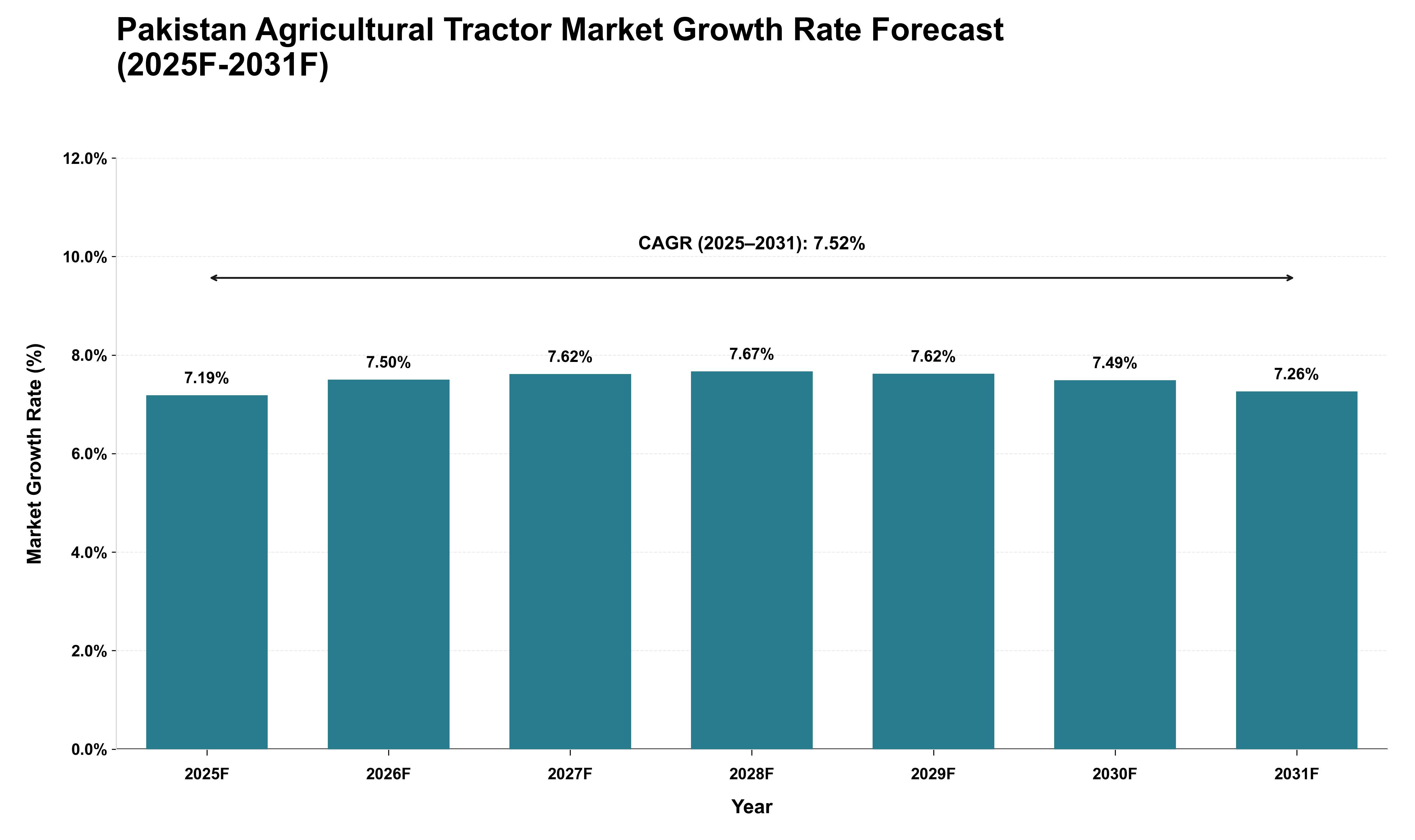
The outlook for the Pakistan agricultural tractor market will be significantly influenced by technological advancements and product substitution trends, as the sector adapts to increasing demands for efficiency and productivity. With a projected CAGR of 7.52% from 2025 to 2031, annual growth rates will reflect a gradual escalation, peaking at 7.67% in 2028 before tapering slightly. This trajectory will be driven by the integration of smart farming technologies and enhanced mechanization, which are expected to replace traditional farming methods. Additionally, import dependencies on advanced machinery may create fluctuations in availability and pricing, impacting local manufacturers' competitiveness. As global supply chains stabilize post-pandemic disruptions, the market will likely experience cyclical trends that align with agricultural output cycles, further reinforcing the demand for modern tractors equipped with innovative features that cater to evolving farming practices in Pakistan.
Key Highlights of the Report:
- Pakistan Agricultural Tractor Market Outlook
- Market Size of Pakistan Agricultural Tractor Market, 2024
- Forecast of Pakistan Agricultural Tractor Market, 2031
- Historical Data and Forecast of Pakistan Agricultural Tractor Revenues & Volume for the Period 2021- 2031
- Pakistan Agricultural Tractor Market Trend Evolution
- Pakistan Agricultural Tractor Market Drivers and Challenges
- Pakistan Agricultural Tractor Price Trends
- Pakistan Agricultural Tractor Porter's Five Forces
- Pakistan Agricultural Tractor Industry Life Cycle
- Historical Data and Forecast of Pakistan Agricultural Tractor Market Revenues & Volume By Engine Power for the Period 2021- 2031
- Historical Data and Forecast of Pakistan Agricultural Tractor Market Revenues & Volume By Lesser than 40 HP for the Period 2021- 2031
- Historical Data and Forecast of Pakistan Agricultural Tractor Market Revenues & Volume By 40 HP to 99 HP for the Period 2021- 2031
- Historical Data and Forecast of Pakistan Agricultural Tractor Market Revenues & Volume By 100 HP to 150 HP for the Period 2021- 2031
- Historical Data and Forecast of Pakistan Agricultural Tractor Market Revenues & Volume By 151 HP to 200 HP for the Period 2021- 2031
- Historical Data and Forecast of Pakistan Agricultural Tractor Market Revenues & Volume By 201 HP to 270 HP for the Period 2021- 2031
- Historical Data and Forecast of Pakistan Agricultural Tractor Market Revenues & Volume By 271 HP to 350 HP for the Period 2021- 2031
- Historical Data and Forecast of Pakistan Agricultural Tractor Market Revenues & Volume By Greater than 350 HP for the Period 2021- 2031
- Historical Data and Forecast of Pakistan Agricultural Tractor Market Revenues & Volume By Type for the Period 2021- 2031
- Historical Data and Forecast of Pakistan Agricultural Tractor Market Revenues & Volume By Orchard Tractors for the Period 2021- 2031
- Historical Data and Forecast of Pakistan Agricultural Tractor Market Revenues & Volume By Row-crop Tractors for the Period 2021- 2031
- Historical Data and Forecast of Pakistan Agricultural Tractor Market Revenues & Volume By Other Types for the Period 2021- 2031
- Pakistan Agricultural Tractor Import Export Trade Statistics
- Market Opportunity Assessment By Engine Power
- Market Opportunity Assessment By Type
- Pakistan Agricultural Tractor Top Companies Market Share
- Pakistan Agricultural Tractor Competitive Benchmarking By Technical and Operational Parameters
- Pakistan Agricultural Tractor Company Profiles
- Pakistan Agricultural Tractor Key Strategic Recommendations






































