Pakistan Agriculture Market Size, Share & Growth Rate
The Pakistan Agriculture Market was estimated at USD 474 Million in 2025 and is projected to reach USD 626 Million by 2032, growing at a CAGR of 4.1% from 2026 to 2032. This growth is driven by increasing demand for food products due to a burgeoning population, as well as a renewed focus on modern agricultural practices and sustainable farming methods. Moreover, government initiatives and technological advancements are playing a crucial role in enhancing productivity and operational efficiency in the sector.
Pakistan Agriculture Market Year-wise Growth Rate and Key Drivers
This graph highlights how the Pakistan Agriculture Market has steadily grown over the years, supported by major growth factors.
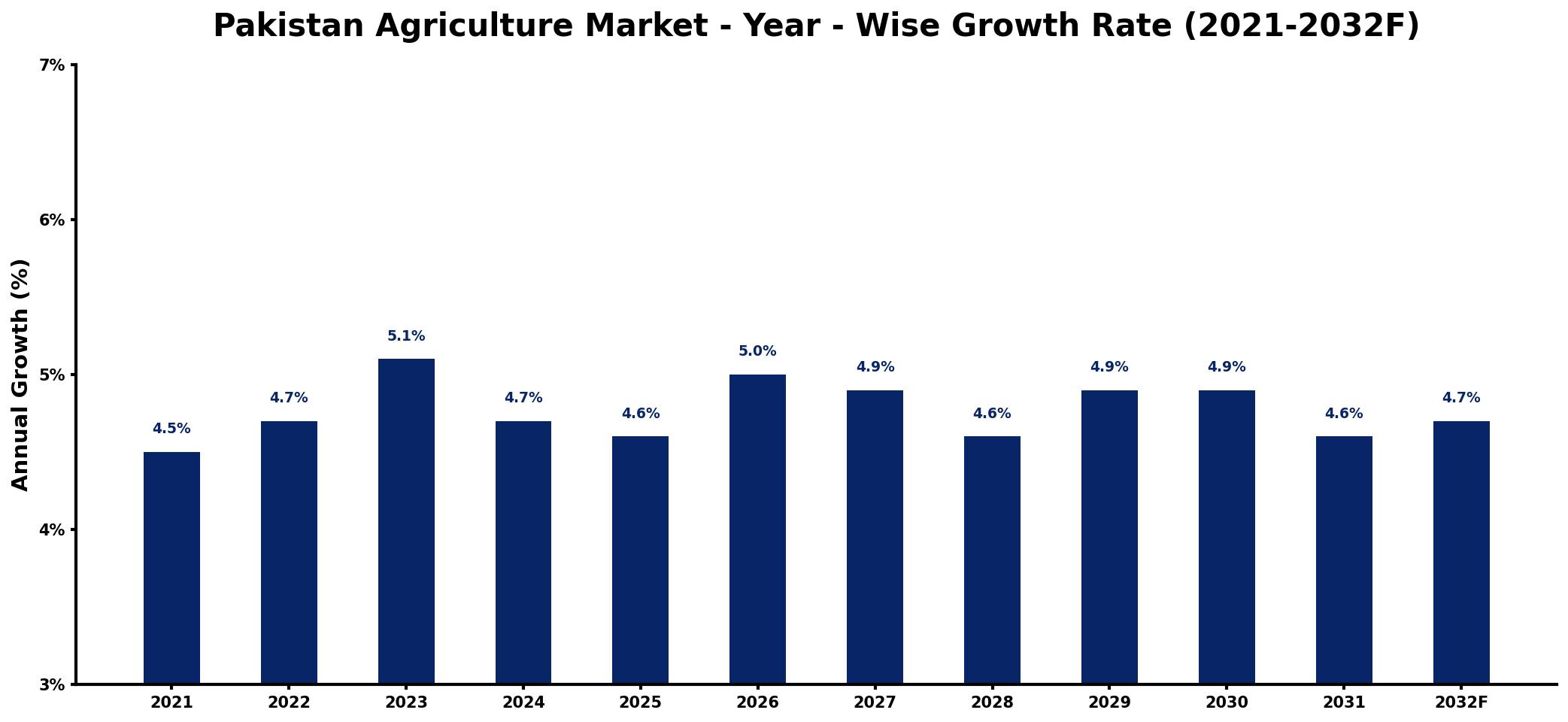
The table below presents the year‑wise growth rates along with the key drivers influencing the market
| Year | Growth Rate | Major Drivers |
| 2021 | 4.5% | Rising export opportunities globally |
| 2022 | 4.7% | Increased investment in technology |
| 2023 | 5.1% | Growing domestic consumption rates |
| 2024 | 4.7% | Expansion of irrigation infrastructure |
| 2025 | 4.6% | Enhanced crop diversification strategies |
| 2026 | 5.0% | Development of value-added products |
| 2027 | 4.9% | Strengthening of supply chain networks |
| 2028 | 4.6% | Improved access to financing options |
| 2029 | 4.9% | Surge in organic farming practices |
| 2030 | 4.9% | Higher consumer awareness levels |
| 2031 | 4.6% | Adoption of sustainable farming methods |
| 2032 | 4.7% | Growth in export market potential |
Note: Market size estimations and growth projections presented in this report are based on 6Wresearch's proprietary forecasting methodology, utilizing the latest available industry data, government publications, and primary research inputs.
Pakistan Agriculture Market Synopsis
The agricultural sector in Pakistan is vital, with wheat and rice serving as staple crops that dominate cultivation. Additionally, the country is recognized for its robust livestock production, particularly in milk and poultry, which caters to both domestic and international markets.
However, the sector struggles with inherent challenges like water scarcity and outdated farming techniques. These barriers necessitate urgent interventions and modernization efforts to tap into the full potential of the agriculture market, fostering a sustainable growth trajectory.
Pakistan Agriculture Market Key Takeaways
- The agriculture market is a critical sector contributing significantly to Pakistan's GDP.
- Emerging technologies are being increasingly adopted to improve farming efficiency.
- Consumer demand is shifting towards organic and sustainably produced agricultural goods.
- Investment opportunities abound in modern farming technologies and value-added agribusinesses.
- Government policies aim to bolster agricultural growth through subsidies and support programs.
Evaluation of Restraints in Pakistan Agriculture Market
The Pakistan agriculture market is constrained by several critical factors. Water scarcity, exacerbated by unpredictable rainfall patterns and inadequate irrigation facilities, severely hampers crop yields across various regions. Additionally, many farmers still rely on outdated agricultural practices, limiting productivity and efficiency. The lack of access to modern technology and financial resources prevents farmers from adopting innovative solutions that could enhance their output and sustainability. Furthermore, pest infestations and the looming threat of climate change continue to pose significant risks to agricultural stability, necessitating comprehensive strategic interventions.
Pakistan Agriculture Market Trends
Several trends are shaping the future of the Pakistan agriculture market. The adoption of precision agriculture and farm management software is revolutionizing traditional farming, driving better decision-making and resource management. Additionally, there is a noticeable shift towards organic farming, spurred by rising consumer awareness regarding health and environmental sustainability. Farmers are also diversifying their crops and livestock to align with changing market dynamics, while the rise of vertical farming and hydroponics is offering innovative solutions to increase agricultural productivity in urban settings.
Pakistan Agriculture Market Opportunities
Investment opportunities in the Pakistan agriculture market are abundant, particularly in agribusinesses focused on crop production, livestock farming, and food processing. Modern farming technologies, including drones, soil sensors, and smart irrigation systems, present avenues for improving efficiency and productivity. The increasing demand for organic and specialty crops—both locally and internationally—presents an attractive investment landscape, allowing stakeholders to promote sustainable practices while reaping long-term returns.
Government Initiatives in the Pakistan Agriculture Market
The government of Pakistan has introduced several policies and initiatives to support agricultural growth. These include subsidies on essential inputs such as fertilizers, seeds, and machinery to boost production. Additionally, the establishment of price support mechanisms aims to stabilize market prices for key crops. Initiatives like the Kissan Package focus on providing relief and financial support to small-scale farmers, addressing their unique challenges. Furthermore, the government is making strides in enhancing credit facilities to improve farmers' access to financing, essential for modernizing agricultural practices.
Future Insights of the Pakistan Agriculture Market
The future outlook for the Pakistan agriculture market is increasingly optimistic. As the nation strives to modernize agricultural practices, the integration of technology and sustainable methods is likely to accelerate productivity and efficiency gains. With a growing population driving food demand, investments in infrastructure and improved irrigation systems are expected to enhance yields. Additionally, the emergence of agri-tech startups and digital platforms is paving the way for better market access, price transparency, and knowledge-sharing among farmers, positioning the market for transformative growth and innovation in the upcoming years.
Pakistan Agriculture Market Latest Developments (2025 - 2026)
Recent developments within the Pakistan agriculture market indicate a positive shift towards modernization and sustainability. Notable advancements in agricultural technology are enhancing productivity, while increased collaborations between the public and private sectors are driving infrastructural improvements. Initiatives focusing on organic farming are gaining traction, reflecting changing consumer preferences. Moreover, efforts to establish better supply chains and market access for farmers are beginning to materialize, fostering a conducive environment for growth and investment.
Pakistan Agriculture Market - Key Attractiveness of the Report
- 10 Years of Market Numbers
- Historical Data Starting from 2022 to 2025
- Base Year: 2025
- Forecast Data until 2032
- Key Performance Indicators Impacting the Market
- Major Upcoming Developments and Projects
Key Highlights of the Report:
- Pakistan Agriculture Market Outlook
- Market Size of Pakistan Agriculture Market, 2025
- Forecast of Pakistan Agriculture Market, 2032
- Historical Data and Forecast of Pakistan Agriculture Revenues & Volume for the Period 2022-2032F
- Pakistan Agriculture Market Trend Evolution
- Pakistan Agriculture Market Drivers and Challenges
- Pakistan Agriculture Price Trends
- Pakistan Agriculture Porter's Five Forces
- Pakistan Agriculture Industry Life Cycle
- Historical Data and Forecast of Pakistan Agriculture Market Revenues & Volume By Type for the Period 2022-2032F
- Historical Data and Forecast of Pakistan Agriculture Market Revenues & Volume By Animal Produce for the Period 2022-2032F
- Historical Data and Forecast of Pakistan Agriculture Market Revenues & Volume By Crop Production for the Period 2022-2032F
- Historical Data and Forecast of Pakistan Agriculture Market Revenues & Volume By Distribution Channel for the Period 2022-2032F
- Historical Data and Forecast of Pakistan Agriculture Market Revenues & Volume By Supermarkets/Hypermarkets for the Period 2022-2032F
- Historical Data and Forecast of Pakistan Agriculture Market Revenues & Volume By Convenience Stores for the Period 2022-2032F
- Historical Data and Forecast of Pakistan Agriculture Market Revenues & Volume By E-Commerce for the Period 2022-2032F
- Historical Data and Forecast of Pakistan Agriculture Market Revenues & Volume By Others for the Period 2022-2032F
- Historical Data and Forecast of Pakistan Agriculture Market Revenues & Volume By Nature for the Period 2022-2032F
- Historical Data and Forecast of Pakistan Agriculture Market Revenues & Volume By Organic for the Period 2022-2032F
- Historical Data and Forecast of Pakistan Agriculture Market Revenues & Volume By Conventional for the Period 2022-2032F
- Pakistan Agriculture Import Export Trade Statistics
- Market Opportunity Assessment By Type
- Market Opportunity Assessment By Distribution Channel
- Market Opportunity Assessment By Nature
- Pakistan Agriculture Top Companies Market Share
- Pakistan Agriculture Competitive Benchmarking By Technical and Operational Parameters
- Pakistan Agriculture Company Profiles
- Pakistan Agriculture Key Strategic Recommendations






































