Pakistan AI in Education Market Size & Growth Rate (2026-2032)
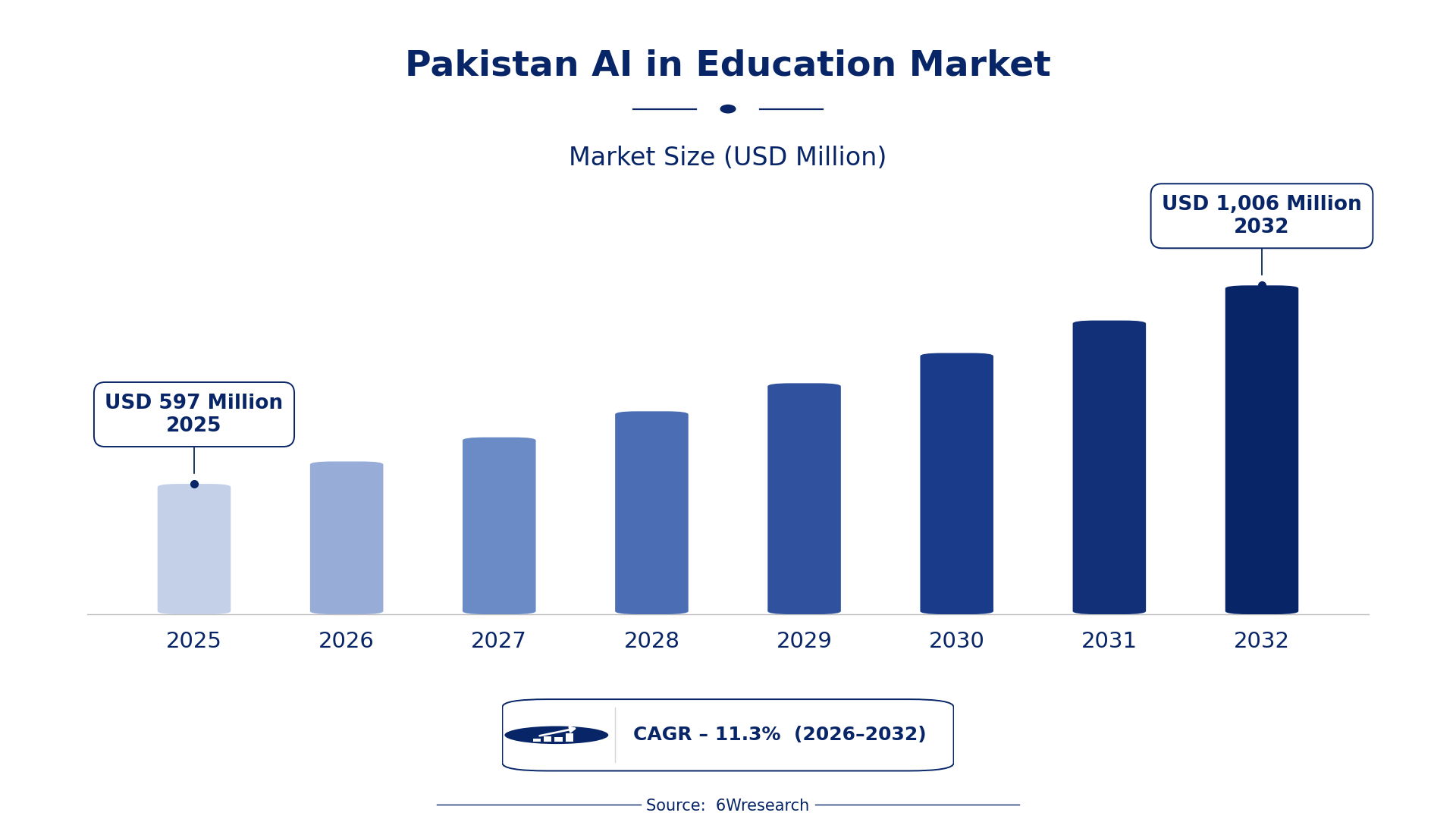
The Pakistan AI in Education Market was estimated at USD 597 Million in 2025 and is projected to reach USD 1006 Million by 2032, growing at a CAGR of 11.3% from 2026 to 2032.
Pakistan AI in Education Market Synopsis
The driving force behind the Pakistan AI in Education Market is the increasing demand for personalized learning solutions. Educational institutions are recognizing the potential of AI to tailor educational content to meet the diverse needs of students, thereby enhancing engagement and learning outcomes.
Government initiatives aimed at promoting digital learning are further catalyzing this growth. By investing in digital infrastructure and AI technologies, the government is creating an ecosystem that encourages innovation and collaboration within the education sector.
Pakistan AI in Education Market Year-wise Growth Rate and Key Drivers
This graph illustrates the annual growth rates of the Pakistan AI in Education Market from 2021 to 2032, highlighting a steady upward trajectory and projected expansion over the forecast period.
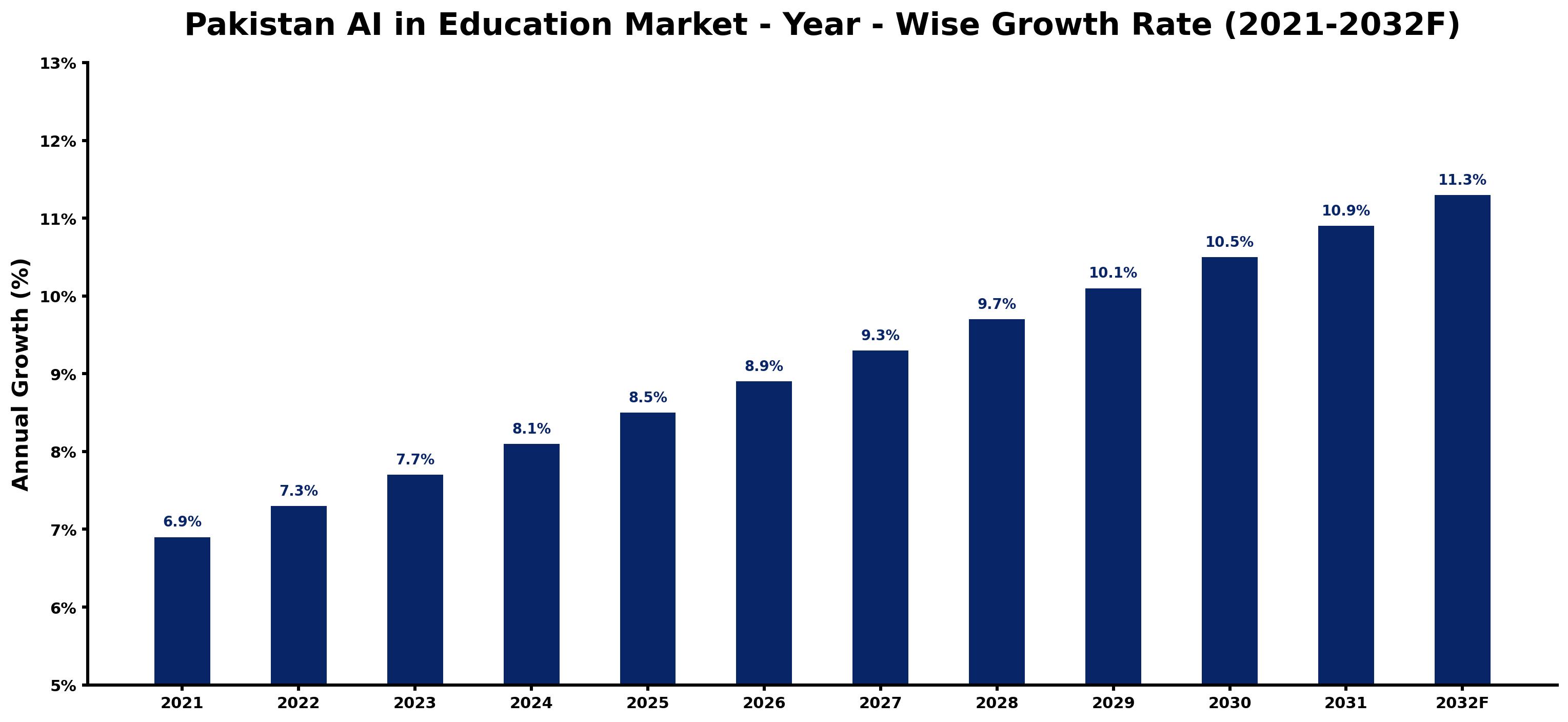
The table below presents the year‑wise growth rates along with the key drivers influencing the market
| Year | Growth Rate | Major Drivers |
| 2021 | 6.9% | Higher smartphone penetration among students and educators. |
| 2022 | 7.3% | Government's Digital Pakistan initiative promoting tech adoption. |
| 2023 | 7.7% | Increased investment in EdTech startups focused on AI. |
| 2024 | 8.1% | Growing focus on STEM education in schools nationwide. |
| 2025 | 8.5% | Rise of online assessment tools utilizing AI technology. |
| 2026 | 8.9% | Collaboration with international AI firms for educational tools. |
| 2027 | 9.3% | Expanding internet access in rural regions boosting interactive learning. |
| 2028 | 9.7% | Increased teacher training programs incorporating AI methodologies. |
| 2029 | 10.1% | Local universities launching AI-focused education degree programs. |
| 2030 | 10.5% | Partnerships with non-profits for AI literacy in schools. |
| 2031 | 10.9% | Increased government funding for AI research in education. |
| 2032 | 11.3% | Emerging demand for AI-driven tutoring systems in classrooms. |
Note: Market size estimations and growth projections presented in this report are based on 6Wresearch's proprietary forecasting methodology, utilizing the latest available industry data, government publications, and primary research inputs.
Pakistan AI in Education Market Key Takeaways
Below are some of the specific key takeaways from the market, including:
- The market is experiencing rapid adoption of AI-driven tools, particularly in personalized learning and virtual classrooms.
- Government policies are increasingly focused on integrating AI technologies into educational frameworks.
- Investment in EdTech startups is on the rise, fostering innovation in AI applications for education.
- Challenges remain, particularly in infrastructure and training, which could hinder market penetration.
- Collaboration between educational institutions and technology providers is essential for maximizing AI's impact.
Evaluation of Restraints in Pakistan AI in Education Market
The Pakistan AI in Education Market is held back by several tangible obstacles. Limited access to reliable internet connectivity in rural areas significantly hampers the effective deployment of AI technologies. on top of that, a lack of adequate training programs for educators prevents the full integration of these tools into traditional teaching methods.
Concerns over data privacy and security also contribute to reluctance among educational institutions to adopt AI. In addition, the high cost of implementing AI technologies poses a barrier, particularly for smaller institutions that may lack the necessary funding. Addressing these issues will be critical for unlocking the market's full potential.
Pakistan AI in Education Market Trends
Currently, the market is witnessing an increasing focus on AI-driven personalized learning experiences. Schools and universities are adopting adaptive learning systems that adjust content based on student performance, making education more tailored and effective.
The push for automated grading systems is another noteworthy trend, streamlining administrative tasks and allowing educators to focus on teaching. The rise of virtual tutoring platforms has also become prominent, especially following the COVID-19 pandemic, as institutions seek innovative solutions for remote learning.
Pakistan AI in Education Market Opportunities
Significant opportunities lie in the expansion of AI technologies tailored to the local context. The demand for customized solutions that address cultural and educational nuances presents a unique growth avenue for developers and educational providers.
Additionally, partnerships between tech companies and educational institutions can facilitate the development of new AI tools, enhancing the overall learning experience. As digital literacy initiatives gain traction, there will be an increased appetite for AI solutions that can bridge the educational gap across various demographics.
Government Initiatives in the Pakistan AI in Education Market
The Pakistani government is taking proactive steps to integrate AI into the education sector. This includes policies that prioritize digital learning and infrastructure development, creating an environment conducive to innovation. By fostering collaborations between educational institutions and technology providers, the government aims to enhance the educational landscape and improve access to quality education.
- A recently completed initiative, the National Education Policy 2021, emphasizes the integration of AI in educational practices.
- Currently underway is the Digital Pakistan Vision, which aims to enhance digital literacy and technology adoption in schools and universities.
- Planned for future implementation is the National Education Development Initiative, designed to leverage AI for improving teaching methodologies.
- Upcoming regulatory frameworks are expected to encourage partnerships between educational institutions and tech startups to foster AI development.
- Ongoing training programs for educators are being developed to equip them with the skills needed to effectively utilize AI tools in the classroom.
Future Insights of the Pakistan AI in Education Market
Looking ahead to 2026-2032, the Pakistan AI in Education Market is set to flourish. Continued investments in digital infrastructure and a strong focus on educational reform will drive AI adoption. As institutions increasingly integrate AI technologies for personalized learning and administrative efficiencies, the market will likely see a surge in innovative solutions tailored to local needs.
The interplay between government initiatives and private sector innovation will be crucial. With a growing emphasis on enhancing the quality of education, the demand for AI-driven tools will continue to rise, positioning the market for substantial growth in the coming years.
Pakistan AI in Education Market Latest Developments
In the past year, the Pakistan AI in Education Market has seen a flurry of activity. Educational institutions are actively seeking partnerships with technology providers to enhance their offerings. The increasing adoption of AI-powered solutions is reshaping how education is delivered across the country.
- A major technology vendor launched a virtual tutoring platform in early 2025, enabling remote education access for underserved communities.
- An initiative to implement AI-based grading systems is currently underway, aimed at streamlining assessment processes in secondary schools.
- By mid-2026, a new program is expected to be rolled out that focuses on training educators in AI applications for classroom management.
- In Q2 2025, a public-private partnership was established to enhance digital infrastructure in rural areas, improving access to AI technologies.
- A pilot project utilizing AI for personalized learning experiences was completed in late 2025, with promising results indicating a potential for broader implementation.
Pakistan AI in Education Market - Key Attractiveness of the Report
- 10 Years of Market Numbers
- Historical Data Starting from 2022 to 2025
- Base Year: 2025
- Forecast Data until 2032
- Key Performance Indicators Impacting the Market
- Major Upcoming Developments and Projects
Key Highlights of the Report:
- Pakistan AI in Education Market Outlook
- Market Size of Pakistan AI in Education Market, 2025
- Forecast of Pakistan AI in Education Market, 2032
- Historical Data and Forecast of Pakistan AI in Education Revenues & Volume for the Period 2022-2032F
- Pakistan AI in Education Market Trend Evolution
- Pakistan AI in Education Market Drivers and Challenges
- Pakistan AI in Education Price Trends
- Pakistan AI in Education Porter's Five Forces
- Pakistan AI in Education Industry Life Cycle
- Historical Data and Forecast of Pakistan AI in Education Market Revenues & Volume By Technology for the Period 2022-2032F
- Historical Data and Forecast of Pakistan AI in Education Market Revenues & Volume By Deep Learning and Machine Learning for the Period 2022-2032F
- Historical Data and Forecast of Pakistan AI in Education Market Revenues & Volume By Natural Language Processing (NLP) for the Period 2022-2032F
- Historical Data and Forecast of Pakistan AI in Education Market Revenues & Volume By Component for the Period 2022-2032F
- Historical Data and Forecast of Pakistan AI in Education Market Revenues & Volume By Solutions for the Period 2022-2032F
- Historical Data and Forecast of Pakistan AI in Education Market Revenues & Volume By Services for the Period 2022-2032F
- Historical Data and Forecast of Pakistan AI in Education Market Revenues & Volume By Application for the Period 2022-2032F
- Historical Data and Forecast of Pakistan AI in Education Market Revenues & Volume By Virtual Facilitators and Learning Environments for the Period 2022-2032F
- Historical Data and Forecast of Pakistan AI in Education Market Revenues & Volume By Intelligent Tutoring Systems (ITS) for the Period 2022-2032F
- Historical Data and Forecast of Pakistan AI in Education Market Revenues & Volume By Content Delivery Systems for the Period 2022-2032F
- Historical Data and Forecast of Pakistan AI in Education Market Revenues & Volume By Fraud and Risk Management for the Period 2022-2032F
- Historical Data and Forecast of Pakistan AI in Education Market Revenues & Volume By Student-initiated learning for the Period 2022-2032F
- Historical Data and Forecast of Pakistan AI in Education Market Revenues & Volume By Others for the Period 2022-2032F
- Historical Data and Forecast of Pakistan AI in Education Market Revenues & Volume By Deployment for the Period 2022-2032F
- Historical Data and Forecast of Pakistan AI in Education Market Revenues & Volume By Cloud for the Period 2022-2032F
- Historical Data and Forecast of Pakistan AI in Education Market Revenues & Volume By On-premises for the Period 2022-2032F
- Historical Data and Forecast of Pakistan AI in Education Market Revenues & Volume By End for the Period 2022-2032F
- Historical Data and Forecast of Pakistan AI in Education Market Revenues & Volume By Educational Institutes for the Period 2022-2032F
- Historical Data and Forecast of Pakistan AI in Education Market Revenues & Volume By Educational Publishers for the Period 2022-2032F
- Historical Data and Forecast of Pakistan AI in Education Market Revenues & Volume By Others for the Period 2022-2032F
- Pakistan AI in Education Import Export Trade Statistics
- Market Opportunity Assessment By Technology
- Market Opportunity Assessment By Component
- Market Opportunity Assessment By Application
- Market Opportunity Assessment By Deployment
- Market Opportunity Assessment By End
- Pakistan AI in Education Top Companies Market Share
- Pakistan AI in Education Competitive Benchmarking By Technical and Operational Parameters
- Pakistan AI in Education Company Profiles
- Pakistan AI in Education Key Strategic Recommendations






































