Pakistan AI in IoT Market Size & Growth Rate (2026-2032)
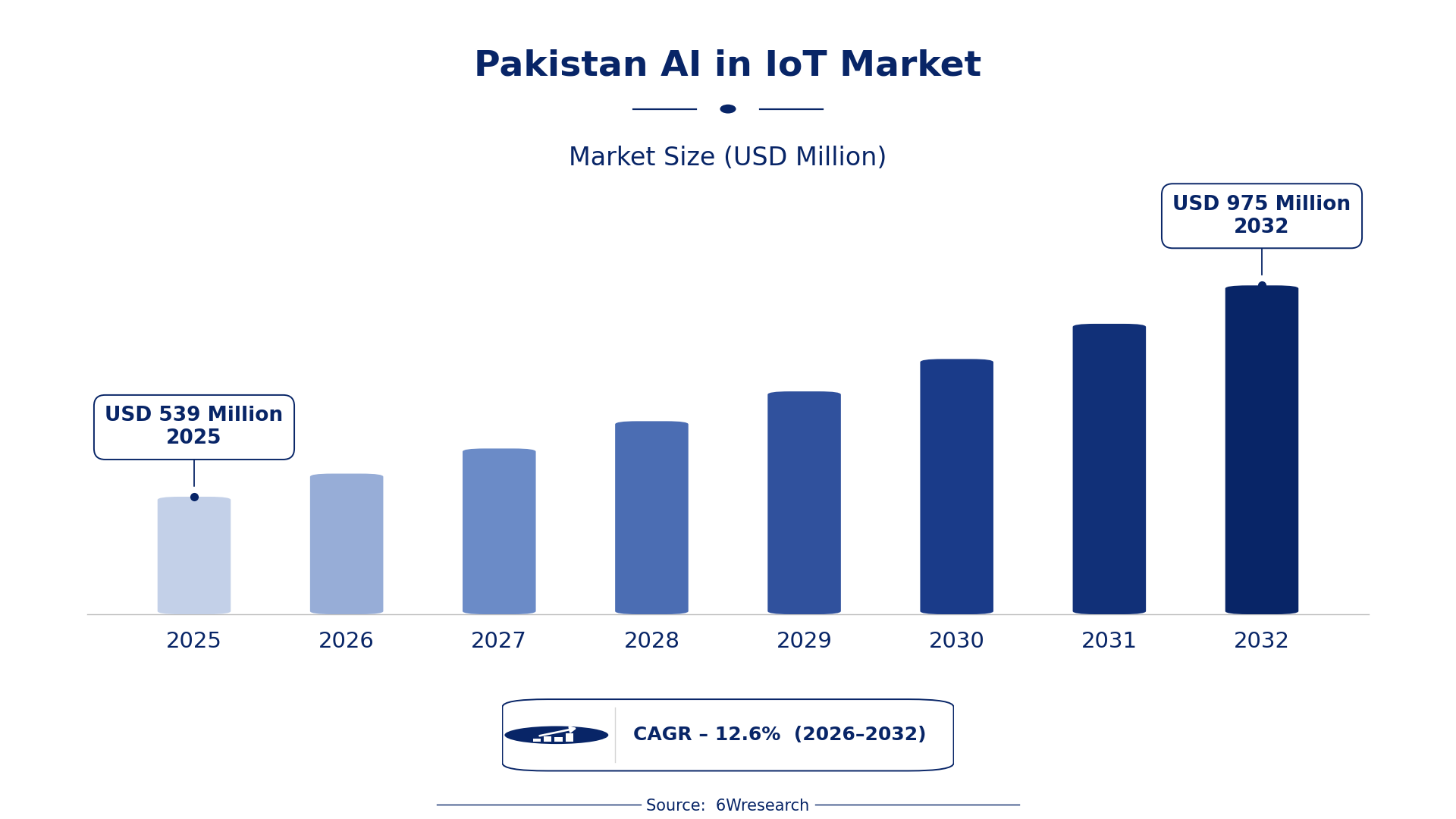
The Pakistan AI in IoT Market was estimated at USD 539 Million in 2025 and is projected to reach USD 975 Million by 2032, growing at a CAGR of 12.6% from 2026 to 2032.
Pakistan AI in IoT Market Synopsis
The Pakistan AI in IoT market is on an upward trajectory, fueled by the widespread adoption of IoT technologies across key sectors. Industries such as healthcare, manufacturing, and agriculture are increasingly integrating AI to enhance data analysis and operational efficiency, setting the stage for transformative growth.
The convergence of AI and IoT is not merely a trend; it is reshaping how businesses operate and engage with customers. As local companies and international players eye the burgeoning market, the potential for innovative applications is vast, promising improved decision-making and resource optimization across various domains.
Pakistan AI in IoT Market Year-wise Growth Rate and Key Drivers
This graph illustrates the annual growth rates of the Pakistan AI in IoT Market from 2021 to 2032, highlighting a steady upward trajectory and projected expansion over the forecast period.
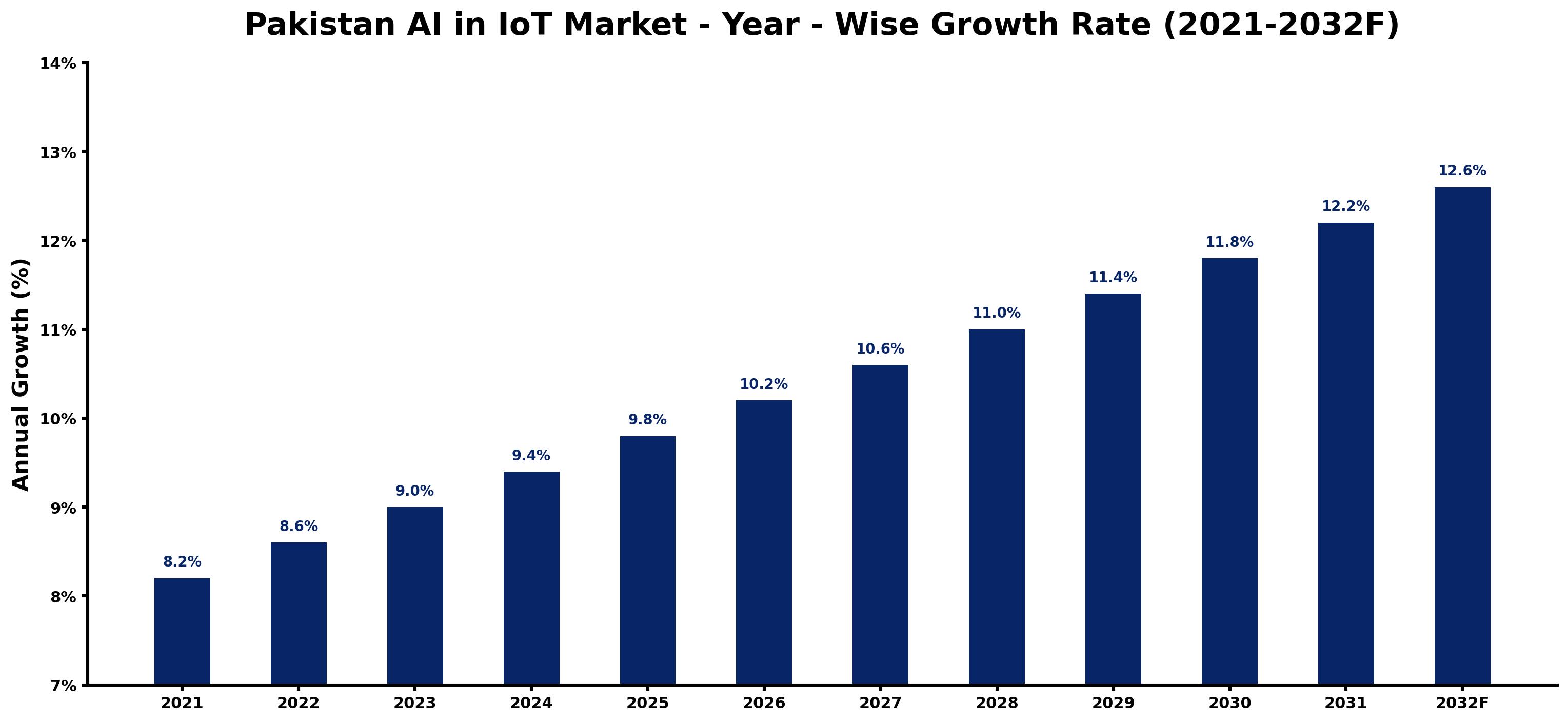
The table below presents the year‑wise growth rates along with the key drivers influencing the market
| Year | Growth Rate | Major Drivers |
| 2021 | 8.2% | Government incentives for AI startups boosting innovation. |
| 2022 | 8.6% | Surge in urbanization driving IoT solutions demand. |
| 2023 | 9.0% | Educational programs enhancing AI and IoT skill sets. |
| 2024 | 9.4% | Local tech hubs fostering AI-powered IoT solutions. |
| 2025 | 9.8% | Increased internet penetration supporting smart device adoption. |
| 2026 | 10.2% | Private-public partnerships advancing smart city projects. |
| 2027 | 10.6% | Regulatory support for IoT-enabled health monitoring solutions. |
| 2028 | 11.0% | Growing investment in AI research initiatives. |
| 2029 | 11.4% | Rise of e-commerce requiring advanced logistics IoT systems. |
| 2030 | 11.8% | Focus on climate resilience promoting smart energy usage. |
| 2031 | 12.2% | Corporate sustainability initiatives leveraging IoT for efficiency. |
| 2032 | 12.6% | Development of regulatory frameworks for autonomous technologies. |
Note: Market size estimations and growth projections presented in this report are based on 6Wresearch's proprietary forecasting methodology, utilizing the latest available industry data, government publications, and primary research inputs.
Pakistan AI in IoT Market Key Takeaways
Below are some of the specific key takeaways from the market, including:
- Rapid growth in the adoption of AI technologies within IoT ecosystems across multiple sectors.
- Government policies promoting digital transformation are enhancing market prospects.
- Emerging trends highlight the increasing use of predictive maintenance and analytics in IoT systems.
- Challenges related to infrastructure and skill gaps must be addressed for sustained growth.
- The market presents lucrative opportunities for partnerships between AI solution providers and IoT firms.
Evaluation of Restraints in Pakistan AI in IoT Market
While the potential for growth is substantial, the Pakistan AI in IoT market is hindered by several pressing challenges. Limited awareness of AI and IoT technologies among both businesses and consumers stymies adoption. on top of that, a shortage of skilled professionals exacerbates the situation, making it difficult for organizations to implement these advanced solutions effectively. Connectivity issues and outdated infrastructure further complicate matters, creating hurdles in the integration of AI with IoT systems. Lastly, concerns surrounding data privacy and security remain significant barriers, demanding careful attention from stakeholders to foster a trustworthy environment for technological advancement.
Pakistan AI in IoT Market Trends
Several key trends are shaping the Pakistan AI in IoT market. The integration of AI for predictive maintenance is gaining traction, allowing industries to anticipate and mitigate equipment failures. Additionally, the rise of AI-powered chatbots is transforming customer service interactions, providing more efficient and personalized experiences. The demand for smart city initiatives is also on the rise, driving interest in AI technologies that optimize urban resource management. As these trends evolve, they are expected to redefine operational paradigms across various sectors.
Pakistan AI in IoT Market Opportunities
Opportunities abound for businesses aiming to invest in the Pakistan AI in IoT market. The surge in smart device adoption creates a fertile ground for innovative AI solutions, particularly in sectors like healthcare and agriculture. Collaborations between AI developers and IoT companies can yield cutting-edge products and services tailored to local needs. on top of that, as awareness of AI benefits grows, organizations are increasingly seeking technologies that enhance efficiency and reduce operational costs, opening doors for new entrants and established players alike.
Government Initiatives in the Pakistan AI in IoT Market
Government policy plays a crucial role in shaping the direction of the Pakistan AI in IoT market. Initiatives aimed at fostering digital transformation have led to the establishment of a supportive regulatory framework. The government’s commitment to enhancing technological infrastructure is evident, with various programs designed to promote innovation and investment in AI and IoT technologies.
- A recently completed initiative saw the launch of the "Digital Pakistan Policy," which lays the groundwork for AI and IoT development.
- Currently, the Ministry of Information Technology is working on creating centers of excellence focused on AI and IoT research.
- Upcoming initiatives include tax incentives aimed at encouraging local businesses to invest in AI-driven IoT projects.
- The government is also planning to expand digital infrastructure through a national upgrade program that will enhance connectivity by 2027.
Future Insights of the Pakistan AI in IoT Market
Looking ahead to 2026-2032, the Pakistan AI in IoT market is set for substantial growth. As the demand for smart solutions escalates, industries will increasingly rely on AI to derive actionable insights from vast data streams. Continued government support for digital initiatives and an uptick in private sector investment will further accelerate this trend. The market is expected to mature as businesses adopt AI technologies not just for efficiency, but as a fundamental aspect of their operational strategies.
Pakistan AI in IoT Market Latest Developments
In the past year, the Pakistan AI in IoT market has witnessed significant developments, reflecting the growing interest in integrating AI with IoT solutions. Both local startups and established enterprises are actively engaging in projects that promise to revolutionize industry standards. These advancements signal a commitment to technological progress and the recognition of the vital role AI and IoT will play in the country's economic future.
- A leading technology vendor launched a new AI analytics platform aimed at enhancing decision-making in the agriculture sector in Q1 2025.
- An initiative focused on developing AI-powered smart meters for energy management is currently underway, expected to be completed by late 2026.
- A major telecommunications provider announced plans for a nationwide rollout of IoT connectivity services, with implementation slated to begin in early 2026.
- By mid-2025, a public-private partnership is set to kick off, aimed at establishing AI research hubs across the country.
Pakistan AI in IoT Market - Key Attractiveness of the Report
- 10 Years of Market Numbers
- Historical Data Starting from 2022 to 2025
- Base Year: 2025
- Forecast Data until 2032
- Key Performance Indicators Impacting the Market
- Major Upcoming Developments and Projects
Key Highlights of the Report:
- Pakistan AI in IoT Market Outlook
- Market Size of Pakistan AI in IoT Market, 2025
- Forecast of Pakistan AI in IoT Market, 2032
- Historical Data and Forecast of Pakistan AI in IoT Revenues & Volume for the Period 2022-2032F
- Pakistan AI in IoT Market Trend Evolution
- Pakistan AI in IoT Market Drivers and Challenges
- Pakistan AI in IoT Price Trends
- Pakistan AI in IoT Porter's Five Forces
- Pakistan AI in IoT Industry Life Cycle
- Historical Data and Forecast of Pakistan AI in IoT Market Revenues & Volume By Component for the Period 2022-2032F
- Historical Data and Forecast of Pakistan AI in IoT Market Revenues & Volume By Platforms for the Period 2022-2032F
- Historical Data and Forecast of Pakistan AI in IoT Market Revenues & Volume By Software Solutions for the Period 2022-2032F
- Historical Data and Forecast of Pakistan AI in IoT Market Revenues & Volume By Services for the Period 2022-2032F
- Historical Data and Forecast of Pakistan AI in IoT Market Revenues & Volume By Vertical for the Period 2022-2032F
- Historical Data and Forecast of Pakistan AI in IoT Market Revenues & Volume By Manufacturing for the Period 2022-2032F
- Historical Data and Forecast of Pakistan AI in IoT Market Revenues & Volume By Energy and Utilities for the Period 2022-2032F
- Historical Data and Forecast of Pakistan AI in IoT Market Revenues & Volume By Transportation and Mobility for the Period 2022-2032F
- Historical Data and Forecast of Pakistan AI in IoT Market Revenues & Volume By BFSI for the Period 2022-2032F
- Historical Data and Forecast of Pakistan AI in IoT Market Revenues & Volume By Government and Defense for the Period 2022-2032F
- Historical Data and Forecast of Pakistan AI in IoT Market Revenues & Volume By Retail for the Period 2022-2032F
- Historical Data and Forecast of Pakistan AI in IoT Market Revenues & Volume By Healthcare and Life Sciences for the Period 2022-2032F
- Historical Data and Forecast of Pakistan AI in IoT Market Revenues & Volume By Telecom for the Period 2022-2032F
- Historical Data and Forecast of Pakistan AI in IoT Market Revenues & Volume By Technology for the Period 2022-2032F
- Historical Data and Forecast of Pakistan AI in IoT Market Revenues & Volume By ML and Deep Learning for the Period 2022-2032F
- Historical Data and Forecast of Pakistan AI in IoT Market Revenues & Volume By NLP for the Period 2022-2032F
- Pakistan AI in IoT Import Export Trade Statistics
- Market Opportunity Assessment By Component
- Market Opportunity Assessment By Vertical
- Market Opportunity Assessment By Technology
- Pakistan AI in IoT Top Companies Market Share
- Pakistan AI in IoT Competitive Benchmarking By Technical and Operational Parameters
- Pakistan AI in IoT Company Profiles
- Pakistan AI in IoT Key Strategic Recommendations






































