Pakistan Aircraft Cabin Interior Market Size, Share & Growth Rate
The Pakistan Aircraft Cabin Interior Market was estimated at USD 1207 Million in 2025 and is projected to reach USD 2221 Million by 2032, growing at a CAGR of 9.1% from 2026 to 2032. This trajectory is primarily driven by the burgeoning air travel demand, coupled with the ongoing modernization efforts across the countrys aviation sector. Airlines are increasingly focused on upgrading their cabin interiors to offer enhanced passenger experiences, contributing to the robust growth forecast for this segment.
Pakistan Aircraft Cabin Interior Market Year-wise Growth Rate and Key Drivers
This graph highlights how the Pakistan Aircraft Cabin Interior Market has steadily grown over the years, supported by major growth factors.
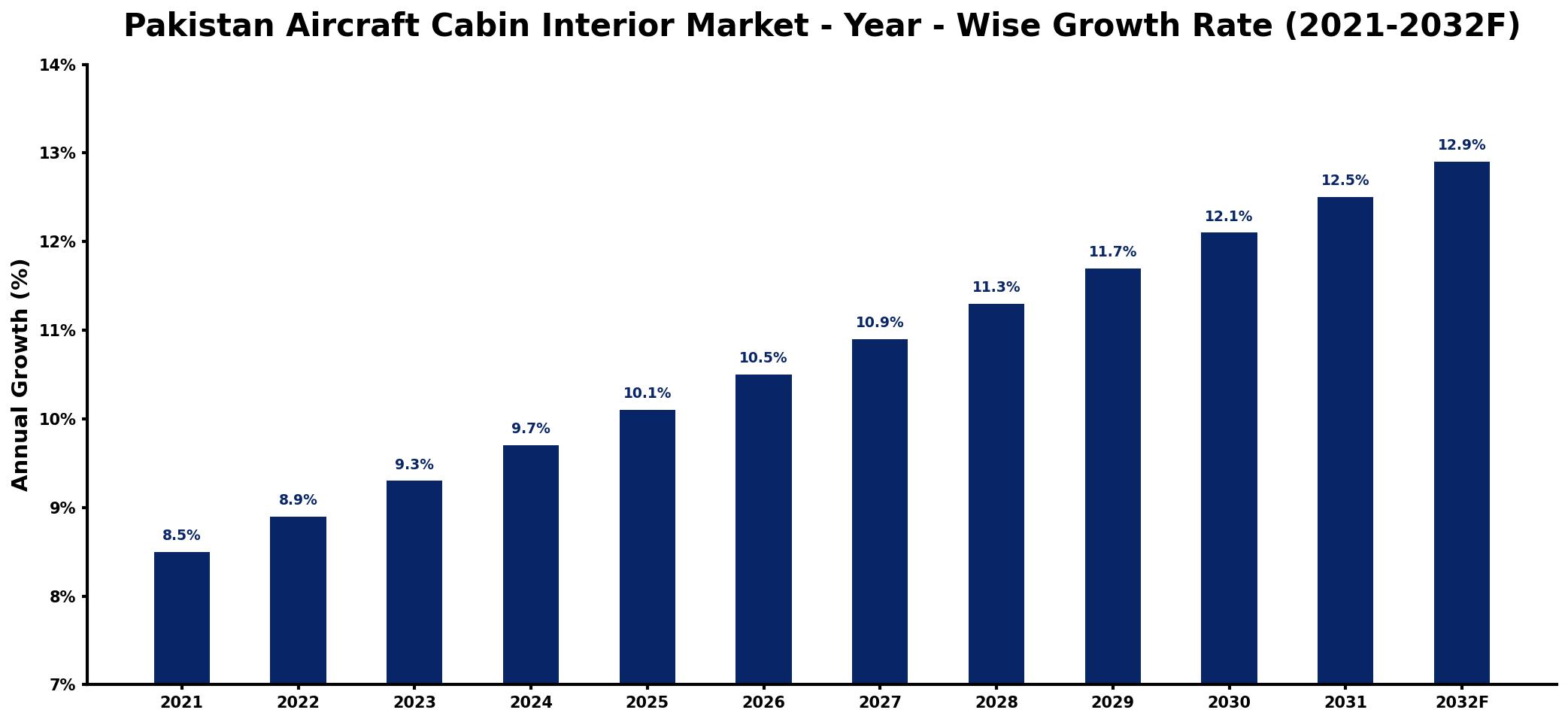
The table below presents the year‑wise growth rates along with the key drivers influencing the market
| Year | Growth Rate | Major Drivers |
| 2021 | 8.5% | Rising demand for air travel |
| 2022 | 8.9% | Increased airline fleet expansions |
| 2023 | 9.3% | Growing focus on passenger comfort |
| 2024 | 9.7% | Investment in aviation infrastructure |
| 2025 | 10.1% | Emergence of low-cost carriers |
| 2026 | 10.5% | Technological advancements in design |
| 2027 | 10.9% | Sustainability initiatives in aviation |
| 2028 | 11.3% | Expansion of regional airports |
| 2029 | 11.7% | Boost in tourism and travel |
| 2030 | 12.1% | Enhanced safety regulations implemented |
| 2031 | 12.5% | Collaboration with international partners |
| 2032 | 12.9% | Rising disposable income trends |
Note: Market size estimations and growth projections presented in this report are based on 6Wresearch's proprietary forecasting methodology, utilizing the latest available industry data, government publications, and primary research inputs.
Pakistan Aircraft Cabin Interior Market Synopsis
The demand for innovative aircraft cabin interiors in Pakistan is growing rapidly, fueled by an increase in air traffic and a shift towards low-cost carriers. As the aviation landscape transforms, airlines are prioritizing upgrades to their cabin offerings, placing significant emphasis on passenger comfort and advanced in-flight technologies.
In tandem with these developments, the market is witnessing an uptick in the adoption of sustainable materials and solutions. The recent emphasis on hygiene post-pandemic has also shaped purchasing decisions, with an increased focus on antimicrobial technologies and touchless interfaces becoming critical elements in cabin design.
Pakistan Aircraft Cabin Interior Market Key Takeaways
- The market is poised for substantial growth, driven by increasing demand for advanced cabin interior solutions.
- Airlines are placing a greater emphasis on passenger comfort, leading to innovations in seating and entertainment systems.
- The shift towards sustainability is prompting airlines to explore eco-friendly materials and designs.
- The emergence of low-cost carriers is expanding the need for cost-effective and customizable cabin solutions.
- Strategic partnerships with international suppliers are essential for local players to enhance manufacturing capabilities.
Evaluation of Restraints in Pakistan Aircraft Cabin Interior Market
Despite its promising outlook, the Pakistan Aircraft Cabin Interior Market faces notable restraints. A significant challenge is the limited pool of local suppliers capable of delivering specialized products, which leads to a heavy reliance on imports. This not only increases costs but can also result in extended lead times, affecting project timelines. Moreover, the existing technological landscape in the country is still developing; inadequate manufacturing facilities hinder the ability to meet sophisticated airline requirements for modern cabin interiors. Lastly, the fluctuating economic and political climate introduces uncertainty, making it essential for stakeholders to navigate these complexities carefully in order to capitalize on the growing opportunities.
Pakistan Aircraft Cabin Interior Market Trends
A defining trend in the market is the increasing preference for lightweight cabin solutions that improve fuel efficiency and reduce operational costs. Airlines are integrating advanced technologies such as mood lighting and premium seating configurations to enhance the overall passenger experience. Furthermore, the push towards sustainability is evident, as companies explore the use of environmentally-friendly materials that align with global eco-consciousness. The heightened focus on hygiene has also seen a rise in demand for antimicrobial surfaces and touchless technologies, reshaping the design parameters for aircraft interiors.
Pakistan Aircraft Cabin Interior Market Opportunities
Opportunities for investment in the Pakistan Aircraft Cabin Interior Market are substantial. As airlines expand their fleets and modernize existing aircraft, the need for upgrading and retrofitting cabin interiors becomes a priority. The growth of low-cost carriers presents avenues for customized solutions that cater to a diverse range of passenger preferences. Additionally, partnerships with local and international suppliers can facilitate innovation in product offerings, presenting a path for businesses to tap into this evolving market landscape.
Government Initiatives in the Pakistan Aircraft Cabin Interior Market
The Pakistani government has taken proactive measures to enhance the competitiveness of the Aircraft Cabin Interior Market. By introducing tax incentives and subsidies, the government aims to attract foreign investment, particularly in manufacturing capabilities for cabin interiors. Additionally, there has been a focus on improving aviation infrastructure, including airport expansions, to accommodate the rising number of air travelers. Regulatory frameworks are in place to ensure compliance with international safety standards, creating an environment that supports quality production and innovation in aircraft cabin interiors.
Future Insights of the Pakistan Aircraft Cabin Interior Market
Looking ahead, the Pakistan Aircraft Cabin Interior Market is set for continuous evolution through 2026-2032. With the increasing volume of air passenger traffic, driven by both regional and international travel demand, airlines will be compelled to invest in advanced cabin interior technologies that enhance comfort and connectivity. The focus on customizable solutions and environmentally-conscious design will further delineate competitive offerings. Manufacturers that prioritize lightweight, durable materials will find themselves well-positioned to capture market share as airlines look to optimize costs while elevating the passenger experience.
Pakistan Aircraft Cabin Interior Market Latest Developments (2025 - 2026)
Recent developments indicate a significant shift in the Pakistan Aircraft Cabin Interior Market, marked by increased collaboration between local manufacturers and international suppliers. This trend is aimed at enhancing product offerings while fostering technological advancements in cabin design. As airlines continue to modernize their fleets, there's been a notable uptick in innovative projects focusing on sustainable and smart cabin solutions that address passenger expectations for comfort and connectivity.
Pakistan Aircraft Cabin Interior Market - Key Attractiveness of the Report
- 10 Years of Market Numbers
- Historical Data Starting from 2022 to 2025
- Base Year: 2025
- Forecast Data until 2032
- Key Performance Indicators Impacting the Market
- Major Upcoming Developments and Projects
Key Highlights of the Report:
- Pakistan Aircraft Cabin Interior Market Outlook
- Market Size of Pakistan Aircraft Cabin Interior Market, 2025
- Forecast of Pakistan Aircraft Cabin Interior Market, 2032
- Historical Data and Forecast of Pakistan Aircraft Cabin Interior Revenues & Volume for the Period 2022-2032F
- Pakistan Aircraft Cabin Interior Market Trend Evolution
- Pakistan Aircraft Cabin Interior Market Drivers and Challenges
- Pakistan Aircraft Cabin Interior Price Trends
- Pakistan Aircraft Cabin Interior Porter's Five Forces
- Pakistan Aircraft Cabin Interior Industry Life Cycle
- Historical Data and Forecast of Pakistan Aircraft Cabin Interior Market Revenues & Volume By Type for the Period 2022-2032F
- Historical Data and Forecast of Pakistan Aircraft Cabin Interior Market Revenues & Volume By Seats for the Period 2022-2032F
- Historical Data and Forecast of Pakistan Aircraft Cabin Interior Market Revenues & Volume By Cabin Lightening for the Period 2022-2032F
- Historical Data and Forecast of Pakistan Aircraft Cabin Interior Market Revenues & Volume By Windows and Windshields for the Period 2022-2032F
- Historical Data and Forecast of Pakistan Aircraft Cabin Interior Market Revenues & Volume By Galley and Lavatory for the Period 2022-2032F
- Historical Data and Forecast of Pakistan Aircraft Cabin Interior Market Revenues & Volume By In-Flight Entertainment & Connectivity for the Period 2022-2032F
- Historical Data and Forecast of Pakistan Aircraft Cabin Interior Market Revenues & Volume By Others for the Period 2022-2032F
- Historical Data and Forecast of Pakistan Aircraft Cabin Interior Market Revenues & Volume By Class for the Period 2022-2032F
- Historical Data and Forecast of Pakistan Aircraft Cabin Interior Market Revenues & Volume By First Class for the Period 2022-2032F
- Historical Data and Forecast of Pakistan Aircraft Cabin Interior Market Revenues & Volume By Business Class for the Period 2022-2032F
- Historical Data and Forecast of Pakistan Aircraft Cabin Interior Market Revenues & Volume By Premium Economy Class for the Period 2022-2032F
- Historical Data and Forecast of Pakistan Aircraft Cabin Interior Market Revenues & Volume By Economy Class for the Period 2022-2032F
- Historical Data and Forecast of Pakistan Aircraft Cabin Interior Market Revenues & Volume By Aircraft Type for the Period 2022-2032F
- Historical Data and Forecast of Pakistan Aircraft Cabin Interior Market Revenues & Volume By Narrow Body Aircraft for the Period 2022-2032F
- Historical Data and Forecast of Pakistan Aircraft Cabin Interior Market Revenues & Volume By Wide-Body Aircraft for the Period 2022-2032F
- Historical Data and Forecast of Pakistan Aircraft Cabin Interior Market Revenues & Volume By Business Jets for the Period 2022-2032F
- Historical Data and Forecast of Pakistan Aircraft Cabin Interior Market Revenues & Volume By Regional Transport Aircraft for the Period 2022-2032F
- Historical Data and Forecast of Pakistan Aircraft Cabin Interior Market Revenues & Volume By End User for the Period 2022-2032F
- Historical Data and Forecast of Pakistan Aircraft Cabin Interior Market Revenues & Volume By OEM for the Period 2022-2032F
- Historical Data and Forecast of Pakistan Aircraft Cabin Interior Market Revenues & Volume By Aftermarket for the Period 2022-2032F
- Pakistan Aircraft Cabin Interior Import Export Trade Statistics
- Market Opportunity Assessment By Type
- Market Opportunity Assessment By Class
- Market Opportunity Assessment By Aircraft Type
- Market Opportunity Assessment By End User
- Pakistan Aircraft Cabin Interior Top Companies Market Share
- Pakistan Aircraft Cabin Interior Competitive Benchmarking By Technical and Operational Parameters
- Pakistan Aircraft Cabin Interior Company Profiles
- Pakistan Aircraft Cabin Interior Key Strategic Recommendations






































