Pakistan Art and Sculpture Market Size, Share & Growth Rate
The Pakistan Art and Sculpture Market was estimated at USD 182 Million in 2025 and is projected to reach USD 239 Million by 2032, growing at a CAGR of 4.0% from 2026 to 2032. This upward trajectory is driven by a renewed interest in both traditional and contemporary art forms, coupled with an expanding global recognition of Pakistani artists. A vibrant community of emerging talents and an increasing number of art exhibitions and online sales platforms are further fueling this growth.
Pakistan Art and Sculpture Market Year-wise Growth Rate and Key Drivers
This graph highlights how the Pakistan Art and Sculpture Market has steadily grown over the years, supported by major growth factors.
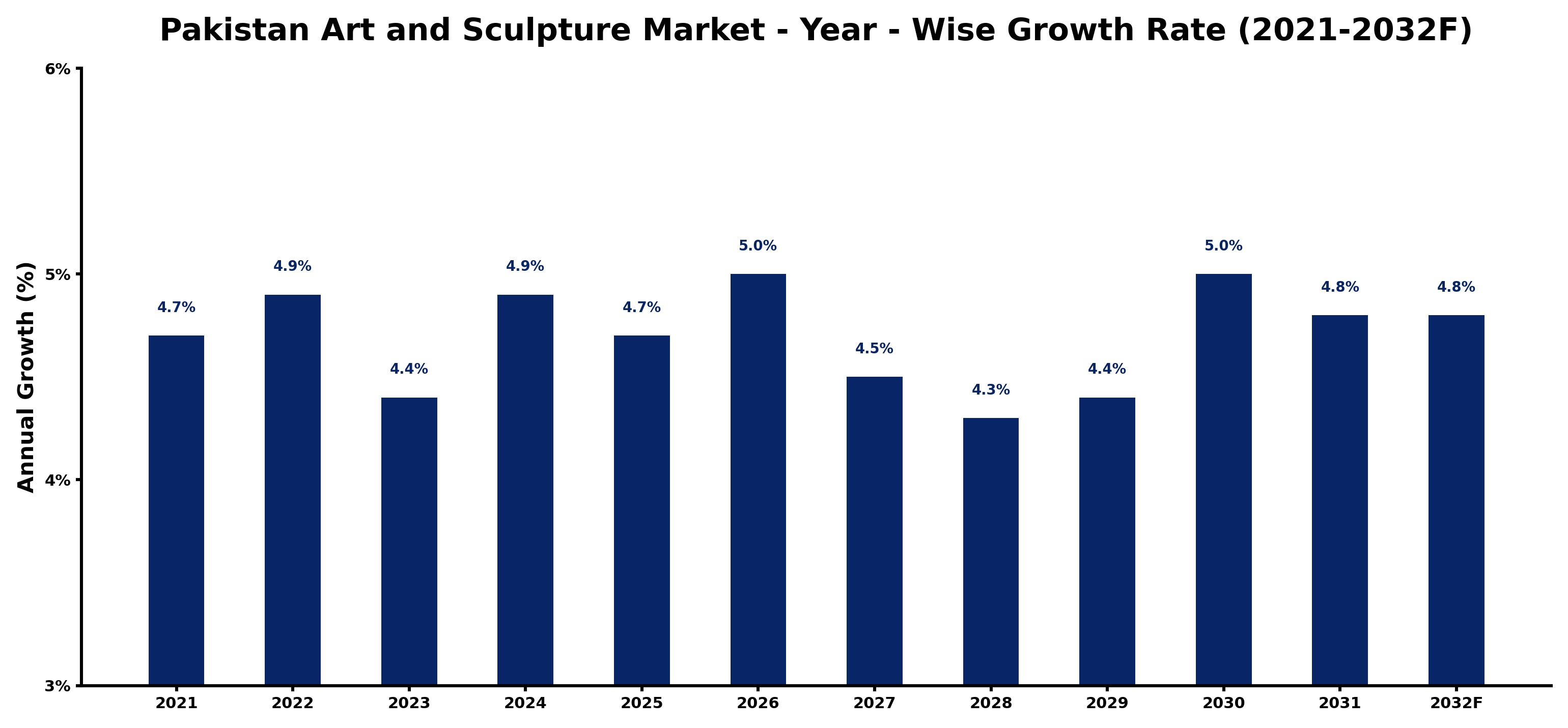
The table below presents the year‑wise growth rates along with the key drivers influencing the market
| Year | Growth Rate | Major Drivers |
| 2021 | 4.7% | Government infrastructure modernization initiatives |
| 2022 | 4.9% | Rising electricity demand across industries |
| 2023 | 4.4% | Government infrastructure modernization initiatives |
| 2024 | 4.9% | Increasing industrial infrastructure investments |
| 2025 | 4.7% | Government infrastructure modernization initiatives |
| 2026 | 5.0% | Increasing adoption of advanced technologies |
| 2027 | 4.5% | Rising electricity demand across industries |
| 2028 | 4.3% | Increasing industrial infrastructure investments |
| 2029 | 4.4% | Increasing adoption of advanced technologies |
| 2030 | 5.0% | Expansion of commercial construction activities |
| 2031 | 4.8% | Expansion of commercial construction activities |
| 2032 | 4.8% | Expansion of manufacturing activities |
Note - Market size estimations and growth projections presented in this report are based on 6Wresearch's advanced forecasting approach, validated with industry datasets as of June 2026.
Pakistan Art and Sculpture Market Synopsis
The most significant force shaping the Pakistan Art and Sculpture Market is the revival of traditional and indigenous art forms. As artists explore and integrate these cultural narratives into their contemporary work, there is a growing appreciation for the unique styles that define Pakistani artistry.
Moreover, the increasing visibility of local artists on international platforms is enhancing the demand for Pakistani art. This recognition not only validates their work but also encourages a fresh wave of creativity that resonates with both local and global audiences.
Pakistan Art and Sculpture Market Key Takeaways
- The market is seeing significant growth fueled by increased interest in both traditional and modern art.
- Emerging artists are gaining recognition, boosting the local and international appeal of Pakistani art.
- Government initiatives are providing support to artists and promoting the market.
- There is a notable rise in online platforms facilitating art sales and expanding market reach.
- The demand for culturally inspired sculptures is on the rise, reflecting a deep appreciation for Pakistani heritage.
Evaluation of Restraints in Pakistan Art and Sculpture Market
Despite its vibrant potential, the Pakistan Art and Sculpture Market encounters significant restraints that limit its full development. Key among these is the lack of infrastructural support for artists, which hampers their ability to create and market their work effectively. The general public's limited awareness and appreciation of contemporary art further complicate the scenario, as many still favor traditional forms. Moreover, economic factors and political instability can disrupt growth, making it challenging for artists to achieve sustainable incomes or gain the exposure they need on global platforms.
Pakistan Art and Sculpture Market Trends
Current trends in the Pakistan Art and Sculpture Market reflect a blend of traditional heritage and contemporary innovation. There is a noticeable shift towards themes that promote cultural identity, as artists seek to resonate with local audiences while appealing to global markets. Additionally, the rise of digital platforms is making art more accessible, allowing artists to showcase their work to a broader audience and facilitating online sales, which is particularly crucial for emerging talents.
Pakistan Art and Sculpture Market Opportunities
The growing interest in contemporary Pakistani art presents robust investment opportunities. With more collectors appreciating the unique narratives embedded in local artwork, investors can find value not only in potential financial returns but also in cultural appreciation. Additionally, the increasing number of art fairs and exhibitions can serve as excellent platforms for new and established artists to gain visibility, thus increasing the market's attractiveness for investment.
Government Initiatives in the Pakistan Art and Sculpture Market
The government of Pakistan has implemented a variety of initiatives aimed at nurturing the art and sculpture market. These efforts include grants for artists, funding for art exhibitions, and the establishment of councils dedicated to the arts. Public policy also emphasizes the preservation of cultural heritage, thus encouraging local artists to draw from historical narratives. Such government backing is essential for fostering creativity and stimulating economic growth within the sector.
Future Insights of the Pakistan Art and Sculpture Market
Looking ahead to 2026-2032, the Pakistan Art and Sculpture Market is expected to continue its growth trajectory, driven by an expanding global footprint of Pakistani artists. The convergence of traditional practices with modern techniques will likely resonate with an increasingly diverse audience. Moreover, the rise of digital sales platforms and government initiatives designed to promote the arts are predicted to further enhance market accessibility and investor interest, solidifying Pakistan's place in the global art scene.
Pakistan Art and Sculpture Market Latest Developments (May 2025 - June 2026)
Recent developments in the Pakistan Art and Sculpture Market have indicated an increase in both the number of exhibitions and the participation of international curators, enhancing the visibility of local artists. The introduction of government-sponsored art fairs has also encouraged community involvement and investment. Additionally, online marketplaces are expanding, creating new channels for artists to reach buyers directly, signaling a significant shift in how art is marketed and sold in Pakistan.
Pakistan Art and Sculpture Market - Key Attractiveness of the Report
- 10 Years of Market Numbers
- Historical Data Starting from 2022 to 2025
- Base Year: 2025
- Forecast Data until 2032
- Key Performance Indicators Impacting the Market
- Major Upcoming Developments and Projects
Key Highlights of the Report:
- Pakistan Art and Sculpture Market Outlook
- Market Size of Pakistan Art and Sculpture Market, 2025
- Forecast of Pakistan Art and Sculpture Market, 2032
- Historical Data and Forecast of Pakistan Art and Sculpture Revenues & Volume for the Period 2022-2032F
- Pakistan Art and Sculpture Market Trend Evolution
- Pakistan Art and Sculpture Market Drivers and Challenges
- Pakistan Art and Sculpture Price Trends
- Pakistan Art and Sculpture Porter's Five Forces
- Pakistan Art and Sculpture Industry Life Cycle
- Historical Data and Forecast of Pakistan Art and Sculpture Market Revenues & Volume By Types for the Period 2022-2032F
- Historical Data and Forecast of Pakistan Art and Sculpture Market Revenues & Volume By Artifacts for the Period 2022-2032F
- Historical Data and Forecast of Pakistan Art and Sculpture Market Revenues & Volume By Sculpture for the Period 2022-2032F
- Historical Data and Forecast of Pakistan Art and Sculpture Market Revenues & Volume By Sales Channel for the Period 2022-2032F
- Historical Data and Forecast of Pakistan Art and Sculpture Market Revenues & Volume By Auction Houses for the Period 2022-2032F
- Historical Data and Forecast of Pakistan Art and Sculpture Market Revenues & Volume By Dealers for the Period 2022-2032F
- Historical Data and Forecast of Pakistan Art and Sculpture Market Revenues & Volume By Galleries for the Period 2022-2032F
- Historical Data and Forecast of Pakistan Art and Sculpture Market Revenues & Volume By Art Fairs for the Period 2022-2032F
- Historical Data and Forecast of Pakistan Art and Sculpture Market Revenues & Volume By Online Sales for the Period 2022-2032F
- Historical Data and Forecast of Pakistan Art and Sculpture Market Revenues & Volume By Retail Outlets for the Period 2022-2032F
- Historical Data and Forecast of Pakistan Art and Sculpture Market Revenues & Volume By Artists Studios for the Period 2022-2032F
- Historical Data and Forecast of Pakistan Art and Sculpture Market Revenues & Volume By Others for the Period 2022-2032F
- Historical Data and Forecast of Pakistan Art and Sculpture Market Revenues & Volume By End-user for the Period 2022-2032F
- Historical Data and Forecast of Pakistan Art and Sculpture Market Revenues & Volume By Private Collectors for the Period 2022-2032F
- Historical Data and Forecast of Pakistan Art and Sculpture Market Revenues & Volume By Museums for the Period 2022-2032F
- Historical Data and Forecast of Pakistan Art and Sculpture Market Revenues & Volume By Real Estate Developers for the Period 2022-2032F
- Historical Data and Forecast of Pakistan Art and Sculpture Market Revenues & Volume By Interior Designers for the Period 2022-2032F
- Historical Data and Forecast of Pakistan Art and Sculpture Market Revenues & Volume By Residential Individual Buyers for the Period 2022-2032F
- Historical Data and Forecast of Pakistan Art and Sculpture Market Revenues & Volume By Other Professionals for the Period 2022-2032F
- Pakistan Art and Sculpture Import Export Trade Statistics
- Market Opportunity Assessment By Types
- Market Opportunity Assessment By Sales Channel
- Market Opportunity Assessment By End-user
- Pakistan Art and Sculpture Top Companies Market Share
- Pakistan Art and Sculpture Competitive Benchmarking By Technical and Operational Parameters
- Pakistan Art and Sculpture Company Profiles
- Pakistan Art and Sculpture Key Strategic Recommendations






































