Pakistan Auto Parts And Accessories Market Size, Share & Growth Rate
The Pakistan Auto Parts And Accessories Market was estimated at USD 246 Million in 2025 and is projected to reach USD 334 Million by 2032, growing at a CAGR of 4.5% from 2026 to 2032. This growth trajectory is largely driven by increasing vehicle ownership as the countrys economy expands, coupled with rising disposable incomes that allow consumers to invest in vehicle maintenance and customization. Additionally, a vibrant aftermarket is emerging, fueled by consumer demand for high-quality and innovative automotive components.
Pakistan Auto Parts And Accessories Market Year-wise Growth Rate and Key Drivers
This graph highlights how the Pakistan Auto Parts And Accessories Market has steadily grown over the years, supported by major growth factors.
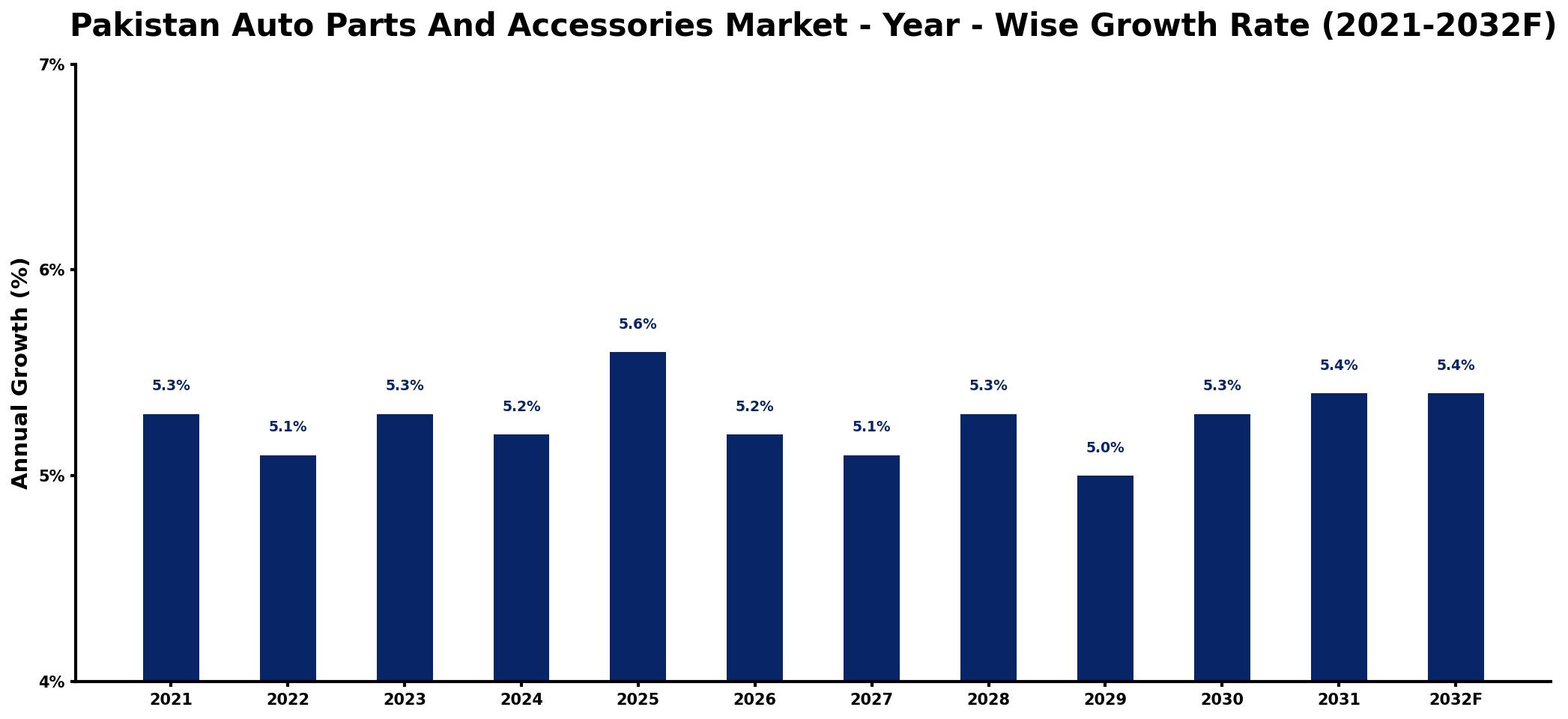
The table below presents the year‑wise growth rates along with the key drivers influencing the market
| Year | Growth Rate | Major Drivers |
| 2021 | 5.3% | Increase in vehicle ownership rates |
| 2022 | 5.1% | Rising consumer spending on maintenance |
| 2023 | 5.3% | Expansion of local manufacturing facilities |
| 2024 | 5.2% | Growth in e-commerce sales channels |
| 2025 | 5.6% | Investment in transportation infrastructure projects |
| 2026 | 5.2% | rising procurement volume requirements |
| 2027 | 5.1% | increased overall sector activity |
| 2028 | 5.3% | improved raw material availability |
| 2029 | 5.0% | growing commercial sector adoption |
| 2030 | 5.3% | Rising awareness of vehicle safety |
| 2031 | 5.4% | rising end-use demand growth |
| 2032 | 5.4% | rising demand from electronics |
Note: Market size estimations and growth projections presented in this report are based on 6Wresearch's proprietary forecasting methodology, utilizing the latest available industry data, government publications, and primary research inputs.
Pakistan Auto Parts And Accessories Market Synopsis
Recent trends indicate a robust momentum in the Pakistan Auto Parts and Accessories Market, driven by a surge in vehicle sales and an aging vehicle fleet that requires enhanced maintenance solutions. Looking ahead, the market is expected to evolve, propelled by technological innovations and a shift toward electric and connected vehicle components.
Local manufacturers are playing a pivotal role in this evolving landscape, producing both OEM and aftermarket parts to cater to diverse consumer needs. However, the market is also challenged by the influx of counterfeit products and competition from imported parts, which necessitates a focus on quality and innovation to maintain consumer trust.
Pakistan Auto Parts And Accessories Market Key Takeaways
- The market is expanding due to rising vehicle ownership and disposable income levels.
- Technological advancements, particularly in electric vehicles, are shaping product offerings.
- Local manufacturers are increasingly focused on quality and customization options.
- The e-commerce sector is enhancing consumer access to a variety of auto parts.
- Investment opportunities in manufacturing and distribution networks are robust.
Evaluation of Restraints in Pakistan Auto Parts And Accessories Market
Despite the optimistic growth trajectory, several key restraints hinder the market's full potential. One significant issue is the prevalence of counterfeit products, which not only undermine the credibility of genuine suppliers but also pose safety risks to consumers. Additionally, the competitive landscape is increasingly challenging, with imported parts often undercutting local manufacturers on price. The lack of stringent quality control standards exacerbates these issues, making it difficult for customers to distinguish between authentic and substandard offerings. Furthermore, limited technological advancements within the local industry restrict opportunities for innovation, ultimately affecting competitiveness and market growth.
Pakistan Auto Parts And Accessories Market Trends
The market is experiencing a notable shift towards more environmentally friendly auto parts, such as those designed for electric vehicles. This trend aligns with the global push for sustainability within the automotive sector. Additionally, customization is increasingly popular, as consumers seek to personalize their vehicles with unique accessories and enhancements. The rise of e-commerce platforms is transforming distribution channels, allowing for easier access and a wider range of products, enhancing overall customer experience.
Pakistan Auto Parts And Accessories Market Opportunities
The market presents several lucrative investment opportunities for stakeholders. There is a growing demand for high-quality aftermarket parts, spurred by the aging vehicle population. Establishing manufacturing facilities focused on producing essential components such as engine parts, batteries, and electronic systems can yield significant returns. Additionally, partnerships with local manufacturers or international brands seeking to enter the market can offer a competitive edge, especially in the niche areas of electric vehicle parts and advanced technology solutions.
Government Initiatives in the Pakistan Auto Parts And Accessories Market
The Pakistani government has introduced various policies to promote local manufacturing within the auto parts and accessories market. These initiatives include reducing import duties on raw materials to encourage domestic production and offering incentives for establishing manufacturing facilities. Furthermore, there is an emphasis on enforcing strict quality control regulations to enhance product safety and reliability. The government also supports research and development activities, fostering innovation that is critical for maintaining competitiveness in this evolving market.
Future Insights of the Pakistan Auto Parts And Accessories Market
Looking forward, the future of the Pakistan Auto Parts and Accessories Market is promising, with various factors contributing to its continued growth. The automotive industry is on an upward trajectory, with increasing vehicle production and sales. Coupled with government support for local manufacturing and innovation in technology, this growth is set to continue. However, stakeholders must remain vigilant about challenges such as fluctuating raw material prices and changing consumer preferences. Adopting strategies that prioritize sustainability, quality, and technological advancements will be essential for capturing market opportunities in the years ahead.
Pakistan Auto Parts And Accessories Market Latest Developments (2025 - 2026)
In the recent months leading up to mid-2026, the Pakistan Auto Parts and Accessories Market has seen a shift towards greater digitalization, with many businesses enhancing their online presence to reach a broader consumer base. E-commerce platforms are increasingly becoming a vital channel for distributing auto parts, offering consumers convenience and diverse options. Additionally, local manufacturers are beginning to invest in advanced manufacturing technologies to boost efficiency and reduce production costs, ensuring they remain competitive against imported products.
Pakistan Auto Parts And Accessories Market - Key Attractiveness of the Report
- 10 Years of Market Numbers
- Historical Data Starting from 2022 to 2025
- Base Year: 2025
- Forecast Data until 2032
- Key Performance Indicators Impacting the Market
- Major Upcoming Developments and Projects
Key Highlights of the Report:
- Pakistan Auto Parts And Accessories Market Outlook
- Market Size of Pakistan Auto Parts And Accessories Market, 2025
- Forecast of Pakistan Auto Parts And Accessories Market, 2032
- Historical Data and Forecast of Pakistan Auto Parts And Accessories Revenues & Volume for the Period 2022-2032F
- Pakistan Auto Parts And Accessories Market Trend Evolution
- Pakistan Auto Parts And Accessories Market Drivers and Challenges
- Pakistan Auto Parts And Accessories Price Trends
- Pakistan Auto Parts And Accessories Porter's Five Forces
- Pakistan Auto Parts And Accessories Industry Life Cycle
- Historical Data and Forecast of Pakistan Auto Parts And Accessories Market Revenues & Volume By Product for the Period 2022-2032F
- Historical Data and Forecast of Pakistan Auto Parts And Accessories Market Revenues & Volume By Driveline & Powertrain for the Period 2022-2032F
- Historical Data and Forecast of Pakistan Auto Parts And Accessories Market Revenues & Volume By Interiors & Exteriors for the Period 2022-2032F
- Historical Data and Forecast of Pakistan Auto Parts And Accessories Market Revenues & Volume By Electronics for the Period 2022-2032F
- Historical Data and Forecast of Pakistan Auto Parts And Accessories Market Revenues & Volume By Bodies & Chassis for the Period 2022-2032F
- Historical Data and Forecast of Pakistan Auto Parts And Accessories Market Revenues & Volume By Wheel & Tires for the Period 2022-2032F
- Historical Data and Forecast of Pakistan Auto Parts And Accessories Market Revenues & Volume By Others for the Period 2022-2032F
- Historical Data and Forecast of Pakistan Auto Parts And Accessories Market Revenues & Volume By Application for the Period 2022-2032F
- Historical Data and Forecast of Pakistan Auto Parts And Accessories Market Revenues & Volume By OEMs for the Period 2022-2032F
- Historical Data and Forecast of Pakistan Auto Parts And Accessories Market Revenues & Volume By Aftermarket for the Period 2022-2032F
- Pakistan Auto Parts And Accessories Import Export Trade Statistics
- Market Opportunity Assessment By Product
- Market Opportunity Assessment By Application
- Pakistan Auto Parts And Accessories Top Companies Market Share
- Pakistan Auto Parts And Accessories Competitive Benchmarking By Technical and Operational Parameters
- Pakistan Auto Parts And Accessories Company Profiles
- Pakistan Auto Parts And Accessories Key Strategic Recommendations






































