Pakistan Automotive Diecast Scale Model Market Size, Share & Growth Rate
The Pakistan Automotive Diecast Scale Model Market was estimated at USD 388 Million in 2025 and is projected to reach USD 528 Million by 2032, growing at a CAGR of 4.5% from 2026 to 2032. This robust growth trajectory is primarily fueled by the increasing interest in collectible items among the population and the expansion of the automotive enthusiast base within the country. Moreover, as disposable incomes rise, consumers are more inclined to invest in high-quality models that reflect their passion for automobiles.
Pakistan Automotive Diecast Scale Model Market Year-wise Growth Rate and Key Drivers
This graph highlights how the Pakistan Automotive Diecast Scale Model Market has steadily grown over the years, supported by major growth factors.
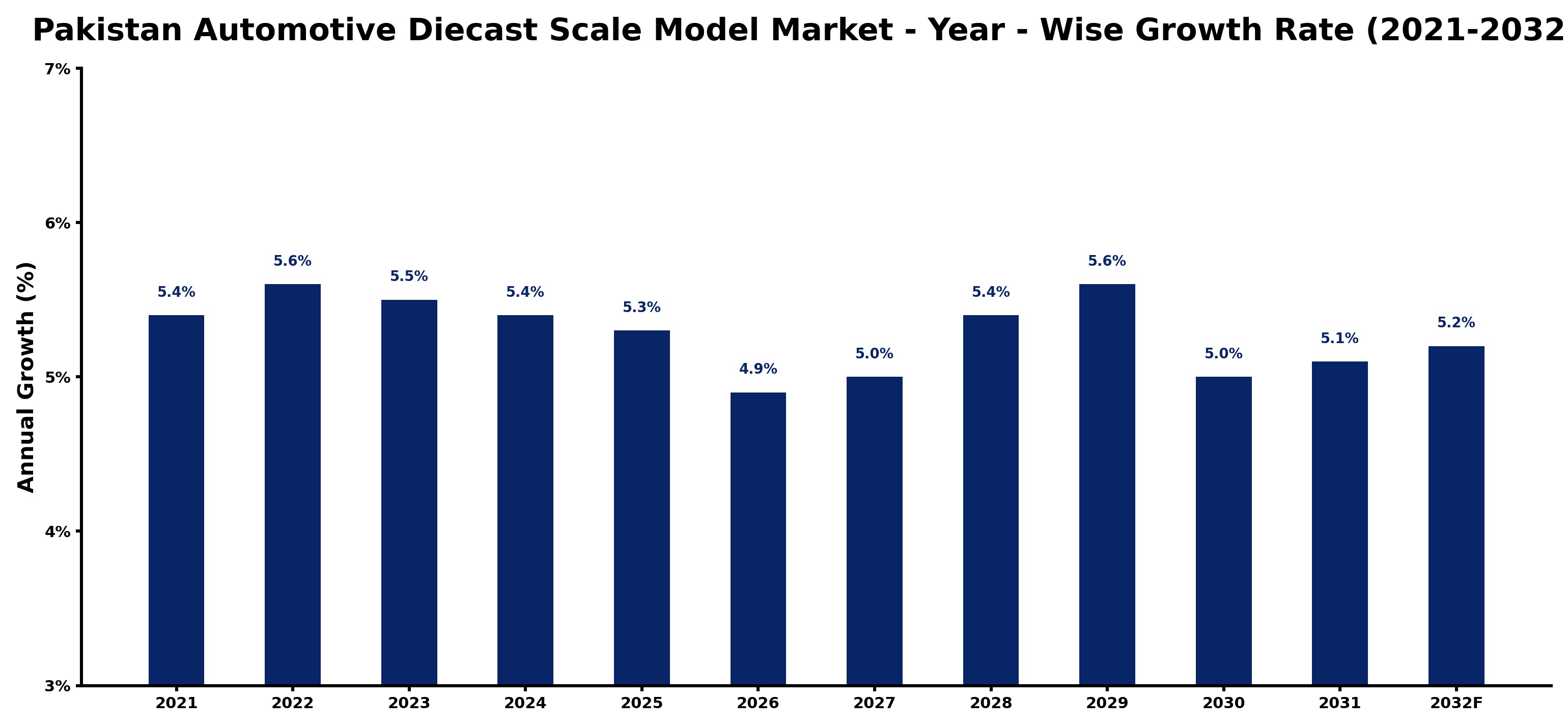
The table below presents the year‑wise growth rates along with the key drivers influencing the market
| Year | Growth Rate | Major Drivers |
| 2021 | 5.4% | Government infrastructure modernization initiatives |
| 2022 | 5.6% | Rapid growth in telecom and data center sectors |
| 2023 | 5.5% | Rising electricity demand across industries |
| 2024 | 5.4% | Growing renewable energy integration projects |
| 2025 | 5.3% | Growing renewable energy integration projects |
| 2026 | 4.9% | Expansion of commercial construction activities |
| 2027 | 5.0% | Rapid growth in telecom and data center sectors |
| 2028 | 5.4% | Increasing industrial infrastructure investments |
| 2029 | 5.6% | Expansion of manufacturing activities |
| 2030 | 5.0% | Expansion of manufacturing activities |
| 2031 | 5.1% | Increasing smart city development projects |
| 2032 | 5.2% | Rising electricity demand across industries |
Note - Market size estimations and growth projections presented in this report are based on 6Wresearch’s advanced forecasting approach, validated with industry datasets as of June 2026.
Pakistan Automotive Diecast Scale Model Market Synopsis
Recently, the market has experienced a notable surge in interest and sales, driven by a wave of collectors looking for detailed replicas of both classic and modern vehicles. However, as the market evolves, it is poised to transition from being a niche segment to a more mainstream hobby, fueled by digital accessibility and enhanced consumer awareness.
The continued integration of technology into model production is set to improve the quality and realism of diecast models. This technological advancement, paired with strategic collaborations between manufacturers and automotive brands, will likely create a new array of products that appeal to both collectors and everyday consumers, driving further growth.
Pakistan Automotive Diecast Scale Model Market Key Takeaways
- The market is projected to grow steadily, supported by increasing disposable income and a growing collector base.
- Customization trends, including personalized models, are enhancing consumer engagement and satisfaction.
- E-commerce and social media are transforming how consumers discover and purchase diecast models, increasing accessibility.
- Collaborations with automotive brands are resulting in exclusive model releases that resonate strongly with enthusiasts.
- The demand for premium and limited-edition models is creating a vibrant market for high-quality replicas.
Evaluation of Restraints in Pakistan Automotive Diecast Scale Model Market
Despite its promising outlook, the Pakistan Automotive Diecast Scale Model Market faces several restraints that can hinder growth. Limited consumer awareness about the variety of available models and their collectible value often results in a smaller potential market. Furthermore, high import duties and taxes increase the retail price of imported diecast models, making them less accessible to a broader audience. The competition from cheaper alternatives, such as plastic kits or lower-quality replicas, poses additional challenges for higher-end models, which may struggle to attract buyers in a price-sensitive market.
Pakistan Automotive Diecast Scale Model Market Trends
A notable trend in the market is the heightened demand for highly detailed and realistic models. Consumers are particularly drawn to popular scales, such as 1:18 and 1:24, which offer intricate designs and craftsmanship. Customization options are gaining traction, enabling collectors to personalize their models with unique features. Additionally, the rise of online platforms and social media is significantly enhancing the visibility of diecast models, enabling enthusiasts to connect and share their collections.
Pakistan Automotive Diecast Scale Model Market Opportunities
The current landscape presents a myriad of investment opportunities. The growing fascination with collectibles among Pakistani consumers signals a lucrative potential for manufacturers to expand their offerings. Furthermore, partnerships with local automotive brands can lead to exclusive releases that cater specifically to local tastes and preferences. These collaborations can enhance brand visibility and consumer loyalty, providing a significant edge in a competitive marketplace.
Government Initiatives in the Pakistan Automotive Diecast Scale Model Market
Government policies have a direct impact on the automotive diecast scale model market in Pakistan. Regulations governing the import and manufacturing processes are designed to protect domestic manufacturers while ensuring quality and safety for consumers. The government has also expressed its commitment to promoting local production through incentives and support initiatives, which can bolster the market and encourage manufacturers to innovate within this niche segment.
Future Insights of the Pakistan Automotive Diecast Scale Model Market
Looking ahead, the Pakistan Automotive Diecast Scale Model Market is set to flourish from 2026 to 2032. Advances in manufacturing technology will continue to enhance the realism and detail of models, appealing to both new and existing collectors. A growing community of enthusiasts, coupled with the expanding e-commerce landscape, will facilitate market penetration and consumer engagement. As disposable incomes rise and interest in automotive collectibles increases, the market is poised for dynamic growth.
Pakistan Automotive Diecast Scale Model Market Latest Developments (May 2025 - June 2026)
In recent months, the industry has witnessed significant movements towards improving distribution channels, especially through digital platforms. Companies are increasingly leveraging social media to promote new releases and limited-edition models, capturing the attention of a broader audience. Innovations in model design and materials are also emerging, reflecting consumer trends towards more sustainable and realistic products.
Pakistan Automotive Diecast Scale Model Market - Key Attractiveness of the Report
- 10 Years of Market Numbers
- Historical Data Starting from 2022 to 2025
- Base Year: 2025
- Forecast Data until 2032
- Key Performance Indicators Impacting the Market
- Major Upcoming Developments and Projects
Key Highlights of the Report:
- Pakistan Automotive Diecast Scale Model Market Outlook
- Market Size of Pakistan Automotive Diecast Scale Model Market, 2025
- Forecast of Pakistan Automotive Diecast Scale Model Market, 2032
- Historical Data and Forecast of Pakistan Automotive Diecast Scale Model Revenues & Volume for the Period 2022-2032F
- Pakistan Automotive Diecast Scale Model Market Trend Evolution
- Pakistan Automotive Diecast Scale Model Market Drivers and Challenges
- Pakistan Automotive Diecast Scale Model Price Trends
- Pakistan Automotive Diecast Scale Model Porter's Five Forces
- Pakistan Automotive Diecast Scale Model Industry Life Cycle
- Historical Data and Forecast of Pakistan Automotive Diecast Scale Model Market Revenues & Volume By Type for the Period 2022-2032F
- Historical Data and Forecast of Pakistan Automotive Diecast Scale Model Market Revenues & Volume By Plastic Model for the Period 2022-2032F
- Historical Data and Forecast of Pakistan Automotive Diecast Scale Model Market Revenues & Volume By Metal Model for the Period 2022-2032F
- Historical Data and Forecast of Pakistan Automotive Diecast Scale Model Market Revenues & Volume By End-users for the Period 2022-2032F
- Historical Data and Forecast of Pakistan Automotive Diecast Scale Model Market Revenues & Volume By Collectors for the Period 2022-2032F
- Historical Data and Forecast of Pakistan Automotive Diecast Scale Model Market Revenues & Volume By Non-collectors for the Period 2022-2032F
- Pakistan Automotive Diecast Scale Model Import Export Trade Statistics
- Market Opportunity Assessment By Type
- Market Opportunity Assessment By End-users
- Pakistan Automotive Diecast Scale Model Top Companies Market Share
- Pakistan Automotive Diecast Scale Model Competitive Benchmarking By Technical and Operational Parameters
- Pakistan Automotive Diecast Scale Model Company Profiles
- Pakistan Automotive Diecast Scale Model Key Strategic Recommendations






































