Pakistan Automotive Gasket & Seal Market: Import Trend Analysis
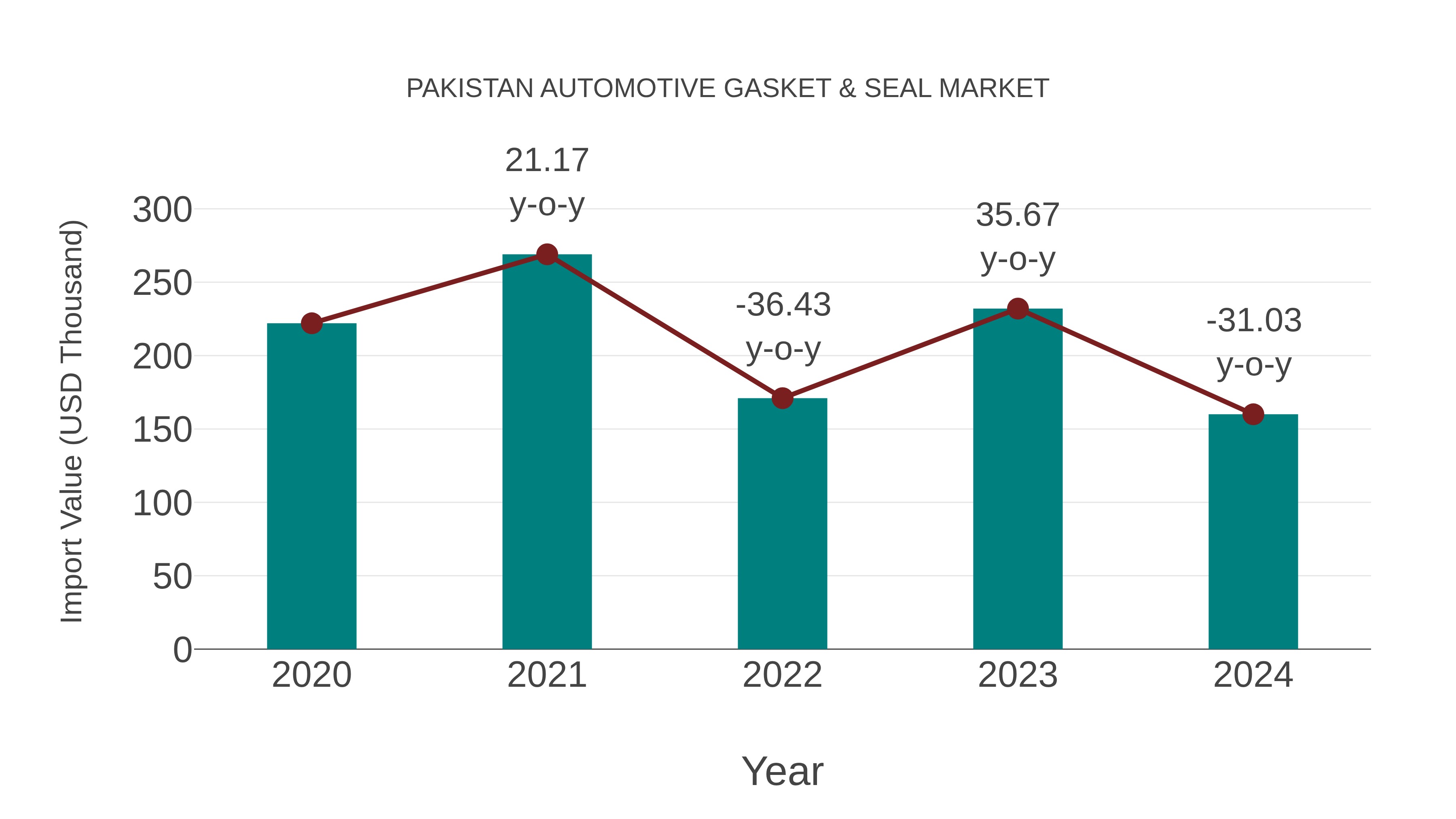
Pakistan import trend for automotive gaskets & seals in 2023-2024 saw a decline of -31.03%, with a CAGR of -7.86% for 2020-2024. This negative growth can be attributed to a combination of reduced demand in the automotive sector and potentially changing trade policies impacting imports of such components.
Key Highlights of the Report:
- Pakistan Automotive Gasket & Seal Market Outlook
- Market Size of Pakistan Automotive Gasket & Seal Market, 2024
- Forecast of Pakistan Automotive Gasket & Seal Market, 2031
- Historical Data and Forecast of Pakistan Automotive Gasket & Seal Revenues & Volume for the Period 2021 - 2031
- Pakistan Automotive Gasket & Seal Market Trend Evolution
- Pakistan Automotive Gasket & Seal Market Drivers and Challenges
- Pakistan Automotive Gasket & Seal Price Trends
- Pakistan Automotive Gasket & Seal Porter's Five Forces
- Pakistan Automotive Gasket & Seal Industry Life Cycle
- Historical Data and Forecast of Pakistan Automotive Gasket & Seal Market Revenues & Volume By Product Type for the Period 2021 - 2031
- Historical Data and Forecast of Pakistan Automotive Gasket & Seal Market Revenues & Volume By Gasket for the Period 2021 - 2031
- Historical Data and Forecast of Pakistan Automotive Gasket & Seal Market Revenues & Volume By Metallic Gasket for the Period 2021 - 2031
- Historical Data and Forecast of Pakistan Automotive Gasket & Seal Market Revenues & Volume By Non Metallic Gasket for the Period 2021 - 2031
- Historical Data and Forecast of Pakistan Automotive Gasket & Seal Market Revenues & Volume By Seals for the Period 2021 - 2031
- Historical Data and Forecast of Pakistan Automotive Gasket & Seal Market Revenues & Volume By Mechanical Seals for the Period 2021 - 2031
- Historical Data and Forecast of Pakistan Automotive Gasket & Seal Market Revenues & Volume By O Ring Seals for the Period 2021 - 2031
- Historical Data and Forecast of Pakistan Automotive Gasket & Seal Market Revenues & Volume By Lip Seals & Rotary Seals for the Period 2021 - 2031
- Historical Data and Forecast of Pakistan Automotive Gasket & Seal Market Revenues & Volume By Vehicle Type for the Period 2021 - 2031
- Historical Data and Forecast of Pakistan Automotive Gasket & Seal Market Revenues & Volume By PC for the Period 2021 - 2031
- Historical Data and Forecast of Pakistan Automotive Gasket & Seal Market Revenues & Volume By LCV & HCV for the Period 2021 - 2031
- Pakistan Automotive Gasket & Seal Import Export Trade Statistics
- Market Opportunity Assessment By Product Type
- Market Opportunity Assessment By Vehicle Type
- Pakistan Automotive Gasket & Seal Top Companies Market Share
- Pakistan Automotive Gasket & Seal Competitive Benchmarking By Technical and Operational Parameters
- Pakistan Automotive Gasket & Seal Company Profiles
- Pakistan Automotive Gasket & Seal Key Strategic Recommendations






































