Pakistan Carbonated Beverages Market: Import Trend Analysis
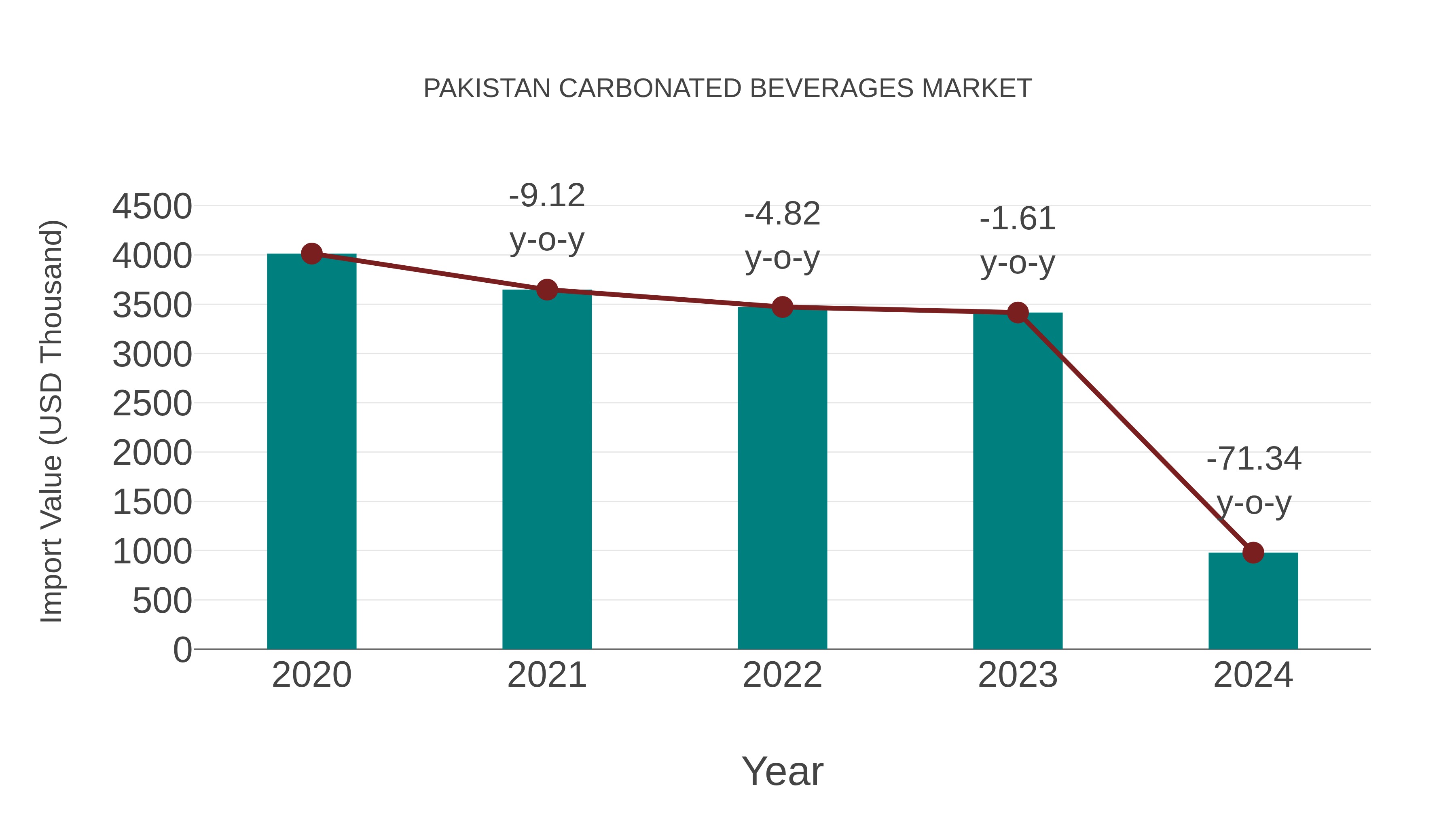
In the Pakistan carbonated beverages market, the import trend exhibited a notable decline from 2023 to 2024, with a growth rate of -71.34%. The compound annual growth rate (CAGR) for imports between 2020 and 2024 stood at -29.72%. This substantial decrease in import momentum can be attributed to shifting consumer preferences towards healthier beverage options, impacting market stability.
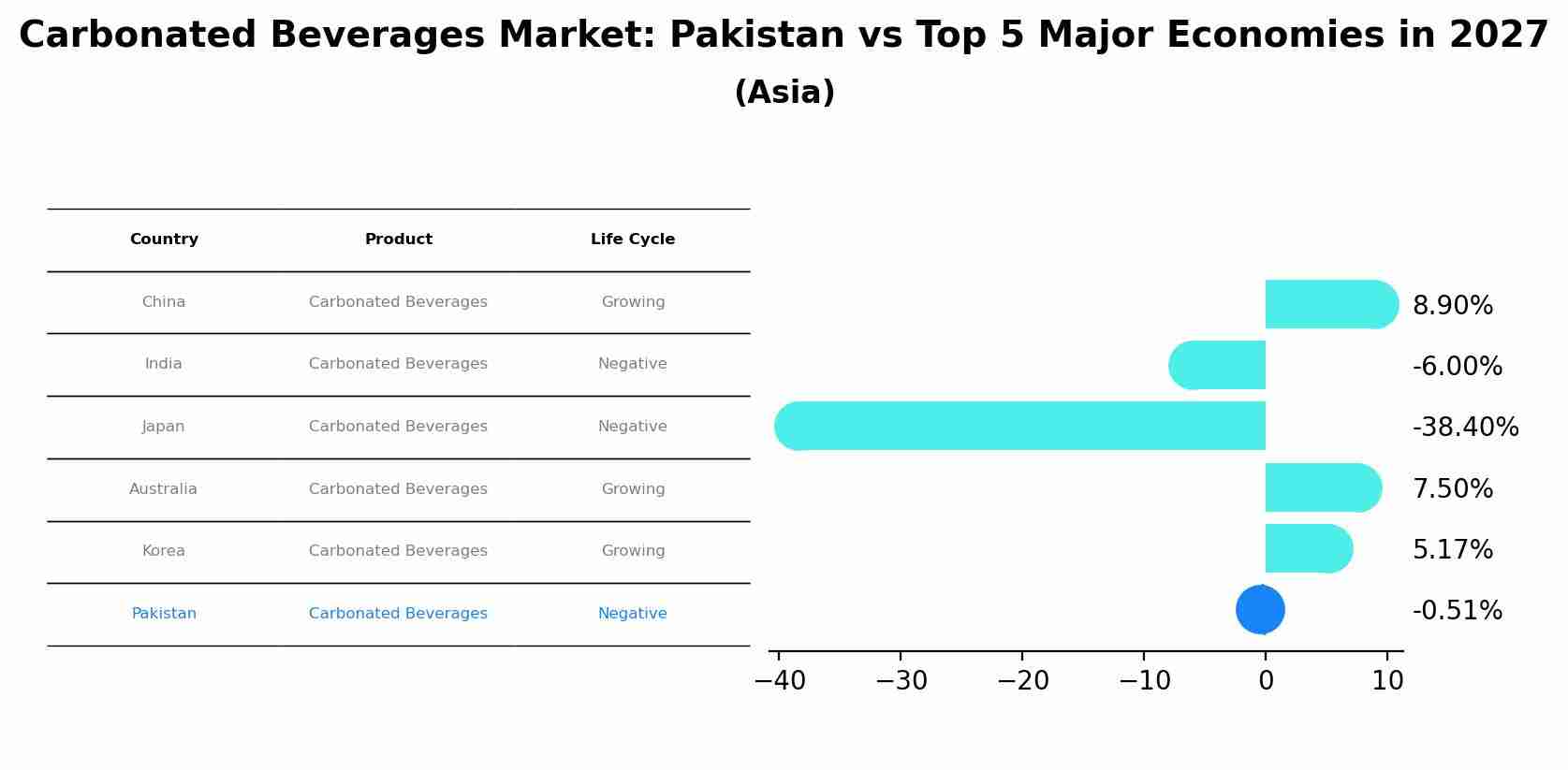
Carbonated Beverages Market: Pakistan vs Top 5 Major Economies in 2027 (Asia)
By 2027, the Carbonated Beverages market in Pakistan is anticipated to reach a growth rate of -0.51%, as part of an increasingly competitive Asia region, where China remains at the forefront, supported by India, Japan, Australia and South Korea, driving innovations and market adoption across sectors.
Pakistan Carbonated Beverages Market Overview
The carbonated beverages market in Pakistan is robust, driven by high consumer demand for soft drinks. Market growth is fueled by a young population, urbanization, and increasing disposable incomes. Both international and local brands compete fiercely, offering a wide range of products to cater to diverse consumer preferences.
Drivers of the market
The carbonated beverages market in Pakistan is primarily driven by the increasing consumption of soft drinks and other carbonated beverages among the younger population. The influence of Western lifestyles, urbanization, and rising disposable incomes contribute to market growth. Additionally, innovative product offerings, extensive marketing campaigns, and the availability of a wide variety of flavors and formulations are significant drivers. The expansion of distribution networks and retail channels further supports market development.
Challenges of the market
The carbonated beverages market in Pakistan encounters challenges such as fluctuating raw material costs and stringent regulatory requirements for health and safety. Increasing health consciousness among consumers and the rising preference for healthier beverage options are also impacting market growth. Additionally, competition from both local and international brands and the need for continuous innovation in flavors and packaging add to the market`s difficulties. Economic instability and high operational costs further complicate the business environment for carbonated beverage manufacturers.
Government Policy of the market
Regulation of the carbonated beverages market in Pakistan involves policies that address public health concerns, such as sugar consumption and food safety. The government has implemented taxation on sugary drinks to discourage excessive consumption and has set strict labeling requirements. Additionally, there are efforts to promote local production and export of beverages.
Key Highlights of the Report:
- Pakistan Carbonated Beverages Market Outlook
- Market Size of Pakistan Carbonated Beverages Market, 2025
- Forecast of Pakistan Carbonated Beverages Market, 2032
- Historical Data and Forecast of Pakistan Carbonated Beverages Revenues & Volume for the Period 2022-2032F
- Pakistan Carbonated Beverages Market Trend Evolution
- Pakistan Carbonated Beverages Market Drivers and Challenges
- Pakistan Carbonated Beverages Price Trends
- Pakistan Carbonated Beverages Porter's Five Forces
- Pakistan Carbonated Beverages Industry Life Cycle
- Historical Data and Forecast of Pakistan Carbonated Beverages Market Revenues & Volume By Product Types for the Period 2022-2032F
- Historical Data and Forecast of Pakistan Carbonated Beverages Market Revenues & Volume By Soft Drinks for the Period 2022-2032F
- Historical Data and Forecast of Pakistan Carbonated Beverages Market Revenues & Volume By Carbonated Water for the Period 2022-2032F
- Historical Data and Forecast of Pakistan Carbonated Beverages Market Revenues & Volume By Sports & Energy Drinks for the Period 2022-2032F
- Historical Data and Forecast of Pakistan Carbonated Beverages Market Revenues & Volume By Others for the Period 2022-2032F
- Historical Data and Forecast of Pakistan Carbonated Beverages Market Revenues & Volume By Flavour for the Period 2022-2032F
- Historical Data and Forecast of Pakistan Carbonated Beverages Market Revenues & Volume By Cola for the Period 2022-2032F
- Historical Data and Forecast of Pakistan Carbonated Beverages Market Revenues & Volume By Fruit Based for the Period 2022-2032F
- Historical Data and Forecast of Pakistan Carbonated Beverages Market Revenues & Volume By Others for the Period 2022-2032F
- Historical Data and Forecast of Pakistan Carbonated Beverages Market Revenues & Volume By Distribution Channel for the Period 2022-2032F
- Historical Data and Forecast of Pakistan Carbonated Beverages Market Revenues & Volume By Hypermarkets & Supermarkets for the Period 2022-2032F
- Historical Data and Forecast of Pakistan Carbonated Beverages Market Revenues & Volume By Convenience Stores for the Period 2022-2032F
- Historical Data and Forecast of Pakistan Carbonated Beverages Market Revenues & Volume By Food Service Outlets for the Period 2022-2032F
- Historical Data and Forecast of Pakistan Carbonated Beverages Market Revenues & Volume By Transport Terminals for the Period 2022-2032F
- Historical Data and Forecast of Pakistan Carbonated Beverages Market Revenues & Volume By Online Stores & D2C for the Period 2022-2032F
- Pakistan Carbonated Beverages Import Export Trade Statistics
- Market Opportunity Assessment By Product Types
- Market Opportunity Assessment By Flavour
- Market Opportunity Assessment By Distribution Channel
- Pakistan Carbonated Beverages Top Companies Market Share
- Pakistan Carbonated Beverages Competitive Benchmarking By Technical and Operational Parameters
- Pakistan Carbonated Beverages Company Profiles
- Pakistan Carbonated Beverages Key Strategic Recommendations






































