Pakistan Cellulose Fiber Market Size Growth Rate
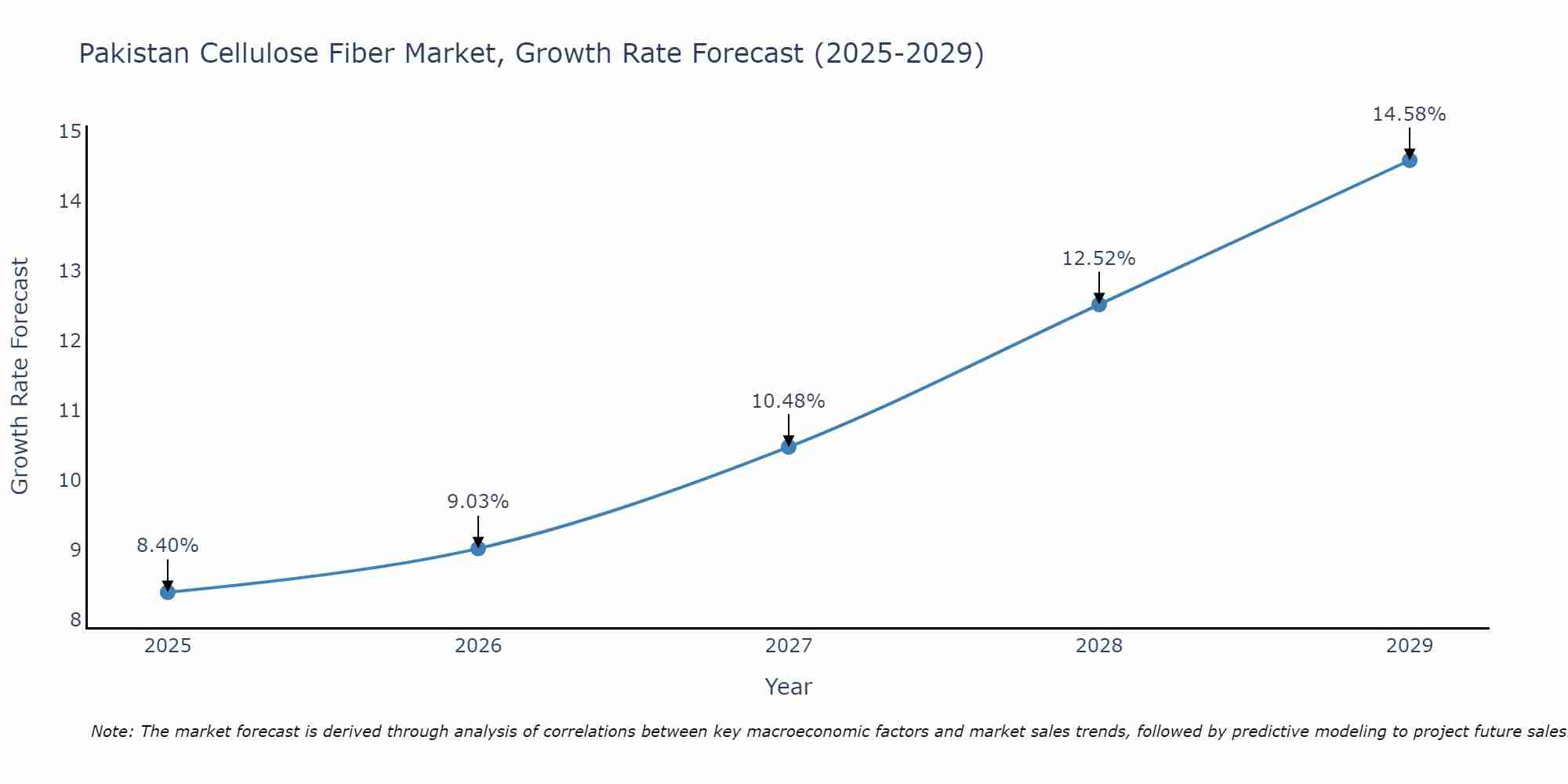
The Pakistan Cellulose Fiber Market is likely to experience consistent growth rate gains over the period 2025 to 2029. Commencing at 8.40% in 2025, growth builds up to 14.58% by 2029.
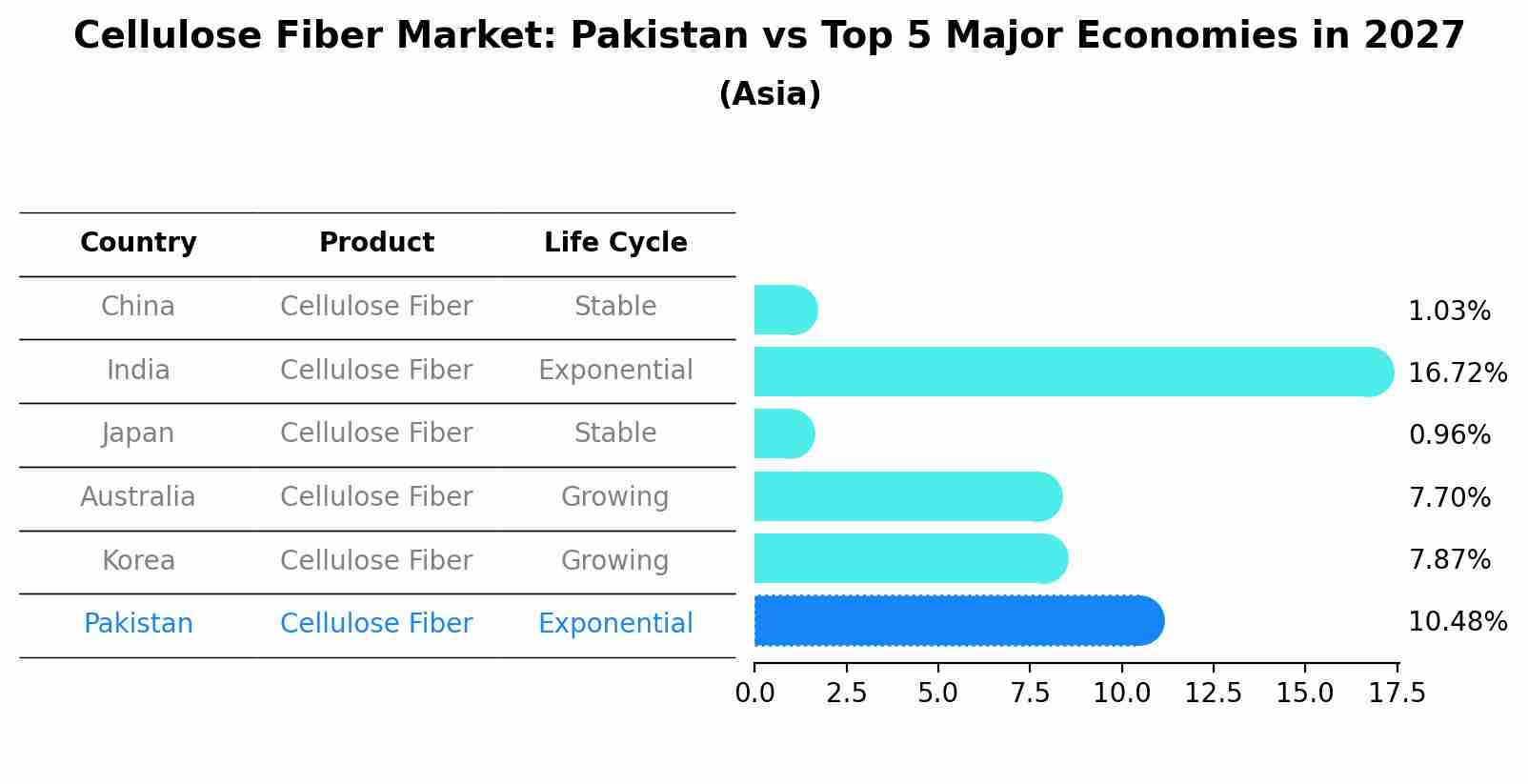
Cellulose Fiber Market: Pakistan vs Top 5 Major Economies in 2027 (Asia)
The Cellulose Fiber market in Pakistan is projected to grow at a high growth rate of 10.48% by 2027, highlighting the country's increasing focus on advanced technologies within the Asia region, where China holds the dominant position, followed closely by India, Japan, Australia and South Korea, shaping overall regional demand.
Pakistan Cellulose Fiber Market Overview
The Pakistan cellulose fiber market is experiencing significant growth driven by increasing demand from the textile and apparel industry. Cellulose fibers, such as viscose and modal, are favored for their natural origin, softness, and biodegradability. Growing consumer preference for sustainable and eco-friendly textiles is expected to further boost market growth, with manufacturers focusing on innovation and product diversification.
Drivers of the market
The Pakistan cellulose fiber market is driven by the increasing awareness regarding sustainable and eco-friendly textiles. Cellulose fibers, derived from sources such as wood pulp and cotton, are widely used in the textile industry due to their biodegradability and comfort properties. The growing demand for natural fibers and the adoption of green manufacturing processes are boosting market growth.
Challenges of the market
The Pakistan cellulose fiber market encounters challenges such as the need for sustainable manufacturing practices, competition from synthetic fibers, and price volatility of raw materials. Market players also face issues related to product innovation and technological advancements.
Government Policy of the market
The government has implemented policies to promote the growth of the cellulose fiber industry, which produces sustainable and biodegradable materials used in various applications such as textiles, paper products, composites, and filtration. Initiatives such as tax incentives, subsidies, and research grants are provided to encourage investment in manufacturing facilities, technology development, and product innovation. Additionally, regulations are in place to ensure the quality and sustainability of cellulose fiber products, including standards for raw material sourcing, production processes, and environmental management. The government also supports research and development in cellulose fiber technology to enhance product performance, reduce costs, and expand market opportunities domestically and internationally.
Key Highlights of the Report:
- Pakistan Cellulose Fiber Market Outlook
- Market Size of Pakistan Cellulose Fiber Market, 2024
- Forecast of Pakistan Cellulose Fiber Market, 2031
- Historical Data and Forecast of Pakistan Cellulose Fiber Revenues & Volume for the Period 2021-2031
- Pakistan Cellulose Fiber Market Trend Evolution
- Pakistan Cellulose Fiber Market Drivers and Challenges
- Pakistan Cellulose Fiber Price Trends
- Pakistan Cellulose Fiber Porter's Five Forces
- Pakistan Cellulose Fiber Industry Life Cycle
- Historical Data and Forecast of Pakistan Cellulose Fiber Market Revenues & Volume By Fiber Type for the Period 2021-2031
- Historical Data and Forecast of Pakistan Cellulose Fiber Market Revenues & Volume By Introduction for the Period 2021-2031
- Historical Data and Forecast of Pakistan Cellulose Fiber Market Revenues & Volume By Natural Cellulose Fibers for the Period 2021-2031
- Historical Data and Forecast of Pakistan Cellulose Fiber Market Revenues & Volume By Man-made Cellulose Fibers for the Period 2021-2031
- Historical Data and Forecast of Pakistan Cellulose Fiber Market Revenues & Volume By Others for the Period 2021-2031
- Historical Data and Forecast of Pakistan Cellulose Fiber Market Revenues & Volume By Applications for the Period 2021-2031
- Historical Data and Forecast of Pakistan Cellulose Fiber Market Revenues & Volume By Introduction for the Period 2021-2031
- Historical Data and Forecast of Pakistan Cellulose Fiber Market Revenues & Volume By Apparel for the Period 2021-2031
- Historical Data and Forecast of Pakistan Cellulose Fiber Market Revenues & Volume By Home Textile for the Period 2021-2031
- Historical Data and Forecast of Pakistan Cellulose Fiber Market Revenues & Volume By Industrial for the Period 2021-2031
- Historical Data and Forecast of Pakistan Cellulose Fiber Market Revenues & Volume By Others for the Period 2021-2031
- Pakistan Cellulose Fiber Import Export Trade Statistics
- Market Opportunity Assessment By Fiber Type
- Market Opportunity Assessment By Applications
- Pakistan Cellulose Fiber Top Companies Market Share
- Pakistan Cellulose Fiber Competitive Benchmarking By Technical and Operational Parameters
- Pakistan Cellulose Fiber Company Profiles
- Pakistan Cellulose Fiber Key Strategic Recommendations






































