Pakistan Consumer Appliances Market: Import Trend Analysis
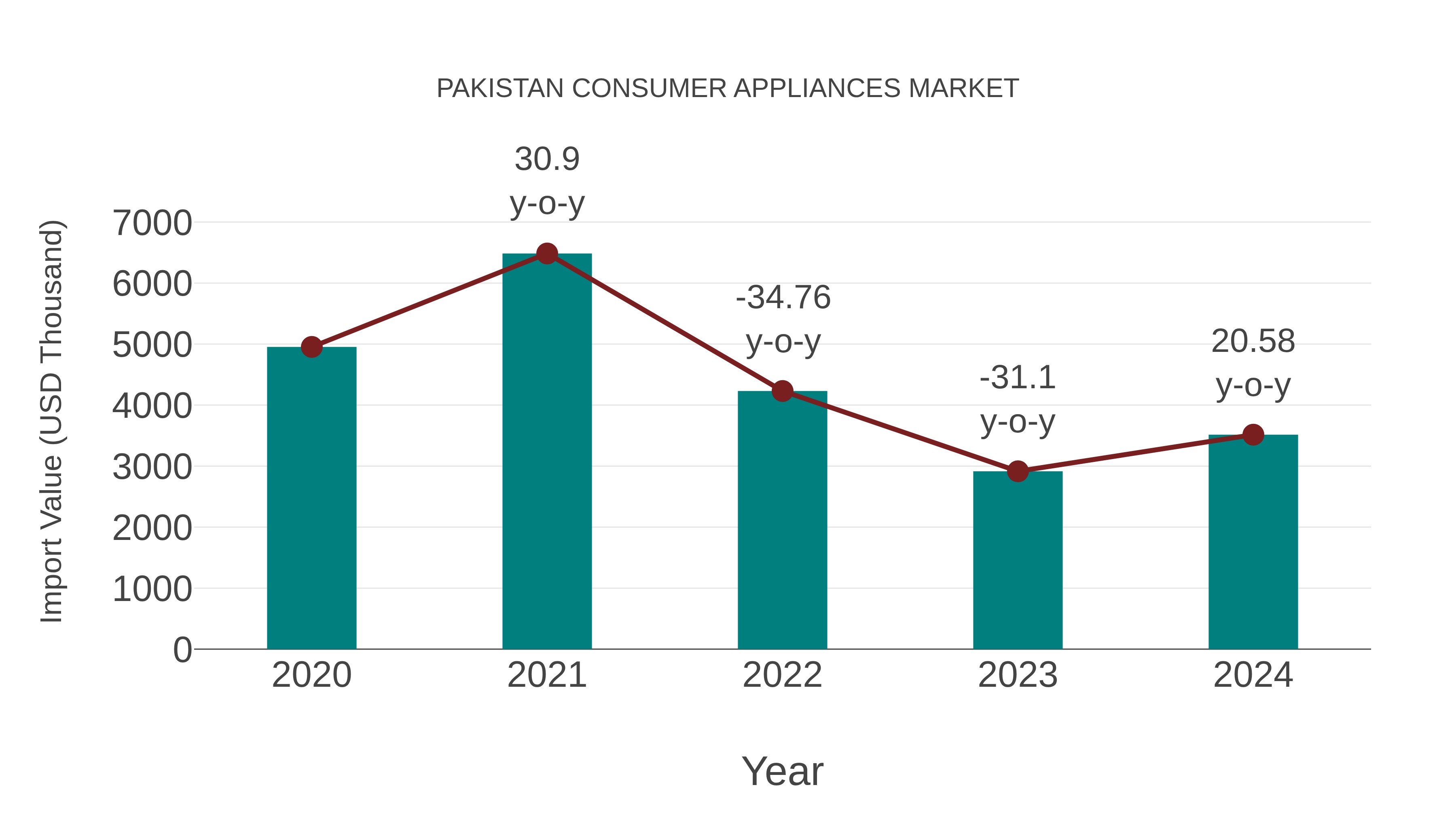
In the Pakistan consumer appliances market, the import trend showed a 20.58% growth rate from 2023 to 2024, contrasting with a -8.22% CAGR for 2020-2024. This significant uptick in import momentum from 2023 to 2024 could be attributed to a notable demand shift towards higher-quality consumer appliances or changes in trade policies that facilitated increased imports during this period.
Key Highlights of the Report:
- Pakistan Consumer Appliances Market Outlook
- Market Size of Pakistan Consumer Appliances Market, 2025
- Forecast of Pakistan Consumer Appliances Market, 2032
- Historical Data and Forecast of Pakistan Consumer Appliances Revenues & Volume for the Period 2022-2032F
- Pakistan Consumer Appliances Market Trend Evolution
- Pakistan Consumer Appliances Market Drivers and Challenges
- Pakistan Consumer Appliances Price Trends
- Pakistan Consumer Appliances Porter's Five Forces
- Pakistan Consumer Appliances Industry Life Cycle
- Historical Data and Forecast of Pakistan Consumer Appliances Market Revenues & Volume By Product Type for the Period 2022-2032F
- Historical Data and Forecast of Pakistan Consumer Appliances Market Revenues & Volume By Air Solutions for the Period 2022-2032F
- Historical Data and Forecast of Pakistan Consumer Appliances Market Revenues & Volume By Entertainment for the Period 2022-2032F
- Historical Data and Forecast of Pakistan Consumer Appliances Market Revenues & Volume By Laundry and Cleanliness for the Period 2022-2032F
- Historical Data and Forecast of Pakistan Consumer Appliances Market Revenues & Volume By Connectivity for the Period 2022-2032F
- Historical Data and Forecast of Pakistan Consumer Appliances Market Revenues & Volume By Water Solution for the Period 2022-2032F
- Historical Data and Forecast of Pakistan Consumer Appliances Market Revenues & Volume By Kitchen Appliances for the Period 2022-2032F
- Historical Data and Forecast of Pakistan Consumer Appliances Market Revenues & Volume By Grooming Accessories for the Period 2022-2032F
- Historical Data and Forecast of Pakistan Air Solutions Consumer Appliances Market Revenues & Volume By Wearables for the Period 2022-2032F
- Historical Data and Forecast of Pakistan Consumer Appliances Market Revenues & Volume By Usage for the Period 2022-2032F
- Historical Data and Forecast of Pakistan Consumer Appliances Market Revenues & Volume By Personal Care/ Individual for the Period 2022-2032F
- Historical Data and Forecast of Pakistan Consumer Appliances Market Revenues & Volume By Domestic Use for the Period 2022-2032F
- Historical Data and Forecast of Pakistan Consumer Appliances Market Revenues & Volume By Distribution Channel for the Period 2022-2032F
- Historical Data and Forecast of Pakistan Consumer Appliances Market Revenues & Volume By Online for the Period 2022-2032F
- Historical Data and Forecast of Pakistan Consumer Appliances Market Revenues & Volume By Offline for the Period 2022-2032F
- Pakistan Consumer Appliances Import Export Trade Statistics
- Market Opportunity Assessment By Product Type
- Market Opportunity Assessment By Usage
- Market Opportunity Assessment By Distribution Channel
- Pakistan Consumer Appliances Top Companies Market Share
- Pakistan Consumer Appliances Competitive Benchmarking By Technical and Operational Parameters
- Pakistan Consumer Appliances Company Profiles
- Pakistan Consumer Appliances Key Strategic Recommendations






































