Pakistan Contactless Payment Market Size & Growth Rate (2026-2032)
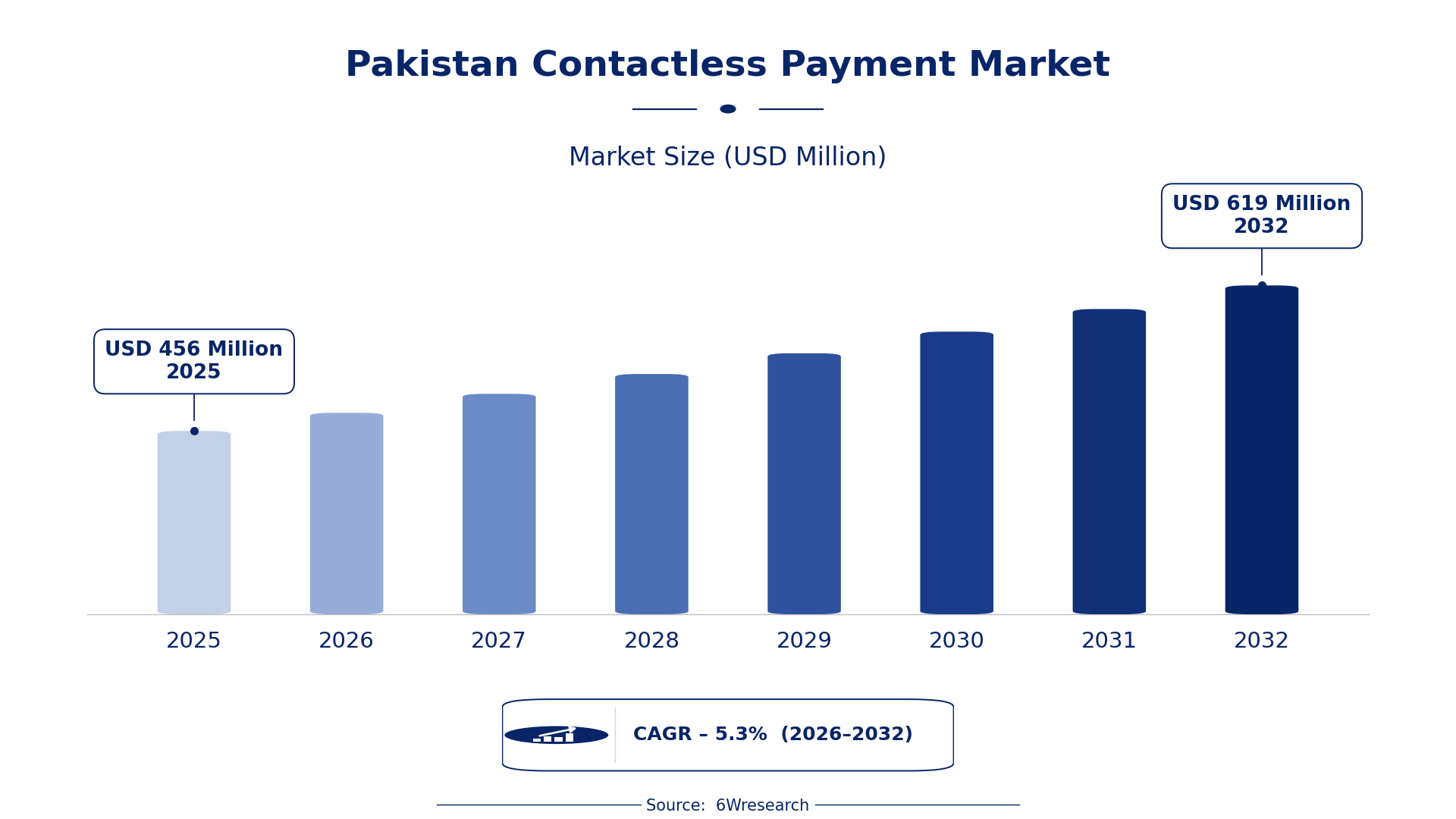
The Pakistan Contactless Payment Market was estimated at USD 456 Million in 2025 and is projected to reach USD 619 Million by 2032, growing at a CAGR of 5.3% from 2026 to 2032.
Pakistan Contactless Payment Market Synopsis
The surge in contactless payments in Pakistan can be attributed to a growing consumer preference for fast, convenient transactions. As more people turn to digital wallets and mobile payment solutions, the landscape is changing rapidly, with both urban and rural areas becoming more engaged in contactless transactions.
Financial institutions are increasingly adopting NFC technology and QR code payments to facilitate quicker checkouts. This shift is further supported by rising smartphone penetration and improved internet connectivity, which serve as critical enablers for digital payment ecosystems across the nation.
Pakistan Contactless Payment Market Year-wise Growth Rate and Key Drivers
This graph illustrates the annual growth rates of the Pakistan Contactless Payment Market from 2021 to 2032, highlighting a steady upward trajectory and projected expansion over the forecast period.
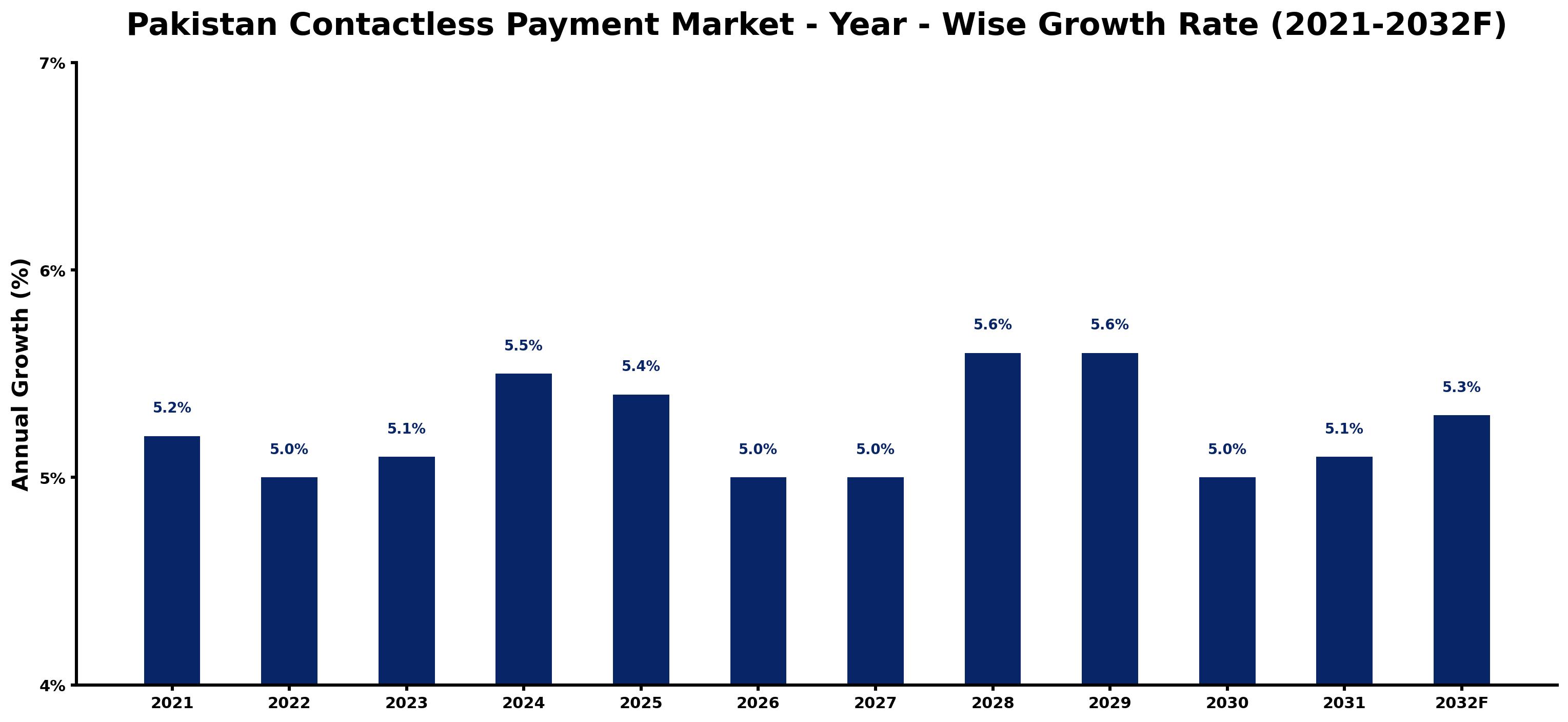
The table below presents the year‑wise growth rates along with the key drivers influencing the market
| Year | Growth Rate | Major Drivers |
| 2021 | 5.2% | State Bank of Pakistan promotes digital payment initiatives. |
| 2022 | 5.0% | Increased smartphone penetration enabling mobile wallet usage. |
| 2023 | 5.1% | Government incentives for fintech startups enhancing payment solutions. |
| 2024 | 5.5% | Rising e-commerce activity boosting demand for contactless payments. |
| 2025 | 5.4% | Health policies favoring contactless transactions post-COVID-19. |
| 2026 | 5.0% | Partnerships between banks and tech firms accelerating innovations. |
| 2027 | 5.0% | Youth demographic adoption of seamless payment technologies. |
| 2028 | 5.6% | Government's cashless economy vision catalyzing consumer transition. |
| 2029 | 5.6% | Rise of QR payment systems among small merchants. |
| 2030 | 5.0% | Increased security concerns driving demand for contactless solutions. |
| 2031 | 5.1% | Local merchants incentivizing customers to adopt digital wallets. |
| 2032 | 5.3% | Prominent retail chains amplifying contactless payment acceptance. |
Note: Market size estimations and growth projections presented in this report are based on 6Wresearch's proprietary forecasting methodology, utilizing the latest available industry data, government publications, and primary research inputs.
Pakistan Contactless Payment Market Key Takeaways
Below are some of the specific key takeaways from the market, including:
- The market is expanding rapidly due to increasing consumer demand for convenience and security.
- Government initiatives are driving awareness and acceptance of contactless payment methods.
- Technological advancements in NFC and mobile wallets are reshaping the payment landscape.
- Challenges related to merchant acceptance and customer trust still need to be addressed for broader adoption.
- Interoperability among various payment systems is crucial for seamless user experience.
Evaluation of Restraints in Pakistan Contactless Payment Market
Despite promising growth, several factors hinder the advancement of contactless payments in Pakistan. A major issue is the limited acceptance among merchants, particularly in smaller retail spaces where traditional cash transactions dominate. Many consumers remain skeptical about security, which further complicates the widespread adoption of these technologies. Regulatory compliance poses another challenge, as businesses navigate complex requirements for transaction safety. Lastly, the lack of interoperability among various payment platforms can frustrate users and create barriers to entry.
Pakistan Contactless Payment Market Trends
The adoption of mobile wallets is gaining momentum, with more consumers preferring digital solutions over cash. QR code payments are emerging as a popular choice for small businesses, facilitating quick transactions without the need for specialized equipment. Enhanced security features, including biometric authentication, are becoming standard to alleviate consumer concerns. Partnerships between fintech companies and traditional banks are also on the rise, aimed at fostering innovation and improving customer experience.
Pakistan Contactless Payment Market Opportunities
There are significant opportunities for growth in the contactless payment sector, particularly in expanding merchant acceptance. Initiatives to educate businesses about the benefits of accepting digital payments could drive this trend. Additionally, tapping into the unbanked population presents a lucrative opportunity, as mobile payment solutions can offer financial inclusion to many. With a growing emphasis on e-commerce, contactless payment solutions will be critical in enhancing customer satisfaction and streamlining transactions.
Government Initiatives in the Pakistan Contactless Payment Market
Government support is crucial for the development of the contactless payment market in Pakistan. Policymakers are focused on establishing a regulatory framework that encourages digital transactions while ensuring security and consumer protection. The aim is to create an environment where contactless payments can thrive, promoting financial inclusion and modernizing the economy.
- A national digital infrastructure upgrade programme recently completed to enhance connectivity for digital payments.
- A regulatory framework established in 2025 to standardize security measures for digital transactions.
- Ongoing initiatives to promote awareness and education about contactless payment solutions among consumers and businesses.
- Upcoming policies focusing on developing interoperability standards among various payment systems by 2026.
- Plans for public-private partnerships to expand the reach of contactless payment technologies into underserved regions.
Future Insights of the Pakistan Contactless Payment Market
Looking ahead to 2026-2032, the Pakistan Contactless Payment Market is set to undergo transformative changes. As consumer confidence grows and technology becomes more accessible, adoption rates are expected to rise significantly. Enhanced collaboration between financial institutions and technology providers will drive innovation and facilitate smoother payment experiences. With government backing, the market is likely to see increased investment in infrastructure, paving the way for a more inclusive digital economy.
Pakistan Contactless Payment Market Latest Developments
In recent months, the contactless payment sector in Pakistan has been marked by notable advancements and strategic initiatives. Companies are actively working to expand their digital payment offerings, tapping into the growing demand for fast and secure transaction methods.
- A major technology vendor launched a new mobile payment platform in early 2025, designed specifically for small businesses.
- A partnership between a leading bank and a fintech company is currently underway, focusing on the integration of NFC technology in retail outlets.
- Expansion of a QR code payment initiative that began in Q1 2025, aimed at enhancing payment options for street vendors and local markets.
- Plans for a nationwide campaign to boost consumer awareness about contactless payments, set to roll out in late 2026.
- Upcoming enhancements to regulatory frameworks expected by mid-2026, targeting improved security measures and consumer protection.
Pakistan Contactless Payment Market - Key Attractiveness of the Report
- 10 Years of Market Numbers
- Historical Data Starting from 2022 to 2025
- Base Year: 2025
- Forecast Data until 2032
- Key Performance Indicators Impacting the Market
- Major Upcoming Developments and Projects
Key Highlights of the Report:
- Pakistan Contactless Payment Market Outlook
- Market Size of Pakistan Contactless Payment Market, 2025
- Forecast of Pakistan Contactless Payment Market, 2032
- Historical Data and Forecast of Pakistan Contactless Payment Revenues & Volume for the Period 2022-2032F
- Pakistan Contactless Payment Market Trend Evolution
- Pakistan Contactless Payment Market Drivers and Challenges
- Pakistan Contactless Payment Price Trends
- Pakistan Contactless Payment Porter's Five Forces
- Pakistan Contactless Payment Industry Life Cycle
- Historical Data and Forecast of Pakistan Contactless Payment Market Revenues & Volume By Component for the Period 2022-2032F
- Historical Data and Forecast of Pakistan Contactless Payment Market Revenues & Volume By Hardware for the Period 2022-2032F
- Historical Data and Forecast of Pakistan Contactless Payment Market Revenues & Volume By Solutions for the Period 2022-2032F
- Historical Data and Forecast of Pakistan Contactless Payment Market Revenues & Volume By Services for the Period 2022-2032F
- Historical Data and Forecast of Pakistan Contactless Payment Market Revenues & Volume By Vertical for the Period 2022-2032F
- Historical Data and Forecast of Pakistan Contactless Payment Market Revenues & Volume By Retail for the Period 2022-2032F
- Historical Data and Forecast of Pakistan Contactless Payment Market Revenues & Volume By Hospitality for the Period 2022-2032F
- Historical Data and Forecast of Pakistan Contactless Payment Market Revenues & Volume By Healthcare for the Period 2022-2032F
- Historical Data and Forecast of Pakistan Contactless Payment Market Revenues & Volume By Energy and Utilities for the Period 2022-2032F
- Historical Data and Forecast of Pakistan Contactless Payment Market Revenues & Volume By Transportation and Logistics for the Period 2022-2032F
- Historical Data and Forecast of Pakistan Contactless Payment Market Revenues & Volume By BFSI for the Period 2022-2032F
- Historical Data and Forecast of Pakistan Contactless Payment Market Revenues & Volume By Others (Government, telecommunications, and education) for the Period 2022-2032F
- Pakistan Contactless Payment Import Export Trade Statistics
- Market Opportunity Assessment By Component
- Market Opportunity Assessment By Vertical
- Pakistan Contactless Payment Top Companies Market Share
- Pakistan Contactless Payment Competitive Benchmarking By Technical and Operational Parameters
- Pakistan Contactless Payment Company Profiles
- Pakistan Contactless Payment Key Strategic Recommendations






































