Pakistan Cooking Appliances Market Summary
The pakistan cooking appliances market was estimated at USD 1293 Million in 2025 and is projected to reach USD 1872 Million by 2032, growing at a CAGR of 6.4% from 2026 to 2032.
Pakistan Cooking Appliances Market Year-wise Growth Rate and Key Drivers
This graph highlights how the Pakistan Cooking Appliances Market has steadily grown over the past five years, supported by major growth factors.
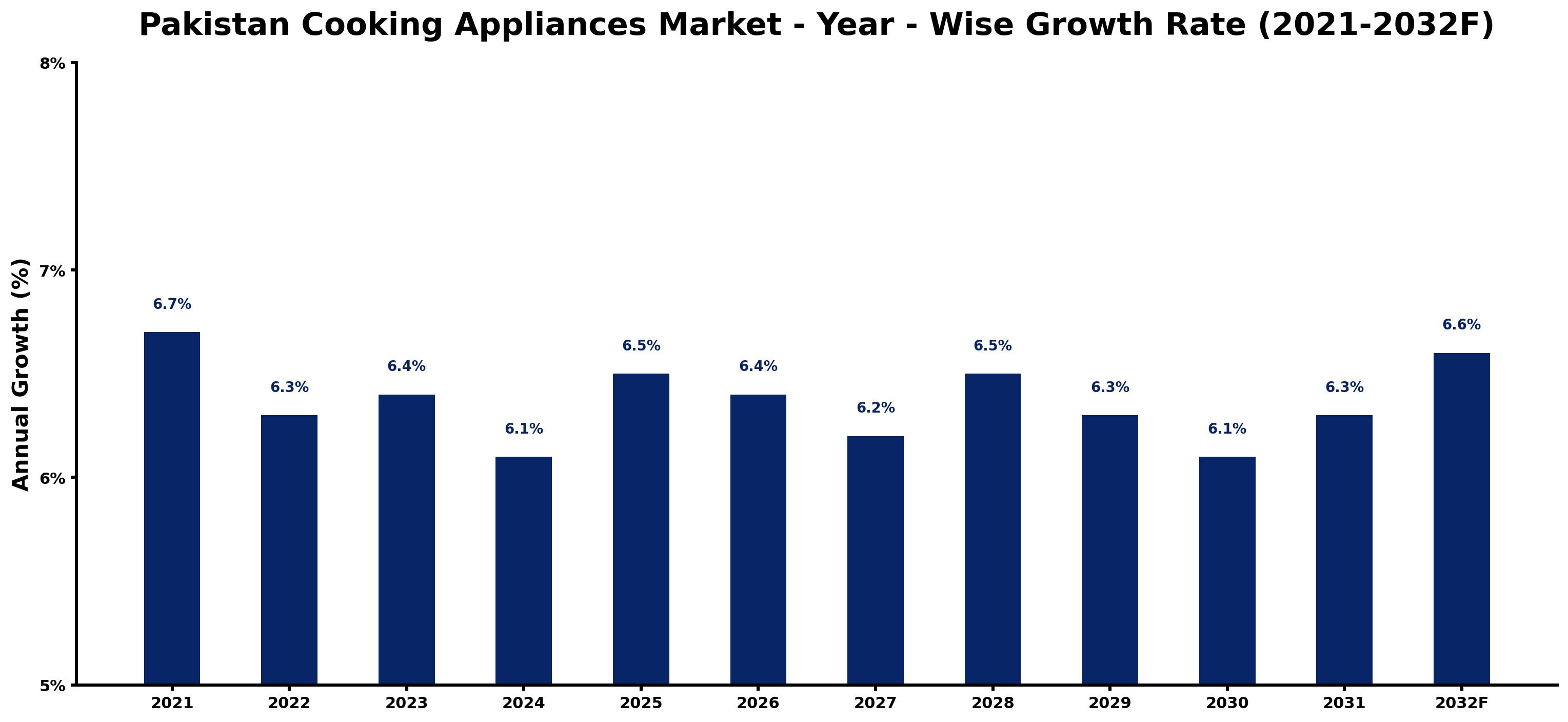
The table below presents the year wise growth rates along with the key drivers influencing the market
| Year | Growth Rate | Major Drivers |
| 2021 | 6.7% | Post-lockdown retail projects highlighted a surge in consumer interest for cooking appliances. |
| 2022 | 6.3% | Increased urbanization in Pakistan pushed homeowners to upgrade their kitchen technologies. |
| 2023 | 6.4% | E-commerce platforms became pivotal in making cooking appliances widely accessible to consumers. |
| 2024 | 6.1% | Local manufacturers started prioritizing energy-efficient designs catering to domestic needs. |
| 2025 | 6.5% | Cultural shifts encouraged home cooking, boosting appliance sales significantly across urban areas. |
| 2026 | 6.4% | Product innovations, such as multi-functional appliances, gained popularity among tech-savvy consumers. |
| 2027 | 6.2% | Changing lifestyles favored convenient cooking solutions that align with busy schedules. |
| 2028 | 6.5% | Sustainability trends prompted consumers to seek energy-efficient appliances, reshaping market offerings. |
| 2029 | 6.3% | Investment in local manufacturing facilities improved supply chains for cooking appliance production. |
| 2030 | 6.1% | Smart home technology trends integrated cooking appliances with home automation systems. |
| 2031 | 6.3% | Youth-driven culinary trends influenced modern appliance designs to attract younger demographics. |
| 2032 | 6.6% | Export opportunities developed as local brands gained recognition in international cooking appliance markets. |
Note - Market size estimations and growth projections presented in this report are based on 6Wresearch's advanced forecasting approach, validated with industry datasets as of June 2026.
Pakistan Cooking Appliances Market Synopsis
The Pakistan Cooking Appliances Market is projected to reach 6.4% and witness significant growth during the forecast period (2026-2032). The market has developed into one of the largest consumer spaces globally for cooking appliances, driven by a combination of increased disposable incomes, urbanization, and the expansion of a middle class that increasingly seeks convenience in food preparation. The acceptance and adoption of modern kitchen appliances, such as microwaves, cookers, and ovens, are reshaping consumer preferences across the country.
Pakistan Cooking Appliances Market Growth Drivers
The growth of the Pakistan Cooking Appliances Market can be attributed to several key factors:
- The burgeoning middle class in Pakistan is characterized by rising disposable incomes, which enables families to invest in modern cooking solutions and improve their cooking experiences.
- Urbanization leads to changing lifestyles, with more consumers living in apartments where compact and efficient cooking appliances are essential for practical meal preparation.
- Convenience products such as microwaves and hybrid cookers are becoming increasingly popular, especially among the working population that seeks quick meal solutions.
- Consumer awareness regarding the benefits of energy-efficient kitchen appliances is fostering a shift towards branded, reliable products that promise durability and lower utility costs.
- As emerging cities like Islamabad and Lahore grow, there is an increased demand for modern kitchen technology, reflecting shifting consumer preferences toward advanced cooking appliances.
Pakistan Cooking Appliances Market Trends and Opportunities
The Pakistan Cooking Appliances Market is witnessing notable trends that present various opportunities for growth:
- The trend towards energy-efficient appliances is driven by consumers' increasing focus on sustainability and cost-saving measures, creating opportunities for manufacturers to innovate in product design.
- Digital appliances that integrate smart technology are becoming a focal point. The automation of cooking processes or app-controlled devices appeals to younger consumers.
- Online retailing platforms are expanding, providing consumers with greater access to a variety of cooking appliances, while also allowing brands to reach wider audiences without significant overhead costs.
- The diversification of product lines, including multi-functional appliances that serve more than one cooking need, is gaining traction among consumers looking for value and versatility.
- With an increasing number of households adopting baking and gourmet cooking trends, there is a growing demand for specialized equipment, further broadening the market scope.
Pakistan Cooking Appliances Market Challenges and Restraints
While the Pakistan Cooking Appliances Market exhibits strong potential, key challenges must be addressed to sustain growth:
- Fluctuating economic conditions and inflation can impact consumer spending, leading to shifts in purchasing behavior and potentially slowing market growth.
- High import tariffs on foreign cooking appliance brands can limit the availability of advanced products, stalling innovation while pushing consumers towards locally manufactured options.
- Awareness and education regarding the maintenance and optimal usage of modern appliances are often lacking, which can deter consumers from investing in higher-end products.
- Competition among local and international brands can create price wars, potentially compromising product quality as manufacturers seek to maintain market share.
- Infrastructure limitations, particularly in rural areas, hinder access to modern appliances, sealing off a significant portion of the potential market.
Pakistan Cooking Appliances Market Regional Analysis
The regional dynamics of the Pakistan Cooking Appliances Market are influenced by urban centers and economic hubs:
- Major cities like Karachi and Lahore drive the highest demand for cooking appliances, attributed to dense populations and an emerging consumer base that favors modern conveniences.
- In contrast, rural areas display slower market growth due to less disposable income and limited access to modern retail avenues, which constrains the availability of cooking appliances.
- The demand in emerging cities is significantly growing, with consumers increasingly interested in modern appliances that complement their lifestyles.
- The strategic geographical positioning of Pakistan encourages export opportunities to neighboring countries, providing manufacturers with access to larger markets.
- Provinces like Punjab and Sindh are leading the consumption trends, indicating the importance of regional economic health in influencing market dynamics.
Pakistan Cooking Appliances Market Government Investment and Initiatives
The government of Pakistan has initiated several measures aimed at boosting the cooking appliance sector:
- Policies promoting local manufacturing and investment in technology are designed to enhance the capabilities of domestic manufacturers, ensuring they remain competitive in both local and international markets.
- Subsidies and financial incentives for energy-efficient appliances are being introduced to encourage consumers to adopt sustainable practices, reducing the overall electricity burden on households.
- Development plans focusing on infrastructure improvement aim to enhance distribution channels and accessibility for modern appliances, which will ultimately increase consumption.
- Support for vocational training programs is being extended to equip the workforce with skills tailored towards appliance maintenance and repair, thus promoting consumer confidence in modern technologies.
- Public campaigns aimed at educating consumers about the benefits of modern cooking appliances are being implemented, increasing overall market awareness and driving demand.
Pakistan Cooking Appliances Market Latest Developments (May 2025 - June 2026)
Recent developments within the Pakistan Cooking Appliances Market signal a responsive adaptation to evolving consumer demands:
- There has been a noticeable increase in awareness regarding energy conservation, prompting many consumers to prioritize energy-efficient products in their purchasing decisions.
- Technological advancements have led to the proliferation of smart cooking devices, attracting tech-savvy consumers and changing the competitive landscape of the market.
- Partnerships between local manufacturers and global technology firms are emerging to enhance product offerings and bring innovative cooking solutions to market.
- Consumer preferences have shifted towards aesthetic and versatile appliances, particularly in urban areas where kitchen space is often limited, leading to higher demand for multi-functional products.
- The surge in e-commerce sales has transformed distribution strategies, allowing brands to reach consumers effectively through digital platforms and adapt faster to market trends.
Pakistan Cooking Appliances Market - Key Attractiveness of the Report
- 10 Years of Market Numbers
- Historical Data Starting from 2022 to 2025
- Base Year: 2025
- Forecast Data until 2032
- Key Performance Indicators Impacting the Market
- Major Upcoming Developments and Projects
Key Highlights of the Report:
- Pakistan Cooking Appliances Market Outlook
- Market Size of Pakistan Cooking Appliances Market, 2025
- Forecast of Pakistan Cooking Appliances Market, 2032
- Historical Data and Forecast of Pakistan Cooking Appliances Revenues & Volume for the Period 2022-2032
- Pakistan Cooking Appliances Market Trend Evolution
- Pakistan Cooking Appliances Market Drivers and Challenges
- Pakistan Cooking Appliances Price Trends
- Pakistan Cooking Appliances Porter's Five Forces
- Pakistan Cooking Appliances Industry Life Cycle
- Historical Data and Forecast of Pakistan Cooking Appliances Market Revenues & Volume By Types for the Period 2022-2032
- Historical Data and Forecast of Pakistan Cooking Appliances Market Revenues & Volume By Microwaves for the Period 2022-2032
- Historical Data and Forecast of Pakistan Cooking Appliances Market Revenues & Volume By Ovens for the Period 2022-2032
- Historical Data and Forecast of Pakistan Cooking Appliances Market Revenues & Volume By Cooktops for the Period 2022-2032
- Historical Data and Forecast of Pakistan Cooking Appliances Market Revenues & Volume By Range Hoods for the Period 2022-2032
- Historical Data and Forecast of Pakistan Cooking Appliances Market Revenues & Volume By Small Appliances for the Period 2022-2032
- Historical Data and Forecast of Pakistan Cooking Appliances Market Revenues & Volume By Parts & Accessories for the Period 2022-2032
- Historical Data and Forecast of Pakistan Cooking Appliances Market Revenues & Volume By Applications for the Period 2022-2032
- Historical Data and Forecast of Pakistan Cooking Appliances Market Revenues & Volume By Household for the Period 2022-2032
- Historical Data and Forecast of Pakistan Cooking Appliances Market Revenues & Volume By Commercial for the Period 2022-2032
- Historical Data and Forecast of Pakistan Cooking Appliances Market Revenues & Volume By Fuel Type for the Period 2022-2032
- Historical Data and Forecast of Pakistan Cooking Appliances Market Revenues & Volume By Cooking gas for the Period 2022-2032
- Historical Data and Forecast of Pakistan Cooking Appliances Market Revenues & Volume By Electricity for the Period 2022-2032
- Historical Data and Forecast of Pakistan Cooking Appliances Market Revenues & Volume By Distribution Channel for the Period 2022-2032
- Historical Data and Forecast of Pakistan Cooking Appliances Market Revenues & Volume By Online for the Period 2022-2032
- Historical Data and Forecast of Pakistan Cooking Appliances Market Revenues & Volume By Offline for the Period 2022-2032
- Pakistan Cooking Appliances Import Export Trade Statistics
- Market Opportunity Assessment By Types
- Market Opportunity Assessment By Applications
- Market Opportunity Assessment By Fuel Type
- Market Opportunity Assessment By Distribution Channel
- Pakistan Cooking Appliances Top Companies Market Share
- Pakistan Cooking Appliances Competitive Benchmarking By Technical and Operational Parameters
- Pakistan Cooking Appliances Company Profiles
- Pakistan Cooking Appliances Key Strategic Recommendations






































