Pakistan Critical Infrastructure Protection Market Size & Growth Rate (2026-2032)
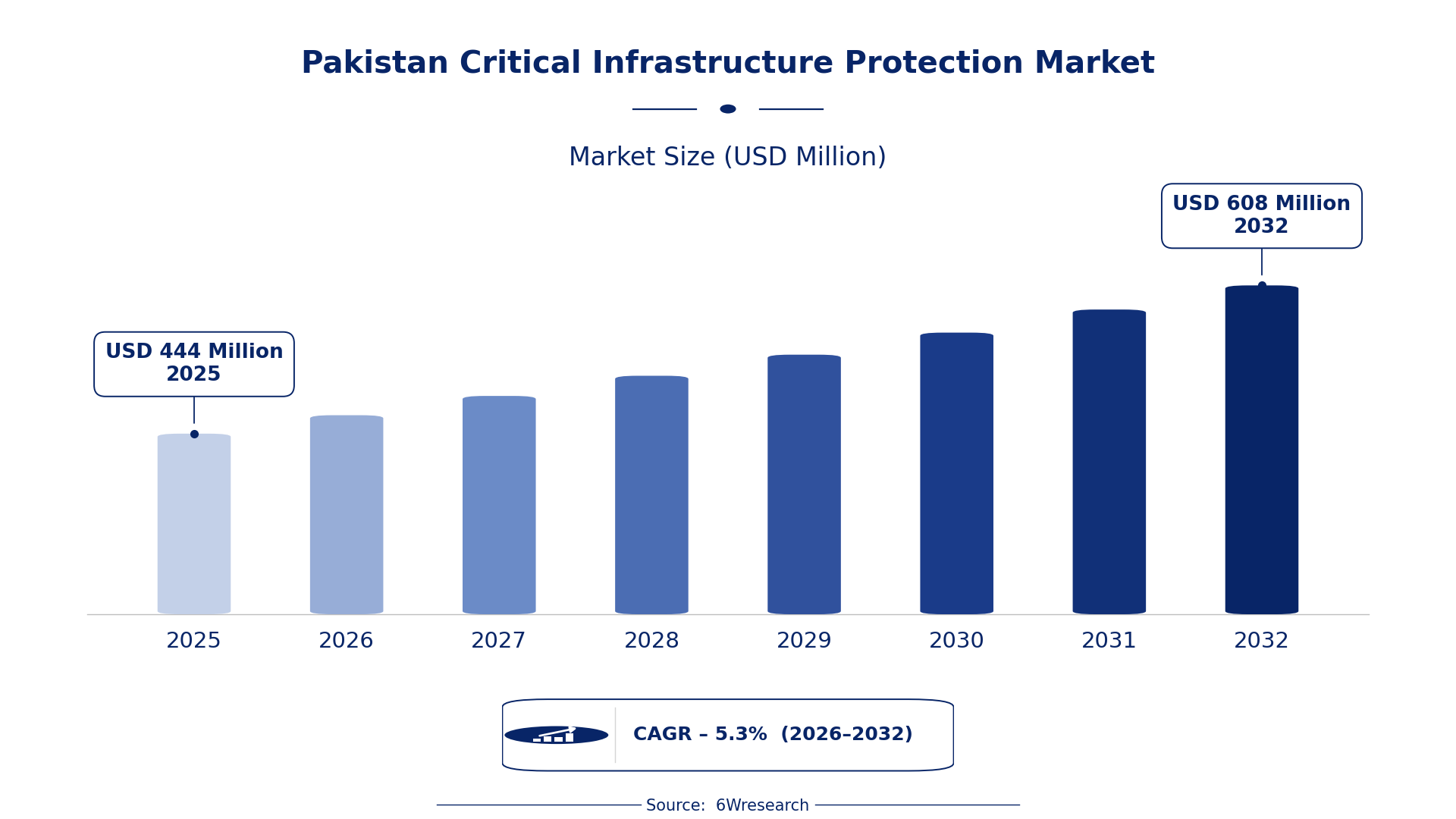
The Pakistan Critical Infrastructure Protection Market was estimated at USD 444 Million in 2025 and is projected to reach USD 608 Million by 2032, growing at a CAGR of 5.3% from 2026 to 2032.
Pakistan Critical Infrastructure Protection Market Synopsis
The urgency for advanced security measures has become pronounced in Pakistan, where critical infrastructures are increasingly under threat from terrorism, cyberattacks, and natural disasters. Sectors like energy, transportation, telecommunications, and healthcare are ramping up their focus on resilience and risk management, investing in technologies that protect their essential operations.
As the landscape of threats diversifies, organizations are no longer merely responding to immediate dangers. They are proactively enhancing their security frameworks, driven by government initiatives, regulatory compliance, and a growing emphasis on integrated security solutions. This evolution reflects a fundamental shift in how Pakistan addresses its vulnerabilities in critical infrastructure.
Pakistan Critical Infrastructure Protection Market Year-wise Growth Rate and Key Drivers
This graph illustrates the annual growth rates of the Pakistan Critical Infrastructure Protection Market from 2021 to 2032, highlighting a steady upward trajectory and projected expansion over the forecast period.
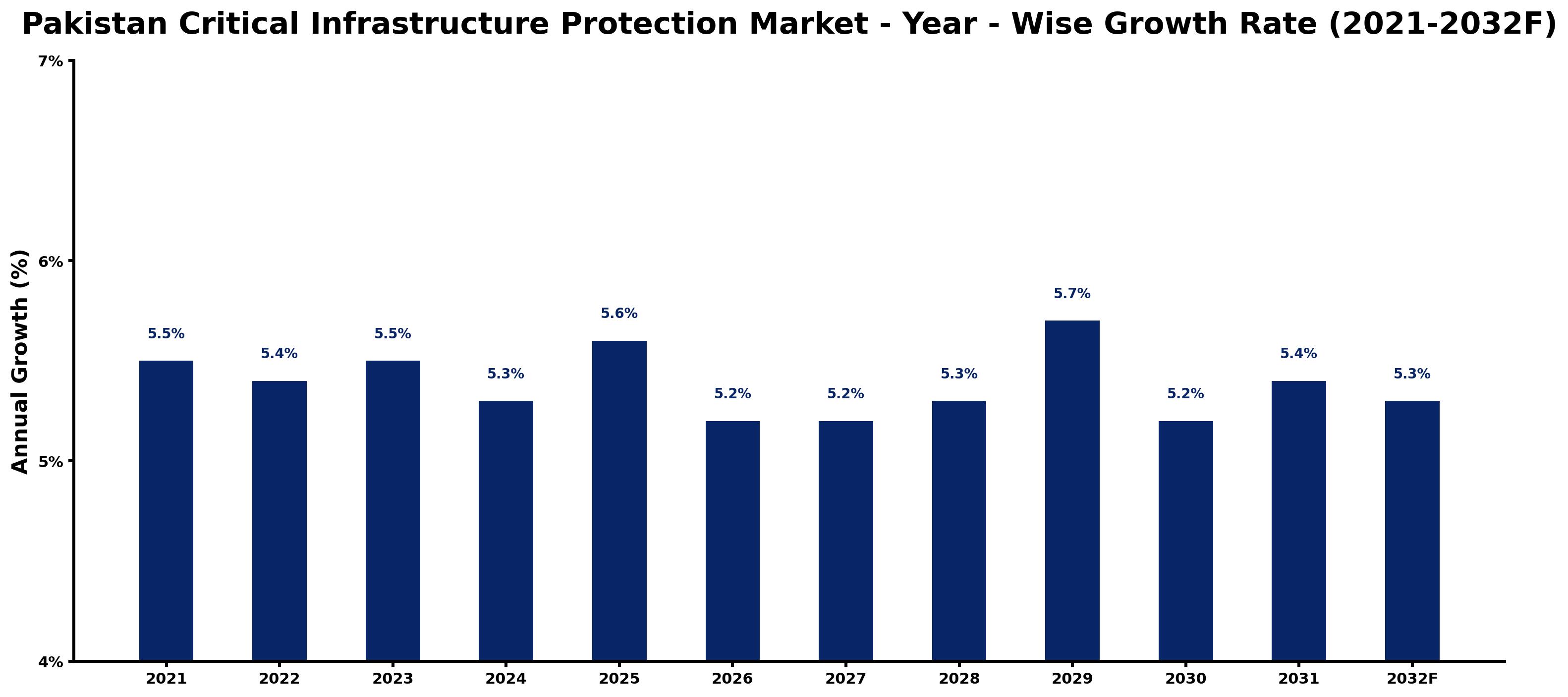
The table below presents the year‑wise growth rates along with the key drivers influencing the market
| Year | Growth Rate | Major Drivers |
| 2021 | 5.5% | National Cyber Security Policy enhances infrastructure protection standards. |
| 2022 | 5.4% | Increased government investment in surveillance and monitoring systems. |
| 2023 | 5.5% | Rising concerns over terrorism prompt security upgrades nationwide. |
| 2024 | 5.3% | Implementation of safety regulations by Pakistan Civil Aviation Authority. |
| 2025 | 5.6% | Growing urbanization drives demand for secure infrastructure solutions. |
| 2026 | 5.2% | Partnerships with international agencies boost technology transfer initiatives. |
| 2027 | 5.2% | Enhanced regulations for critical infrastructure raise security spending. |
| 2028 | 5.3% | Foreign direct investment influx supports security technology adoption. |
| 2029 | 5.7% | Regional conflicts heighten focus on infrastructure defense systems. |
| 2030 | 5.2% | Technological advancements improve efficacy of security measures. |
| 2031 | 5.4% | Increased public awareness of security challenges promotes growth. |
| 2032 | 5.3% | Strengthened public-private partnerships enhance critical infrastructure resilience. |
Note: Market size estimations and growth projections presented in this report are based on 6Wresearch's proprietary forecasting methodology, utilizing the latest available industry data, government publications, and primary research inputs.
Pakistan Critical Infrastructure Protection Market Key Takeaways
Below are some of the specific key takeaways from the market, including:
- The rising need for sophisticated cybersecurity measures is shaping investments across key infrastructure sectors.
- Government policies are increasingly mandating collaboration between public and private sectors for enhanced security frameworks.
- Technological advancements, including AI and IoT, are being integrated into security strategies to mitigate emerging threats.
- Investment opportunities in disaster recovery planning are expanding as organizations prioritize resilience.
- Regulatory requirements are compelling organizations to adopt comprehensive security systems.
Evaluation of Restraints in Pakistan Critical Infrastructure Protection Market
Despite growth, the Pakistan Critical Infrastructure Protection Market is hindered by several real challenges. Inadequate funding for necessary security measures remains a significant barrier. Additionally, there's a notable lack of advanced technological deployment, which is crucial to address the evolving threat landscape. The presence of multiple stakeholders with divergent priorities complicates coordination efforts, and limited cybersecurity expertise leaves critical infrastructure vulnerable. A fragmented regulatory framework exacerbates these issues, making cohesive action difficult and placing the country’s critical assets at risk.
Pakistan Critical Infrastructure Protection Market Trends
The market is witnessing an uptick in the adoption of advanced technologies. AI and machine learning are becoming integral in enhancing security across critical sectors. The telecommunications industry, in particular, is increasingly focused on cybersecurity to defend against breaches and data leaks. Integrated security solutions that combine physical and cyber defenses are also gaining traction, driven by the growing need for comprehensive risk management. These trends reflect a broader move toward sophisticated, multi-layered security frameworks within Pakistan’s critical infrastructure.
Pakistan Critical Infrastructure Protection Market Opportunities
Investment opportunities within this market are substantial, especially in the realms of cybersecurity solutions and disaster recovery planning. As digital infrastructures become more ingrained in daily operations, the demand for advanced protective technologies is surging. Physical security systems, like video surveillance and access control, are crucial to safeguard against traditional threats. The commitment to develop disaster recovery plans further underscores the pressing need for resilience and continuity in the face of potential crises.
Government Initiatives in the Pakistan Critical Infrastructure Protection Market
The Pakistani government is actively shaping the Critical Infrastructure Protection Market through a series of strategic initiatives. Recognizing the criticality of safeguarding essential services, public policy is increasingly focused on resilience. This has resulted in regulatory frameworks aimed at enhancing security measures and promoting collaboration across sectors, ultimately fortifying the nation’s critical assets.
- A recently completed initiative involved the National Counter Terrorism Authority (NACTA) Act, designed to coordinate efforts to protect against terrorist threats.
- Current ongoing programs include the implementation of the National Security Policy, which emphasizes risk assessment and strategic planning for critical infrastructure security.
- The Pakistan Electronic Crimes Act is actively being enforced to tackle cybersecurity challenges faced by critical infrastructures.
- Planned initiatives include a public-private partnership aimed at upgrading telecommunications infrastructure by 2028 to improve security measures.
- Future strategic evaluations are underway to enhance the response protocols of the National Disaster Management Authority (NDMA) for natural disasters.
Future Insights of the Pakistan Critical Infrastructure Protection Market
Looking ahead to 2026-2032, the Pakistan Critical Infrastructure Protection Market is likely to expand as governmental efforts intensify towards the fortification of vital assets. The persistent threats from cyberattacks and geopolitical instability will drive organizations to bolster their security strategies further. Innovations in technology, particularly through the use of cloud-based solutions and AI, will reshape how security frameworks are constructed. Collaborative efforts between public and private sectors will be crucial in crafting robust security models, ensuring a secure future for Pakistan's critical infrastructures.
Pakistan Critical Infrastructure Protection Market Latest Developments
In the past 12-14 months, the Pakistan Critical Infrastructure Protection Market has seen a surge in activity as organizations adapt to increasing threats. Recent advancements emphasize integrating technology with security measures while addressing regulatory requirements. Stakeholders are aligning their strategies to safeguard vital assets amid rising vulnerabilities.
- An ongoing initiative launched in early 2025 focuses on enhancing cybersecurity protocols across the energy sector, aiming for completion by late 2026.
- A major technology vendor is currently rolling out a new integrated security system in transportation networks, expected to be fully operational by mid-2026.
- A collaborative effort between governmental agencies and private enterprises is planned to introduce advanced video surveillance technologies by 2027.
- A strategic training program for cybersecurity professionals has recently been initiated to address expertise gaps, with phases rolling out throughout 2026.
- A nationwide assessment of critical infrastructure resilience is underway, aiming to produce actionable insights by late 2025.
Pakistan Critical Infrastructure Protection Market - Key Attractiveness of the Report
- 10 Years of Market Numbers
- Historical Data Starting from 2022 to 2025
- Base Year: 2025
- Forecast Data until 2032
- Key Performance Indicators Impacting the Market
- Major Upcoming Developments and Projects
Key Highlights of the Report:
- Pakistan Critical Infrastructure Protection Market Outlook
- Market Size of Pakistan Critical Infrastructure Protection Market, 2025
- Forecast of Pakistan Critical Infrastructure Protection Market, 2032
- Historical Data and Forecast of Pakistan Critical Infrastructure Protection Revenues & Volume for the Period 2022-2032F
- Pakistan Critical Infrastructure Protection Market Trend Evolution
- Pakistan Critical Infrastructure Protection Market Drivers and Challenges
- Pakistan Critical Infrastructure Protection Price Trends
- Pakistan Critical Infrastructure Protection Porter's Five Forces
- Pakistan Critical Infrastructure Protection Industry Life Cycle
- Historical Data and Forecast of Pakistan Critical Infrastructure Protection Market Revenues & Volume By Solution for the Period 2022-2032F
- Historical Data and Forecast of Pakistan Critical Infrastructure Protection Market Revenues & Volume By Physical Safety for the Period 2022-2032F
- Historical Data and Forecast of Pakistan Critical Infrastructure Protection Market Revenues & Volume By Security Video Surveillance Systems for the Period 2022-2032F
- Historical Data and Forecast of Pakistan Critical Infrastructure Protection Market Revenues & Volume By Screening for the Period 2022-2032F
- Historical Data and Forecast of Pakistan Critical Infrastructure Protection Market Revenues & Volume By Scanning for the Period 2022-2032F
- Historical Data and Forecast of Pakistan Critical Infrastructure Protection Market Revenues & Volume By Cybersecurity for the Period 2022-2032F
- Historical Data and Forecast of Pakistan Critical Infrastructure Protection Market Revenues & Volume By Encryption for the Period 2022-2032F
- Historical Data and Forecast of Pakistan Critical Infrastructure Protection Market Revenues & Volume By Threat Intelligence for the Period 2022-2032F
- Historical Data and Forecast of Pakistan Critical Infrastructure Protection Market Revenues & Volume By Component for the Period 2022-2032F
- Historical Data and Forecast of Pakistan Critical Infrastructure Protection Market Revenues & Volume By Solution for the Period 2022-2032F
- Historical Data and Forecast of Pakistan Critical Infrastructure Protection Market Revenues & Volume By Services for the Period 2022-2032F
- Historical Data and Forecast of Pakistan Critical Infrastructure Protection Market Revenues & Volume By Vertical for the Period 2022-2032F
- Historical Data and Forecast of Pakistan Critical Infrastructure Protection Market Revenues & Volume By Financial Institutions for the Period 2022-2032F
- Historical Data and Forecast of Pakistan Critical Infrastructure Protection Market Revenues & Volume By Government for the Period 2022-2032F
- Historical Data and Forecast of Pakistan Critical Infrastructure Protection Market Revenues & Volume By Defense for the Period 2022-2032F
- Historical Data and Forecast of Pakistan Critical Infrastructure Protection Market Revenues & Volume By Transport and Logistics for the Period 2022-2032F
- Historical Data and Forecast of Pakistan Critical Infrastructure Protection Market Revenues & Volume By Energy and Power for the Period 2022-2032F
- Historical Data and Forecast of Pakistan Critical Infrastructure Protection Market Revenues & Volume By Commercial Sector for the Period 2022-2032F
- Historical Data and Forecast of Pakistan Critical Infrastructure Protection Market Revenues & Volume By Telecom for the Period 2022-2032F
- Historical Data and Forecast of Pakistan Critical Infrastructure Protection Market Revenues & Volume By Chemicals and Manufacturing for the Period 2022-2032F
- Pakistan Critical Infrastructure Protection Import Export Trade Statistics
- Market Opportunity Assessment By Solution
- Market Opportunity Assessment By Cybersecurity
- Market Opportunity Assessment By Component
- Market Opportunity Assessment By Vertical
- Pakistan Critical Infrastructure Protection Top Companies Market Share
- Pakistan Critical Infrastructure Protection Competitive Benchmarking By Technical and Operational Parameters
- Pakistan Critical Infrastructure Protection Company Profiles
- Pakistan Critical Infrastructure Protection Key Strategic Recommendations






































