Pakistan Distribution Boards Market: Import Trend Analysis
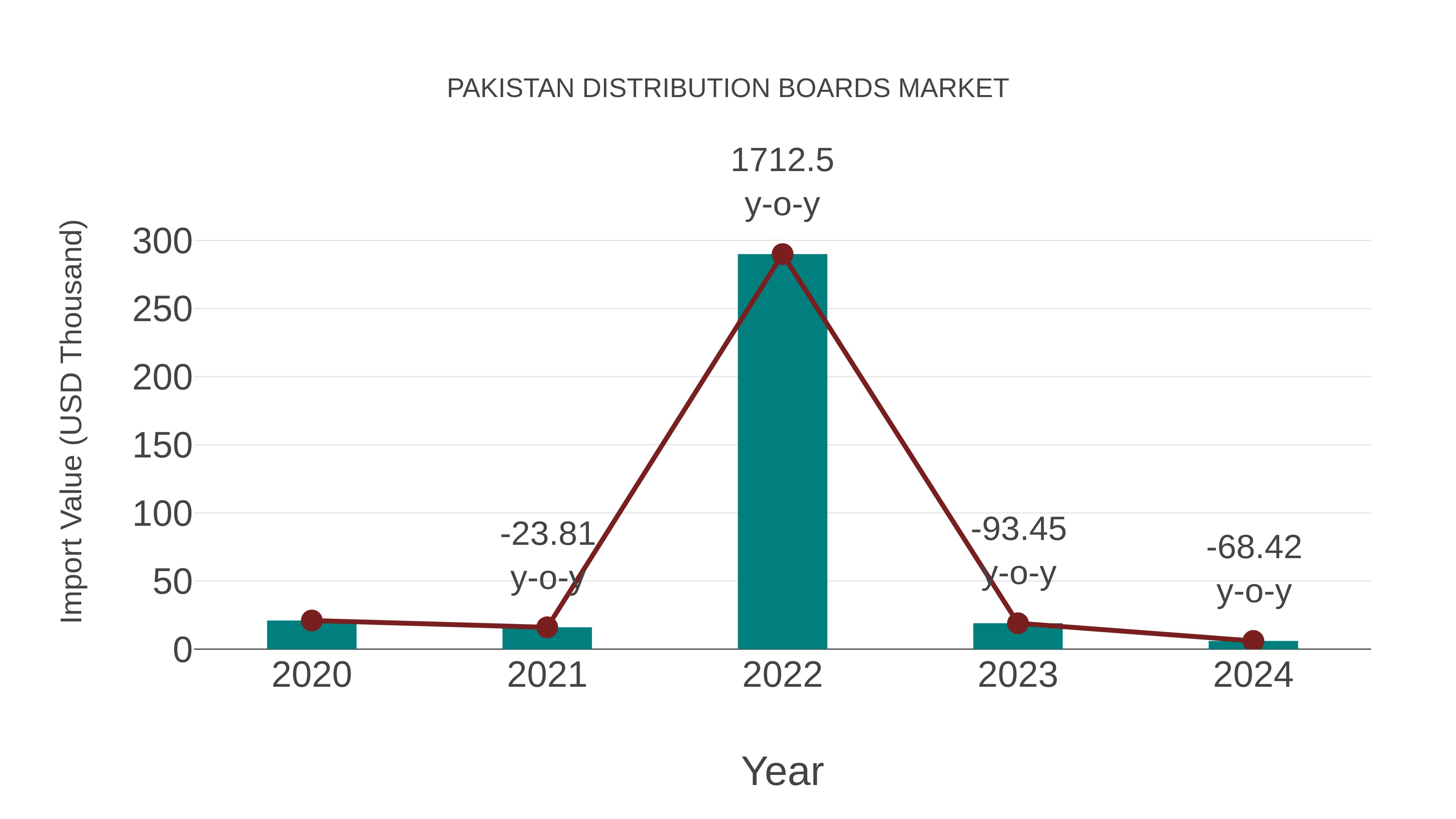
Pakistan import trend for the distribution boards market experienced a significant decline from 2023 to 2024, with a growth rate of -68.42%. The compound annual growth rate (CAGR) for the period 2020-2024 stood at -26.89%. This notable decrease could be attributed to a shift in demand, changes in trade policies, or market instability during the period.
Pakistan Distribution Boards Market Overview
The Pakistan Distribution Boards Market is witnessing steady growth due to increasing urbanization, industrialization, and infrastructure development projects across the country. Distribution boards are essential components of electrical systems, regulating and distributing power supply to different circuits within a building or facility. The market is driven by the rising demand for energy-efficient solutions, safety regulations, and the need to upgrade aging infrastructure. Key players in the market are focusing on product innovations, such as smart distribution boards with monitoring capabilities and remote access features. Additionally, government initiatives to improve electricity access in rural areas are expected to further boost the market. The market is highly competitive, with players such as Siemens Pakistan, Schneider Electric Pakistan, and ABB Pakistan leading the way in providing quality distribution board solutions to meet the diverse needs of customers.
Pakistan Distribution Boards Market Trends
The Pakistan Distribution Boards Market is experiencing several key trends. There is a growing demand for smart distribution boards equipped with advanced monitoring and control features to enhance energy efficiency and safety. The market is also witnessing a shift towards modular and customizable distribution boards to accommodate varying needs and applications. Additionally, there is a rising focus on incorporating renewable energy sources such as solar power into distribution systems, driving the adoption of hybrid distribution boards. Furthermore, the increasing emphasis on compliance with international standards and regulations is influencing manufacturers to develop boards that meet stringent quality and safety requirements. Overall, the Pakistan Distribution Boards Market is evolving towards more technologically advanced, flexible, and sustainable solutions to meet the changing demands of the industry and consumers.
Pakistan Distribution Boards Market Challenges
In the Pakistan Distribution Boards Market, some challenges include the presence of counterfeit products leading to quality concerns, lack of standardization in product specifications and regulations, limited access to finance for small manufacturers, and inconsistent power supply affecting the overall demand for distribution boards. Additionally, competition from unorganized local players and import of cheaper alternatives from other countries pose a threat to established manufacturers in the market. The need for technological advancements and innovation to cater to the increasing demand for smart distribution boards further adds complexity to the industry. Overall, addressing these challenges will require collaboration between industry players, regulatory bodies, and financial institutions to ensure sustainable growth and competitiveness in the Pakistan Distribution Boards Market.
Pakistan Distribution Boards Market Investment Opportunities
The Pakistan Distribution Boards Market presents a promising investment opportunity driven by factors such as increasing urbanization, industrialization, and infrastructure development in the country. With a growing demand for electricity distribution solutions across residential, commercial, and industrial sectors, there is a need for efficient and reliable distribution boards. Investors can capitalize on this by investing in companies involved in manufacturing, supplying, and installing distribution boards that meet the evolving needs of customers. Additionally, the government`s initiatives to improve access to electricity in rural areas further contribute to the market growth. Investing in innovative technologies and solutions tailored to the specific requirements of the Pakistani market can offer lucrative returns in the distribution boards sector.
Pakistan Distribution Boards Market Government Policy
In Pakistan, the distribution boards market is primarily regulated by the Pakistan Engineering Council (PEC) and the Pakistan Standards and Quality Control Authority (PSQCA). PEC sets the standards for the design and installation of distribution boards to ensure safety and reliability in electrical systems. PSQCA is responsible for certifying distribution boards that meet the required standards, ensuring quality and compliance with regulations. Additionally, the government has implemented policies to promote the use of energy-efficient distribution boards to address the growing energy consumption in the country. These policies aim to improve the efficiency and sustainability of electrical systems, encouraging manufacturers to produce innovative and eco-friendly distribution boards. Overall, government regulations and initiatives play a crucial role in shaping the Pakistan distribution boards market by ensuring safety, quality, and energy efficiency.
Pakistan Distribution Boards Market Future Outlook
The Pakistan Distribution Boards Market is expected to witness steady growth in the coming years due to increasing urbanization, industrialization, and infrastructure development projects in the country. The demand for distribution boards is likely to be driven by the need for efficient and reliable electrical distribution systems in residential, commercial, and industrial sectors. Additionally, the growing focus on renewable energy sources such as solar power is expected to create opportunities for the integration of distribution boards in solar energy systems. Technological advancements such as smart distribution boards with remote monitoring capabilities are also anticipated to gain traction in the market. Overall, the Pakistan Distribution Boards Market is poised for growth as the country continues to invest in upgrading its electrical infrastructure to meet the demands of a modernizing economy.
Key Highlights of the Report:
- Pakistan Distribution Boards Market Outlook
- Market Size of Pakistan Distribution Boards Market, 2025
- Forecast of Pakistan Distribution Boards Market, 2032
- Historical Data and Forecast of Pakistan Distribution Boards Revenues & Volume for the Period 2022 - 2032F
- Pakistan Distribution Boards Market Trend Evolution
- Pakistan Distribution Boards Market Drivers and Challenges
- Pakistan Distribution Boards Price Trends
- Pakistan Distribution Boards Porter's Five Forces
- Pakistan Distribution Boards Industry Life Cycle
- Historical Data and Forecast of Pakistan Distribution Boards Market Revenues & Volume By Voltage Rating for the Period 2022 - 2032F
- Historical Data and Forecast of Pakistan Distribution Boards Market Revenues & Volume By Low Voltage for the Period 2022 - 2032F
- Historical Data and Forecast of Pakistan Distribution Boards Market Revenues & Volume By Medium Voltage for the Period 2022 - 2032F
- Historical Data and Forecast of Pakistan Distribution Boards Market Revenues & Volume By End Use for the Period 2022 - 2032F
- Historical Data and Forecast of Pakistan Distribution Boards Market Revenues & Volume By Transmission & Distribution Utilities for the Period 2022 - 2032F
- Historical Data and Forecast of Pakistan Distribution Boards Market Revenues & Volume By Manufacturing & Processing Industry for the Period 2022 - 2032F
- Historical Data and Forecast of Pakistan Distribution Boards Market Revenues & Volume By Commercial & Residential for the Period 2022 - 2032F
- Historical Data and Forecast of Pakistan Distribution Boards Market Revenues & Volume By Others for the Period 2022 - 2032F
- Pakistan Distribution Boards Import Export Trade Statistics
- Market Opportunity Assessment By Voltage Rating
- Market Opportunity Assessment By End Use
- Pakistan Distribution Boards Top Companies Market Share
- Pakistan Distribution Boards Competitive Benchmarking By Technical and Operational Parameters
- Pakistan Distribution Boards Company Profiles
- Pakistan Distribution Boards Key Strategic Recommendations






































