Pakistan Electrical Components Market Size, Share & Growth Rate
The Pakistan Electrical Components Market was estimated at USD 503 Million in 2025 and is projected to reach USD 729 Million by 2032, growing at a CAGR of 5.4% from 2026 to 2032. This growth trajectory is primarily fueled by rapid urbanization and ongoing infrastructure development initiatives that necessitate reliable electrical components. Additionally, the rising demand for smart electrical solutions and energy-efficient products is further driving the market forward.
Pakistan Electrical Components Market Year-wise Growth Rate and Key Drivers
This graph highlights how the Pakistan Electrical Components Market has steadily grown over the years, supported by major growth factors.
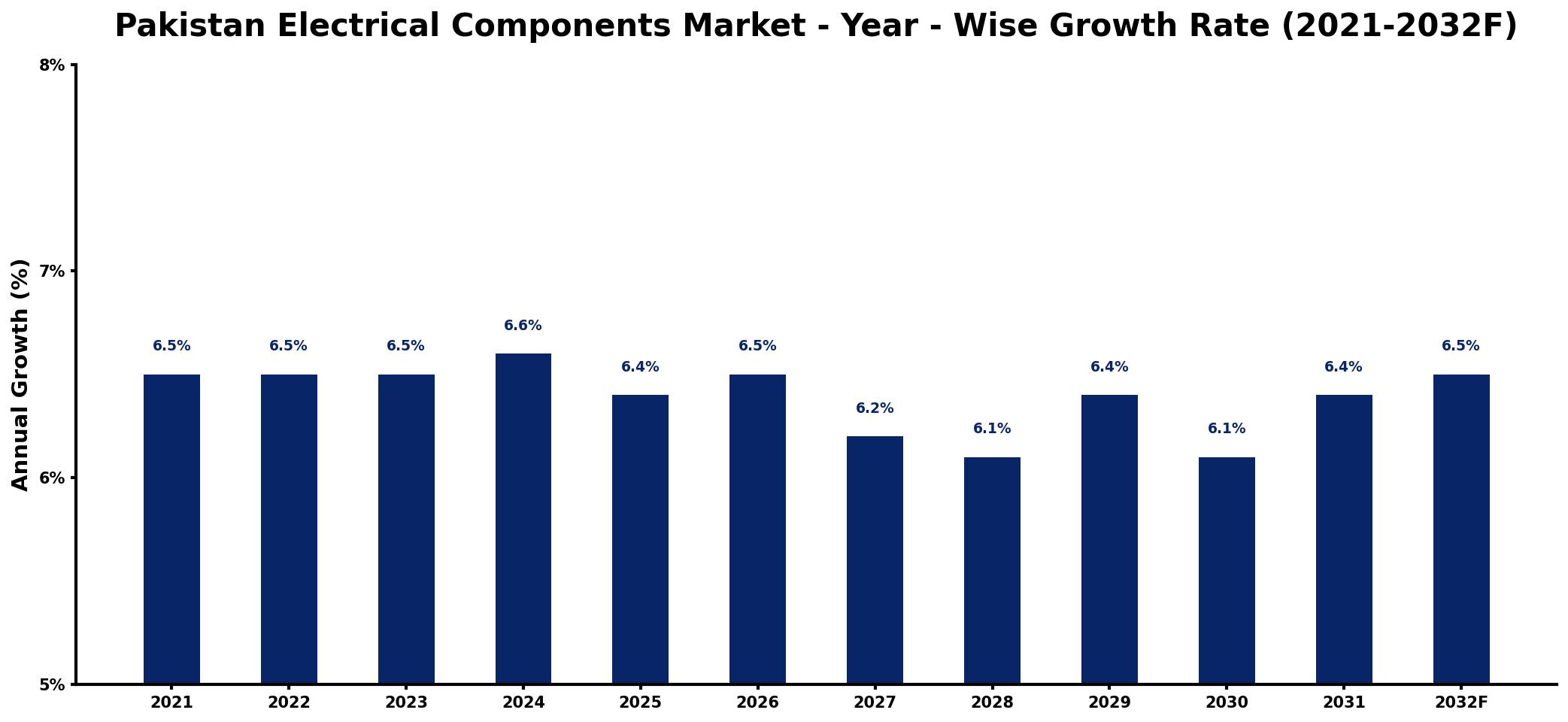
The table below presents the year‑wise growth rates along with the key drivers influencing the market
| Year | Growth Rate | Major Drivers |
| 2021 | 6.5% | Rising construction sector investments |
| 2022 | 6.5% | Growing renewable energy initiatives |
| 2023 | 6.5% | Increased urban population growth |
| 2024 | 6.6% | Expansion of manufacturing facilities |
| 2025 | 6.4% | Surge in infrastructure projects |
| 2026 | 6.5% | growing downstream application demand |
| 2027 | 6.2% | Growth in export markets demand |
| 2028 | 6.1% | Increased government energy policies |
| 2029 | 6.4% | Rising consumer electronics usage |
| 2030 | 6.1% | Investment in smart city projects |
| 2031 | 6.4% | Development of green technologies |
| 2032 | 6.5% | Enhanced energy efficiency regulations |
Note: Market size estimations and growth projections presented in this report are based on 6Wresearch's proprietary forecasting methodology, utilizing the latest available industry data, government publications, and primary research inputs.
Pakistan Electrical Components Market Synopsis
The Pakistan Electrical Components Market is on an upward trend, driven by significant investments in infrastructure and a robust push for industrialization. The market encapsulates a diverse array of products including switches, cables, lighting fixtures, and circuit breakers, all of which are increasingly in demand as urban living expands.
Moreover, as Pakistan's energy landscape evolves, there is a growing emphasis on the adoption of renewable energy and energy-efficient products. Consumer awareness regarding sustainability is reshaping buying patterns, positioning the market for substantial future growth.
Pakistan Electrical Components Market Key Takeaways
- Urbanization and infrastructure development are primary drivers for market expansion.
- There is a notable shift towards energy-efficient and smart electrical products.
- Government initiatives play a crucial role in fostering a favorable environment for market growth.
- Increased investments in renewable energy projects are paving the way for new market opportunities.
- Intense competition is leading to product innovation and improved distribution strategies.
Evaluation of Restraints in Pakistan Electrical Components Market
Despite its promising outlook, the Pakistan Electrical Components Market is challenged by a myriad of factors. Inconsistent government policies can create an unpredictable environment for manufacturers and investors, stifling growth potential. Additionally, SMEs in the sector often face barriers in securing financing, hampering their ability to compete effectively. Issues such as the prevalence of counterfeit products and a lack of standardization further complicate market dynamics, making it essential for stakeholders to navigate these challenges judiciously.
Pakistan Electrical Components Market Trends
A significant trend shaping the Pakistan Electrical Components Market is the increasing adoption of LED lighting solutions, which are lauded for their energy-saving capabilities. Smart home technologies, encompassing automation systems and IoT-enabled devices, are also gaining traction among consumers eager for efficiency and convenience. Concurrently, there is a heightened focus on the safety and reliability of electrical components, influencing product development across the sector.
Pakistan Electrical Components Market Opportunities
The market presents lucrative investment opportunities in several areas including cables, switchgear, and lighting products. The government's commitment to infrastructure enhancement creates a consistent demand for high-quality electrical components. There's also potential for growth in the renewable energy segment, particularly in the production of solar panels and related technologies. Collaborations with international firms to bring innovative solutions to the local market are likely to yield competitive advantages.
Government Initiatives in the Pakistan Electrical Components Market
The Pakistani government is actively pursuing policies designed to bolster the electrical components sector. These include incentives for local manufacturing, measures to ensure compliance with international quality standards, and tax breaks for companies engaging in research and development. Furthermore, initiatives aimed at workforce skill development are being implemented to enhance industry competitiveness, ensuring that local businesses are well-equipped to thrive in an evolving landscape.
Future Insights of the Pakistan Electrical Components Market
Looking ahead to the 2026-2032 period, the Pakistan Electrical Components Market is poised for steady growth. The confluence of urbanization, industrial expansion, and government support for infrastructure development indicates a robust future. Additionally, the rise of smart technologies and renewable energy projects will catalyze demand for innovative electrical solutions. While challenges remain, including fluctuating raw material costs and international competition, the overall trajectory appears promising as the market adapts to meet modern demands.
Pakistan Electrical Components Market Latest Developments (2025 - 2026)
In the recent months, the market has seen a notable shift towards eco-friendly practices as more companies explore sustainable manufacturing processes. The rise of local startups focused on innovative solutions is contributing to increased competition and product diversity. Additionally, various trade shows and industry forums have highlighted the commitment to integrating advanced technologies into electrical components, further aligning with global trends.
Pakistan Electrical Components Market - Key Attractiveness of the Report
- 10 Years of Market Numbers
- Historical Data Starting from 2022 to 2025
- Base Year: 2025
- Forecast Data until 2032
- Key Performance Indicators Impacting the Market
- Major Upcoming Developments and Projects
Key Highlights of the Report:
- Pakistan Electrical Components Market Outlook
- Market Size of Pakistan Electrical Components Market, 2025
- Forecast of Pakistan Electrical Components Market, 2032
- Historical Data and Forecast of Pakistan Electrical Components Revenues & Volume for the Period 2022-2032F
- Pakistan Electrical Components Market Trend Evolution
- Pakistan Electrical Components Market Drivers and Challenges
- Pakistan Electrical Components Price Trends
- Pakistan Electrical Components Porter's Five Forces
- Pakistan Electrical Components Industry Life Cycle
- Historical Data and Forecast of Pakistan Electrical Components Market Revenues & Volume By Building Automation for the Period 2022-2032F
- Historical Data and Forecast of Pakistan Electrical Components Market Revenues & Volume By Datacom Accessories for the Period 2022-2032F
- Historical Data and Forecast of Pakistan Electrical Components Market Revenues & Volume By Security & wiring Accessories for the Period 2022-2032F
- Historical Data and Forecast of Pakistan Electrical Components Market Revenues & Volume By Cables & Wires for the Period 2022-2032F
- Historical Data and Forecast of Pakistan Electrical Components Market Revenues & Volume By Datacom Cables for the Period 2022-2032F
- Historical Data and Forecast of Pakistan Electrical Components Market Revenues & Volume By LV Cables for the Period 2022-2032F
- Historical Data and Forecast of Pakistan Electrical Components Market Revenues & Volume By MV&HV Cables for the Period 2022-2032F
- Historical Data and Forecast of Pakistan Electrical Components Market Revenues & Volume By Special Cables for the Period 2022-2032F
- Historical Data and Forecast of Pakistan Electrical Components Market Revenues & Volume By Industrial Automation for the Period 2022-2032F
- Historical Data and Forecast of Pakistan Electrical Components Market Revenues & Volume By Automation Controls for the Period 2022-2032F
- Historical Data and Forecast of Pakistan Electrical Components Market Revenues & Volume By Auxiliary Controls for the Period 2022-2032F
- Historical Data and Forecast of Pakistan Electrical Components Market Revenues & Volume By Drives & Motion Controls for the Period 2022-2032F
- Historical Data and Forecast of Pakistan Electrical Components Market Revenues & Volume By Measurement Controls and Relays for the Period 2022-2032F
- Historical Data and Forecast of Pakistan Electrical Components Market Revenues & Volume By Lighting for the Period 2022-2032F
- Historical Data and Forecast of Pakistan Electrical Components Market Revenues & Volume By Fixtures for the Period 2022-2032F
- Historical Data and Forecast of Pakistan Electrical Components Market Revenues & Volume By Lamps & LEDs for the Period 2022-2032F
- Historical Data and Forecast of Pakistan Electrical Components Market Revenues & Volume By Power Distribution for the Period 2022-2032F
- Historical Data and Forecast of Pakistan Electrical Components Market Revenues & Volume By Cable Management for the Period 2022-2032F
- Historical Data and Forecast of Pakistan Electrical Components Market Revenues & Volume By Enclosures & Panels for the Period 2022-2032F
- Historical Data and Forecast of Pakistan Electrical Components Market Revenues & Volume By LV Electrical Distribution for the Period 2022-2032F
- Historical Data and Forecast of Pakistan Electrical Components Market Revenues & Volume By Renewable Energies for the Period 2022-2032F
- Historical Data and Forecast of Pakistan Electrical Components Market Revenues & Volume By HVAC for the Period 2022-2032F
- Historical Data and Forecast of Pakistan Electrical Components Market Revenues & Volume By Renewable energy for the Period 2022-2032F
- Historical Data and Forecast of Pakistan Electrical Components Market Revenues & Volume By Safety & Tools for the Period 2022-2032F
- Historical Data and Forecast of Pakistan Electrical Components Market Revenues & Volume By Safety Equipment for the Period 2022-2032F
- Historical Data and Forecast of Pakistan Electrical Components Market Revenues & Volume By Working Tools & Accessories for the Period 2022-2032F
- Pakistan Electrical Components Import Export Trade Statistics
- Market Opportunity Assessment By Building Automation
- Market Opportunity Assessment By Cables & Wires
- Market Opportunity Assessment By Industrial Automation
- Market Opportunity Assessment By Lighting
- Market Opportunity Assessment By Power Distribution
- Market Opportunity Assessment By Renewable Energies
- Market Opportunity Assessment By Safety & Tools
- Pakistan Electrical Components Top Companies Market Share
- Pakistan Electrical Components Competitive Benchmarking By Technical and Operational Parameters
- Pakistan Electrical Components Company Profiles
- Pakistan Electrical Components Key Strategic Recommendations






































