Pakistan Electronics Accessories Market Size Growth Rate
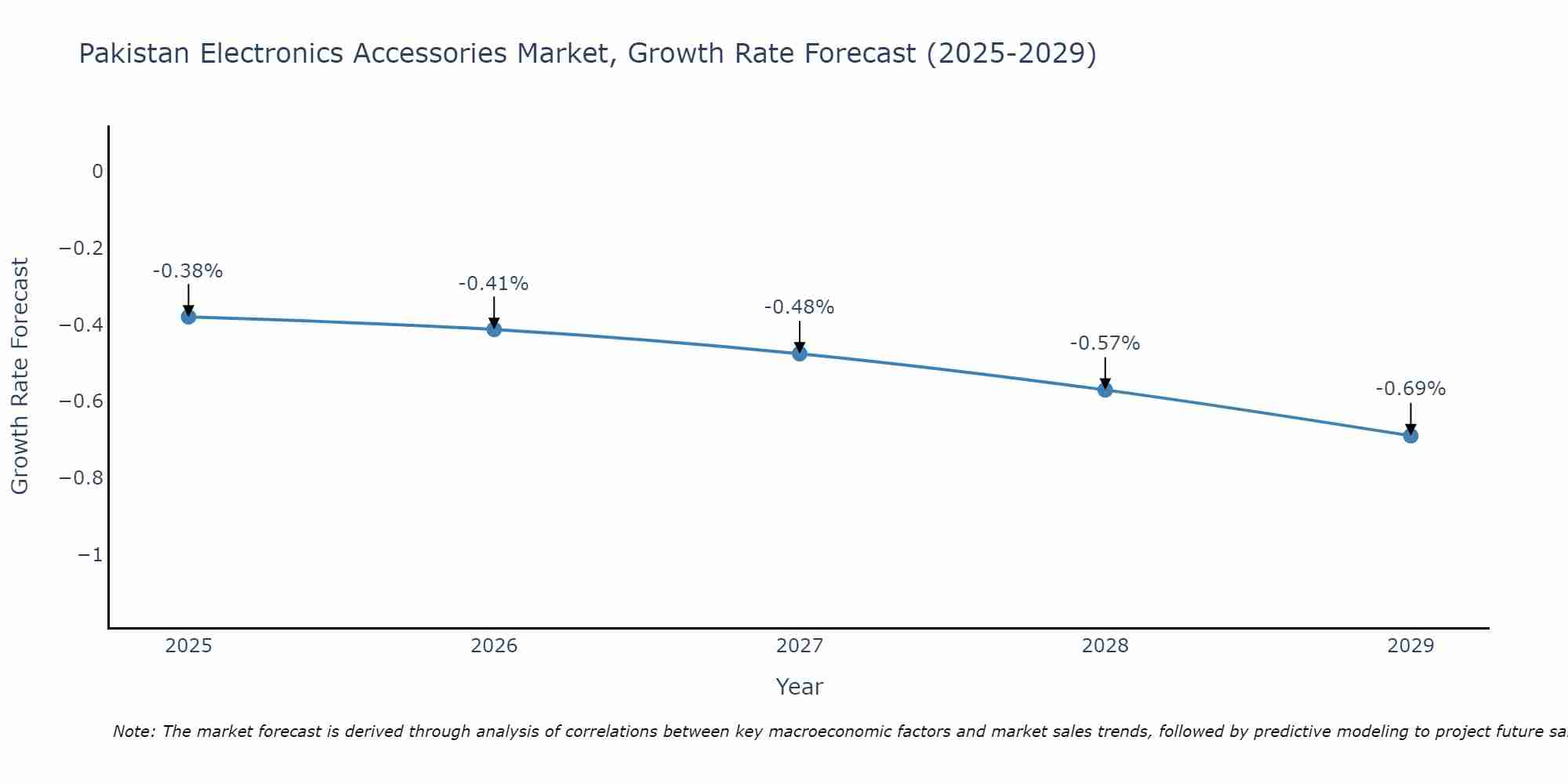
The Pakistan Electronics Accessories Market could see a tapering of growth rates over 2025 to 2029. Beginning strongly at -0.38% in 2025, growth softens to -0.69% in 2029.
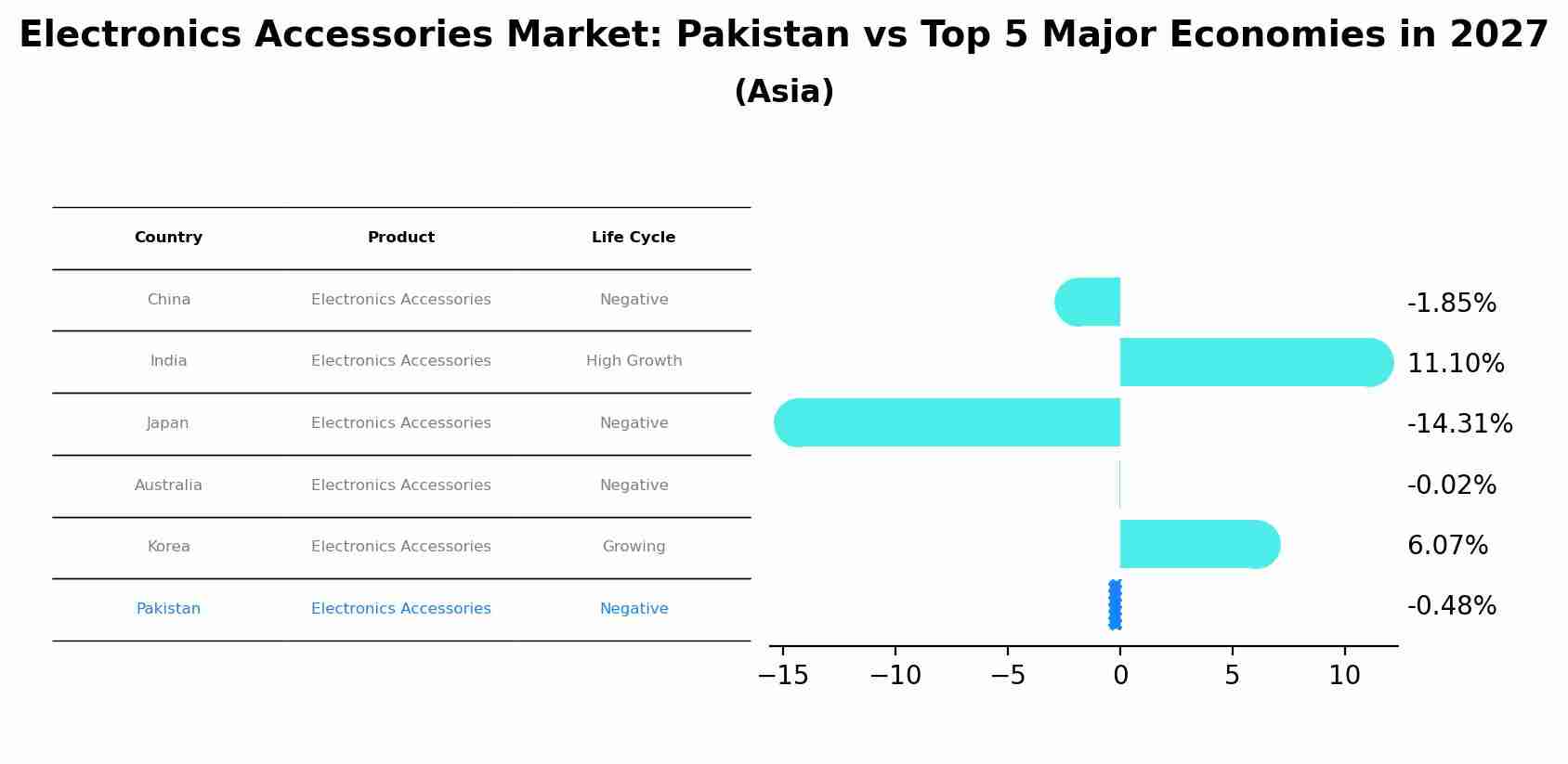
Electronics Accessories Market: Pakistan vs Top 5 Major Economies in 2027 (Asia)
Pakistan's Electronics Accessories market is anticipated to experience a negative growth rate of -0.48% by 2027, reflecting trends observed in the largest economy China, followed by India, Japan, Australia and South Korea.
Pakistan Electronics Accessories Market Synopsis
The Pakistan Electronics Accessories Market is witnessing steady growth driven by increasing consumer demand for smartphones, laptops, and other electronic devices. The market offers a wide range of accessories such as phone cases, screen protectors, chargers, earphones, and power banks. Local and international brands compete in this highly fragmented market, with key players including Hama, Belkin, and Anker. E-commerce platforms are playing a significant role in expanding the market reach, offering consumers a convenient way to purchase accessories online. The market is also influenced by changing consumer preferences towards trendy and fashionable accessories that not only provide functionality but also enhance the aesthetics of their devices. As disposable incomes rise and technology adoption increases, the Pakistan Electronics Accessories Market is poised for further growth in the coming years.
Pakistan Electronics Accessories Market Trends
The Pakistan Electronics Accessories Market is experiencing a surge in demand for wireless and smart accessories such as wireless earbuds, smartwatches, and portable chargers. With the increasing adoption of smartphones and other electronic devices, consumers are looking for accessories that offer convenience and functionality. Additionally, eco-friendly and sustainable accessories are gaining popularity among environmentally conscious consumers. Online retail channels are playing a significant role in driving the sales of electronics accessories, offering a wide range of products and convenient shopping experiences. The market is also witnessing a trend towards customization and personalization of accessories, allowing consumers to express their individual style. Overall, the Pakistan Electronics Accessories Market is evolving to meet the changing preferences and lifestyles of consumers.
Pakistan Electronics Accessories Market Challenges
In the Pakistan Electronics Accessories Market, key challenges include high import duties and taxes on electronic products, which lead to higher prices for consumers and hinder market growth. Additionally, the presence of counterfeit products poses a significant challenge as it affects consumer trust and brand reputation. Limited access to the latest technology and innovations due to geographical constraints and slow adoption of e-commerce platforms also restrict market expansion. Furthermore, the lack of standardized regulations and quality control measures in the industry can result in inferior product quality and safety concerns for consumers. Overcoming these challenges will require collaboration between government bodies, industry stakeholders, and technology companies to address regulatory issues, combat counterfeiting, improve access to technology, and enhance consumer trust in the market.
Pakistan Electronics Accessories Market Investment Opportunities
In the Pakistan Electronics Accessories Market, there are several promising investment opportunities. With the increasing adoption of smartphones and other electronic devices in the country, there is a growing demand for accessories such as phone cases, screen protectors, chargers, and headphones. Investing in the manufacturing or distribution of high-quality and affordable electronic accessories tailored to the Pakistani market could be lucrative. Additionally, there is potential in investing in e-commerce platforms or retail outlets that specialize in selling a wide range of electronics accessories to cater to the needs of tech-savvy consumers. Partnering with local electronics stores or mobile phone providers to offer bundled accessory deals could also be a profitable investment strategy in this growing market.
Pakistan Electronics Accessories Market Future Outlook
The Pakistan Electronics Accessories Market is poised for significant growth in the coming years, driven by increasing consumer demand for smartphones, laptops, and other electronic devices. The market is expected to benefit from the rising adoption of technological advancements such as wireless charging, smart wearables, and high-quality audio accessories. Additionally, the expanding e-commerce sector in Pakistan is providing a platform for easy accessibility and distribution of electronics accessories, further boosting market growth. With a growing young population and increasing disposable income levels, the demand for innovative and high-quality electronics accessories is likely to surge, creating opportunities for both local and international manufacturers and retailers to capitalize on this evolving market trend.
Key Highlights of the Report:
- Pakistan Electronics Accessories Market Outlook
- Market Size of Pakistan Electronics Accessories Market, 2024
- Forecast of Pakistan Electronics Accessories Market, 2031
- Historical Data and Forecast of Pakistan Electronics Accessories Revenues & Volume for the Period 2021 - 2031
- Pakistan Electronics Accessories Market Trend Evolution
- Pakistan Electronics Accessories Market Drivers and Challenges
- Pakistan Electronics Accessories Price Trends
- Pakistan Electronics Accessories Porter's Five Forces
- Pakistan Electronics Accessories Industry Life Cycle
- Historical Data and Forecast of Pakistan Electronics Accessories Market Revenues & Volume By Product Type for the Period 2021 - 2031
- Historical Data and Forecast of Pakistan Electronics Accessories Market Revenues & Volume By Mobile Phone Accessories for the Period 2021 - 2031
- Historical Data and Forecast of Pakistan Electronics Accessories Market Revenues & Volume By Headphone and Earbud for the Period 2021 - 2031
- Historical Data and Forecast of Pakistan Electronics Accessories Market Revenues & Volume By Computer Accessories for the Period 2021 - 2031
- Historical Data and Forecast of Pakistan Electronics Accessories Market Revenues & Volume By Automotive infotainment Accessories for the Period 2021 - 2031
- Historical Data and Forecast of Pakistan Electronics Accessories Market Revenues & Volume By End Use for the Period 2021 - 2031
- Historical Data and Forecast of Pakistan Electronics Accessories Market Revenues & Volume By Residential for the Period 2021 - 2031
- Historical Data and Forecast of Pakistan Electronics Accessories Market Revenues & Volume By Commercial for the Period 2021 - 2031
- Historical Data and Forecast of Pakistan Electronics Accessories Market Revenues & Volume By Distribution Channel for the Period 2021 - 2031
- Historical Data and Forecast of Pakistan Electronics Accessories Market Revenues & Volume By Multi-brand Store for the Period 2021 - 2031
- Historical Data and Forecast of Pakistan Electronics Accessories Market Revenues & Volume By Single-brand Store for the Period 2021 - 2031
- Historical Data and Forecast of Pakistan Electronics Accessories Market Revenues & Volume By Price Range for the Period 2021 - 2031
- Historical Data and Forecast of Pakistan Electronics Accessories Market Revenues & Volume By Premium for the Period 2021 - 2031
- Historical Data and Forecast of Pakistan Electronics Accessories Market Revenues & Volume By Medium for the Period 2021 - 2031
- Historical Data and Forecast of Pakistan Electronics Accessories Market Revenues & Volume By Low for the Period 2021 - 2031
- Pakistan Electronics Accessories Import Export Trade Statistics
- Market Opportunity Assessment By Product Type
- Market Opportunity Assessment By End Use
- Market Opportunity Assessment By Distribution Channel
- Market Opportunity Assessment By Price Range
- Pakistan Electronics Accessories Top Companies Market Share
- Pakistan Electronics Accessories Competitive Benchmarking By Technical and Operational Parameters
- Pakistan Electronics Accessories Company Profiles
- Pakistan Electronics Accessories Key Strategic Recommendations






































