Pakistan Energy Security Market Size & Growth Rate (2026-2032)
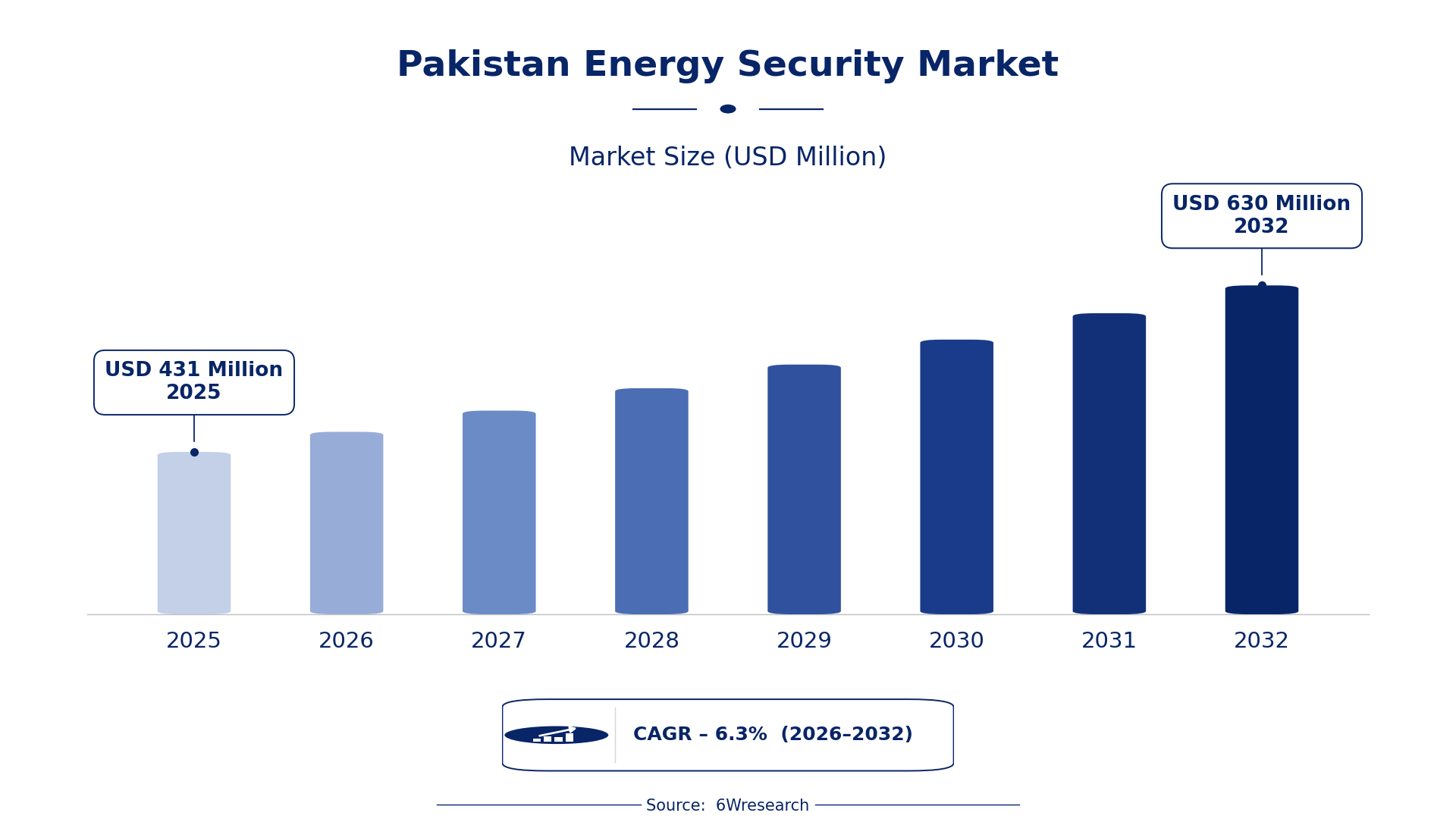
The Pakistan Energy Security Market was estimated at USD 431 Million in 2025 and is projected to reach USD 630 Million by 2032, growing at a CAGR of 6.3% from 2026 to 2032.
Pakistan Energy Security Market Synopsis
Pakistan is at a critical juncture in its energy security journey, heavily influenced by its reliance on imported oil and gas. The pressing need to diversify energy sources is becoming increasingly clear as the country grapples with frequent supply disruptions and price fluctuations in the global market.
In response, the government is steering investments towards renewable energy projects, with solar and wind power taking center stage. However, the path to energy security remains fraught with challenges, including aging infrastructure and high transmission losses that hinder efficiency.
Pakistan Energy Security Market Year-wise Growth Rate and Key Drivers
This graph illustrates the annual growth rates of the Pakistan Energy Security Market from 2021 to 2032, highlighting a steady upward trajectory and projected expansion over the forecast period.
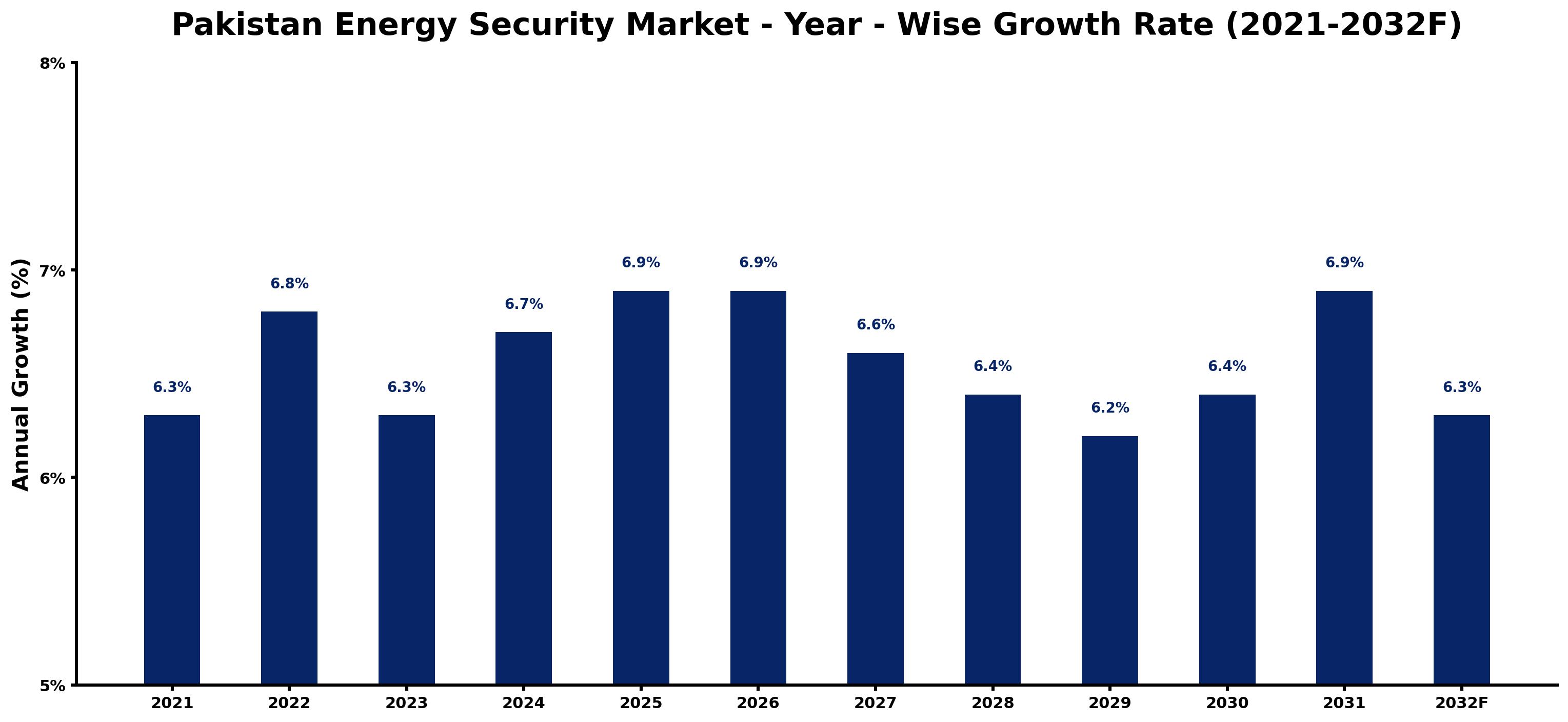
The table below presents the year‑wise growth rates along with the key drivers influencing the market
| Year | Growth Rate | Major Drivers |
| 2021 | 6.3% | Government's energy conservation policy boosts renewable investments. |
| 2022 | 6.8% | Increase in private sector investment in solar technologies. |
| 2023 | 6.3% | Implementation of CPEC projects enhances energy infrastructure. |
| 2024 | 6.7% | Rising urban population drives demand for stable energy sources. |
| 2025 | 6.9% | Regulatory support for wind energy project initiatives grows. |
| 2026 | 6.9% | Increased public awareness of energy efficiency reforms. |
| 2027 | 6.6% | Government incentives promote hybrid energy system adoption. |
| 2028 | 6.4% | Collaborations with international energy agencies facilitate innovation. |
| 2029 | 6.2% | Strengthened energy security policies attract foreign investments. |
| 2030 | 6.4% | Emerging tech initiatives enhance grid management efficiencies. |
| 2031 | 6.9% | National electricity policy prioritizes clean energy transition. |
| 2032 | 6.3% | Growing industrial sector demands reliability in energy supply. |
Note: Market size estimations and growth projections presented in this report are based on 6Wresearch's proprietary forecasting methodology, utilizing the latest available industry data, government publications, and primary research inputs.
Pakistan Energy Security Market Key Takeaways
Below are some of the specific key takeaways from the market, including:
- The market is projected to grow steadily, indicating increased investment opportunities in renewable energy sources.
- Government initiatives aim to reduce dependency on imported fuels, supporting the domestic energy production sector.
- Renewable energy policies, such as net metering, are encouraging investments in solar and wind energy capacities.
- Technological advancements in energy efficiency and storage are critical for enhancing the overall energy landscape.
- Political stability and favorable regulations are essential for attracting foreign investment in the energy sector.
Evaluation of Restraints in Pakistan Energy Security Market
The Pakistan Energy Security Market faces considerable restraints that impede progress. A heavy reliance on imported oil and gas leaves the country vulnerable to international market volatility. Coupled with this is the challenge of inadequate infrastructure, which includes outdated transmission lines and high losses in distribution. Political instability further complicates the situation, creating an unpredictable environment that discourages long-term investments. The combination of these factors necessitates a comprehensive strategy that focuses not only on immediate solutions but also on sustainable practices for the future.
Pakistan Energy Security Market Trends
A notable trend in the Pakistan Energy Security Market is the accelerated shift towards renewable energy. As the global narrative on climate change gains momentum, Pakistan is focusing on expanding its renewable energy capacity. The government's emphasis on sustainability has led to an increase in projects aimed at harnessing solar and wind energy. Additionally, energy efficiency measures and smart grid technologies are gaining traction, allowing for better management of resources and reduced wastage.
Pakistan Energy Security Market Opportunities
Opportunities abound for investors in the Pakistan Energy Security Market, particularly in the renewable energy sector. As the government pushes to meet its energy demands through domestic sources, investments in solar and wind projects are expected to rise. Innovations in energy storage technology also present avenues for growth, enabling better management of renewable energy supply. on top of that, partnerships with international firms could facilitate technology transfer and bolster local capabilities, making it an attractive market for development.
Government Initiatives in the Pakistan Energy Security Market
The government of Pakistan is actively shaping the energy security market through targeted policies aimed at enhancing domestic production and sustainability. Recent initiatives illustrate a concerted effort to decrease reliance on imported energy and foster a self-sufficient energy sector. These policies are vital for addressing the underlying challenges and ensuring a more stable energy future for the nation.
- A recently completed initiative focused on enhancing solar energy capacity, which included setting up solar parks across various regions.
- Current efforts are underway to revamp transmission infrastructure, aimed at reducing losses and improving reliability for consumers.
- A national program promoting energy efficiency standards for appliances is set to launch in early 2026 to reduce overall demand.
- Future plans include increasing the share of renewables in the energy mix, with a target to reach 30% by 2030 through dedicated investment in wind and solar technologies.
Future Insights of the Pakistan Energy Security Market
Looking ahead to 2026-2032, the Pakistan Energy Security Market is expected to evolve significantly. Continued population growth and economic development will drive the demand for energy, compelling authorities to diversify sources effectively. Investments in infrastructure and renewable technologies are likely to result in an enhanced energy mix, bolstering energy security. However, the interplay of political stability and regulatory frameworks will determine the pace of progress in this sector.
Pakistan Energy Security Market Latest Developments
Over the past year, the Pakistan Energy Security Market has seen a surge in activity, primarily driven by government initiatives and private sector investments. The push towards renewable energy has led to several notable advancements, reflecting a shift in how energy needs are met in the country.
- A major technology vendor initiated a comprehensive energy storage project in late 2025, aimed at optimizing renewable energy utilization.
- An ongoing partnership between local firms and international renewable energy companies is currently enhancing the efficiency of solar installations.
- A planned public-private initiative to develop a wind farm in the Sindh province is expected to start construction in mid-2026.
- A regional operator completed an upgrade of its distribution networks, significantly reducing power outages reported in urban areas.
Pakistan Energy Security Market - Key Attractiveness of the Report
- 10 Years of Market Numbers
- Historical Data Starting from 2022 to 2025
- Base Year: 2025
- Forecast Data until 2032
- Key Performance Indicators Impacting the Market
- Major Upcoming Developments and Projects
Key Highlights of the Report:
- Pakistan Energy Security Market Outlook
- Market Size of Pakistan Energy Security Market, 2025
- Forecast of Pakistan Energy Security Market, 2032
- Historical Data and Forecast of Pakistan Energy Security Revenues & Volume for the Period 2022-2032F
- Pakistan Energy Security Market Trend Evolution
- Pakistan Energy Security Market Drivers and Challenges
- Pakistan Energy Security Price Trends
- Pakistan Energy Security Porter's Five Forces
- Pakistan Energy Security Industry Life Cycle
- Historical Data and Forecast of Pakistan Energy Security Market Revenues & Volume By Power Plants for the Period 2022-2032F
- Historical Data and Forecast of Pakistan Energy Security Market Revenues & Volume By Nuclear for the Period 2022-2032F
- Historical Data and Forecast of Pakistan Energy Security Market Revenues & Volume By Thermal for the Period 2022-2032F
- Historical Data and Forecast of Pakistan Energy Security Market Revenues & Volume By Hydro for the Period 2022-2032F
- Historical Data and Forecast of Pakistan Energy Security Market Revenues & Volume By Oil for the Period 2022-2032F
- Historical Data and Forecast of Pakistan Energy Security Market Revenues & Volume By Gas for the Period 2022-2032F
- Historical Data and Forecast of Pakistan Energy Security Market Revenues & Volume By Renewable Energy for the Period 2022-2032F
- Historical Data and Forecast of Pakistan Energy Security Market Revenues & Volume By Technologies for the Period 2022-2032F
- Historical Data and Forecast of Pakistan Energy Security Market Revenues & Volume By Physical for the Period 2022-2032F
- Historical Data and Forecast of Pakistan Energy Security Market Revenues & Volume By Network Security for the Period 2022-2032F
- Pakistan Energy Security Import Export Trade Statistics
- Market Opportunity Assessment By Power Plants
- Market Opportunity Assessment By Technologies
- Pakistan Energy Security Top Companies Market Share
- Pakistan Energy Security Competitive Benchmarking By Technical and Operational Parameters
- Pakistan Energy Security Company Profiles
- Pakistan Energy Security Key Strategic Recommendations






































