Pakistan Farm Equipment Market Size, Share & Growth Rate
The Pakistan Farm Equipment Market was estimated at USD 479 Million in 2025 and is projected to reach USD 628 Million by 2032, growing at a CAGR of 3.9% from 2026 to 2032. This growth trajectory is primarily driven by the increasing mechanization of agriculture, which addresses the pressing need for higher productivity amidst a growing population. Moreover, supportive government policies aimed at modernizing farming practices further bolster this market's expansion.
Pakistan Farm Equipment Market Year-wise Growth Rate and Key Drivers
This graph highlights how the Pakistan Farm Equipment Market has steadily grown over the years, supported by major growth factors.
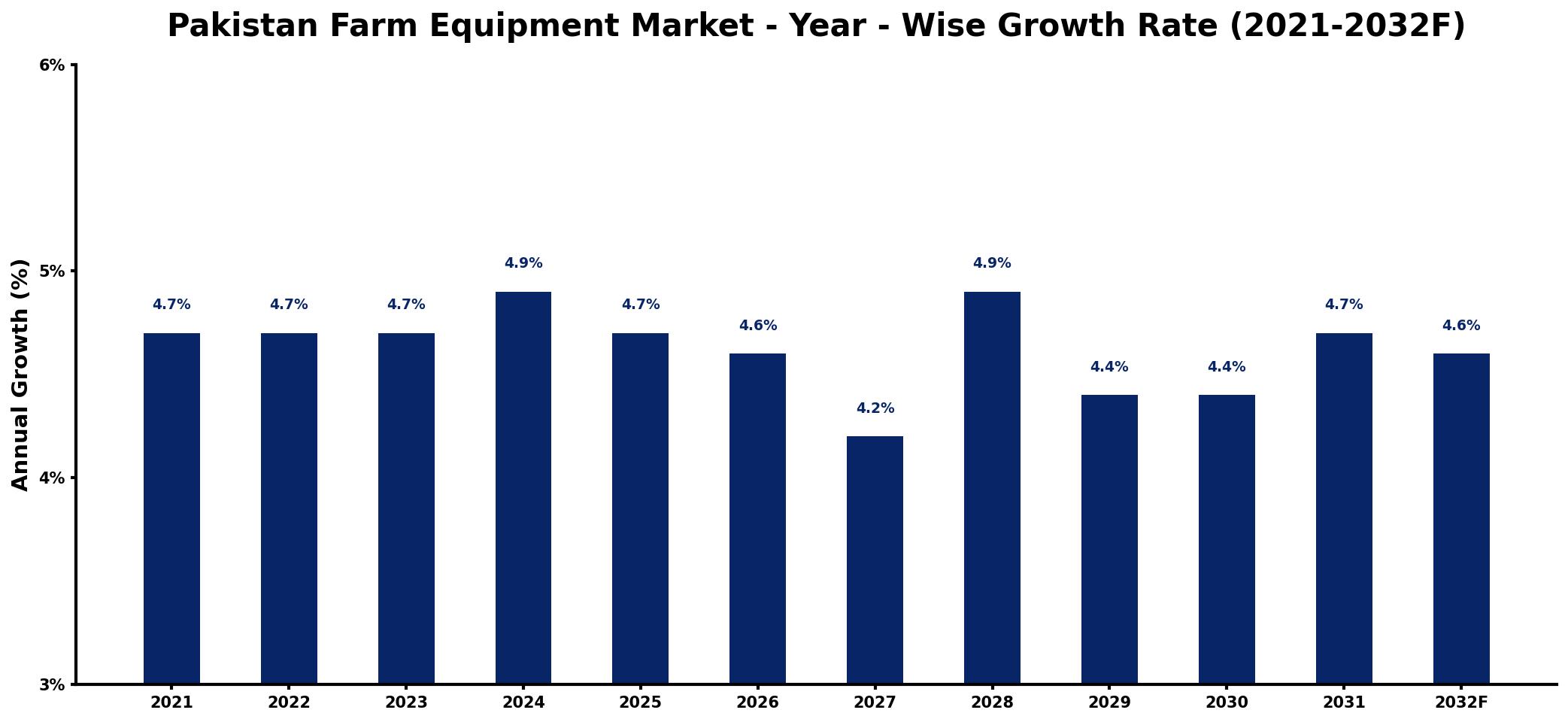
The table below presents the year‑wise growth rates along with the key drivers influencing the market
| Year | Growth Rate | Major Drivers |
| 2021 | 4.7% | Rising demand for agricultural innovation |
| 2022 | 4.7% | Increased investment in rural infrastructure |
| 2023 | 4.7% | Growing mechanization in agriculture |
| 2024 | 4.9% | Expansion of export markets abroad |
| 2025 | 4.7% | strengthening international trade flows |
| 2026 | 4.6% | Enhanced financial support for agriculture |
| 2027 | 4.2% | rising infrastructure development spending |
| 2028 | 4.9% | Boost in government agricultural initiatives |
| 2029 | 4.4% | rising end-use demand growth |
| 2030 | 4.4% | Increased adoption of precision agriculture |
| 2031 | 4.7% | Growing awareness of climate resilience |
| 2032 | 4.6% | improved processing technologies adoption |
Note: Market size estimations and growth projections presented in this report are based on 6Wresearch's proprietary forecasting methodology, utilizing the latest available industry data, government publications, and primary research inputs.
Pakistan Farm Equipment Market Synopsis
The most significant force shaping the Pakistan Farm Equipment Market is the ongoing trend towards agricultural mechanization. Farmers are now turning to advanced machinery like tractors and harvesters, recognizing that these tools significantly enhance efficiency and yield. This shift is critical as the agriculture sector strives to meet both domestic demands and global standards.
In addition to mechanization, the incorporation of precision agriculture technologies is gaining traction among farmers. Innovations such as GPS tracking and smart irrigation systems help optimize resource use and minimize environmental impact. The combination of these factors illustrates a robust market poised for further growth and innovation.
Pakistan Farm Equipment Market Key Takeaways
- The Pakistan Farm Equipment Market is witnessing a shift towards mechanization, enhancing productivity and reducing labor costs.
- Government initiatives promoting modern farming practices are providing substantial support for market growth.
- Technological advancements, especially in precision agriculture, are becoming increasingly vital to meet evolving demands.
- Local manufacturers are emerging alongside international brands, creating a diverse product portfolio for farmers.
- There is an urgent need to address accessibility issues, ensuring that modern equipment reaches rural farmers effectively.
Evaluation of Restraints in Pakistan Farm Equipment Market
Despite the promising outlook, the Pakistan Farm Equipment Market faces several significant restraints. A primary barrier is the high cost of modern machinery, which limits access for many farmers, particularly in rural areas. Additionally, inadequate infrastructure for maintenance and repair services compounds these issues, making it challenging for farmers to invest in and maintain advanced equipment. Moreover, many farmers lack the necessary technical knowledge and awareness about the benefits of mechanization, which inhibits wider adoption. Addressing these factors is critical to unlocking the market's full potential.
Pakistan Farm Equipment Market Trends
The current trend within the Pakistan Farm Equipment Market leans heavily towards increasing mechanization and the adoption of advanced technologies. Farmers are increasingly opting for tractors, harvesters, and sophisticated irrigation systems to boost their operational efficiency. Furthermore, the demand for precision agriculture tools is rising as farmers seek to optimize resource use while minimizing their environmental footprint. These trends reflect a broader commitment to sustainable farming practices and highlight the evolving nature of agricultural operations in Pakistan.
Pakistan Farm Equipment Market Opportunities
The market presents substantial investment opportunities across various segments, including tractors, harvesters, and innovative irrigation systems. With a considerable portion of Pakistan's population engaged in agriculture, there is a pressing demand for modern, efficient farm equipment. Investors can explore collaborations with international manufacturers to introduce advanced solutions, or focus on local manufacturing to meet domestic needs. Additionally, the integration of innovative technologies, such as drone-based crop monitoring, represents a frontier for growth that can significantly enhance agricultural productivity.
Government Initiatives in the Pakistan Farm Equipment Market
The government of Pakistan has implemented various policies designed to bolster the farm equipment market. These include subsidies for agricultural machinery to encourage farmers to adopt modern technologies, as well as incentives aimed at boosting local manufacturing capabilities. There are also efforts to improve farmers' access to credit, enabling them to invest in necessary farm equipment. Additionally, governmental focus on research and development plays a vital role in advancing agricultural productivity and efficiency within the sector.
Future Insights of the Pakistan Farm Equipment Market
Looking ahead to the 2026-2032 period, the Pakistan Farm Equipment Market is poised for steady growth. This will be driven by an ongoing shift toward mechanization, accelerated by government initiatives aimed at modernizing agricultural practices. The increasing demand for efficient and sustainable farming solutions will propel advancements in technology adoption. Moreover, heightened awareness of the benefits associated with mechanized farming, combined with favorable government policies, positions the market for significant growth in response to food security challenges.
Pakistan Farm Equipment Market Latest Developments (2025 - 2026)
Recent developments within the Pakistan Farm Equipment Market indicate a robust direction towards embracing technology-driven solutions. Initiatives aimed at improving farmer education regarding advanced equipment are gaining momentum, paving the way for greater adoption. Additionally, the introduction of various financing programs by local governments is making modern machinery more accessible to smallholder farmers. The overall sentiment in the market reflects an increasing readiness to invest in innovation, signaling a transformative period for the agricultural sector.
Pakistan Farm Equipment Market - Key Attractiveness of the Report
- 10 Years of Market Numbers
- Historical Data Starting from 2022 to 2025
- Base Year: 2025
- Forecast Data until 2032
- Key Performance Indicators Impacting the Market
- Major Upcoming Developments and Projects
Key Highlights of the Report:
- Pakistan Farm Equipment Market Outlook
- Market Size of Pakistan Farm Equipment Market, 2025
- Forecast of Pakistan Farm Equipment Market, 2032
- Historical Data and Forecast of Pakistan Farm Equipment Revenues & Volume for the Period 2022-2032F
- Pakistan Farm Equipment Market Trend Evolution
- Pakistan Farm Equipment Market Drivers and Challenges
- Pakistan Farm Equipment Price Trends
- Pakistan Farm Equipment Porter's Five Forces
- Pakistan Farm Equipment Industry Life Cycle
- Historical Data and Forecast of Pakistan Farm Equipment Market Revenues & Volume By Power Output for the Period 2022-2032F
- Historical Data and Forecast of Pakistan Farm Equipment Market Revenues & Volume By <30 HP for the Period 2022-2032F
- Historical Data and Forecast of Pakistan Farm Equipment Market Revenues & Volume By 31??70 HP for the Period 2022-2032F
- Historical Data and Forecast of Pakistan Farm Equipment Market Revenues & Volume By 71??130 HP for the Period 2022-2032F
- Historical Data and Forecast of Pakistan Farm Equipment Market Revenues & Volume By 131??250 HP for the Period 2022-2032F
- Historical Data and Forecast of Pakistan Farm Equipment Market Revenues & Volume By >250 HP for the Period 2022-2032F
- Historical Data and Forecast of Pakistan Farm Equipment Market Revenues & Volume By Drive Type for the Period 2022-2032F
- Historical Data and Forecast of Pakistan Farm Equipment Market Revenues & Volume By Two-wheel for the Period 2022-2032F
- Historical Data and Forecast of Pakistan Farm Equipment Market Revenues & Volume By Four-wheel for the Period 2022-2032F
- Historical Data and Forecast of Pakistan Farm Equipment Market Revenues & Volume By Function for the Period 2022-2032F
- Historical Data and Forecast of Pakistan Farm Equipment Market Revenues & Volume By Plowing & Cultivating for the Period 2022-2032F
- Historical Data and Forecast of Pakistan Farm Equipment Market Revenues & Volume By Sowing & Planting for the Period 2022-2032F
- Historical Data and Forecast of Pakistan Farm Equipment Market Revenues & Volume By Plant Protection & Fertilizing for the Period 2022-2032F
- Historical Data and Forecast of Pakistan Farm Equipment Market Revenues & Volume By Harvesting & Threshing for the Period 2022-2032F
- Historical Data and Forecast of Pakistan Farm Equipment Market Revenues & Volume By Others for the Period 2022-2032F
- Historical Data and Forecast of Pakistan Farm Equipment Market Revenues & Volume By Equipment Type for the Period 2022-2032F
- Historical Data and Forecast of Pakistan Farm Equipment Market Revenues & Volume By Tractors for the Period 2022-2032F
- Historical Data and Forecast of Pakistan Farm Equipment Market Revenues & Volume By Combines for the Period 2022-2032F
- Historical Data and Forecast of Pakistan Farm Equipment Market Revenues & Volume By Sprayers for the Period 2022-2032F
- Historical Data and Forecast of Pakistan Farm Equipment Market Revenues & Volume By Balers for the Period 2022-2032F
- Historical Data and Forecast of Pakistan Farm Equipment Market Revenues & Volume By Others for the Period 2022-2032F
- Pakistan Farm Equipment Import Export Trade Statistics
- Market Opportunity Assessment By Power Output
- Market Opportunity Assessment By Drive Type
- Market Opportunity Assessment By Function
- Market Opportunity Assessment By Equipment Type
- Pakistan Farm Equipment Top Companies Market Share
- Pakistan Farm Equipment Competitive Benchmarking By Technical and Operational Parameters
- Pakistan Farm Equipment Company Profiles
- Pakistan Farm Equipment Key Strategic Recommendations






































